
Reading, Writing and Math Lessons for Kids Aged 5-7: When They Help
Learn Math13 min
Which Is Better?

Dimas Prasetyo
Education Analyst, Algonova
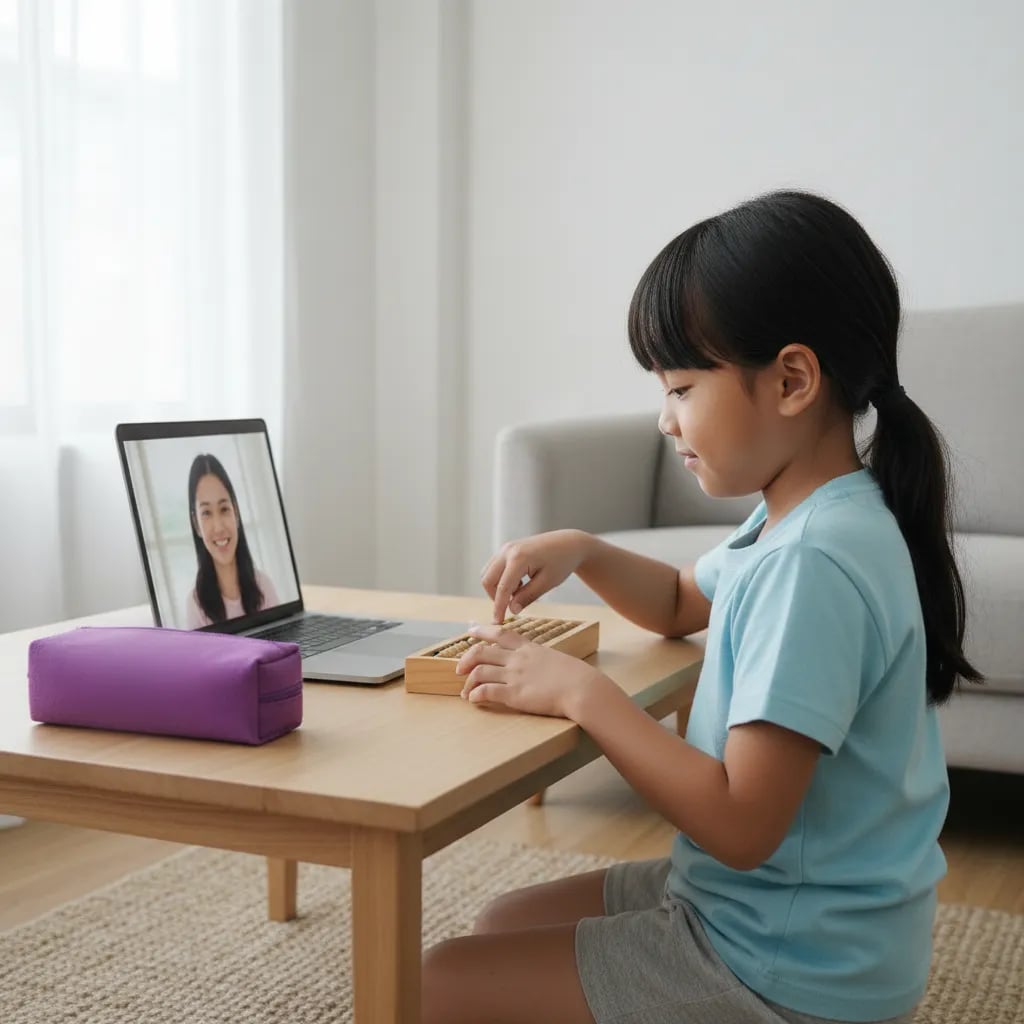
An online abacus class works for kids from about age 7 who have their own abacus at home and can focus on a screen. A sempoa centre near you is the safer start for 4-6 year olds, because a teacher needs to correct their finger technique in person. In Indonesia, abacus (sempoa) classes cost roughly Rp 100,000-750,000 a month before registration fees. This guide helps you choose.
An abacus class, called sempoa in Indonesia, trains fast mental arithmetic: children first move beads on a soroban-style abacus, then learn to picture it in their heads. We explain the tool and its stages in what is sempoa. This article covers one decision only: a class at a nearby centre or one over video call.
The syllabus is the same either way. What differs is who corrects your child's fingers and how many hours you spend in traffic.
| Sempoa centre near you | Online abacus class | |
|---|---|---|
| Finger correction | Hands-on, the teacher adjusts the child's grip | Through the camera, which needs a good angle |
| Best age | 4-7 | 7 and up |
| Abacus | Provided or sold by the centre | You need one at home |
| Parent's role | Drop-off and pick-up | Sit nearby for the first few weeks |
| Travel time | 30-60 minutes per round trip in big cities | None |
| Choice of provider | Whatever is near your home | Any provider, any city |
Take a family in South Jakarta with two classes a week at a shophouse centre: drop-off and pick-up eat about 4 hours a week. An online class saves that time. But their 5-year-old can't sit through a 40-minute video lesson alone yet, so the centre still wins for now.
Most Indonesian abacus providers take children aged 4-12, and some chains start at 3. Age matters less than readiness, though.
Your child is ready if they can:
For online lessons, private tutoring providers themselves recommend primary-school age, roughly 7 and older. Kindergarteners still need a teacher who can reposition their fingers by hand.
A 3-year randomised trial with about 200 primary pupils in India (Barner et al., Child Development, 2016) found that mental abacus training improved arithmetic compared with a control group. It did not raise general cognitive abilities such as working memory, and children who started with stronger visual-spatial memory gained the most. So abacus trains one skill well. It doesn't make a child "smarter" across the board.
If your child is 6 or 7 and still shaky on what numbers mean, start there. Our maths programme for ages 6-7 builds number sense before speed.
Abacus classes in Indonesia cost about Rp 100,000-750,000 a month in tuition, plus a registration fee of around Rp 200,000-500,000 and the cost of an abacus or workbooks. The figures below come from the price list compiled by biayales.id (updated March 2024) and from EduPoint's own price page (2026). Branches set their own prices, so confirm before you sign up.
| Provider or format | Listed price | Notes |
|---|---|---|
| Adil Sempoa Mandiri (ASMA) | Rp 100,000-200,000 a month | tuition, kindergarten to primary |
| Sempoa Kreatif | Rp 120,000-350,000 a month | registration Rp 250,000-500,000 |
| Sempoa SIP | Rp 350,000-500,000 a month | ages 3-12 |
| Sempoa Yes | Rp 750,000 a month | registration Rp 200,000, equipment Rp 600,000 |
| Private online abacus tutor (EduPoint) | Rp 69,000 per 60-minute session | charged per session |
| Private home-visit abacus tutor (EduPoint) | Rp 86,000 per 90-minute session | tutor comes to you |
A year at Rp 350,000 a month comes to Rp 4,200,000. Add a Rp 250,000 registration fee and about Rp 150,000 for an abacus, and the first year costs roughly Rp 4.6 million, before any level exams.
For other methods, see our breakdowns of Kumon fees in Indonesia and private primary tutoring costs.
Searching "abacus classes near me" usually returns a map of shophouse centres and phone numbers. Before paying a registration fee, ask each centre:
One thing you should know: Algonova has no physical centres in Indonesia and doesn't teach abacus. We teach maths, coding and design online. If what you're after is a general maths tutor close to home, our guide to finding a maths class near you compares home tutors, tutoring centres and online classes.
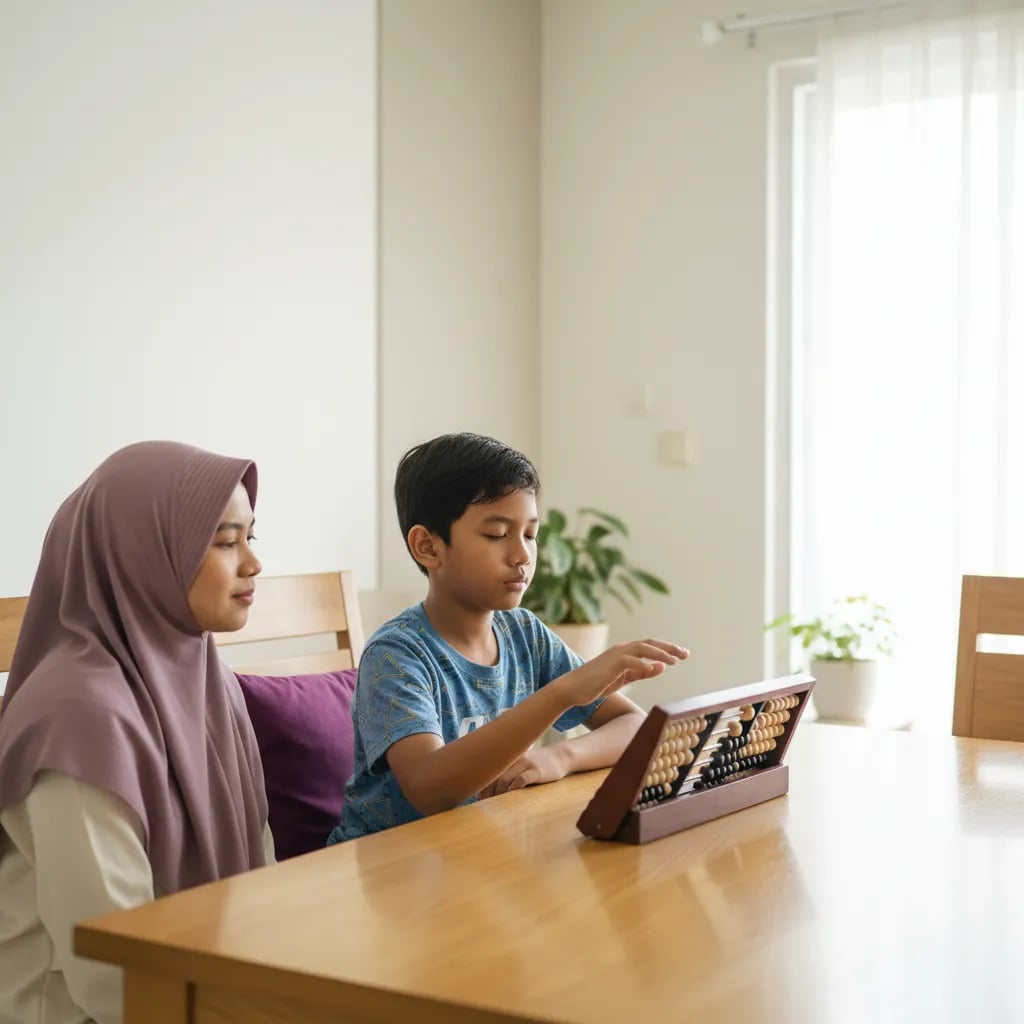
An online abacus class makes sense when there's no good centre within 20-30 minutes, or when your weekly driving schedule is already full. It also suits a child who did abacus in person and only needs to continue their level after a move.
To make it work, set up:
It's a poor fit for children under 6, for kids who drift off on screens, and for homes where the internet drops often. A small class at a nearby centre is worth the commute for them.
Abacus trains speed. Before you sign up, decide what you actually want to fix: how fast your child calculates, or how well they understand the questions they get at school.
Dimas Prasetyo, Education Analyst, Algonova
Abacus suits your child if your goal is fast addition, subtraction and multiplication and they enjoy repetitive practice. Check after 3 months: do they still practise without a fight, and are they quicker on school sums?
Signs it isn't the right tool:
Abacus doesn't cover fractions, word problems or algebra. For a fuller comparison, read sempoa, Kumon or Sakamoto and sempoa, jarimatika or online maths. For kindergarteners just learning to add, jarimatika finger maths can be easier because it needs no equipment.
Many parents look for abacus classes because their child's maths grades dropped. If that's your reason, a maths class that teaches concepts usually hits the target better than speed drills.
Algonova's online maths classes for primary school kids run live with a teacher in groups of up to 10 children, from Rp 102,000 per lesson. More than 1,000,000 students in 97 countries have learned with us. The first step is a free diagnostic of about 60 minutes: your child solves problems with a teacher, and you see which topics are solid and which need another pass.
Raka, a Grade 3 pupil, is a good example. He calculated fast but kept getting low test scores. The diagnostic showed the gaps were word problems and place value, not speed. More abacus wouldn't have fixed that.
Most abacus providers in Indonesia accept children aged 4-12, and the easiest window is usually 5-7. Readiness matters more than the birthday: your child should recognise numbers 1-10, count objects to 20, hold a pencil with their fingertips and sit for about 30 minutes. A 4-year-old who isn't ready often loses interest because their finger control isn't there yet. A 9 or 10-year-old can still start, but will take longer to reach mental calculation because classmates began earlier. Under 6, choose an in-person class with a teacher who can adjust your child's hand. From 7, online lessons can work well if you have an abacus at home and stay close for the first few sessions. If you're unsure, book one trial class and see whether your child wants to go back the following week.
Online abacus classes can work for primary-school children who can focus on a screen and own an abacus. The camera is the key detail: point it at the table, not the face, so the teacher can see your child's fingers. Private tutoring providers themselves recommend online lessons from about age 7 and in-person lessons for kindergarteners. An 8-year-old who did abacus at a centre and then moved city usually continues online without trouble. A 5-year-old beginner often struggles, because the teacher can't physically fix the thumb and index finger positions. Results also depend on 10-15 minutes of daily practice at home, exactly as with in-person classes. Without that, no format moves quickly. Ask the online teacher for a short note after each lesson so you know what to practise before the next one.
Abacus classes in Indonesia cost roughly Rp 100,000-750,000 a month in tuition, according to the price list compiled by biayales.id. ASMA is listed at Rp 100,000-200,000 a month, Sempoa SIP at about Rp 350,000-500,000 and Sempoa Yes at about Rp 750,000. On top of tuition there's usually a registration fee of Rp 200,000-500,000, the abacus, workbooks per level and sometimes level exams. Private tutors charge per session: EduPoint lists Rp 69,000 for a 60-minute online session and Rp 86,000 for a 90-minute home visit. At Rp 350,000 a month, a year comes to Rp 4,200,000, or about Rp 4.6 million once registration and equipment are added. Prices vary by branch and city, so ask for a written breakdown. Some centres require a new workbook at every level, so year two can cost differently from year one.
A good abacus class near you has small groups, a trial session and clear answers about levels and fees. Shortlist 2-3 centres within 20-30 minutes of home or school and book a trial at each. During the trial, count the children per teacher: above 8, the teacher can't check everyone's fingers. Ask how long a level takes, whether there's daily homework, whether missed classes can be made up and what you'll pay outside tuition. Two centres with the same monthly fee can differ by Rp 600,000 in the first year if one requires an equipment and workbook package. Watch the room as well: children who look tense or afraid of mistakes rarely stay long. Put each centre's answers in one table so they're easy to compare. And count the driving: two trips a week at 40 minutes each is more than 5 hours a month.
No. Algonova doesn't teach abacus and has no physical centres in Indonesia. We're an online school for children aged 5-17 with maths, coding and design programmes. Our maths classes run live with a teacher in groups of up to 10, from Rp 102,000 per lesson, and focus on understanding: place value, operations, fractions, word problems and on to secondary-school topics. Parents often come to us after abacus, when their child calculates quickly but test scores haven't moved. If you want to know whether your child needs speed practice or stronger concepts, book a free maths diagnostic of about 60 minutes. The teacher checks each topic, and you get a picture you can use to choose any class, abacus included. Your child joins from home on a laptop or computer, and there's no obligation to enrol afterwards.
Abacus trains calculation speed with a physical abacus and later an imagined one, while maths tuition teaches concepts and how to solve problems. A child who does abacus can add four two-digit numbers in seconds, yet still not know when a word problem calls for multiplication or division. Good maths tuition covers the school syllabus: place value, fractions, units, geometry and word problems. You don't have to pick one. A Grade 2 child, for instance, can do abacus for speed and learn concepts at school or in an extra class. The trouble starts when parents expect abacus to lift grades that fell because of concepts. For a closer comparison of methods, read our article on sempoa, Kumon and Sakamoto, then choose based on the mistakes that show up most in your child's tests. A few marked test papers usually show the pattern.
Mental calculation, where a child computes by picturing the beads without touching an abacus, usually takes years of regular practice. Each provider has its own number of levels, and one level typically takes months, depending on attendance and home practice. The Barner et al. (2016) trial in India followed pupils for 3 years and found better arithmetic in the group trained on the abacus. The same study noted that children with stronger visual-spatial memory progressed faster. A child who practises 10-15 minutes every day generally moves up levels sooner than one who only practises in class. Stopping halfway means the main benefit never arrives, so weigh your family's time commitment before enrolling. Ask the centre how long their students typically stay and how many levels they usually finish in the first year.
Your child needs a maths class more than abacus if their grades drop because of word problems, fractions, units or geometry, not because they calculate slowly. Another sign: they fly through drill sheets but get stuck when a question is written in sentences, or often pick the wrong operation. Picture a Grade 4 child who can work out 25 x 4 instantly but doesn't see that "4 boxes of 25 marbles" means multiplication. More speed drills won't fix that. It's better to start with a topic-by-topic check so the gaps are clear. Algonova runs a free maths diagnostic of about 60 minutes for primary-school children. You can use the result to decide whether your child needs help at home, a concepts class, or abacus on top. Bring one or two recent test papers, because the mistake pattern there often points to the topics to revisit.
Blog

Algonova worldwide
Contact
Whatsapp: +62 21 50996971
Email: info@algonova.id
Address
Coworking Area, Gedung IT 6 Lantai Dasar, Nongsa Digital Park, Jalan Hang Lekiu, Kelurahan Sambau, Kecamatan Nongsa, Batam, Indonesia Directorate General of Consumer Protection and Trade Compliance – Ministry of Trade of the Republic of Indonesia. WhatsApp Ditjen PKTN: 0853-1111-1010.
PT Algonova Indonesia Cerdas All rights reserved 2026
