
Abacus Classes for Kids in Indonesia: Online or Nearby? Best Age and 2026 Fees
Which Is Better?13 min
Learn Math

Nadia Rahmawati
Math Curriculum Team, Algonova
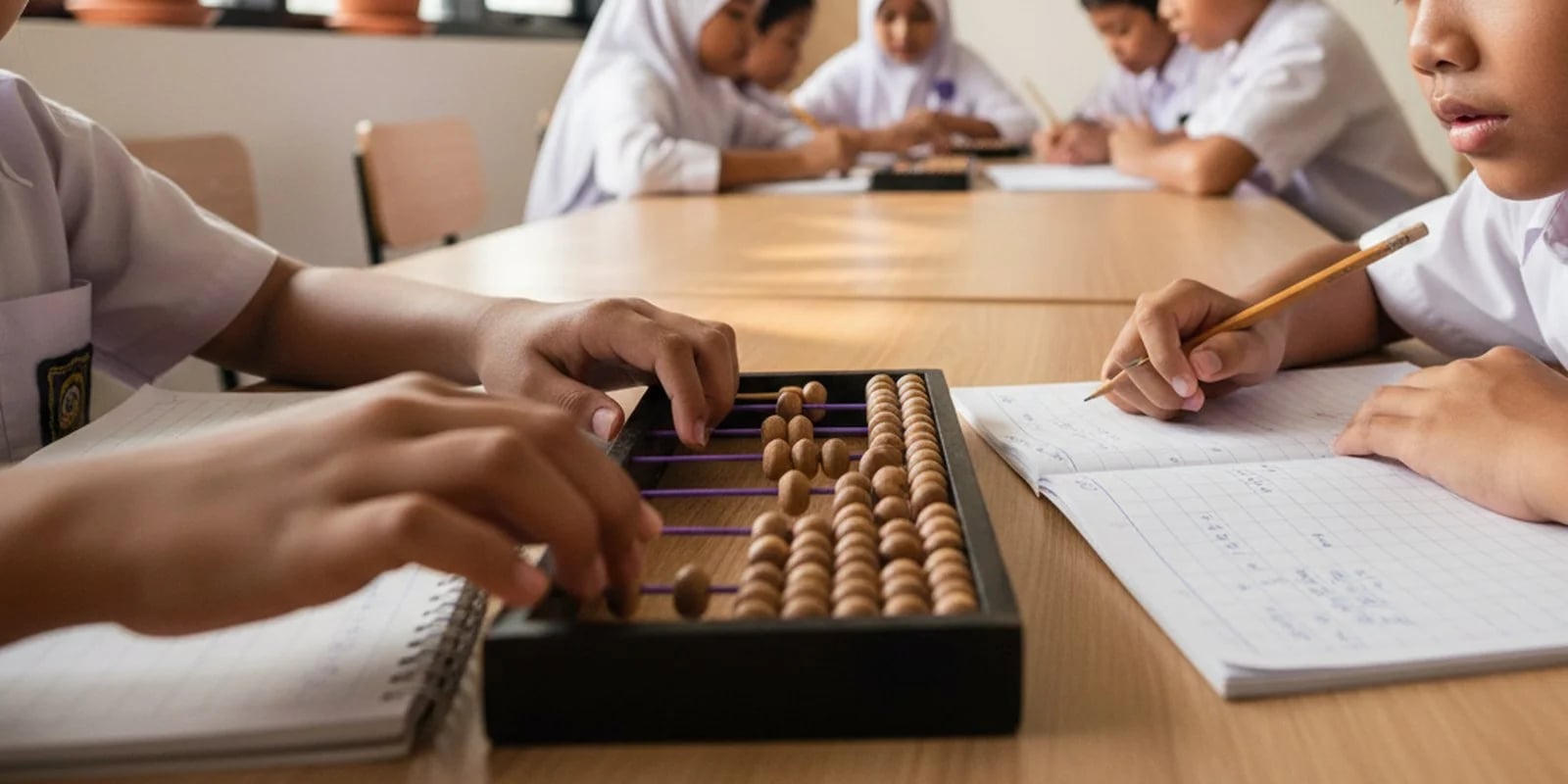
An abacus (sempoa) is a manual calculating tool: a frame of beads that slide to represent numbers. In Indonesia, abacus courses are sold not as math lessons but as mental arithmetic training, the ability to calculate quickly in your head by picturing an abacus.
Table of Contents
This article explains how it works, what it really trains, and what research says about the benefits that get advertised. We do not sell abacus courses, so we have no reason to overstate or understate them.
A modern abacus (the Japanese soroban) has several vertical rods separated by one horizontal bar:
A number is formed by sliding beads toward the bar. To show the number 7 on one rod: the top bead (5) slides down, and two bottom beads (1+1) slide up. A child moves the beads with thumb and index finger, and that finger position is taught from the first lesson, because final speed depends on the movement becoming automatic.
This is the heart of the method, and the part parents most often misunderstand. Learning the abacus runs in three stages:
The third stage is what looks impressive at a demonstration: a child answers a string of sums faster than an adult can type them into a calculator. The time required is not a matter of weeks. Abacus programs are usually split into graded levels, and reaching the mental stage typically takes years of regular practice.
This is where parents should read the advertising carefully. Let us separate two things.
A scientific review by Chunjie Wang (2020, Frontiers in Neuroscience) summarised dozens of studies on abacus-based mental arithmetic training. Its conclusion: the benefits are real, but mostly for skills that sit right next to what is trained, namely calculation speed and accuracy, and working memory for numbers. In research terms this is called near transfer. A child who is slow and error-prone at arithmetic really can be helped.
The claims that appear most often in promotional material, that the abacus raises general intelligence, activates the right brain, or lifts IQ, are not backed by the same review. On fluid intelligence, Wang concluded that the effect of abacus training "appears to not go beyond a placebo effect". In one large longitudinal study reviewed, there was no significant difference in Raven intelligence-test scores between children who trained and those who did not. Wang also noted that many of these studies carry methodological weaknesses that introduce too many possible confounds.
The practical takeaway: if you buy an abacus course to make your child calculate faster, that is a reasonable goal. If you buy it to make your child "smarter" in general, that hope does not yet have evidence behind it.
Some course providers list specific numbers, such as "improves concentration by 40%", without citing a source. A figure with no study behind it should be treated as marketing, not as a finding. That holds for every method, including the ones we sell ourselves.
The abacus usually starts around kindergarten to early primary age, when a child already knows numbers but has not yet settled into another way of calculating. A condition that matters more than age: the child has to tolerate regular practice. The abacus is a repetitive method. A child who bores quickly with repetition tends to stop before reaching the mental stage, and stopping halfway means the benefit never arrives.
The three are often treated as interchangeable. In fact they answer different problems.
| What it trains | A good fit if the child... | |
|---|---|---|
| Abacus | Speed and accuracy of calculation in the head | Understands the material but is slow and error-prone |
| Kumon | Persistence and independence through daily worksheets | Needs a routine of regular practice and can study alone |
| Math tutoring | Understanding of concepts, why a formula works | Does not understand the material, not merely slow |
The clearest difference: the abacus and Kumon train how to do the work; math tutoring explains why. If your child does not understand why fractions can be added, more calculation practice will not fix it; they will only get faster at something they do not understand. If a child understands well but always runs out of time on a test, adding more concept explanation is not the answer either. A more detailed comparison, including jarimatika and the Sakamoto method, is in the comparison of four arithmetic methods.
Mental arithmetic is the ability to perform calculations in your head without pen, paper, or a device. In the context of abacus training, it specifically means picturing the abacus in your mind and sliding imaginary beads to reach an answer. This is the skill that abacus courses in Indonesia actually sell: not the physical tool itself, but the mental speed that comes from internalizing it over months or years of practice. Children who complete the full program can add, subtract, multiply, and divide multi-digit numbers without writing anything down. The speed is real, though the path to get there demands consistent effort over a long period.
A calculator gives instant answers; an abacus trains a child to find answers independently. The two serve different purposes. A calculator is a tool for getting a result. An abacus course is a training method for building mental computation speed. No teacher recommends replacing a calculator with an abacus for daily tasks. The point of abacus training is what it does to the child's brain during the learning process, not the tool itself. Once the training is done, the child carries the skill in their head, while a calculator stays on the desk.
We do not teach the abacus. Algonova math classes sit in the third column of the table above, building conceptual understanding rather than drilling calculation speed. The format is online, in Private (1 student), Mini (2-4 students), and Group (up to 10 students) formats, with a teacher. So our answer is not always "sign up with us". If your child's problem is purely calculation speed and the concepts are already solid, an abacus really is the better fit, and we will say so. The easiest way to find out which problem it is: a free diagnostic class of about 60 minutes where the child works through problems with a teacher, and you get a picture of whether what is missing is understanding or speed. There is no obligation to continue.
The abacus is a calculating tool that, through years of practice, trains a child to compute quickly in their head. The benefit to calculation speed and accuracy is supported by research; claims of raising general intelligence are not. Before signing up for any method, make sure you know your child's real problem: are they slow, or do they not understand? Those two problems need different solutions.
Source: Wang, C. (2020). A Review of the Effects of Abacus Training on Cognitive Functions and Neural Systems in Humans. Frontiers in Neuroscience.
Want to find out what your child actually needs? Try a free math diagnostic, about 60 minutes with a teacher, no obligation.
An abacus is a calculating tool: a frame of beads that slide to represent numbers. The bead above the bar is worth 5, the four beads below the bar are each worth 1, and every rod represents one place value. Learning the abacus runs in three stages: calculating with the physical tool, then picturing the tool in your head, then answering automatically without either the tool or the mental image.
According to the scientific review by Chunjie Wang (2020, Frontiers in Neuroscience), the benefits of the abacus appear mainly in skills that sit right next to what is trained — calculation speed and working memory for numbers. On fluid intelligence, Wang concluded that the effect "appears to not go beyond a placebo effect". So claims of a general increase in intelligence do not yet have evidence behind them.
Not a matter of weeks. Abacus programs are usually split into graded levels, and reaching the mental stage typically takes years of regular practice. A child who stops halfway never gets to the main benefit.
Usually from kindergarten to early primary age, when a child already knows numbers. But what matters more than age is the tolerance for repeated practice — the abacus is a repetitive method, and a child who bores quickly with repetition tends to stop before reaching the mental stage.
It depends on the child's problem. The abacus trains calculation speed and accuracy — a good fit if the child understands the material but is slow and error-prone. Math tutoring builds conceptual understanding — a good fit if the child does not understand why a formula works. Adding more calculation practice for a child who does not understand the concept only makes them faster at something they do not understand.
The abacus trains calculating in your head by picturing the tool. Kumon uses daily worksheets at a level matched to the student's ability, and emphasises independence: the student studies an example and then tries to work through it alone. Both train how to do the work rather than explaining the concept.
No. Algonova teaches math, coding, AI, and digital design for ages 5–17 online. Our math classes focus on conceptual understanding, not on training calculation speed.
Blog

Algonova worldwide
Contact
Whatsapp: +62 21 50996971
Email: info@algonova.id
Address
Coworking Area, Gedung IT 6 Lantai Dasar, Nongsa Digital Park, Jalan Hang Lekiu, Kelurahan Sambau, Kecamatan Nongsa, Batam, Indonesia Directorate General of Consumer Protection and Trade Compliance – Ministry of Trade of the Republic of Indonesia. WhatsApp Ditjen PKTN: 0853-1111-1010.
PT Algonova Indonesia Cerdas All rights reserved 2026
