Private Tutor Cost in Indonesia 2026: Price per Hour, per Month, and a Cost Calculator

Parent Guides12 min
Parent Guides

Maya Putri
Early Childhood Education Specialist
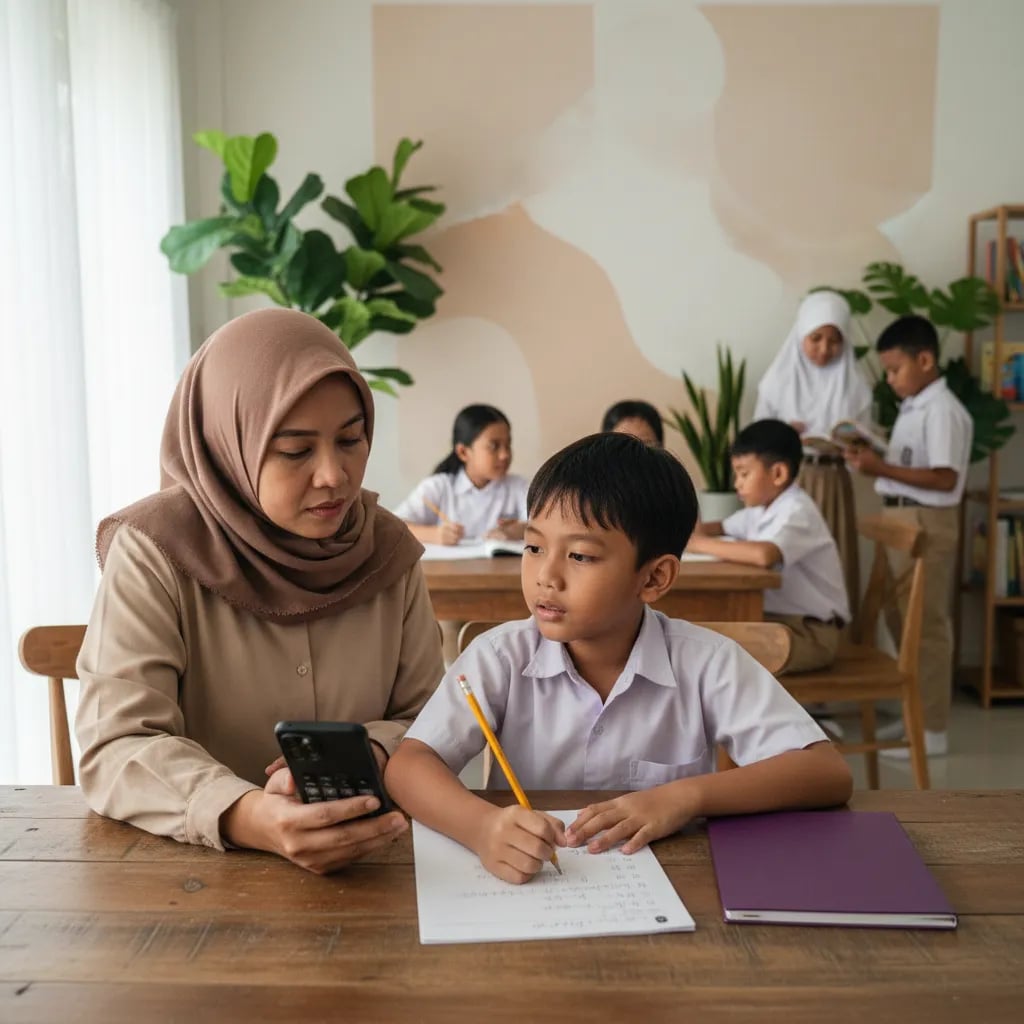
Kumon fees in Indonesia in October 2026 run from Rp 410,000 to Rp 575,000 per subject each month, plus a one-time sign-up fee of about Rp 300,000 to Rp 350,000. The exact figure depends on your area and your child's level. Below you will find a table by area, a yearly cost calculation, an explanation of how the Kumon method works, and a comparison with online group classes.
Kumon has two cost parts: a one-time sign-up fee and a monthly fee charged per subject.
Kumon Indonesia sets prices in six areas. The table follows the list published by the Indonesian site Tuwaga, last updated 28 November 2025. The monthly fee is per subject, so a child studying math and English pays twice.
| Area | Region | Preschool to primary | Junior to senior high |
|---|---|---|---|
| Area 1 | Greater Jakarta and Karawang | Rp 525,000 | Rp 575,000 |
| Area 2 | Serang and Cilegon | Rp 490,000 | Rp 540,000 |
| Area 3 | Bali, West Java, Kalimantan, Greater Surabaya, and others | Rp 460,000 | Rp 510,000 |
| Area 4 | East Java outside Greater Surabaya | Rp 440,000 | Rp 490,000 |
| Area 5 | Riau | Rp 420,000 | Rp 470,000 |
| Area 6 | Aceh, Yogyakarta, Central Java, Lampung, NTB, West Sumatra | Rp 410,000 | Rp 460,000 |
The same source lists the sign-up fee at Rp 350,000 for Areas 1 to 4 and Rp 300,000 for Areas 5 and 6. Kumon sometimes runs promotions with the sign-up fee waived, so ask your local centre first.
Example: a Grade 3 child in Bekasi (Area 1) studying math pays Rp 525,000 per month. In Yogyakarta (Area 6) the same subject costs Rp 410,000.
These figures come from third-party articles, not from a Kumon price list that we verified.
We could not open the Kumon Indonesia website when we checked in October 2026, so its official price list is unverified here. Read the table as an estimate, not an exact tariff. The sources differ slightly:
A gap of Rp 20,000 to Rp 35,000 between sources for the same region is normal when the data comes from different years. The only way to be sure is to call or visit the Kumon centre in your city and ask for a written breakdown, including any material fees.
One subject at Kumon in Greater Jakarta costs about Rp 6.65 million in the first year: 12 months of fees plus the one-time sign-up fee.
The formula: monthly fee x number of subjects x 12 months + sign-up fee. Examples for a primary school child:
| Scenario | Calculation | First-year total |
|---|---|---|
| Math only, Greater Jakarta | Rp 525,000 x 12 + Rp 350,000 | Rp 6,650,000 |
| Math and English, Greater Jakarta | Rp 1,050,000 x 12 + Rp 350,000 | Rp 12,950,000 |
| Math only, Yogyakarta or Central Java | Rp 410,000 x 12 + Rp 300,000 | Rp 5,220,000 |
One calculation is easy to miss: according to parents quoted in Mojok, children visit the centre twice a week, so eight visits a month. Rp 525,000 divided by 8 is about Rp 65,600 per visit. This is a rough calculation and an unfair comparison with a class where a teacher teaches for a full 60 minutes, because a visit contains different things. The next sections explain the difference.
Kumon is a self-study method built on worksheets, created by Toru Kumon in Japan in 1954 for his son, who was in Grade 2.
In Indonesia, Kumon teaches math, English, and Bahasa Indonesia. How it works in five steps:
In short, daily repetition until the skill is automatic. According to parents in Mojok, a beginner usually spends about 30 minutes at the centre and takes home up to 10 worksheets a day, including during school holidays. The same parents note that Kumon does not help with school homework.
That is how the method is designed: Kumon trains fluency and a daily study habit. If a child does not understand why a method works, a worksheet alone will not explain it. For a fuller comparison of the two approaches, read Algonova vs Kumon.

Kumon and online group classes differ in three things: who explains, where the child studies, and how often the child practises.
Algonova teaches math in live online classes with a tutor, groups of up to 10 children, from Rp 102,000 per lesson, in 45, 60, or 90 minute formats. The table compares the two:
| Kumon | Online group class (Algonova) | |
|---|---|---|
| Learning style | Independent worksheets, daily repetition | Tutor explains concepts in a live class |
| Place | Kumon centre plus worksheets at home | Online from home |
| Monthly cost | Rp 410,000 to Rp 575,000 per subject | Rp 408,000 for 1 lesson a week, Rp 816,000 for 2 |
| Sign-up fee | Rp 300,000 to Rp 350,000 | Free trial class with a diagnostic |
| Who explains | Instructor checks, child studies alone | Tutor explains directly |
| Strength | Calculation fluency, daily discipline | Concept understanding, live questions |
Algonova calculation: Rp 102,000 x 4 lessons = Rp 408,000, and Rp 102,000 x 8 lessons = Rp 816,000. The final price depends on the class and length you choose.
The two can also be used together. What decides it is the child's problem: slow calculation or unclear concepts.
Besides online group classes, there are four alternatives with different costs: private tutors, subscription online tuition, abacus (sempoa), and Sakamoto.
If you are unsure between sempoa, Kumon, and Sakamoto, the guide to choosing between sempoa, Kumon, and Sakamoto covers each one by the problem the child has. For online math tuition prices, also see online math tutoring cost.

Kumon fits a child who already understands the concepts but is slow or makes careless mistakes, and a family that wants a daily study routine.
Three signs Kumon is likely a good fit:
Three signs to try another format:
Not sure which one your child needs? The cheapest step is a level check. Algonova offers private math tutoring for children and online math classes for primary school kids, starting with a diagnostic of about 60 minutes. For the right age to start, read when to start math tuition.
Kumon costs about Rp 410,000 to Rp 575,000 per subject each month, depending on area and your child's level. According to the Tuwaga list (updated November 2025), a preschool to primary child in Greater Jakarta pays Rp 525,000, while in Yogyakarta and Central Java it is about Rp 410,000. Junior to senior high costs roughly Rp 50,000 more. Other sources such as Mojok give Rp 430,000 for Central Java, so small gaps between sources are normal. Because we have not verified Kumon's official price list as of October 2026, treat these as estimates. Ask the nearest Kumon centre for a written breakdown before you sign up, including extra costs such as materials. For scale, the gap between Area 1 and Area 6 at primary level is about Rp 115,000 a month, or Rp 1.38 million over a year. If you move cities, the monthly fee can follow the area of the new centre, so ask before relocating.
Yes, Kumon charges a one-time sign-up fee of about Rp 300,000 to Rp 350,000 according to the sources we read. Tuwaga lists Rp 350,000 for Areas 1 to 4 and Rp 300,000 for Areas 5 and 6. Mojok gives Rp 300,000 for Yogyakarta and Central Java, citing the official Kumon site. The fee is paid separately from the monthly fee. Promotions with a waived sign-up fee appear from time to time, so asking the centre first can save up to Rp 350,000. Also ask whether the fee applies again when your child adds a second subject, because the sources we read do not say. Keep the payment receipt and note the enrolment date so you can check later if rates change. The sources we read do not say whether the sign-up fee is refunded if a child quits in the first month, so ask about that before paying.
Yes, Kumon fees are per subject, so a child studying two subjects pays two monthly fees. Kumon Indonesia offers math, English, and Bahasa Indonesia. For example, a primary child in Greater Jakarta studying math and English pays about Rp 525,000 x 2 = Rp 1,050,000 per month, using the Tuwaga list. Parents who only want to fix math can start with one subject and add a second after the child is used to the daily worksheet routine, not both at once at the start. That keeps the first-year cost closer to Rp 6.65 million instead of nearly double. Over a year the gap is clear: one subject in Greater Jakarta is about Rp 6.65 million in the first year, two subjects about Rp 12.95 million. Also ask whether there is a discount for the second subject, since the sources we read do not mention one.
According to parents quoted in Mojok, a beginner studies about 30 minutes per visit, twice a week, then does worksheets at home. Duration and schedule are set by each Kumon centre, so they can differ. At home the child takes up to 10 worksheets a day, including during school holidays, according to the same account. That means Kumon is not only hours at the centre but also a daily commitment at home, so a parent has to make sure it happens. Before enrolling, ask for the exact schedule, the number of daily worksheets, and who checks the results, so you can judge whether the rhythm suits your family. Children who move up levels usually get more worksheets, and time at the centre can change. So count time for the whole family: travel twice a week plus about 30 minutes to an hour at home, according to parents' accounts, not only time at the centre.
Kumon accepts children from preschool to senior high, with worksheets arranged by level. The Kumon price list is split into two groups, preschool to primary and junior to senior high, so the range covers preschool up to high school. A placement test sets the starting level, and that level does not have to match the school grade. A Grade 2 child may start below or above their grade. For the general right age to start math tuition, read our guide on when to start math tuition. Ask the nearest Kumon centre whether there is a minimum age for the subject you choose. Because the starting level comes from a test, parents need not worry that a child is behind or that it is too easy. A child who still finds it hard to sit still for 30 minutes may be more comfortable starting with a more playful format and moving to worksheets when ready.
No, Kumon does not help with school homework, according to parents quoted in Mojok. Kumon worksheets follow their own sequence of skills, not the chapter order of the school textbook. A child can be quick at mental math and still need help with word problems or new school topics. Parents who expect homework support often combine Kumon with a private tutor or a class that follows the school curriculum. If homework and understanding are the main problem, compare with a class where a tutor explains directly first. You can try one through a free trial class with a diagnostic of about 60 minutes before you decide. If you first want to know whether the child's problem is fluency or understanding, a level test at the start answers that more cheaply than trying several classes in a row over many months.
For one subject per month, Kumon usually costs less than an online group class with the same number of sessions, but what you pay for is different. One Kumon subject in Greater Jakarta is about Rp 525,000 per month. An Algonova online group class starts at Rp 102,000 per lesson, so Rp 408,000 for one lesson a week and Rp 816,000 for two. At Kumon you pay for the worksheet system and monitoring, in an online class you pay for a tutor explaining live. Subscription platforms such as CoLearn start at about Rp 90,000 per month as of August 2026, far cheaper, but without a tutor who adapts to the child. A yearly view shows the gap: one Kumon subject is about Rp 6.65 million in Greater Jakarta, while an online group class twice a week is about Rp 9.8 million (96 lessons, twice a week for 48 weeks, from Rp 102,000 each). That gap buys a tutor explaining live and lessons of 45 to 90 minutes. Choose by your child's problem first and price second.
The safest way is to ask for a trial class or placement test, then compare two or three options. Kumon gives a placement test to set the starting level. Algonova offers a free trial class with a math diagnostic of about 60 minutes, no credit card, and the result is explained to parents. With both results you know your child's real level and can see which learning style they are comfortable with. Do not rush into a long prepaid plan. Also ask about the stopping policy: whether the current month's fee is refunded if your child quits mid-month, and whether you pay the sign-up fee again if you return later. Compare the results in writing: the level found, the material suggested, and the number of sessions needed. From that you can work out the real monthly cost before spending a single rupiah.

Algonova worldwide
Contact
Whatsapp: +62 21 50996971
Email: info@algonova.id
Address
Coworking Area, Gedung IT 6 Lantai Dasar, Nongsa Digital Park, Jalan Hang Lekiu, Kelurahan Sambau, Kecamatan Nongsa, Batam, Indonesia Directorate General of Consumer Protection and Trade Compliance – Ministry of Trade of the Republic of Indonesia. WhatsApp Ditjen PKTN: 0853-1111-1010.
PT Algonova Indonesia Cerdas All rights reserved 2026