
Kumon Fees in Indonesia 2026: Monthly Cost, How the Method Works, and Online Alternatives
Parent Guides12 min
Learn Math

Nadia Rahmawati
Math Curriculum Team, Algonova
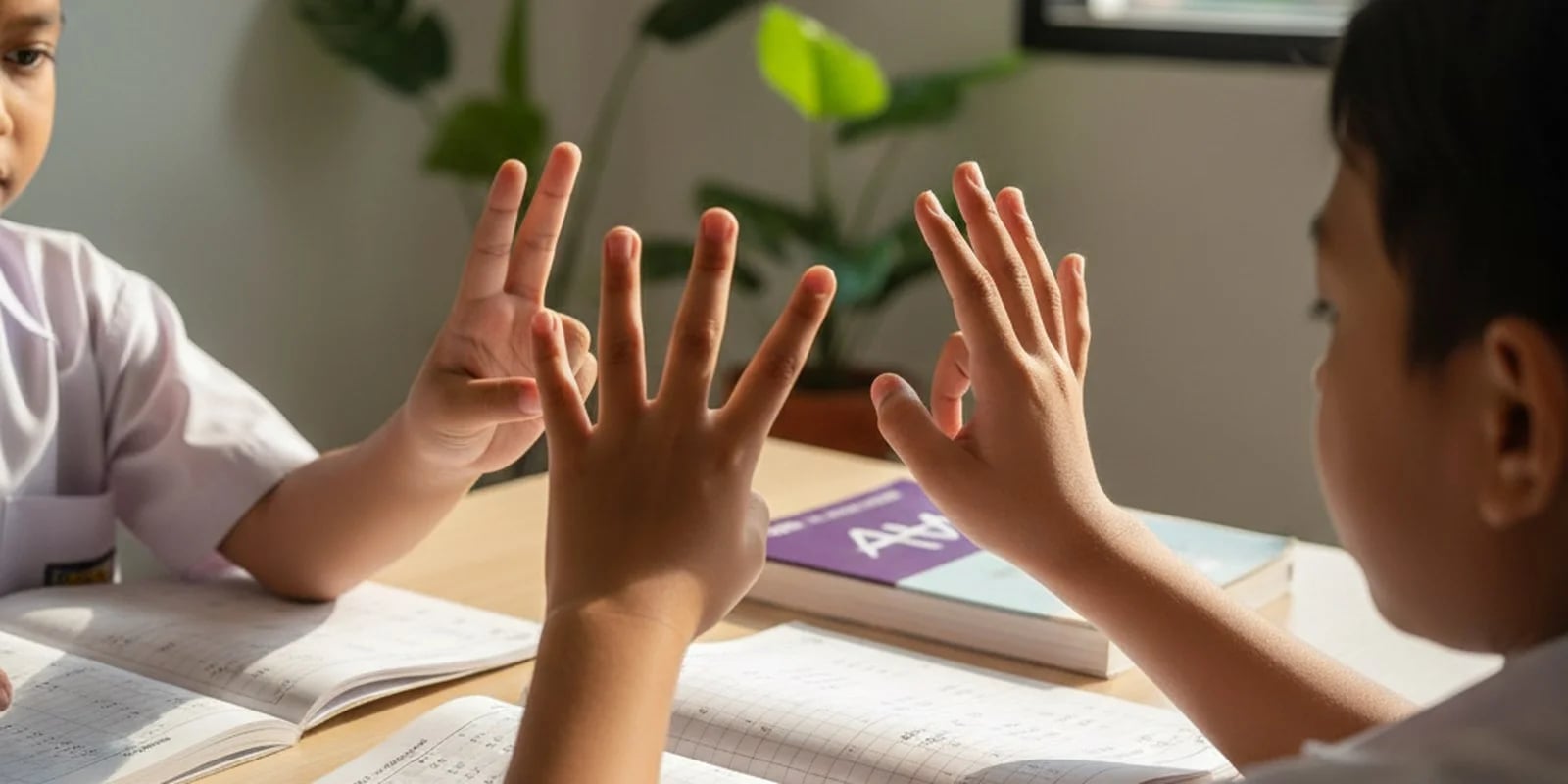
Jarimatika is a mental-arithmetic method that uses the fingers as a tool for the four basic operations: multiplication, division, addition, and subtraction. The name combines the Indonesian words jari (finger) and matematika (mathematics).
Table of Contents
The method was developed by Septi Peni Wulandani and spread through a series of books published since the mid-2000s. In Indonesia jarimatika is popular for the simplest reason of all: there is nothing to buy. We do not teach jarimatika, so this article describes it plainly, including the part promotional material rarely mentions: where the method stops.
Three practical reasons, and all of them are about access rather than any teaching advantage:
That third reason is also the source of the biggest misunderstanding, which we cover below.
Jarimatika assigns each finger a certain value, then uses a fixed movement pattern for each operation. For addition and subtraction, the right hand usually represents ones and the left hand represents tens, so a child can count past 10 without running out of fingers. For multiplication, a special pattern is used for each number, for example a dedicated technique for the 6 to 10 times tables that draws on the properties of those numbers.
The key thing for parents to understand: this is a technique for calculating, not an explanation of concepts. A child who has mastered times-7 on their fingers does not necessarily understand what multiplication means. They have mastered a procedure that produces the right answer. That is not a flaw; it is the design. It only becomes a problem if a parent assumes the child now "understands math".
Jarimatika makes the most sense in early primary school, when a child already knows numbers and is memorising the basic times tables. Outside that range its usefulness drops quickly. For preschoolers, finger coordination is often not ready and the number concept has not formed yet. For children in grade 5 and up, the material has moved on to fractions, decimals, and ratios, which jarimatika does not handle.
This is the part that is discussed least and is most useful for your decision. Jarimatika works on simple whole-number operations. It is not designed for:
In other words, jarimatika covers part of the grade 1 to 4 material and touches nothing after that. A child struggling in junior high will not be helped by jarimatika, however well they have mastered it. There is also a subtler limit: there are only ten fingers, so once the numbers grow large the method runs out of room. That requires an understanding of place value, which has to be taught separately.
The three are often compared, yet they answer different needs:
| Tool | Scope | A good fit if the child… | |
|---|---|---|---|
| Jarimatika | Fingers | Basic operations, early primary | Is slow at arithmetic and you want a no-cost solution |
| Abacus | Abacus, then no tool | Arithmetic, up to large numbers | Understands the material but needs advanced speed |
| Math tutoring | A teacher and explanation | The whole curriculum | Does not understand the material, not merely slow |
A full comparison of the four popular methods, including Kumon and Sakamoto, is in the comparison of arithmetic methods. If you are specifically weighing the abacus, its separate explanation is in the article on the abacus.
A child masters the jarimatika trick, their arithmetic test scores rise, and the parent concludes the math problem is solved. Then fractions arrive in grade 5 and the scores fall again, because what was trained all along was speed on one kind of problem, not understanding that carries over to new material. A simple way to check: ask the child to explain why 7 × 8 = 56, not just to state the answer. If all they can do is perform the finger movements, what they have mastered is the procedure. Again, that is still useful. But it is not the same thing as understanding math.
We teach neither jarimatika nor the abacus. Algonova math classes sit in the third row of the table above, building conceptual understanding with a teacher in small online groups, on a curriculum that continues from primary through senior high. For the primary level there is the math for primary-school kids program.
If your child's difficulty is purely calculation speed in early primary, jarimatika is a reasonable and cheap choice, and we will say so plainly. We answer a different problem. The easiest way to find out which one it is: a free 45-minute diagnostic class with a teacher, with no obligation to continue.
Jarimatika is a finger-based calculating technique for basic operations, developed by Septi Peni Wulandani, best suited to early primary children. Its strengths are real: free, practical, and quick to show results. Its limits are real too: it covers part of lower-primary material and stops there. For fractions, word problems, and everything after, something different is needed, and it is better to know that now than in grade 5.
Jarimatika is a calculating method that uses the fingers as a tool for the four basic operations: multiplication, division, addition, and subtraction. The name combines the Indonesian words "jari" (finger) and "matematika" (mathematics). The method was developed by Septi Peni Wulandani and spread through a series of books.
It makes the most sense in early primary school, when a child already knows numbers and is memorising the basic times tables. For preschoolers, finger coordination is often not ready yet. For grade 5 and up, the material has moved on to fractions and ratios, which jarimatika does not handle.
Its scope is limited to simple whole-number operations. Jarimatika is not designed for fractions, decimals, word problems, algebra, geometry, or statistics. It also trains a calculating procedure rather than conceptual understanding — a child can give the right answer without understanding why.
Jarimatika is more practical and costs nothing in equipment, but it stops at the basic operations of early primary. The abacus reaches further, up to large numbers, and can lead on to mental arithmetic, but it needs a tool and years of practice. Both train speed rather than conceptual understanding.
Yes. The books are widely available and many parents teach it themselves without signing up for a course. This is one of the main reasons the method is so popular in Indonesia.
Because in grade 5 the material moves on to fractions, decimals, and word problems — areas jarimatika does not cover. What was trained all along was speed on one kind of problem, not understanding that carries over to new material. A way to check: ask the child to explain why 7 × 8 = 56, not just to state the answer.
Blog

Algonova worldwide
Contact
Whatsapp: +62 21 50996971
Email: info@algonova.id
Address
Coworking Area, Gedung IT 6 Lantai Dasar, Nongsa Digital Park, Jalan Hang Lekiu, Kelurahan Sambau, Kecamatan Nongsa, Batam, Indonesia Directorate General of Consumer Protection and Trade Compliance – Ministry of Trade of the Republic of Indonesia. WhatsApp Ditjen PKTN: 0853-1111-1010.
PT Algonova Indonesia Cerdas All rights reserved 2026
