Sakamoto Math Fees in Indonesia 2026: Cost Items, How to Calculate and Online Alternatives
Which Is Better?10 min
Parent Guides

Maya Putri
Early Childhood Education Specialist
"Math tutoring near me" is one of the most common searches Indonesian parents type. What they are really looking for is not a location. It is a way for a child to get help with maths without draining the family's time every single week.
This guide compares the three options honestly — a private tutor who comes to your home, a tutoring centre nearby, and online classes. Including when you should not choose online.
The reason is almost always the same, and almost never about teaching quality:
This matters because the answer is not always "find something closer". Sometimes the answer is to remove the journey entirely.
Best for: a child who has fallen well behind on one specific topic, or who genuinely cannot focus around other people.
The upsides are real: full one-to-one attention, material adapted on the spot, no travel at all. It is the most flexible format there is.
The downsides are equally real. It is the most expensive option per hour. Quality rests entirely on one person — if that tutor stops, you are back at zero. And most private tutors work without a written curriculum, so progress is hard to judge beyond the next test score.
What to ask before agreeing: what is the plan for the next three months, and how will you know whether it worked.
Best for: a child who needs structure, a fixed schedule, and a learning environment outside the house.
Centres have a curriculum, a substitute teacher when someone is unavailable, and a schedule that is actually kept. For many families, the fact that you have to leave the house is exactly what makes the learning happen.
The downside is class size. The more children in the room, the more likely teaching becomes one-directional — the teacher explains at the front, and the child who did not follow will not raise their hand. Class size is rarely printed in the brochure, so it has to be asked directly.
One more distinction worth making: some centres do not teach maths, they train arithmetic speed. Daily worksheet programmes build accuracy and pace; abacus and finger-arithmetic methods train mental calculation with an aid. All of this can be useful — but it is not the same thing as understanding why a formula works. Be clear about which one you are buying.
What to ask before enrolling: how many children are in a class, and what happens if my child falls behind on a chapter.
Best for: families who want a teacher and a small group without adding a journey to the weekly schedule.
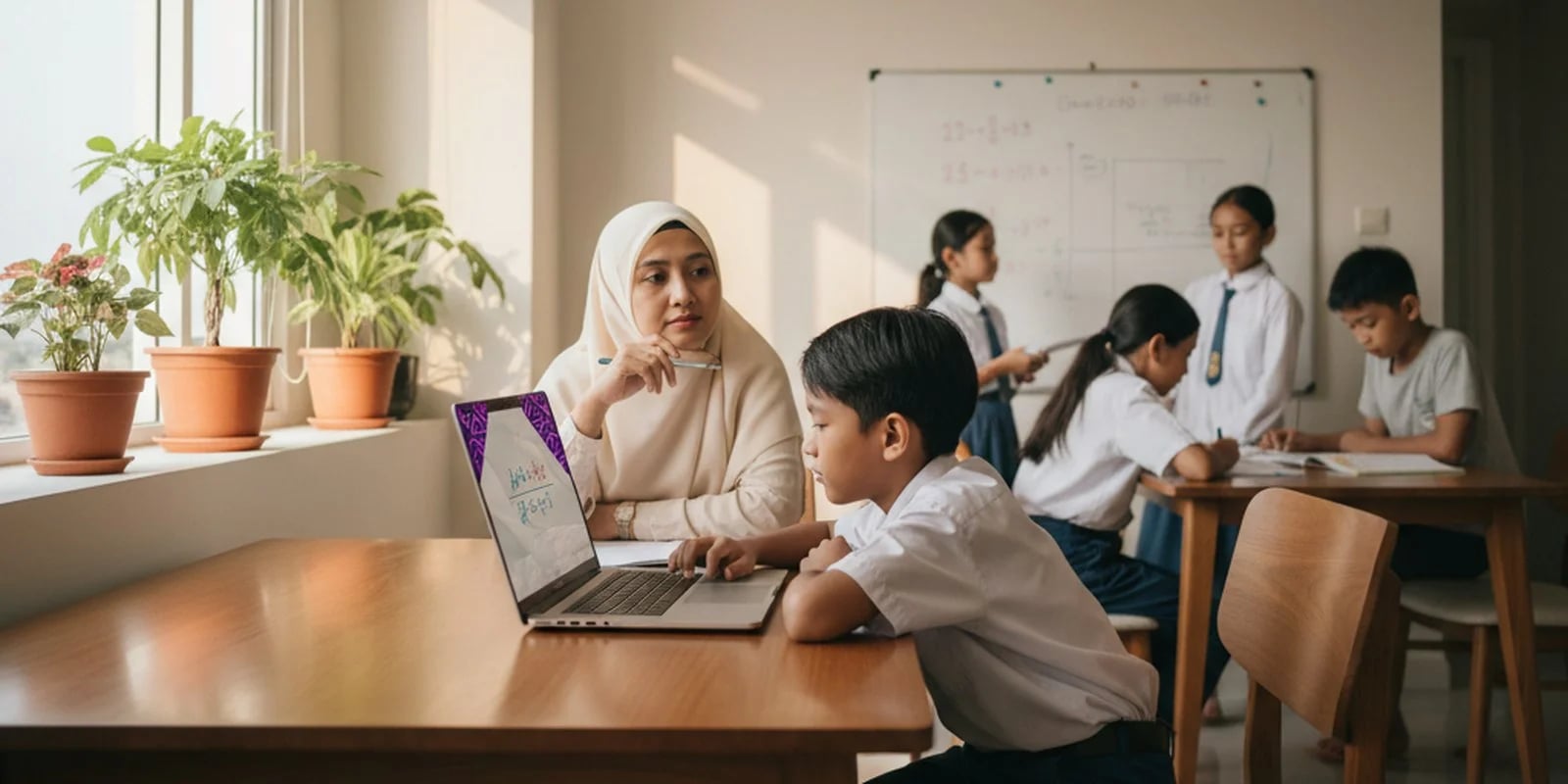
Here "near me" stops being a question. The child learns from home, and your choice of teacher is no longer limited to a 5 km radius. For families outside the big cities, this is often the only way to reach someone who actually specialises in maths.
The downsides deserve to be stated plainly. A child below year 2 usually cannot sit in front of a screen unsupervised. You need a stable internet connection. And there is none of the face-to-face social side that comes with showing up somewhere.
What to ask before enrolling: whether classes are genuinely live with a teacher or just recorded video, and how many children are in a group.
| Private tutor at home | Centre near home | Online classes | |
|---|---|---|---|
| Attention per child | Highest (1:1) | Depends on class size | Depends on class size |
| Travel time | None | Every week | None |
| Cost per hour | Highest | Mid-range | Mid-range |
| Written curriculum | Often none | Usually yes | Usually yes |
| If the teacher is away | Class cancelled | Substitute available | Substitute available |
| Choice of teacher | Limited by radius | Limited by radius | Not limited by location |
| Suitable for young children | Yes | Yes | Needs supervision |
1. Is the problem speed or understanding? If your child understands but works slowly, a regular drill programme makes sense. If your child does not understand why fractions can be added, they need someone to explain — not more worksheets.
2. How many hours a week are realistic for your family? Count the travel. A 90-minute lesson 30 minutes from home costs 2.5 hours. If that number is not sustainable across a school year, pick a format that removes the journey.
3. Does your child learn better alone or in a group? Some children thrive watching a peer solve the same problem. Others stop asking questions the moment someone else is in the room. This answer decides between private and group — not between online and offline.
Algonova is an online school. Our maths classes run live with a teacher, in Private (1 student), Mini (2-4 students), and Group (up to 10 students) formats, on a curriculum built to run for years — not patch-up sessions before a test. The programme is split by school stage: maths for primary-school children and classes for SMP–SMA.
Because the format is online, the "near me" question does not apply: a child can join from any city in Indonesia, with no travel time to account for.
We are not right for everyone. If your child is under seven and cannot yet focus on a screen without you nearby, or if you specifically want someone physically present in your home, a private tutor is the better choice — and we will say so plainly.
The honest way to find out whether it fits is to try it. We run a free diagnostic class of about 60 minutes with a teacher: your child works through problems, and you get a picture of where they actually stand. There is no obligation to continue afterwards.
Searching for "math tutoring near me" is usually a search for something that can survive a whole school year. Distance is only one variable — and for many families it can be removed entirely.
What actually determines the outcome is three other things: how many children are in a class, whether there is a written curriculum, and whether the teaching builds understanding or only trains speed. Ask all three, wherever you enrol.
When searching for maths tutoring near you, parents can now also consider online classes that bring a quality teacher straight into your home with no journey at all. What matters most is not distance but the quality of the teacher, the class size, and the fit with your child. The same logical thinking is trained in Algonova's coding classes. To get started, see the programme options on the Algonova classes page, or try a free maths diagnostic first.
The main difference is not quality but travel time and choice of teacher. A centre limits you to whoever teaches within reach of your home; online removes that limit, but requires a child who can already focus on a screen. For children below year 2, in-person is usually easier to sustain.
Ask three things wherever you enrol: how many children are in a class, whether there is a written curriculum for the coming months, and whether the teaching builds conceptual understanding or only trains calculation speed. These three answers matter more to the outcome than distance does.
A private tutor gives full attention and maximum flexibility, but costs the most per hour and often works without a written curriculum. A group class is cheaper, has structure and a substitute teacher, but attention per child depends on class size. The right choice depends more on how your child learns than on the format itself.
No. They train calculation speed and accuracy. Maths tutoring builds conceptual understanding — why a formula works and when to use it. Both can be useful, but they answer different needs. If your child understands the material but works slowly, drill makes sense; if the material itself is unclear, they need explanation.
Algonova is an online school, so a child can join from any city in Indonesia with no travel time. Classes run live with a teacher in small groups.
It depends on where the child is starting from and how far behind they are. What you can do from day one is ask for a written plan for the first three months and how it will be measured, so progress is not judged only by the next test score.

Algonova worldwide
Contact
Whatsapp: +62 21 50996971
Email: info@algonova.id
Address
Coworking Area, Gedung IT 6 Lantai Dasar, Nongsa Digital Park, Jalan Hang Lekiu, Kelurahan Sambau, Kecamatan Nongsa, Batam, Indonesia Directorate General of Consumer Protection and Trade Compliance – Ministry of Trade of the Republic of Indonesia. WhatsApp Ditjen PKTN: 0853-1111-1010.
PT Algonova Indonesia Cerdas All rights reserved 2026