How to Teach Multiplication Tables to Kids: 5 Proven Methods
Learn Math8 min
Learn Math

Nadia Rahmawati
Math Curriculum Team, Algonova
Updated: November 2026
Online or offline math lessons can both work for primary school kids, as long as the teacher is good and the child attends regularly. The right choice depends on your child's age, how well they can sit and focus, the distance to the tutoring place, and your family's schedule. One 2013 meta-analysis found no significant difference between fully online and face-to-face learning, but its studies mostly involved adults.
Neither is automatically more effective, because teacher quality and regular attendance matter more than the location.
The evidence most often cited is the 2013 meta-analysis by Means and colleagues in Teachers College Record. It found that fully online learning did not differ significantly from face-to-face, while a blend of both did slightly better. The authors themselves warn that the blend was mixed with other factors, such as more study time.
The limitation matters: most studies in that analysis involved college students and adults, not primary school children. So the result is not a promise for a 7-year-old. For primary school kids, we can use the practical considerations in the next sections.
The biggest differences are travel time, how the teacher supervises, and who prepares the study space.
| Aspect | Online lessons (live class) | Offline lessons (tutoring center or home tutor) | | Time and transport | No travel time | Travel time and cost, unless the tutor comes to your home | | Choice of teachers | Not limited by city | Limited to nearby teachers or centers | | Supervision | The teacher watches through the screen, parents prepare the device and connection | The teacher supervises directly, including the child's handwriting | | Schedule | Easier to adjust | Follows the center's or tutor's schedule | | Teaching aids | Household objects and the screen | Hands-on teaching aids are possible | | Shy children | Some speak up more easily through a screen | Some are more comfortable meeting in person |
If you are weighing a home tutor, read how to find a private tutor to come to your home and private tutor or tutoring center. A picture of the costs is in private tutoring costs for primary school.
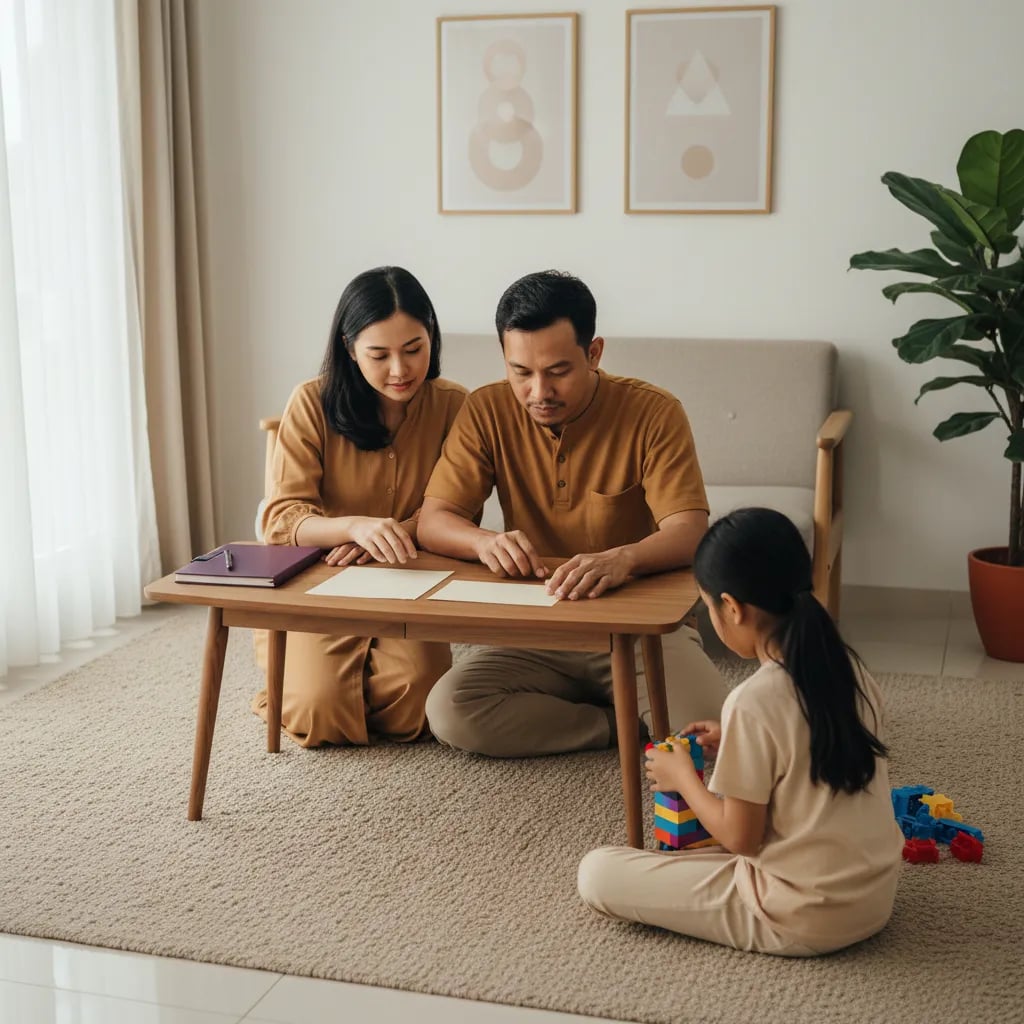
Offline lessons fit better when the child still struggles to sit in front of a screen for long, or when the home has no stable device and internet.
These conditions usually favor offline lessons:
If one or two of these describe your family, offline lessons are an honest and sensible choice. Algonova does not run offline classes in Indonesia, so we can only describe the online format. For general advice on choosing a tutoring provider, see how to choose an online tutoring program for primary school.
Online lessons fit better when distance, schedule or the choice of teachers near home is the obstacle.
Conditions that tend to suit online:
Online does not mean unsupervised. In a live class the teacher greets each child by name and gives questions on the spot. At Algonova groups are capped at 10 children so the teacher can watch each one. Classes start at Rp 102,000 per lesson, with durations of 45, 60 or 90 minutes. A fuller view of costs is in online math lesson costs.
Online lessons work when there is active interaction, a quiet space, and a teacher who knows where the child is weak.
Use this list to judge any online tutoring provider:
Screen time is worth considering too. If your child already uses devices a lot for other things, read how many hours of screen time is right for a child first, so lessons do not pile on top of already long screen time. If your child loses focus easily, children who struggle to focus on studying explains the causes.
The most honest way is to try, because a trial session shows more than a list of pros and cons.
The steps are simple:
At Algonova, the first step is a free diagnostic of about 60 minutes with a teacher. The result is used to build the schedule in the math program for primary school children, and private math lessons are available for one child. A comparison of group and private classes is in online math tutoring for kids.
Online lessons can be effective for primary school kids, as long as the class is live, the teacher corrects directly and the child attends regularly. Existing research, including the 2013 meta-analysis by Means and colleagues, found that fully online learning did not differ significantly from face-to-face. But most participants were adults, so the result cannot be assured for primary school kids. The safest way is to try one trial class and see whether the child understands, dares to ask questions and wants to come back next time.
Online lessons are often cheaper overall because there is no travel cost or time, but the price of the lesson itself depends on the provider and format. Compare on the same terms: subject, duration, private or group, number of sessions and included services. Do not compare the price of one session with the price of a package of many sessions. At Algonova, group math classes start at Rp 102,000 per lesson. For details and how to compare, see the online math lesson cost and private tutoring cost articles on this blog.
For grade 1, many parents find offline easier because the child is still learning to sit calmly and write neatly. There is no official age rule. If the child can focus for about 30-40 minutes with breaks and a parent can sit in at the start, online is still worth trying. If the child gets restless in front of a screen, postpone it or choose in-person lessons. Start with a trial session and watch your child's reaction, not only the results of the problems.
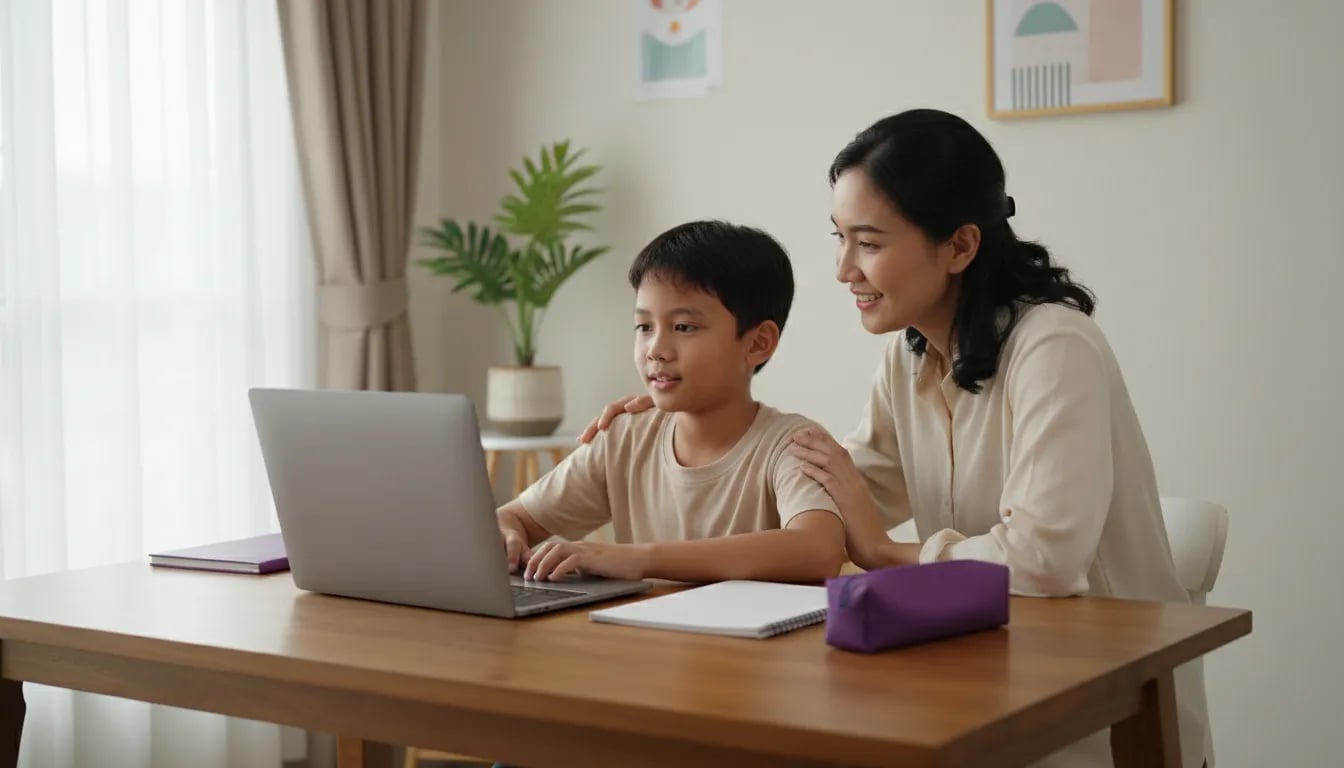
In the early grades, a parent should sit with the child for the first few minutes to make sure the device, sound and notebook are ready. After that the child can usually follow alone, and the parent only needs to stay in a nearby room. Older children, grades 4-6, generally just need a check at the start and end of the session. For example, prepare the desk, laptop and notebook ten minutes before class, then ask at the end what new thing they learned today.
First check whether the class is too passive, too long, or the material too easy or too hard. A good class gets the child talking, answering and solving problems, not just watching. If the child still does not enjoy it after several sessions, consider shorter sessions or offline lessons. If restlessness also shows up elsewhere, read the article on children who struggle to focus, and talk to a pediatrician if the concern continues.
Private lessons give one child full attention, while small groups give study companions and are usually more affordable. A child who needs to catch up from the basics, or who is shy, often benefits from private lessons. A child motivated by peers usually fits a small group. Algonova offers both: group classes of up to 10 children and private lessons for one child. A diagnostic at the start helps decide which format makes more sense.
Many families start with 1-2 times a week, then adjust to the child's ability and energy. Too packed makes the child tired, while too rare makes the material easy to forget. Consider homework and other school activities too. The article on how many times a week a primary school child should take lessons covers the trade-offs in more detail. Evaluate after one month: is the child more confident, and is their score or understanding moving?
No, Algonova in Indonesia runs online classes only. Math classes are live with a teacher, in groups of up to 10 children or as private lessons for one child. If you are looking for in-person lessons, we suggest trying a few tutoring places near home and comparing them on the same terms. If you would like to see the online format first, a free diagnostic of about 60 minutes can be tried first.

Algonova worldwide
Contact
Whatsapp: +62 21 50996971
Email: info@algonova.id
Address
Coworking Area, Gedung IT 6 Lantai Dasar, Nongsa Digital Park, Jalan Hang Lekiu, Kelurahan Sambau, Kecamatan Nongsa, Batam, Indonesia Directorate General of Consumer Protection and Trade Compliance – Ministry of Trade of the Republic of Indonesia. WhatsApp Ditjen PKTN: 0853-1111-1010.
PT Algonova Indonesia Cerdas All rights reserved 2026