Sakamoto Math Fees in Indonesia 2026: Cost Items, How to Calculate and Online Alternatives
Which Is Better?10 min
Which Is Better?

Dimas Prasetyo
Education Analyst, Algonova
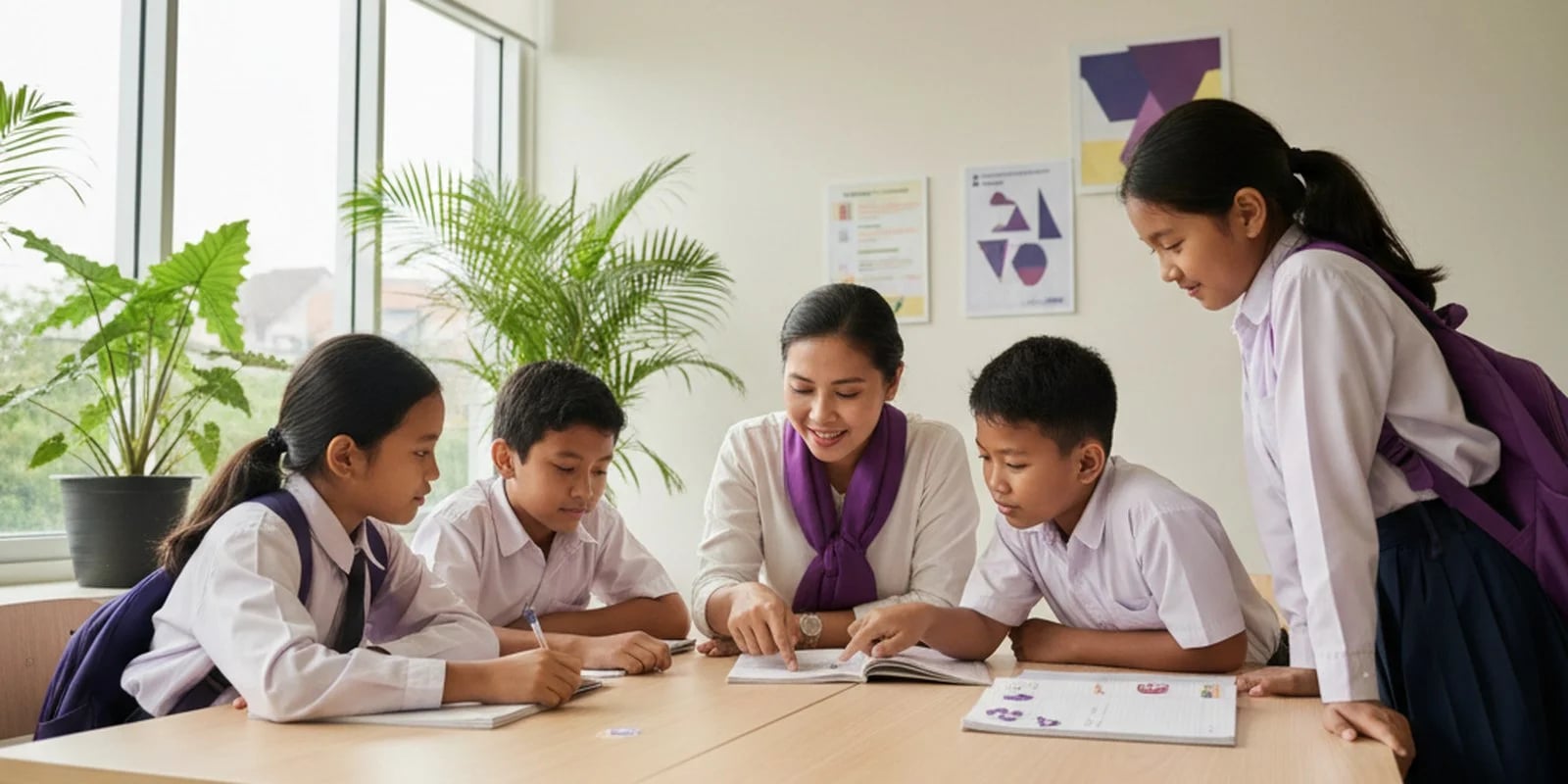
"Should my child have private tutoring or go to a bimbel?" — this question comes up in almost every family that decides to add learning outside school.
One thing you should know before reading any article on this: nearly everything written about this topic is produced by private tutoring providers. Which is why nearly all of it ends with the same conclusion, that private tutoring is more effective.
We offer all three formats — Private (1 student), Mini (2-4 students), and Group (up to 10 students). We still have an interest here: we want you to choose us. But we have no interest in pushing you toward one particular format, and that is what allows this article to discuss all three as they are.
The question is usually framed as a choice between two things. In fact there are three:
The third option often disappears from the discussion, even though it is where most of the difference in cost and outcome actually sits.
The real advantages: the entire lesson is directed at your child. The teacher can stop at the confusing point and repeat it as often as needed. The schedule is flexible. If your child is far behind on one chapter, this is the fastest way to catch up.
The drawbacks that are rarely mentioned:
Makes most sense if: your child is far behind and needs to catch up quickly, or has a specific learning difficulty, or genuinely cannot concentrate with other people present.
The real advantages: there is a curriculum, there is a schedule that is kept to, and there is a substitute teacher if someone is unavailable. The system does not collapse because of one person. The cost per child is far lower. For many families, having to turn up somewhere is exactly what makes the learning actually happen.
The drawbacks that are rarely mentioned:
Makes most sense if: your child needs structure and a fixed schedule, their difficulty is the same as their classmates', and the location really is nearby.
This format sits between the two, and that is not a compromise — there are things that only appear here.
Advantages: the teacher still has time to notice each child, but the cost is shared. There is a curriculum and there are substitute teachers, as with a bimbel. The child sees peers working on the same problems — which for some children is the strongest motivator of all, because "if they can do it, so can I". If the format is online, travel time disappears entirely and the choice of teacher is not limited by distance from home.
The honest drawbacks:
Makes most sense if: your child needs concepts explained and a little social push, but does not need full one-to-one attention.
| Private tutoring | Large-class bimbel | Small classes | |
|---|---|---|---|
| Attention per child | Full | Low | Medium–high |
| Cost per hour | Highest | Lowest | Middle |
| Written curriculum | Often absent | Usually present | Usually present |
| If the teacher is unavailable | Class cancelled | Substitute available | Substitute available |
| Learning pace | Follows the child | Follows the average | Follows the small group |
| Encouragement from peers | None | Present, but anonymous | Present and felt |
| Travel time | None | Yes | None if online |
| Catching up a large gap | Best | Difficult | Difficult |
Whatever you choose, these three questions affect the outcome more than the choice of format:
1. How many children are in a class? If the answer is not a specific number, that is itself an answer.
2. What is the plan for the coming months, and how will we know it is working? A serious place has a written answer, and usually has diagnostic tests to measure it. One that does not, teaches session by session following homework.
3. If my child does not understand a chapter, what happens? This separates places that chase the curriculum from places that teach the child.
Choosing a format before knowing the problem.
A child who is slow at calculating but understands the concepts needs practice, not more explanation. A child who does not understand the concepts will not be helped by extra problems, however many. A child who understands and is able but never does the work needs structure and supervision, not a cleverer teacher.
These three children look the same on a report card, and the solutions are entirely different.
We offer all three formats for mathematics: Private (1 student), Mini (2-4 students), and Group (up to 10 students) — all online, live with a teacher, with a curriculum structured over several years rather than homework support ahead of a test. There are separate programmes for primary school children and for the SMP–SMA years.
Because we have all three, we do not need to convince you that our format is the only right one. We do the opposite: we work out first which format suits your child.
A child can also move between formats as they progress — for example starting in the Private format to close a gap, then continuing in the Mini format once caught up. This is not possible if you are tied to a provider that has only one format.
As the programme runs there are diagnostic tests to track progress, regular reports for parents, and an official certificate once the child completes a set number of sessions.
The easiest way to determine the right format is a free diagnostic class of about 60 minutes with a teacher: your child works through problems, and you get a picture of whether what is missing is understanding, speed, or study habits — and which format answers it. There is no obligation to continue afterwards.
If you are comparing arithmetic methods such as sempoa or Kumon, that is discussed separately in our guide comparing methods.
Choose private tutoring if your child needs full attention and tailored material; choose a bimbel if your child is motivated by a group setting and a more affordable cost. Neither is absolutely better — it all depends on what your child needs.
Which is more effective for a child who is behind? Generally private tutoring, because the teacher can focus on filling that child's specific gaps.
Is there an option between the two? Yes. Small online group classes combine personal attention with a lighter cost. For logic and coding lessons, see Algonova coding classes, available in Private (1 student), Mini (2-4 students), and Group (up to 10 students) formats, or try a free coding class to experience it.
Private tutoring is one teacher for one child, with a flexible schedule and full attention, but the highest hourly cost and often no written curriculum. A bimbel is a class with many children, with a curriculum, a fixed schedule, and substitute teachers, at a far lower cost per child — but the attention each child receives depends on class size.
It depends on the child's problem, not on the format itself. Private tutoring is the right choice if the child is far behind and needs to catch up quickly, or cannot focus with other people present. A bimbel fits better if the child needs structure and a fixed schedule, and their difficulty is similar to their classmates'. The third format — small classes — sits between the two.
There is no single correct number, but class size affects the outcome more than the differences between providers. What matters: ask for the exact figure before enrolling. If a tutoring centre does not answer with a number, that is itself an answer.
Yes. For mathematics three formats are available: Private (1 student), Mini (2-4 students), and Group (up to 10 students) — all online. A child can also move between formats as they progress, for example starting in Private to close a gap and then continuing in Mini.
The Private format (1 student). A group, however small, moves at the group's pace and cannot stop and wait for one child. Once the gap has been closed, the Mini format (2-4 students) can be a more economical way to continue.
Three things: how many children are in a class, what the plan is for the coming months and how success will be measured, and what happens if the child does not understand a chapter. The answers to those three shape the outcome more than the choice between private tutoring and a bimbel.

Algonova worldwide
Contact
Whatsapp: +62 21 50996971
Email: info@algonova.id
Address
Coworking Area, Gedung IT 6 Lantai Dasar, Nongsa Digital Park, Jalan Hang Lekiu, Kelurahan Sambau, Kecamatan Nongsa, Batam, Indonesia Directorate General of Consumer Protection and Trade Compliance – Ministry of Trade of the Republic of Indonesia. WhatsApp Ditjen PKTN: 0853-1111-1010.
PT Algonova Indonesia Cerdas All rights reserved 2026