Future careers in the AI era: what to prepare now

AI Education8 min
Math Education

Reza Maulana
School Partnerships, Algonova
The most effective way to teach multiplication to kids isn't drilling 1x1 through 10x10 into memory — it's building visual understanding and patterns first, typically starting at ages 7–9 (Grades 2–4) in 15-minute daily sessions. The strongest approach combines visual arrays, equal grouping, skip-counting songs, games, and retrieval practice — the same framework Indonesia's Kurikulum Merdeka phases A/B follow.
Algonova is an online course platform for coding, math, AI, and design for kids aged 5–17, with 1,000,000+ alumni across 97 countries since 2016. Classes are held live with certified teachers in Private (1 student), Mini (2-4 students), and Group (up to 10 students) formats — not pre-recorded videos.
Cognitive Load Theory (John Sweller, UNSW 1988) shows that primary-school kids have limited working memory. Memorizing 100 multiplication facts without patterns overloads them until they give up — not because they aren't smart, but because the method is wrong.
What actually works: build understanding first, memorization second. A child who understands that "3 × 4 means four groups of three" doesn't need to memorize — she can reconstruct the answer. The National Council of Teachers of Mathematics (NCTM) calls this "multiplication as repeated addition": conceptual grounding first, then fluency (recall speed).
Signs your child is ready for multiplication:
If your child still struggles with addition or can't yet group objects, don't rush into multiplication — reinforce the foundation first. Under the Kurikulum Merdeka framework, mastery of addition through 100 is a prerequisite before introducing multiplication in Grade 2.
The Concrete → Representational → Abstract (CRA) framework from international curricula is the most reliable standard: children start with real objects, move to pictures/diagrams, then to symbolic numbers. Kurikulum Merdeka phases A/B (Grades 1–2) also adopt this same approach for numeracy.
Arrange objects in rows and columns. Example: 3 rows × 4 columns of small candies = 12 candies. Children can see that 3 × 4 and 4 × 3 give the same total (commutative property) simply by rotating the array. This is the foundation of the array method recommended by the NCTM and used in the international Common Core curriculum.
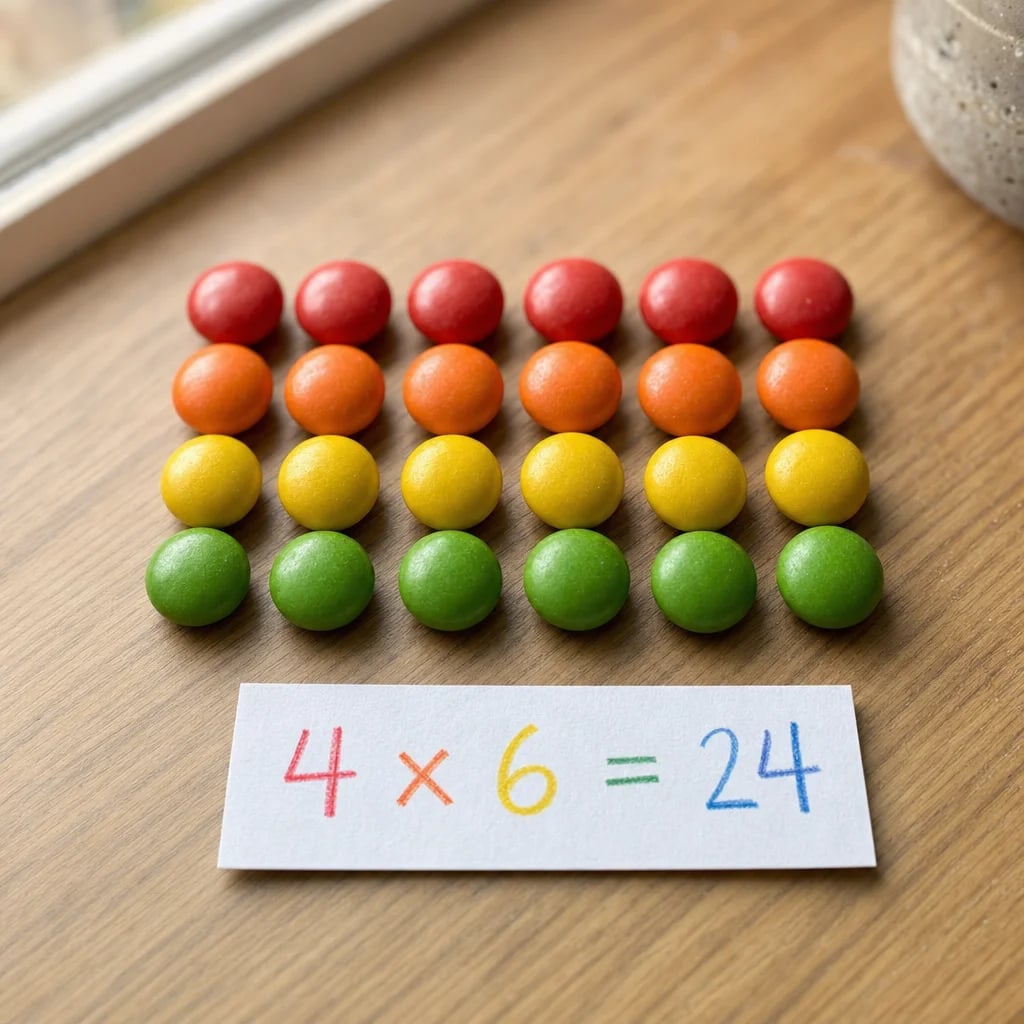
Before the symbol "3 × 4", teach three groups of four. Divide candies into three dishes, four in each. The child counts the total: 4+4+4=12. Only then introduce the symbol "×" — as shorthand for repeated addition, not a mantra to be memorized.
Skip-counting means counting by jumps: 2, 4, 6, 8… or 5, 10, 15, 20… Children's brains absorb rhythm faster than random numbers. Try skip-counting songs from local or international education channels (Have Fun Teaching on YouTube). Use them for 5 minutes before meals or in the car on the way to school.
Games turn drill into fun without reducing practice:
Purdue University researchers (Karpicke & Roediger, 2008) showed that retrieval-based recall strengthens memory 2–3× more effectively than simply re-reading a table.
Once the child understands the concept, focus on fluency. Use physical flashcards or an app. The key: spacing between sessions. 5 minutes each morning for 4 weeks is far more effective than 60 minutes once a week — proven by dozens of cognitive-psychology studies since 2006.
At first I forced my son to memorize tables 1-10 in two weeks. He cried every night and started saying 'I'm stupid at math'. After we switched to the array method with Lego and card games, within a month he was fluent through x5 — and more importantly, he now says 'math is fun'.
Sari, mother of Alif (Grade 3), Jakarta
Consistency beats intensity. Here's the daily routine that works in Indonesian families:
Minutes 0–3: Skip-counting warm-up. Count together: 2, 4, 6… then 5, 10, 15… then 10, 20, 30. While walking around the room or climbing stairs to the bedroom.
Minutes 3–8: Core method (one method per session). Monday: array with Lego. Tuesday: bingo cards. Wednesday: multiplication songs. Thursday: dice. Friday: mixed drill. Variety prevents boredom and reinforces memory through different cognitive angles.
Minutes 8–13: Retrieval flashcards. 10 mixed cards — facts already mastered + 2 new ones. This part matters: don't only practice what the child already knows. Add 2 new facts every week, and retire ones that are answered automatically within 2 seconds.
Minutes 13–15: Brief reflection. "Which fact felt easiest today? Which one needs another round tomorrow?" This kind of reflection trains metacognition — Kurikulum Merdeka phase B lists it as a key competency to be built alongside numeracy.
The child doesn't need to master everything at once. Master one table, then move to the next. This is what separates a calm approach from panic drill that creates math anxiety.
Indonesian kids ideally start multiplication in Grade 2 (ages 7–8), after mastering two-digit addition and the concept of equal grouping. This also matches the Kurikulum Merdeka phase A/B syllabus from Kemendikbudristek — phase A targets skip-counting to 100 in Grade 1, phase B introduces × 2, × 5, × 10 in Grade 2, then full × 3–10 in Grade 3.
Realistic milestones:
| Grade | Age | Multiplication Target |
|---|---|---|
| Grade 1 | 6–7 years | Skip-counting 2, 5, 10; grouping concept |
| Grade 2 | 7–8 years | Master × 2, × 5, × 10 |
| Grade 3 | 8–9 years | × 3, × 4, × 6, × 7, × 8, × 9 |
| Grade 4 | 9–10 years | Full mastery 1×1 to 12×12; ready for division |
Context data: The TIMSS 2023 (Trends in International Mathematics and Science Study) results place Indonesian Grade 4 students below the international average in basic numeracy, with multiplication and division as the weakest areas. This underscores the importance of consistent early practice, especially on conceptual foundations — not just rote drill.
Signs your child needs extra help:
If these signs appear, it doesn't mean your child lacks talent — it usually means the learning method needs to change, not the child. Small classes with a teacher who can adjust pace often resolve emotional blocks in 4–6 weeks.
Multiplication isn't the final gate in math — division, fractions, and algebra come next. A child who builds the multiplication foundation calmly and with real understanding will move through all of that far more smoothly than a child who just memorized.
Want direct help from a certified teacher? Try a free Math Master Class at Algonova — 60 minutes, your child learns live, and you see the method firsthand.
The best way to teach a child multiplication is to build it on addition and visual patterns first, then move to memorizing the tables through short daily practice and games. Use groups of objects, arrays, and skip-counting so the child understands why it works, not just what to recite. Coding reinforces the same pattern thinking. See Algonova's coding classes for ages 5 to 17, or try a free class to check your child's level through a diagnostic session.
Indonesian kids ideally start multiplication in Grade 2, around ages 7-8. This aligns with Kurikulum Merdeka phase B from Kemendikbudristek, which introduces x2, x5, and x10 in Grade 2, then expands to x3-x10 in Grade 3. Before Grade 2, the foundation is skip-counting (2, 4, 6... or 5, 10, 15...) and object grouping. Without this foundation, multiplication feels like random code and children get frustrated quickly. Some kids are ready earlier (Grade 1) - usually visible in how easily they group Legos or candies. If those signs appear, start slowly with visual arrays, not rote drill. The goal at any age is understanding first, memorization second.
With consistent 15-minute daily practice, most children need 4-6 months for full fluency on tables 1-10. Fastest order: x2 (1 week), x5 and x10 (2 weeks), x4 (1 week), x3 (2 weeks), then x6, x8, x9 (2-3 weeks each), and x7 last (3-4 weeks because it's the least patterned). Kids drilled for 1 hour once a week often need 1-2 years for the same result - which is why spaced practice beats occasional long sessions. Cognitive research from Purdue University has confirmed this since 2008. If after 6-8 weeks of consistent practice on one table the child still isn't fluent, it's usually not the child - the method needs to change.
For x9, use the classic finger trick: spread 10 fingers; for 9x3, fold the third finger - the fingers on its left (2) are tens, the ones on its right (7) are units, giving 27. This trick works for 9x1 through 9x10 and children generally love it because it feels like magic. For x7, there's no shortcut - it's the hardest fact because it lacks patterns. The best approach: master all other tables first (x2, x3, x4, x5, x6, x8, x9, x10), and the x7 table automatically becomes shorter (only 7x7, 7x8, 7x9 are truly new - the rest have been practiced from the commutative side). Don't start with x7 - that's the order that makes kids give up.
Math anxiety usually appears when a child has been drilled too hard or compared to peers. The solution isn't stopping practice, but changing format: shift from flashcards to games (Multiplication War with cards, dice, or board games), from long seated sessions to 10-minute walks or play. Kurikulum Merdeka actually emphasizes joy-based and meaningful learning - so parents who change approach align with official curriculum philosophy. Praise the process ("you didn't give up") rather than outcome ("you're smart") - Carol Dweck's research on growth mindset shows effort-praise builds greater mathematical resilience. If tears happen every session for 3-4 weeks, consider consulting a professional teacher - small classes often resolve emotional blocks within a month.
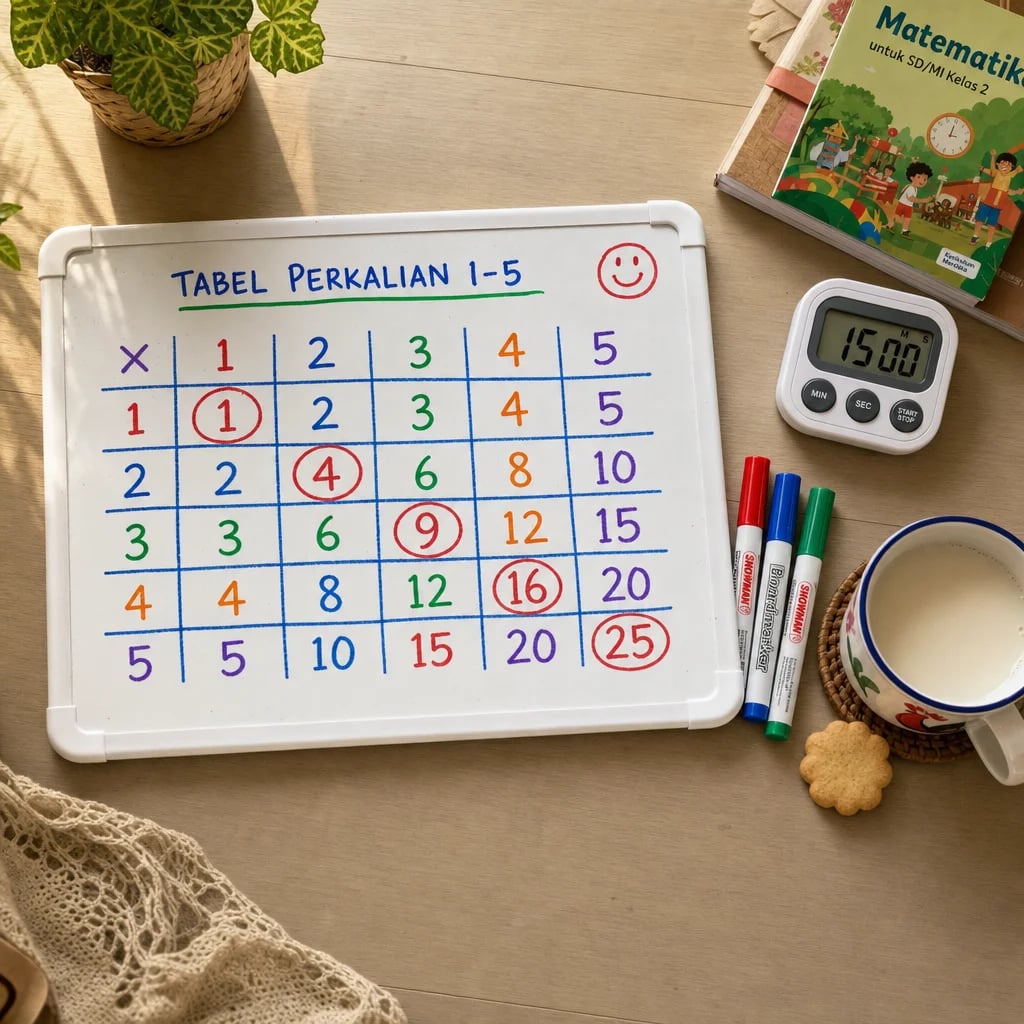
Free tools that work: playing cards (for Multiplication War), 2-3 dice, a small whiteboard with colored markers, candies or small Legos for building arrays. All these bring the concrete element needed before mathematical symbols mean anything. For digital, apps like Times Tables Rock Stars (popular in UK schools), Prodigy Math, or Khan Academy Kids offer gamified drill. Keep each session short - longer ones actually reduce retention. Avoid passive video without interaction - the child needs to do (not watch). If you must choose one tool, dice are the cheapest investment with the biggest impact: usable for warm-up, drill, and family game night all at once.
A child who memorizes knows 6x7=42, but asked "why" or "what does it mean", can't explain. When the question shifts slightly (like "6 boxes with 7 marbles each - how many marbles?"), the memorizing child often gets confused. A child who understands knows 6x7 means six groups of seven - and can reconstruct the answer through repeated addition or an array if they forget. The National Council of Teachers of Mathematics (NCTM) calls this "conceptual understanding first, fluency second". To check: ask the child to draw 3x4 as an array. If they can draw 3 rows of 4 dots (or 4 rows of 3) and say the total is 12, they understand. If they write 12 immediately but can't draw it, they've only memorized - and that's fragile.
Not always. Most children can master multiplication with 15 minutes of daily home practice at no extra cost - provided parents stay consistent and use the right method (arrays, games, spaced repetition). Paid tutoring makes sense in three situations: (1) the child is 6+ months behind class and parents lack time for daily coaching; (2) math anxiety requires a neutral teacher, not a parent; (3) the goal is higher, like olympiad prep or curriculum acceleration. At Algonova, live online math classes in 1-on-1 private, mini-group of 2–4, or group of up to 10 students formats, plus an AI-based diagnostic, help place each child at the right level. Before committing to paid classes, try a free 60-minute Master Class first to see whether the method fits your child.
This situation is more common than parents realize - and usually it's not a sign the child is slow, but a sign a more basic foundation has gaps. Check first: is the child fluent in repeated addition (5+5+5=15) and skip-counting to 100? If not, step back one level: practice skip-counting for 2 weeks through play (climbing stairs counting by 2s or 5s), then grouping (divide candies into 3 dishes of 5), then the symbol "x". TIMSS 2023 data shows Indonesian Grade 4 students on average below international standards for basic numeracy - meaning many families face similar situations. Consistent 15-minute daily practice over 6-8 weeks is usually enough to catch up. If no progress after 2 months, consult a professional teacher for a deeper assessment.

Algonova worldwide
Contact
Whatsapp: +62 21 50996971
Email: info@algonova.id
Address
Coworking Area, Gedung IT 6 Lantai Dasar, Nongsa Digital Park, Jalan Hang Lekiu, Kelurahan Sambau, Kecamatan Nongsa, Batam, Indonesia Directorate General of Consumer Protection and Trade Compliance – Ministry of Trade of the Republic of Indonesia. WhatsApp Ditjen PKTN: 0853-1111-1010.
PT Algonova Indonesia Cerdas All rights reserved 2026