Direct and Inverse Proportion Explained for Kids + 12 Worked Examples with Answers
Math Education8 min
Math Education

Dewi Lestari
Mathematics Specialist
Preschool math is not about counting to 100 before first grade — it is about building number sense through play, concrete objects, and daily interaction with parents. Children ages 4-6 learn math best through 5 areas: counting, sorting, patterns, shapes, and measurement.
Many parents panic when their preschooler cannot count to 20 yet. They buy worksheets, sit their child at the desk for 20 minutes, and hope for fast results. What usually happens is the opposite: the child associates math with pressure, and the door to learning closes before primary school even starts.
Early childhood development research consistently shows something different. Children ages 4-6 learn math best through a play-based approach — games, concrete objects, movement, and everyday conversation. What is being built is not memorization of digits, but number sense: a feel for big vs. small, more vs. less, patterns, and space. This is the foundation that supports arithmetic and logical thinking later.
This guide covers what actually works for preschool math in 2026: the 5 key areas, 12 no-worksheet home activities, 5 common parent mistakes, and when a child is ready for structured classes.
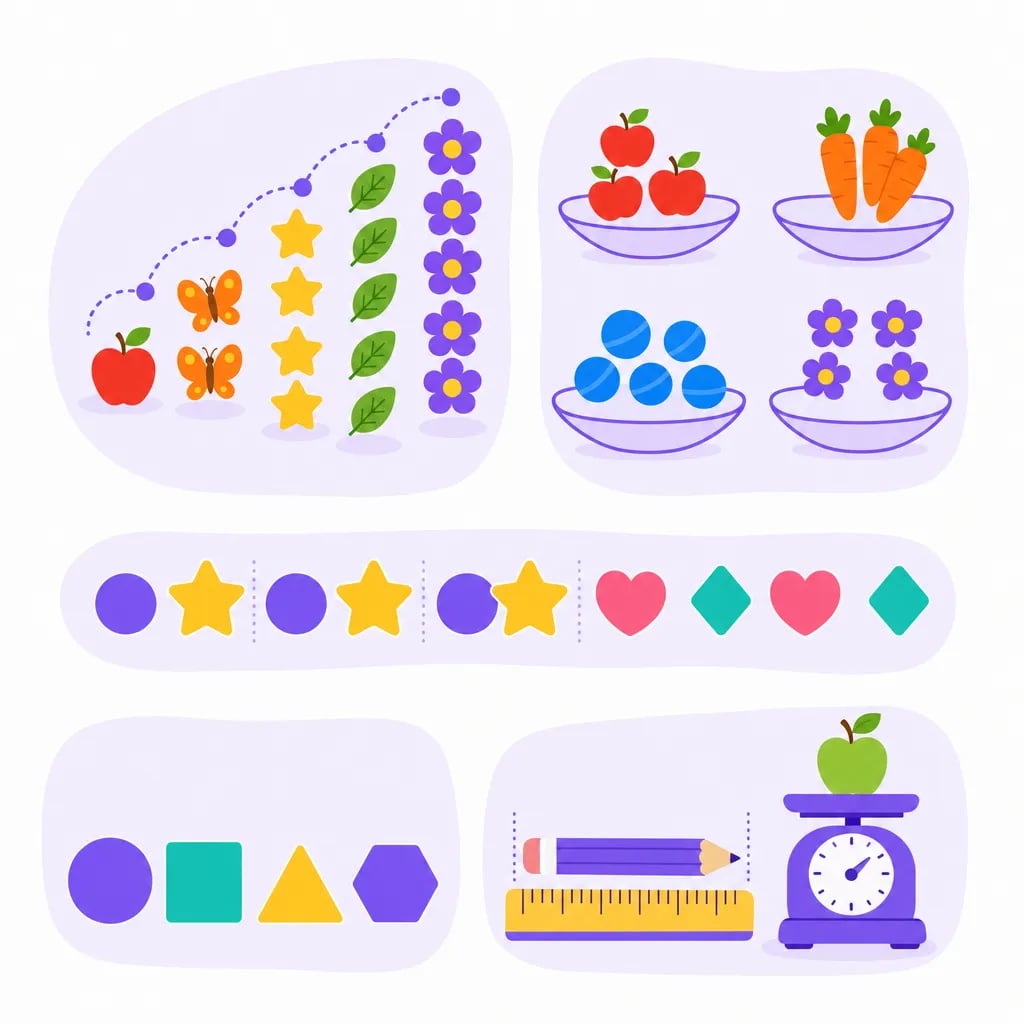
Math for ages 4-6 does not start with digits. It starts with 5 interconnected areas. Know all five so you can pick balanced activities at home.
Counting is not just reciting "one, two, three". Preschoolers need one-to-one correspondence — each number represents one object. Activities: count stairs as you climb, count spoons when setting the table, count toys before putting them away. Target for age 4: up to 10. Ages 5-6: up to 20 with understanding.
Grouping objects by color, shape, size, or function. This is the foundation of logical thinking. Activities: separate socks by color while folding laundry, group LEGO by size, arrange fruit in a basket by type.
Recognizing and continuing patterns is the beginning of algebra. Start with simple AB-AB (red-blue-red-blue), then ABC-ABC. Activities: make a bead necklace with a repeating pattern, arrange garden stones alternating big-small, clap a rhythm and have the child copy it.
Recognizing circle, triangle, square, then 3D shapes like cube and sphere. This is the foundation of geometry. Activities: hunt for shapes at home ("find 3 round things!"), do puzzles, build with blocks, draw with shape stencils.
Concepts of length, weight, volume, and time — before formal units. Activities: measure your child's height with a ribbon each month, weigh cooking ingredients with hands ("which is heavier, apple or orange?"), pour water between differently sized cups, count how long tooth brushing takes.
These five areas work together. A child strong in sorting and patterns usually picks up arithmetic in primary school quickly, because their brain is already used to seeing structure. For a broader view on when to start formal math tutoring, read when a child should start math tutoring.
Want your child to excel at math? Try a free Master Class.
The best maths games match the level of difficulty to the child's age and emphasise conceptual understanding rather than just answering quickly. Choose ones that give clear feedback and make the child want to try again.
Are maths games genuinely effective? Yes, as a supplement. Games build fluency and motivation, but they still need to be combined with conceptual understanding from a teacher or parent.
How do you go further than just playing? Coding combines mathematical logic with building games yourself, not only playing them. See Algonova coding classes for ages 5–17, or try a free coding class.
Yes, Algonova Indonesia offers a complete math program for kids aged 6 to 17, covering all school levels from primary, junior high, to senior high. Each level has a dedicated curriculum aligned with the child's cognitive stage and the Indonesian school curriculum (Kurikulum Merdeka). For primary school (6-12): basic operations, fractions, simple geometry, and introduction to algebra. For junior and senior high (13-17): algebra, quadratic equations, basic trigonometry, advanced geometry, basic calculus, statistics, UTBK SNBT preparation, and advanced topics. All classes are online live with certified teachers in small groups of up to 10 students per class. Our method is built on visual conceptual understanding, not formula memorisation. Try a free trial class for a child's level diagnostic and recommended learning path.
Yes. For mathematics Algonova Indonesia offers a free 45 minute diagnostic session with no commitment. The format is called Metode Diagnostik Algonova. No credit card is needed and there is no auto subscription afterwards. Note that these 45 minutes are a diagnostic session, not a regular class. A regular math class runs 90 minutes, while the coding and design tracks have their own introductory format, a free 60 minute master class. During the diagnostic a certified teacher maps the child's level: which topics are already solid and where the gaps sit. The child also tries the online learning platform and works through first problems matched to their school level. After the session parents receive a personal learning plan based on the diagnostic result, plus a transparent explanation of program, schedule, and pricing from Rp 102,000 per lesson. To book, fill in the form on the website.
Algonova Indonesia math classes come in three formats: 1-on-1 private, a mini-group of 2–4 kids, and a group of up to 10 students with similar ability and school grade levels. This small group format is deliberately chosen because it provides the optimal balance between social interaction with peers and personal teacher attention. In a mini-group, every child averages about 10 minutes of direct teacher interaction in a single session. Compare with traditional offline bimbel typically of 20-40 students per class — direct interaction there is only 1-2 minutes per child, or none at all. For families wanting full attention, one-on-one private class format is also available with one student per teacher. This format is more intensive and suits competition preparation, catching up from severe gaps, or specific topic depth.
Kids math tutoring at Algonova Indonesia starts from Rp 102,000 per lesson. The price includes a live session with a certified teacher, digital learning materials, online platform access, and an official certificate upon completing each program level. The transparent 'starting from' rate is the same across all school levels — the final quote depends only on class format (private, mini-group, or group) and how many sessions per week you choose. Groups are the most affordable option; private classes are more intensive and suit competition prep or closing larger gaps. Full pricing details are shared transparently after the free trial class. No surprise fees — every cost component is explained before formal enrolment. To receive the latest pricing details, fill in the booking form on the website.
Yes, all Algonova Indonesia math programs are fully available online with live sessions taught by certified teachers — not recorded videos. Kids learn in real time in small groups of up to 10 students, with two-way interaction, live Q&A, and problems worked on alongside the teacher throughout the class. To join online class, a child only needs a computer or laptop with a camera, a stable internet connection, and a headset. The Algonova platform runs directly in the browser so no special software installation is required. Kids can write problems in a regular notebook or on a tablet with stylus. Because every class is fully online, families can join from anywhere in Indonesia and easily fit lessons around school and other activities.
Three main factors make Algonova math tutoring effective for Indonesian kids. First, the curriculum aligns with Kurikulum Merdeka used in national schools, so what is learned at Algonova directly helps with school lessons and exams. Second, the methodology is built on visual conceptual understanding (not formula memorisation). Kids learn to break big problems into small systematic steps — a thinking pattern transferable to other subjects like science and IT. Third, small groups of up to 10 students per class let teachers adjust pace to each child's ability. Slower kids get personal help, while faster kids don't get bored waiting. The result: most Algonova students see math grade improvements at school within the first 2-3 months.
Algonova Indonesia is specifically designed to help kids behind catch up in a way that doesn't make them feel defeated or ashamed. Every new student starts with a free diagnostic during the trial class to identify exactly where the gap occurred. Based on the diagnostic, the teacher builds a personal learning path that closes the gap from the most basic foundation. For example, a junior high student weak in algebra might actually be behind in primary school fraction operations. We go back to the foundation, then progress gradually without comparison with other peers. Many Algonova students who initially started 1-2 grade levels behind successfully caught up and even surpassed classmates within 3-6 months with weekly classes and consistent homework. It's never too late to start. Try a free trial class for diagnosis without commitment.
Some of the best options for primary-age kids are Prodigy Math (a curriculum-based RPG), DragonBox for deep number sense, and Mathletics, used by schools worldwide. Choose one that matches your child's grade level and is free of aggressive ads or disruptive in-app purchases.
Yes, when chosen and supervised properly. Math games are proven to reduce math anxiety, sharpen mental calculation, and build logical thinking. However, they work best as a complement to, not a replacement for, structured learning with a teacher.
For primary-school kids, 20-30 minutes per session is effective. What matters most isn't long duration but consistency and parental involvement. Make sure games don't replace physical activity, reading, or social interaction.
Yes. Khan Academy Kids, for example, is completely free and ad-free. Always check the age rating, privacy policy, and presence of ads or in-app purchases before downloading any app for your child.
When a child starts asking 'how does this work,' gets bored with repetitive drills, or wants to build something themselves, that's a sign they're ready to level up. Live online classes with a teacher, like at Algonova, can answer a child's questions and adapt to their learning style in ways a game cannot.
Math and coding are both built on logic, patterns, and problem-solving. Kids who get used to thinking systematically through math games usually grasp programming concepts like Scratch or Python more quickly. The two skills reinforce each other.

Algonova worldwide
Contact
Whatsapp: +62 21 50996971
Email: info@algonova.id
Address
Coworking Area, Gedung IT 6 Lantai Dasar, Nongsa Digital Park, Jalan Hang Lekiu, Kelurahan Sambau, Kecamatan Nongsa, Batam, Indonesia Directorate General of Consumer Protection and Trade Compliance – Ministry of Trade of the Republic of Indonesia. WhatsApp Ditjen PKTN: 0853-1111-1010.
PT Algonova Indonesia Cerdas All rights reserved 2026