Online vs In-Person Coding Classes for Kids: Which Fits Better? (2026)
Which Is Better?9 min read
Learn Math

Maya Putri
Early Childhood Education Specialist
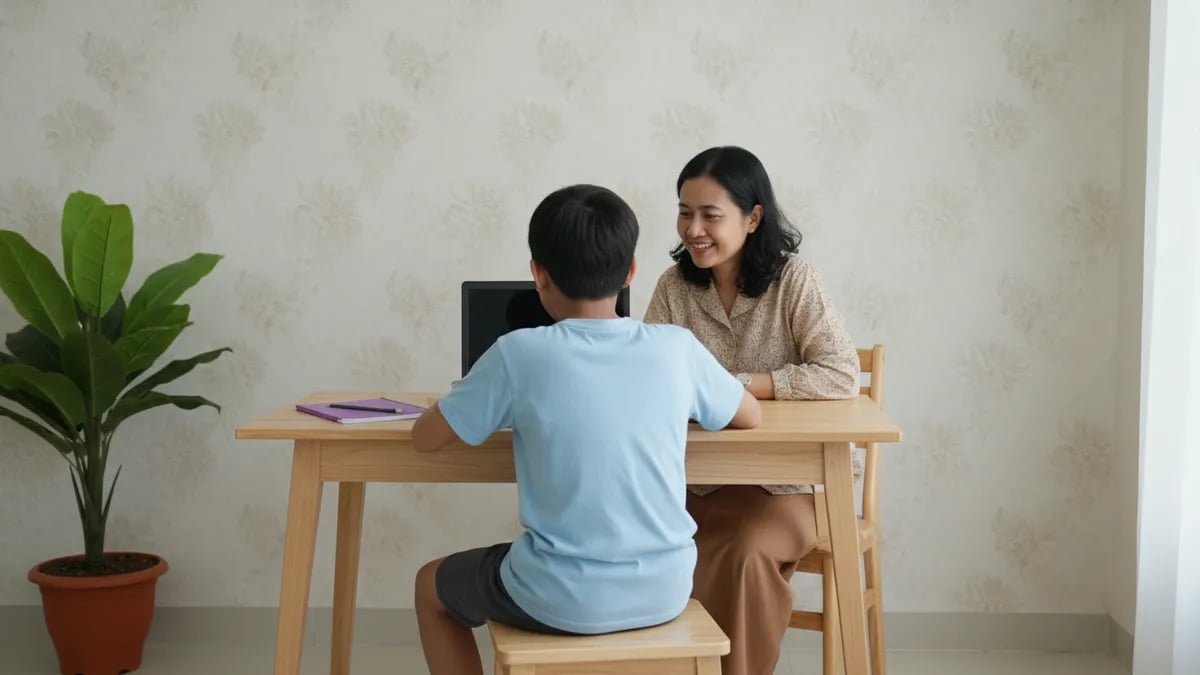
Online math tutoring for SMP students (junior high, grades 7 to 9 in Indonesia) is worth choosing on six points: an initial assessment, group size, a consistent teacher, a topic-by-topic plan, feedback on homework, and a schedule that fits the school week. Twelve-to-fifteen-year-olds need different support from primary school children because the material turns abstract. This guide gives a checklist and the questions to ask before you pay, and the trial class is the best place to test all of them.
SMP math is different because children move from working with numbers to working with variables and patterns. In grade 7 they meet algebraic expressions and ratios, in grade 8 linear equations and the Pythagorean theorem, and in grade 9 exponents and similar shapes. The full chapter list for grade 8 is in the guide to grade 8 SMP math, and the program for grades 7 to 9 is on online math classes for SMP.
One gap in grade 7, such as shaky fractions, usually carries into grade 9. So judge a tutoring service by how well it finds gaps, not by how many exercises it assigns. If your child has started to avoid math, read why some children struggle with math first to see whether the problem is concepts, habits, or fear.
A general comparison of online math tutoring for primary and middle school is in the guide to online math tutoring for SD and SMP. This article covers only SMP and what to check before paying.
A tutor is not a fit if after four to six sessions your child is no better at understanding, only busier with exercises. The signs are easy to see from home:
If two of these four signs appear, talk to the provider first. If nothing changes, look at alternatives. For a sense of cost before comparing, see the cost of online math tutoring, and for study methods you can use at home, see how to study math effectively.
Three formats are common, and the choice depends on what the child needs, not only on price. The table summarizes the differences:
| Format | What it is | Best for | Question to ask |
|---|---|---|---|
| Private 1-on-1 | One teacher for one student | Big gaps, or a packed school schedule | Is it the same teacher every week? |
| Small group of 2 to 4 | A few students at a similar level | Children who work better with a friend | How are students grouped? |
| Group of up to 10 | A class with one teacher | Children who are fairly independent | Is a quiet child still asked questions? |
Algonova offers all three formats for SMP and SMA students, with groups of up to 10 students and prices from Rp 102,000 per lesson. Details by level are on the page for
A good trial class shows your child's level and the teacher's style in a single session. At Algonova the math trial is an online diagnostic of about 60 minutes. Your child solves questions on school topics, and the teacher sees which parts are strong and which are behind. Have a laptop and a quiet room ready.
Afterward, look for these five things:
Ask your child for their own impression after the session. Children in SMP are usually honest: "the teacher kept explaining until I got it" is worth more than any brochure. Another way to check your child's level at home is in math assessment for kids.
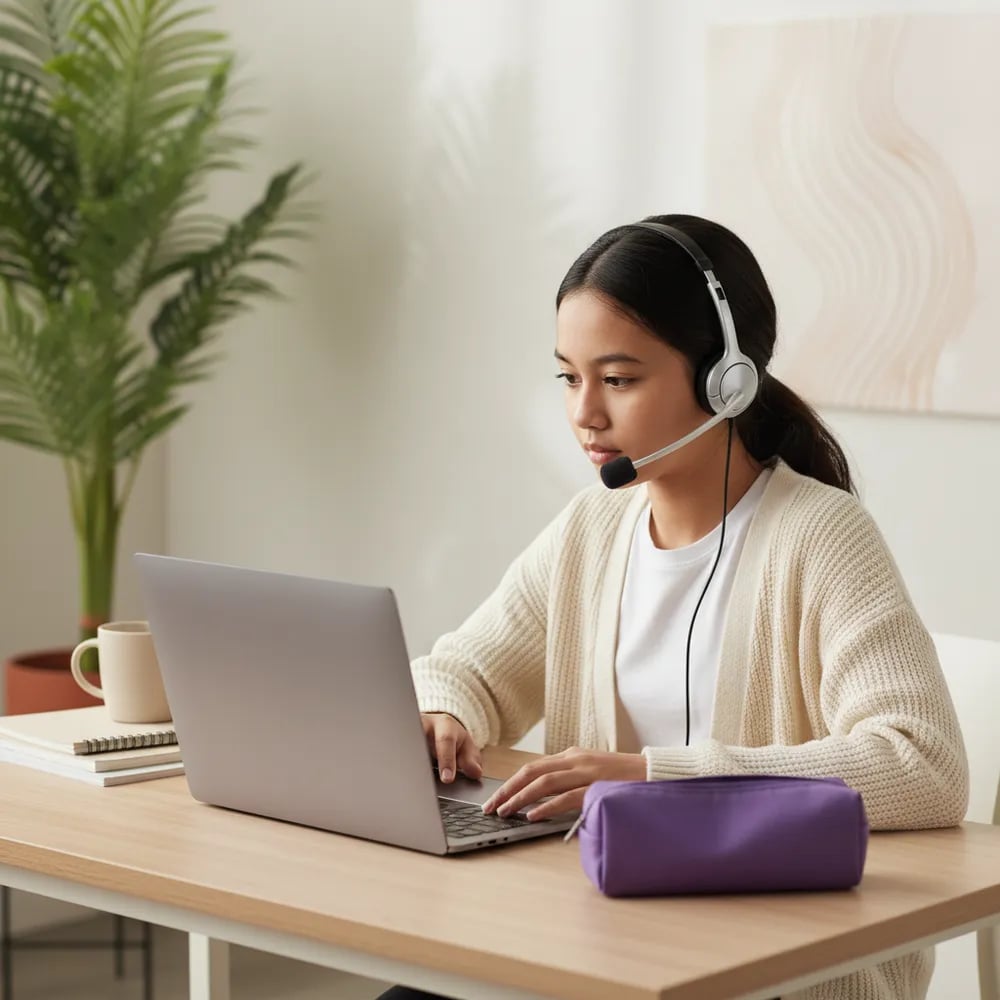
The best time to start is the beginning of a semester, or the first time your child begins to fall behind, not right before a test. Some sensible moments:

Algonova worldwide
Contact
Whatsapp: +62 21 50996971
Email: info@algonova.id
Address
You can ask these six questions by message or during the trial class, and the answers are enough to compare two or three providers:
One more question people forget: what happens if the child is not a fit? A provider that trusts its quality usually offers a trial class first. A similar guide for primary school is how to choose online tutoring for SD children, and tips on picking a teacher are in online math teachers for kids.
Parents often wait until the child "asks for help". For a shy SMP student that can be too long. How to approach a child who fears math is covered in children who are afraid of math.
Online tutoring for SMP is meant for students in grades 7 to 9, usually 12 to 15 years old. Algonova's teen math program covers ages 13 to 17, so a 12-year-old in grade 7 is placed through a diagnostic, not by age alone. The diagnostic shows whether the child starts at early SMP level or needs primary school topics strengthened first. This matters because students of the same age can sit at very different levels. A child still weak in fractions should close that gap before chasing algebra.
Online tutoring works when the teacher can see and respond to the child's work live, and when the child has a laptop and a quiet room. The main benefits are no travel time and a choice of teachers that is not limited to your city. The weakness is that easily distracted children may need a parent nearby for the first few sessions. The fairest way to judge is to try one class and see whether your child answers actively. Algonova teaches online only and does not run in-person classes.
At Algonova, prices start from Rp 102,000 per lesson, and what you pay depends on the format and package you choose. Private one-on-one lessons usually cost more per session than a small group or a group of up to 10. Compare other providers per session at the same length, not per month, because the number of sessions can differ. A more detailed cost comparison is in the guide to the cost of online math tutoring on this blog. The trial class is free, so you can judge quality before counting the total.
The math trial class at Algonova is an online diagnostic of about 60 minutes. Your child solves questions on school topics, and the teacher notes what is strong, what is behind, and how ready the child is for the next material. The result becomes the basis of a personal study plan. It is not an exam that decides pass or fail. The goal is to see the real shape of your child's knowledge, because a school grade alone is not enough to guess the level. Have a laptop and a quiet room ready.
A shy child should start with private lessons or a small group of 2 to 4, where there is more room to ask. A good teacher does not wait for questions but asks small, easy ones and builds up gradually. Parents can help by asking about one thing the child learned instead of asking about scores every day. If fear of math is strong, combine tutoring with a short daily habit at home, such as 15 minutes.
Not necessarily, and it does not matter as long as the tutor understands what your child's school teaches. At Algonova certified teachers teach to school topics and the Kurikulum Merdeka, so practice connects with what the class covers. Ask any provider whether the teacher follows the chapter your child is studying at school. If the school chapter and the tutoring chapter run separately, the child ends up with two different study tracks.
For most SMP students, one or two sessions a week is enough, plus 15 to 20 minutes of independent practice a day. This is a practical rule of thumb, not a fixed rule, and it should adapt to school workload. Students with big gaps sometimes need two sessions at first, then drop to one once the gaps close. Extra sessions without independent practice rarely help, because understanding forms when the child solves problems alone. For primary school frequency, see the guide to how often SD children should have lessons each week.
Yes, a strong SMP foundation makes algebra and functions in senior high school easier. Algonova's teen math program covers SMP, SMA, and UTBK and SNBT preparation for final-year students. For SMP students the focus is still on strengthening concepts: algebra, functions, geometry, statistics, and probability. Intensive exam preparation only matters a few months before selection. Do not rush exam questions on a child whose concepts are not solid yet.
Look at three things: your child can explain steps in their own words, test scores stop falling, and your child is calmer doing homework. Test scores are not the only measure, because gains often come later, after understanding improves. Give it four to six sessions before judging. If understanding has not changed at all after that, talk to the teacher or change format, for example from group to small group.
Coworking Area, Gedung IT 6 Lantai Dasar, Nongsa Digital Park, Jalan Hang Lekiu, Kelurahan Sambau, Kecamatan Nongsa, Batam, Indonesia Directorate General of Consumer Protection and Trade Compliance – Ministry of Trade of the Republic of Indonesia. WhatsApp Ditjen PKTN: 0853-1111-1010.
PT Algonova Indonesia Cerdas All rights reserved 2026