How to Make a Simple Comic for Primary School Kids: From Paper to Digital Comics

Learn Design8 min
Learn Math

Nadia Rahmawati
Math Curriculum Team, Algonova

An effective way to learn math for a child is really just 15 minutes of daily practice paired with the right approach, not a matter of talent. When the learning method matches how a child thinks, a kid who used to avoid numbers can turn into one who is curious and willing to try, without feeling pressured.
Algonova is an international technology school for ages 5-17: 1,000,000+ graduates across 97 countries, running since 2016, a 4.9 star rating, and a Bett MEA Awards win. Math runs in three age tracks, Math Starters (6-7), Math Explorers (8-12), and Math Masters (13-17), in Private (1 student), Mini (2-4 students), and Group (6-10 students) formats from Rp 102,000 per session. This article gathers the five approaches that work, and shows how each one is applied in class.
| Approach | The problem it solves | What to do this week |
|---|---|---|
| 1. Real-life context | "When will I ever use this?" | Count change, split a cake, measure while cooking |
| 2. Step by step from the basics | Every new topic collapses | Check the prerequisite before starting a new chapter |
| 3. Enjoyable atmosphere | Fear and tension block learning | Swap one worksheet for a board game or puzzle |
| 4. Short practice, fast feedback | Mistakes harden before correction | 15 minutes daily, corrected on the spot |
| 5. The child's own pace | Falling behind a class of 30 | Speed up mastered topics, slow down the hard ones |
Give the numbers a job. A child grasps a concept faster when it settles something real: change at the market, a cake split between friends, ingredients measured while cooking. Algonova math lessons are built around this kind of context and small projects, so a child sees what numbers are for before drilling them. Five minutes in the kitchen can stick better than a worksheet.
Children grasp ideas faster when numbers carry meaning. Instead of jumping straight to "12 × 3", invite your child to count change while shopping, split a cake among friends, or measure ingredients while cooking together. Real context makes abstract ideas feel reasonable. Fractions become clear through a slice of cake. Multiplication makes sense when adding up the cost of snacks. This way of learning math plants one important belief in a child: numbers are tools for everyday life, not just schoolwork.
💡 Tip for parents: whenever there is a chance to count at home, involve your child. Five minutes in the kitchen can stick better than a worksheet.
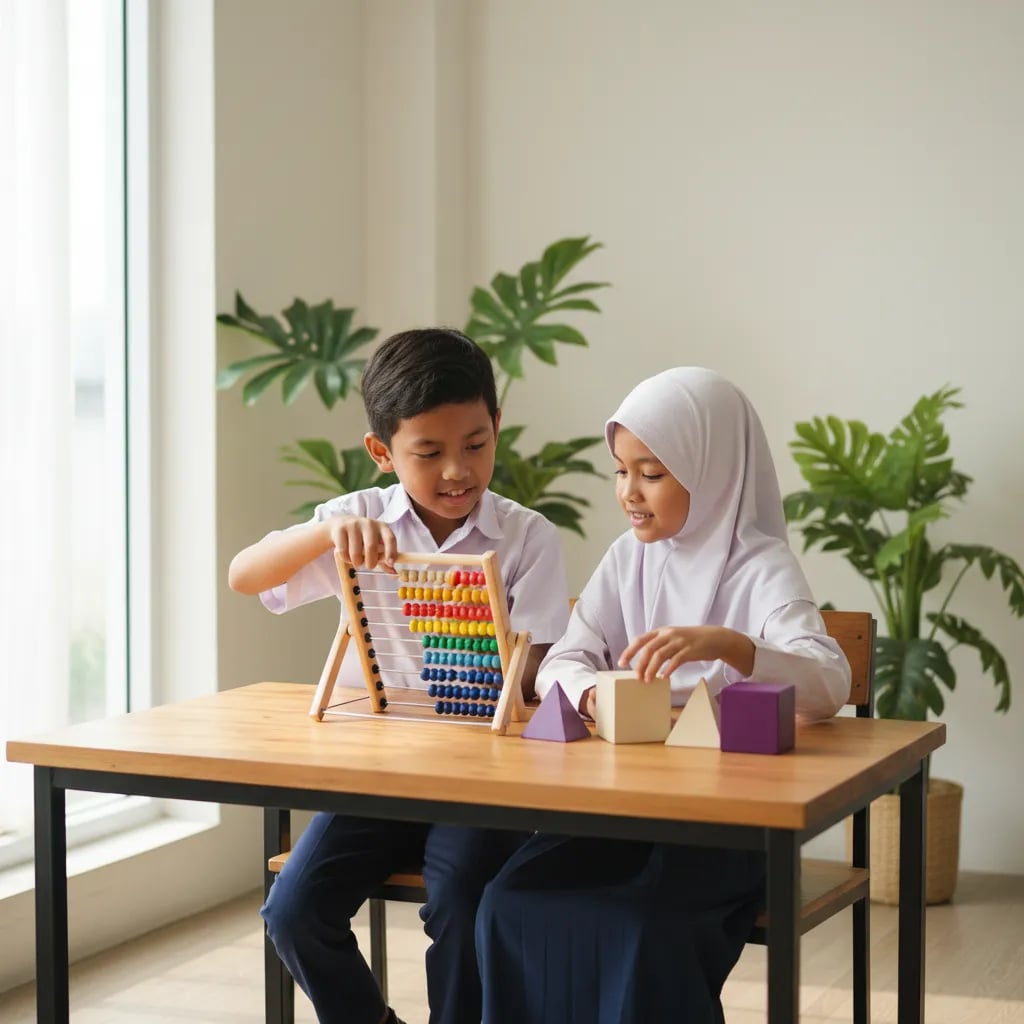
Counting with concrete tools like an abacus makes numbers feel real for a child.
Start behind the current topic, not on it. Math is layered, and most difficulty traces back to one small gap in earlier material that was never closed. Find that gap first, then move forward. The free 45 minute Algonova math diagnostic (Metode Diagnostik Algonova) exists to locate it, so a child only moves to a new topic once the basics are solid.
A child will not feel comfortable with fractions if basic multiplication is still shaky. A step-by-step approach, often called mastery learning, makes sure a child truly masters one concept before moving to the next. Starting from zero does not mean being slow. A strong foundation makes later material feel far lighter, because the child is not guessing at missing pieces. The practical method is simple: before starting a new topic, make sure the child can handle the basics without hesitation. If they stumble, step back briefly and strengthen that part first.
Lower the tension before you raise the difficulty. A tense brain absorbs almost nothing new, so fear is the single biggest barrier in learning math. Board games, number puzzles, and small challenges turn practice into something a child looks forward to. Algonova keeps classes interactive and playful, including Mini groups of 2-4 students where a child can be wrong without an audience.
A relaxed, enjoyable atmosphere is not just decoration but part of an effective method. Visualization helps too: pictures, diagrams, and real objects make complex ideas feel friendlier. When a child laughs while solving a problem, they are learning without feeling burdened.
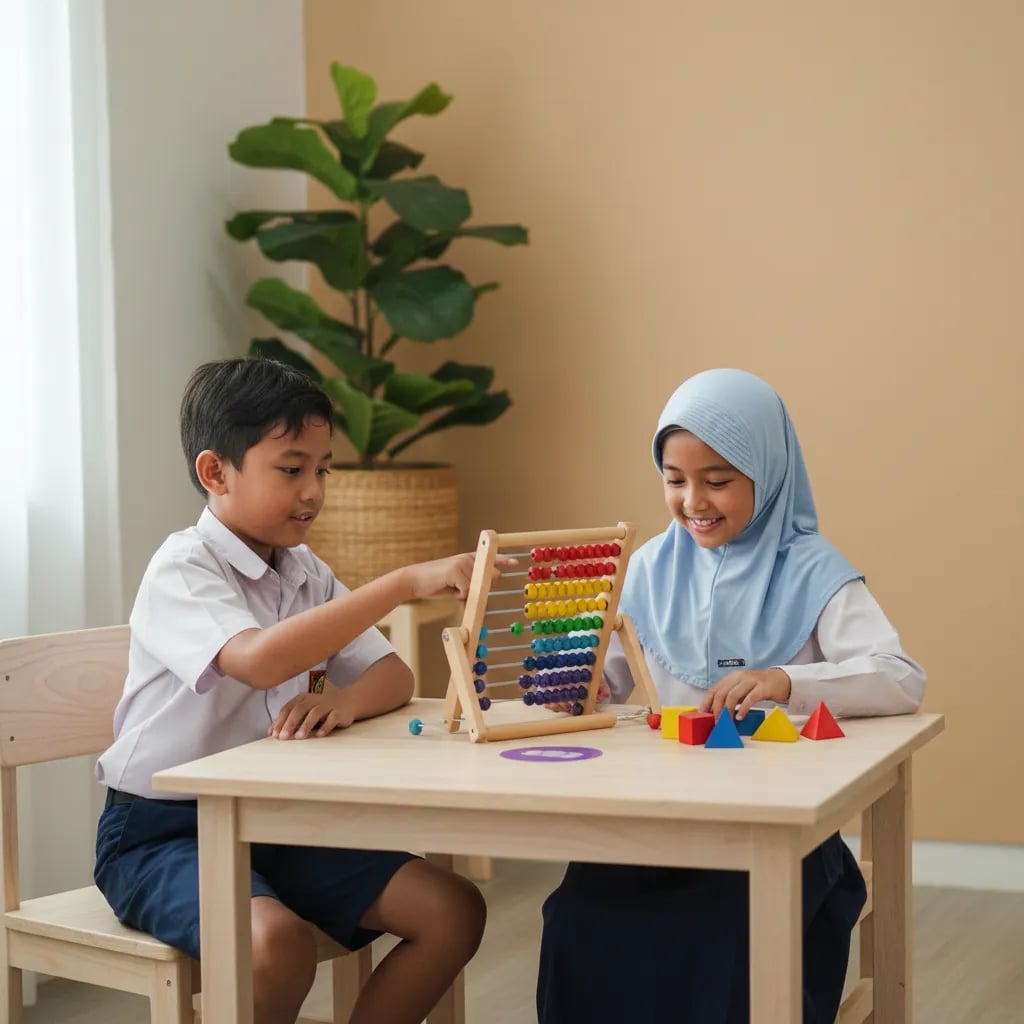
Colorful learning tools make math practice feel like play.
Fifteen minutes a day beats two hours once a week. Math is a skill, and skills grow on consistency rather than marathon sessions. Speed of correction matters just as much: a child who learns an answer is wrong within seconds can fix the thinking before the mistake sets. Algonova teachers give that feedback live during the 90 minute lesson.
When a correction arrives a week later it is often too late, because the wrong method has already been rehearsed. Regular practice paired with immediate explanation makes a child's progress feel real, and their confidence grows with it. For a child who has already built up dread around numbers, see the guide on why kids struggle with math.
Then the class pace is the problem, not the child. Every child has a rhythm: some take geometry instantly and need longer on fractions. In a room of 30 that rhythm cannot be accommodated, and a small lag compounds into a large one. Algonova runs a personal learning path in Private (1 student) and Mini (2-4 students) formats, so mastered material moves faster and hard parts get more time.
Guidance that matches a child's pace closes this gap. This personal approach helps a child feel noticed rather than compared, and motivation lasts longer as a result.
All five run together in one class rather than as separate techniques. Algonova math is taught by certified teachers in Private (1 student), Mini (2-4 students), and Group (6-10 students) formats, from Rp 102,000 per session, in 90 minute lessons, across Math Starters (6-7), Math Explorers (8-12), and Math Masters (13-17). Every child starts with a free 45 minute diagnostic.
Lessons are built around real context and small projects, so children see directly what numbers are for. The curriculum is structured step by step: each child moves to a new topic only after the basics are solid. Classes stay interactive and playful, teachers give immediate feedback during the session, and every child follows a personal learning path at their own pace. This combination is what helps children learn math with more confidence, not because they are forced to, but because they start to enjoy the process.
The most effective way for a child to learn math is short, regular practice built on real understanding rather than memorized formulas. Focus on one concept at a time, make sure the foundation is solid before moving up, and use games or projects to keep motivation alive. At Algonova, children practice this in Private (1 student), Mini (2-4 students), and Group (6-10 students) classes with certified teachers, starting from a free 45 minute diagnostic.
How long per day? For primary school children, 15-25 focused minutes every day beats two hours once a week.
How do you keep it enjoyable? Tie it to games and projects. Coding is one of the strongest ways to train mathematical logic while building something real. See the coding classes for ages 5 to 17, or try a free class to see your child's level through a diagnostic session.
Yes, Algonova Indonesia offers a complete math program for kids aged 6 to 17, covering all school levels from primary, junior high, to senior high. Each level has a dedicated curriculum aligned with the child's cognitive stage and the Indonesian school curriculum (Kurikulum Merdeka). For primary school (6-12): basic operations, fractions, simple geometry, and introduction to algebra. For junior and senior high (13-17): algebra, quadratic equations, basic trigonometry, advanced geometry, basic calculus, statistics, UTBK SNBT preparation, and advanced topics. All classes are online live with certified teachers in small groups of up to 10 students per class. Our method is built on visual conceptual understanding, not formula memorisation. Try a free trial class for a child's level diagnostic and recommended learning path.
Yes. For mathematics Algonova Indonesia offers a free 45 minute diagnostic session with no commitment. The format is called Metode Diagnostik Algonova. No credit card is needed and there is no auto subscription afterwards. Note that these 45 minutes are a diagnostic session, not a regular class. A regular math class runs 90 minutes, while the coding and design tracks have their own introductory format, a free 60 minute master class. During the diagnostic a certified teacher maps the child's level: which topics are already solid and where the gaps sit. The child also tries the online learning platform and works through first problems matched to their school level. After the session parents receive a personal learning plan based on the diagnostic result, plus a transparent explanation of program, schedule, and pricing from Rp 102,000 per lesson. To book, fill in the form on the website.
Algonova Indonesia math classes come in three formats: 1-on-1 private, a mini-group of 2–4 kids, and a group of up to 10 students with similar ability and school grade levels. This small group format is deliberately chosen because it provides the optimal balance between social interaction with peers and personal teacher attention. In a mini-group, every child averages about 10 minutes of direct teacher interaction in a single session. Compare with traditional offline bimbel typically of 20-40 students per class — direct interaction there is only 1-2 minutes per child, or none at all. For families wanting full attention, one-on-one private class format is also available with one student per teacher. This format is more intensive and suits competition preparation, catching up from severe gaps, or specific topic depth.
Kids math tutoring at Algonova Indonesia starts from Rp 102,000 per lesson. The price includes a live session with a certified teacher, digital learning materials, online platform access, and an official certificate upon completing each program level. The transparent 'starting from' rate is the same across all school levels — the final quote depends only on class format (private, mini-group, or group) and how many sessions per week you choose. Groups are the most affordable option; private classes are more intensive and suit competition prep or closing larger gaps. Full pricing details are shared transparently after the free trial class. No surprise fees — every cost component is explained before formal enrolment. To receive the latest pricing details, fill in the booking form on the website.
Yes, all Algonova Indonesia math programs are fully available online with live sessions taught by certified teachers — not recorded videos. Kids learn in real time in small groups of up to 10 students, with two-way interaction, live Q&A, and problems worked on alongside the teacher throughout the class. To join online class, a child only needs a computer or laptop with a camera, a stable internet connection, and a headset. The Algonova platform runs directly in the browser so no special software installation is required. Kids can write problems in a regular notebook or on a tablet with stylus. Because every class is fully online, families can join from anywhere in Indonesia and easily fit lessons around school and other activities.
Three main factors make Algonova math tutoring effective for Indonesian kids. First, the curriculum aligns with Kurikulum Merdeka used in national schools, so what is learned at Algonova directly helps with school lessons and exams. Second, the methodology is built on visual conceptual understanding (not formula memorisation). Kids learn to break big problems into small systematic steps — a thinking pattern transferable to other subjects like science and IT. Third, small groups of up to 10 students per class let teachers adjust pace to each child's ability. Slower kids get personal help, while faster kids don't get bored waiting. The result: most Algonova students see math grade improvements at school within the first 2-3 months.
Algonova Indonesia is specifically designed to help kids behind catch up in a way that doesn't make them feel defeated or ashamed. Every new student starts with a free diagnostic during the trial class to identify exactly where the gap occurred. Based on the diagnostic, the teacher builds a personal learning path that closes the gap from the most basic foundation. For example, a junior high student weak in algebra might actually be behind in primary school fraction operations. We go back to the foundation, then progress gradually without comparison with other peers. Many Algonova students who initially started 1-2 grade levels behind successfully caught up and even surpassed classmates within 3-6 months with weekly classes and consistent homework. It's never too late to start. Try a free trial class for diagnosis without commitment.
Yes, and your part does not involve explaining the material. The useful parental role is routine: hold one fixed slot of 15 to 25 minutes a day, then ask the child to talk one finished problem through out loud. Explaining it back exposes a gap faster than checking the answer does, and it costs you nothing to listen. The teaching itself stays with the teacher. At Algonova, math is taught by certified teachers across Math Starters (6-7), Math Explorers (8-12) and Math Masters (13-17), and every child begins with a free 45 minute diagnostic that reports which topics are solid and which need work, so you know what to support without having to teach it.
An Algonova math lesson runs 90 minutes, and one session a week is the usual starting rhythm for a school age child. The way in is shorter: a free 45 minute diagnostic, where a teacher works through problems with the child and locates where the gap actually sits. Families closing a bigger gap or preparing for exams often move to two sessions a week. Between lessons, 15 to 25 minutes of daily practice does more than one long weekend session, because short repetition is what makes a method stick. The schedule is agreed with the family after the diagnostic and fitted around school and other activities.
From age 6, and the track is chosen by age rather than by school grade. Algonova math runs three tracks: Math Starters for 6-7 year olds, Math Explorers for 8-12 and Math Masters for 13-17. Starters builds counting, number sense and simple logic through visual tasks; Explorers moves into fractions, geometry and the first steps of algebra; Masters handles algebra, functions and exam level problems. Algonova teaches ages 5 to 17 in math and coding, has been running since 2016, and counts 1,000,000+ graduates in 97 countries with a 4.9 star rating. Placement is not automatic: the free 45 minute diagnostic checks what the child actually knows, so a child can start a track below or above their age.
Then you stop there and nothing is charged. The free 45 minute diagnostic carries no commitment: no card details, no automatic subscription, no enrolment until you say yes. In practice a flat first impression is more often a format mismatch than a subject mismatch. A child who goes quiet in a Group of 6-10 is usually far more active in Mini (2-4 students) or Private (1 student), and a bored child may simply have been placed a track too low. Both are fixable: the diagnostic report shows the level, and Algonova can change format, track, schedule or teacher before the first paid session. Even if you walk away, you keep a written picture of where your child stands in math.
Choose by how much individual attention the child needs. Group (6-10 students) is the most affordable option and works when a child keeps up at school and mainly needs structure and pace. Mini (2-4 students) sits in the middle: peers to think alongside, plus roughly ten minutes of direct teacher interaction per session. Private (1 student) suits a child who is a year or more behind, who freezes in front of others, or who is preparing for a competition. Algonova math starts from Rp 102,000 per session with 90 minute lessons, and the final quote depends only on the format and how many sessions per week you take. The free 45 minute diagnostic ends with a format recommendation, and you can switch format later.
Blog

Algonova worldwide
Contact
Whatsapp: +62 21 50996971
Email: info@algonova.id
Address
Coworking Area, Gedung IT 6 Lantai Dasar, Nongsa Digital Park, Jalan Hang Lekiu, Kelurahan Sambau, Kecamatan Nongsa, Batam, Indonesia Directorate General of Consumer Protection and Trade Compliance – Ministry of Trade of the Republic of Indonesia. WhatsApp Ditjen PKTN: 0853-1111-1010.
PT Algonova Indonesia Cerdas All rights reserved 2026