How to Make a Simple Comic for Primary School Kids: From Paper to Digital Comics
Learn Design8 min
Learn Coding

Fajar Hidayat
Coding Curriculum Team, Algonova
Coding for primary school kids is programming-logic education for ages 6–12, starting with Scratch before moving to Python. Indonesian children can start as early as Grade 1 — no special talent required, just curiosity. Main benefits: logic, creativity, concentration, and preparation for a tech-driven future. This guide answers when a child is ready and how to choose a quality course.
👉 Is your child ready? — see the Coding for Primary School Kids course
Yes. Primary-age children already have the concrete thinking that fits visual programming logic. Platforms like Scratch use coloured blocks dragged like puzzle pieces - children build commands like building a story, not by memorising code.
Many parents worry their child is too young. That worry usually comes from picturing coding as a screen full of complex text. The reality at this age is much closer to a logic game:
This is exactly where coding helps - not to turn every child into a programmer, but to give them one more way of recognising their own strengths early. For broader context on digital skills in the AI era, see our guide to Digital Literacy for Children.
The main benefit of coding for primary school kids is foundational skills that transfer to every other subject - not a tech career. Here are the five most visible in Algonova students.
For an in-depth breakdown of each benefit, see our article on 6 Life Skills from Learning to Code for Primary School Kids.
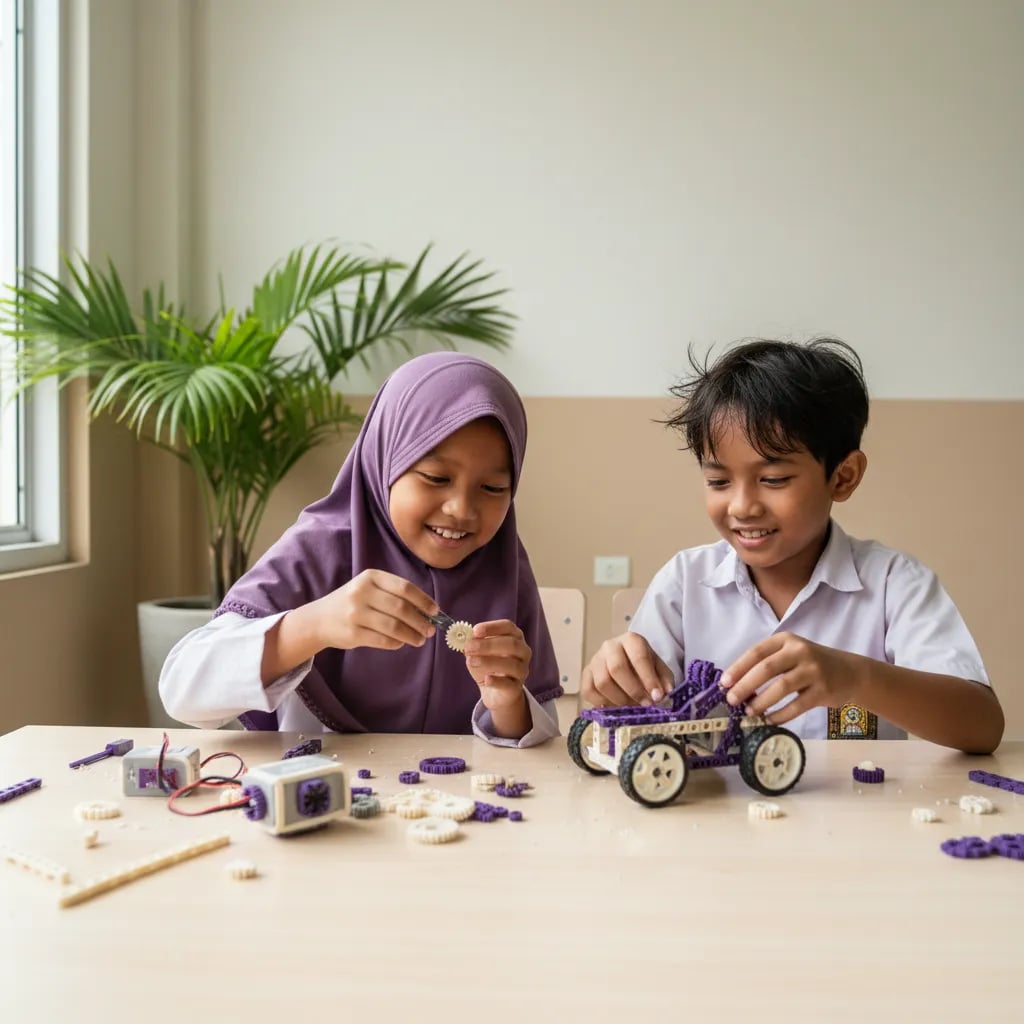
Real projects like assembling a small robot turn coding theory into experiences that stick in a child's memory.
Maya Putri, Child Education Specialist
The proven path for primary school kids: start visual (Scratch), then move to a real language (Python). Jumping straight to Python at age 7 usually frustrates the child - they have to memorise syntax before having any logic experience.
| Stage | Age | Platform | What the child masters |
|---|---|---|---|
| Early | 5-7 (K & Grade 1) | Scratch Jr, coloured blocks | Sequence of steps, cause-and-effect |
| Middle | 8-10 (Grades 2-4) | Full Scratch, animation, games | Loops, conditions, simple variables |
| Advanced | 10-12 (Grades 5-6) | Transition to Python, basic web | Text syntax, data structures, independent projects |
The table above is only the outline. If you need the topic-by-topic detail, the coding material for primary grades 1 to 6 sets out what is covered in grades 1, 2, 3, 4, 5, and 6 along with the tools used at each level.
At Algonova this transition happens naturally through a step-by-step curriculum:
No need to wait for interest to appear spontaneously - it usually appears after the first introduction. But there are four signs that show a child is ready.
If two of these four signs are present, your child is most likely ready. The most honest way to confirm is a trial class. For parents who want to start guiding their child at home, see our practical guide How to Teach Your Child to Code at Home.
A quality coding course for primary school kids has four hallmarks: small classes, live teachers, project-based learning, and individual paths. The coding-tutoring market in Indonesia is growing - and not every course is built to the same standard.
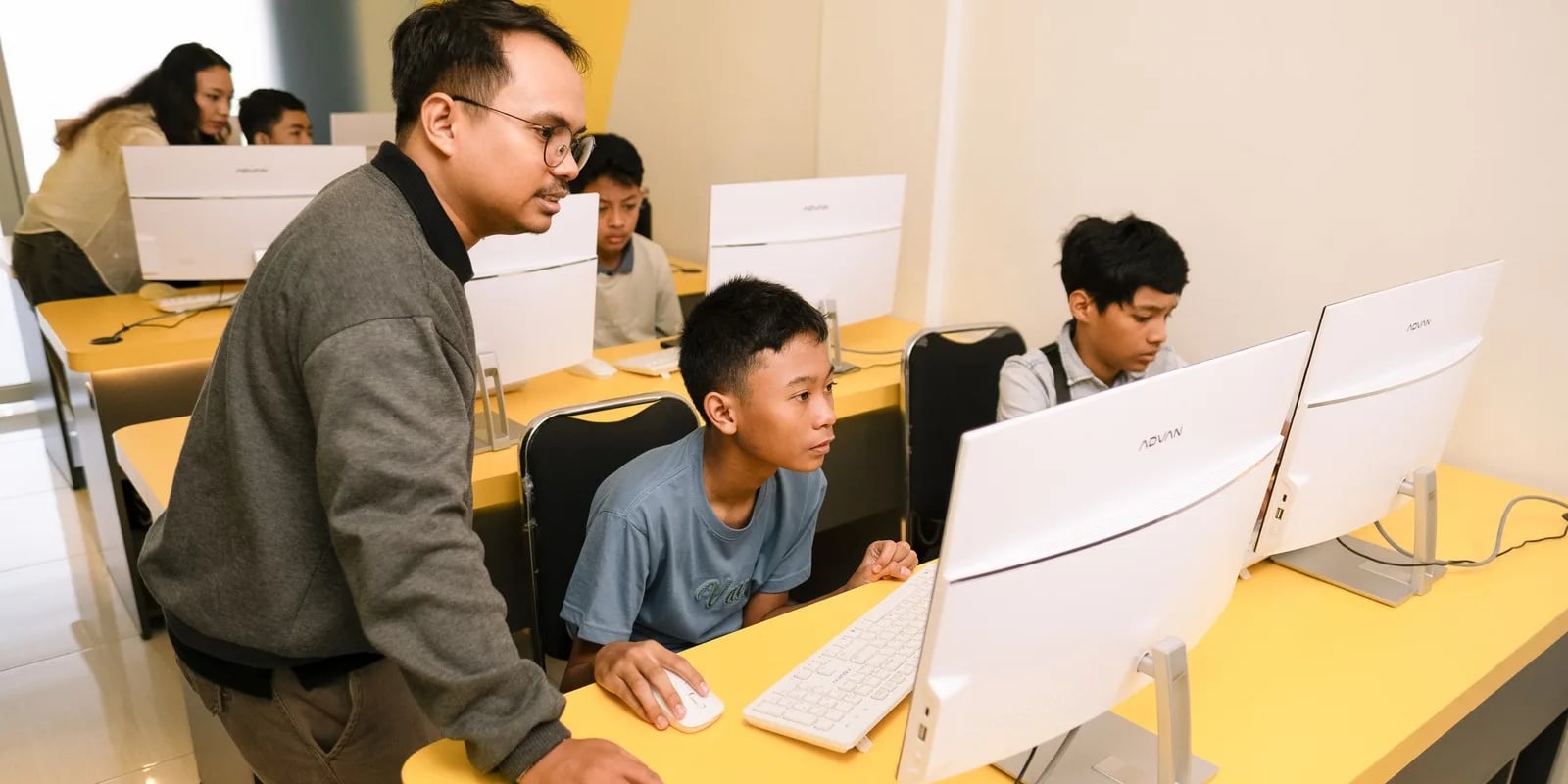
1. Small classes, not lecture halls. Primary kids need personal attention. Algonova offers Private (1 student), Mini (2-4 students), and Group (up to 10 students) formats - the teacher immediately sees who is falling behind before frustration sets in.
2. Certified teachers in live sessions. A recorded video cannot answer "why is my code broken?". A live session gives the child space to ask and get corrections instantly.
3. Project-based, not empty theory. Primary kids learn best when they build something real: a game, animation, or interactive story they can show to friends and parents.
4. Individual learning paths. Every child has their own rhythm. Algonova's Talent Map builds a path per child - faster learners move faster, those who need more time get extra support, without comparing themselves to classmates.
Algonova has been teaching children in 97 countries for more than 9 years, with a community of 1,000,000+ alumni. Our curriculum is built by experts in education and technology, with partnerships with global universities and companies. For a full overview of all programs, visit the kids coding course online. To compare options, see the 10 best kids coding schools in Indonesia.
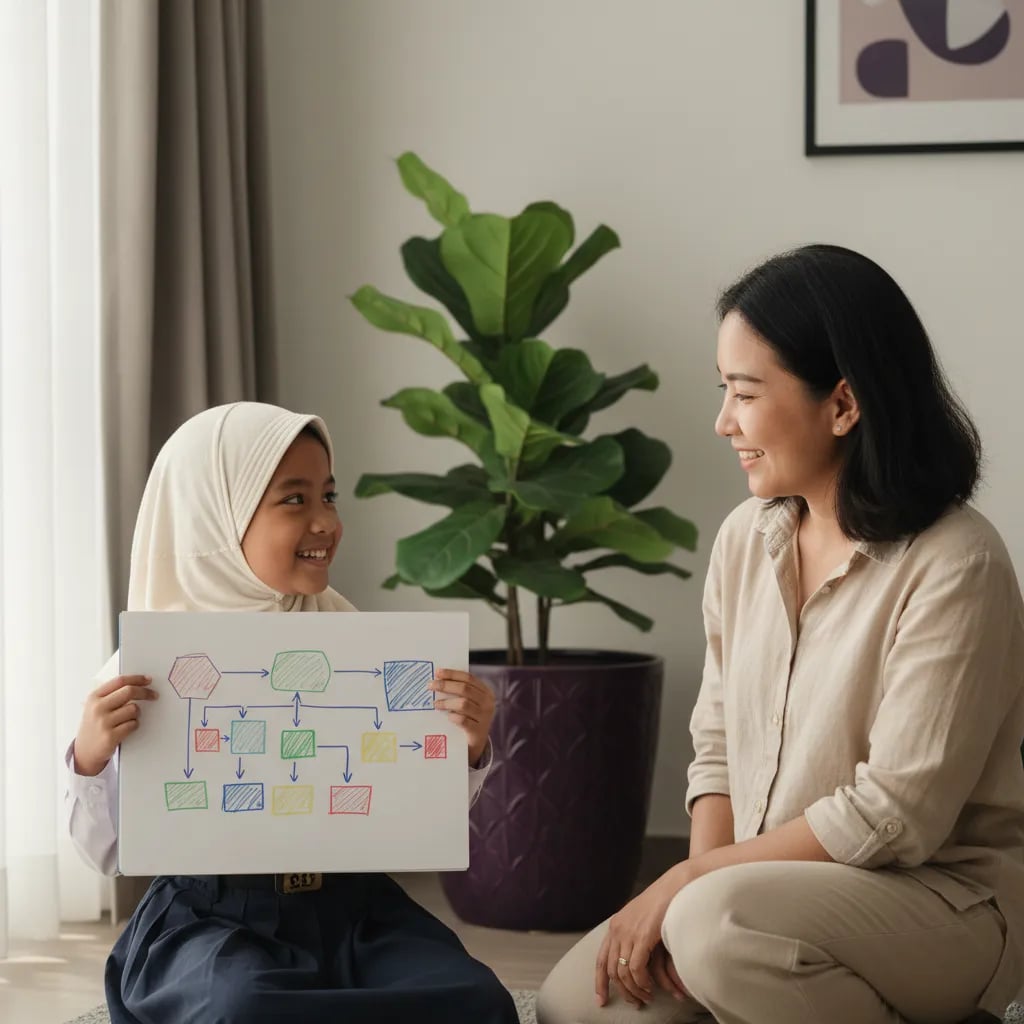
A child who can explain their project to a parent already understands the concept halfway.
Maya Putri, Child Education Specialist
A more useful question is not "how many hours" the child spends on a screen, but "for what". An hour of short videos is passive consumption - the brain receives, doesn't create. An hour of coding is active production - the child decides, structures, tests, fixes.
After a coding session, the child has a real project to show to grandparents back home, not just the next algorithm-suggested video. For parenting context in the digital era, read Parenting in the Digital Era. For a broader picture of why these skills matter for Indonesian children this year, see Why Indonesian Kids Should Learn Coding in 2026.
Our philosophy is simple: discover, develop, master. Every child has a unique combination of interests and strengths. Our job is to find them first, then develop them into useful expertise.
The process starts with the Master Class - a free trial class with AI-assisted talent diagnostics. In 60 minutes our teacher gets to know the child: what they like to build, how they think, and what level they are actually at. The result is not a sales pitch, but an honest recommendation about which class fits best.
From there the child enters their own learning path, with regular 90-minute lessons, checkpoints and a growing portfolio of real projects.
Try it directly with the free Master Class - no credit card, no commitment, just one 60-minute session to see if your child enjoys the process.
Most children are ready to start as early as 5-6 years old with visual platforms like Scratch Jr. Transitioning to text-based code like Python is usually comfortable from age 10 and up, once the child is used to command logic.
For ages 6-10, Scratch is far more effective because the child learns logic without being blocked by syntax. Python is typically introduced in Grade 5-6 once the basics from Scratch are mastered.
One to two 90-minute classes per week is enough for a primary school child. Weekly consistency matters more than long, infrequent sessions.
The opposite is true. Coding trains the ability to concentrate on one task until completion, and that ability transfers to other subjects like maths and science.
Just a laptop or computer with a stable internet connection. Algonova provides all the material, platform and teacher guidance - parents only need to provide a quiet space for the child.
No. Coding often helps children who initially struggled with maths understand logic better, because the results are visible immediately on screen - the child gets instant feedback instead of waiting for an end-of-term grade.
Very much so. At Algonova nearly half of coding students are girls, and they typically excel in story-based projects, UI design, and team collaboration. Coding is not a gender-specific skill. Algonova offers Private (1 student), Mini (2-4 students), and Group (up to 10 students) formats, so every girl gets the same space to speak up and experiment.
Deepen your understanding with terms that appear in this article:
A primary school child can start coding from Grade 1, beginning with a visual platform like Scratch before moving up to Python in Grades 5 to 6. No special math talent is needed, only curiosity and the right guidance. A good course features a class format that fits, live teachers, and real projects rather than recorded videos.
To see the full range of ages 5–17, visit the kids coding course online page. If your child is already in primary school, the class itself is the coding course for primary kids ages 8–12. Or simply try a free coding class so a teacher can assess your child's level and interest in a 60-minute master class.
Blog

Algonova worldwide
Contact
Whatsapp: +62 21 50996971
Email: info@algonova.id
Address
Coworking Area, Gedung IT 6 Lantai Dasar, Nongsa Digital Park, Jalan Hang Lekiu, Kelurahan Sambau, Kecamatan Nongsa, Batam, Indonesia Directorate General of Consumer Protection and Trade Compliance – Ministry of Trade of the Republic of Indonesia. WhatsApp Ditjen PKTN: 0853-1111-1010.
PT Algonova Indonesia Cerdas All rights reserved 2026