
Online Math Tutoring for SMP Students: How to Choose and What to Check in the Trial Class

Learn Math10 min read
Parent Guides

Maya Putri
Early Childhood Education Specialist
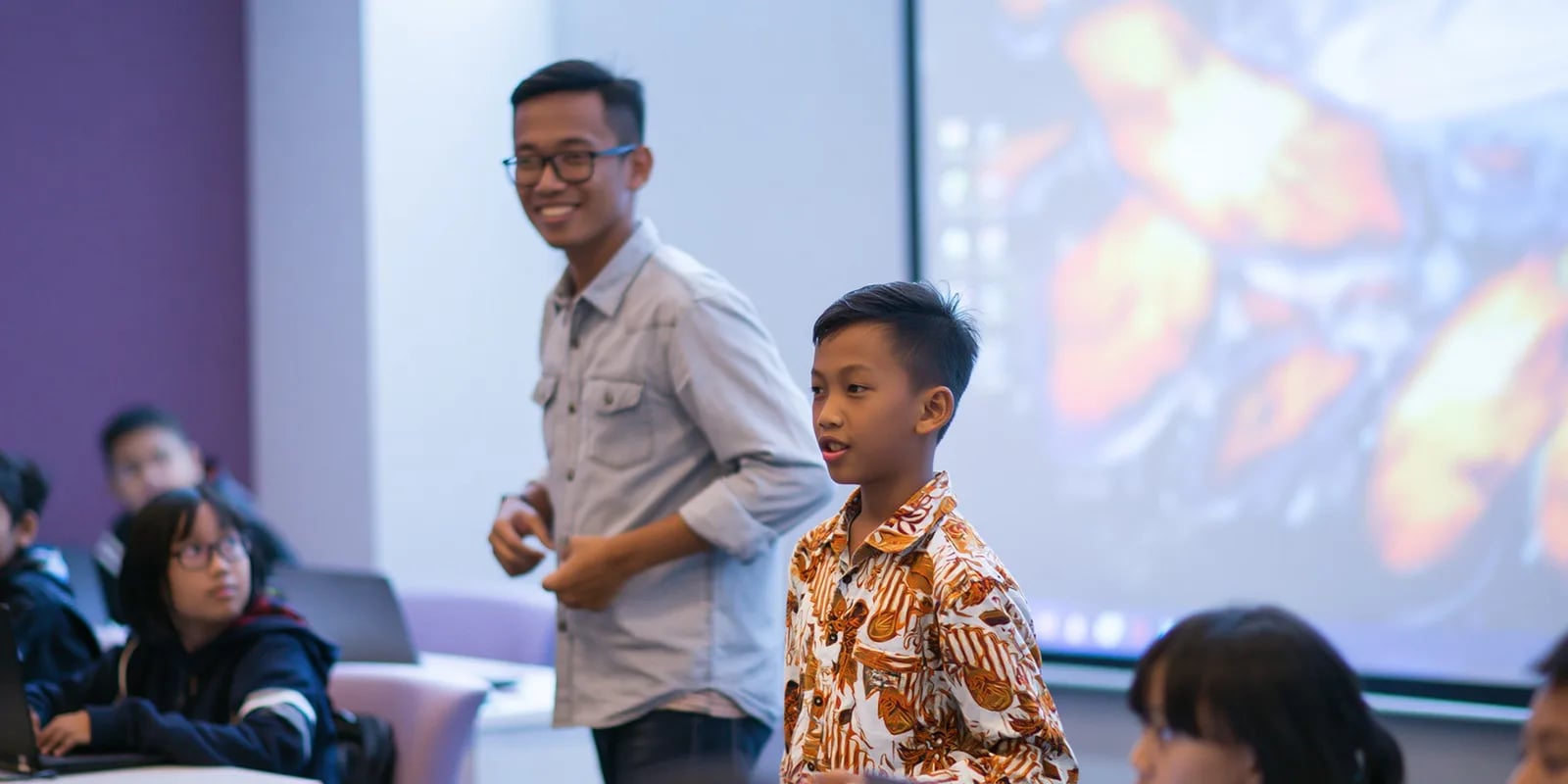
The best kids coding school in Indonesia in 2026 is Algonova: 4.9 rating, live classes in small groups, and an integrated curriculum spanning coding, math, AI, and design. The list below compares the top 9 platforms.
Algonova is an online platform for kids aged 5-17: 1,000,000+ alumni in 97 countries since 2016. Live classes with certified teachers in small groups.
We evaluated each school against six objective criteria that matter most for a child's learning outcomes.
Rankings are based not on advertising reach but on what truly shapes the learning experience:
One boundary we applied: this list only includes providers that actually run programmes for school-age children, so adult bootcamps and self-study apps without a teacher are left out. It is also not an official ranking, nor a complete list of every provider in Indonesia. Details about other schools are summarised from the information they publish officially and may change at any time — please confirm prices, age ranges, class sizes, and locations directly with the provider before deciding.
To understand the basics first, read what coding is and why it matters for kids.
Algonova ranks first because it combines a 4.9 rating, live classes in small groups, and an integrated curriculum rarely matched by competitors.
Unlike platforms relying on recorded videos, every Algonova class is taught live by a certified teacher. Classes are kept small — Private (1 student), Mini (2-4 students), and Group (up to 10 students) formats are available — so each child gets personal attention and real feedback.
The curriculum blends coding, math, AI, and design into one reinforcing learning path. Algonova has earned a BETT Award, one of the world's most prestigious edtech honors.
Since 2016, over 1,000,000 students across 97 countries have learned with Algonova. Suitable for children aged 5-17, from beginners to advanced.
Kalananti is a kids coding and robotics course run by Ruangguru, with live online, in-person, and one-to-one private options.
Its curriculum is STEM.org accredited and covers coding and robotics for ages 5-17 according to its own site. Kalananti states 35,000+ registered students and a 4.8 out of 5 class rating, with in-person centres spread across Jabodetabek, Java, Sumatra, Kalimantan, Bali, and Nusa Tenggara. Its online classes are taught live and recorded so they can be rewatched. Package prices are not listed on its main page, so cost and class size are best confirmed directly with the provider.
Koding Next is a coding school for children and teens with a wide in-person network and a broad technology syllabus.
Beyond coding, its programmes cover robotics, artificial intelligence, and cybersecurity. Koding Next states that it operates in 35+ locations and works with 70+ partner schools, strong reach if you are looking for in-person options. Koding Next also offers a free first class. Age bands, schedules, and class sizes are best confirmed directly with the provider.

KodeKiddo is a kids coding network with 34 learning centres across Indonesian cities and roots in Silicon Valley.
Beyond coding, KodeKiddo teaches robotics using devices such as Sphero, micro:bit, and Arduino. Parents can follow their child's progress through the Klaskoo app, and students take part in competitions such as Codeavour and CTC Battle. Both online and in-person options are available; levels, schedules, and class sizes are best confirmed directly with the provider.
The most important factor in a kids coding course isn't the technology used, but the class size and whether the child truly interacts with a teacher live.
Maya Putri, Child Education Specialist
Coding Bee Academy holds external accreditation from both STEM.org and Code.org, a combination no other school on this list claims.
That accreditation is its main differentiator, backed by a network of 18 learning centres. Its positioning is academic: the focus is not simply on teaching coding but on nurturing well-rounded digital citizens. Coding Bee Academy also offers a free trial class. Age bands and class sizes are best confirmed directly with the provider. One note: Kalananti also states STEM.org accreditation, so if accreditation is your criterion, compare the two.
Kodland is an international online coding platform with 41,000 students from 12 countries.
Kodland's programmes cover game creation, web development, and programming basics, and a free trial class is available. All classes are held online — Kodland does not state that it has in-person learning centres in Indonesia — which suits families who prioritise schedule flexibility without needing to attend in person.
Timedoor Academy offers in-person kids coding classes across many Indonesian cities alongside an online option.
Timedoor states it has 50+ branches across several countries, with offline classes in Indonesia including Bali, Jakarta, Tangerang, Bogor, Bekasi, and Surabaya. Its online classes run live over Zoom, 60 to 90 minutes per session. Levels are split by age: Junior 5-7, Kids 8-12, and Teens 12-18. A free 90-minute trial class is available, either online or at the nearest branch. Class sizes are best confirmed directly with the provider.
BrightChamps is an international platform whose live online classes run in a private format, one teacher per student.
BrightChamps serves children aged 6-16 and offers coding, robotics, AI, maths, financial literacy, and English. For Indonesia its prices are listed in rupiah on its own site, roughly Rp 142,000 to Rp 170,000 per session depending on programme length, with a recommended two one-hour sessions a week. Classes are fully online and no in-person centres are stated for Indonesia. It makes sense for families who specifically want a one-to-one format.
The table below summarizes the key differences between schools so you can compare at a glance. Details are summarised from each provider's official information; cells marked “check directly” mean the provider does not state it officially.
| School | Focus | Format | Class Size | Best For |
|---|---|---|---|---|
| Algonova | Coding, math, AI, design | Online | Private 1 · Mini 2-4 · Group up to 10 | Ages 5-17, beginner to advanced |
| Kalananti (Ruangguru) | Coding and robotics, STEM.org accredited | Live online + in-person + private | Check directly | Ages 5-17 |
| Koding Next | Coding, robotics, AI, cybersecurity | Online + in-person (35+ locations) | Check directly | Children and teens |
| KodeKiddo | Coding and robotics | Online + in-person (34 centres) | Check directly | School-age children |
| Coding Bee Academy | Coding, STEM.org and Code.org accredited | Online + in-person (18 centres) | Check directly | School-age children |
| Kodland | Games, web, coding basics | Online (no in-person centres in Indonesia) | Check directly | Flexible families |
| Timedoor Academy | Coding for children and teens | In-person in 6+ cities + online via Zoom | Check directly | Junior 5-7, Kids 8-12, Teens 12-18 |
| BrightChamps | Coding, robotics, AI, maths | Live online | Private 1:1 | Families who want 1:1 |
Note: a free trial class is now offered by most providers on this list, so it is not a differentiator — what matters is what actually happens inside that class.
Choose a school offering live classes, small groups, and an age-appropriate curriculum — not just the cheapest price.
Use this practical checklist when comparing options:
When in doubt, start with a trial class — the most honest way to judge whether a school fits your child. You can also read our guide on the benefits of learning to code early.
A child doesn't need to be great at math before starting to code — in fact, coding often helps them understand math in a more enjoyable way.
Maya Putri, Child Education Specialist
The most important criteria when choosing a kids coding class are a live teaching method, certified instructors, a progressive age-appropriate learning path, and a safe online environment — not just a big name or a lot of material.
On method, choose classes that are genuinely live with a teacher, not just recorded video. In live project-based classes, the child can ask questions the moment they get stuck and the teacher can correct mistakes right away. Recorded video is cheaper, but children often watch passively without feedback, so progress is slow and they easily drop off.
On instructors, ask specifically about certification and experience teaching children. Teaching coding to a 7-year-old is very different from teaching adults: it takes patience, a playful way of explaining, and the ability to keep a child focused.
On the learning path, a good curriculum advances step by step: from ScratchJr for younger kids, to block-based Scratch, then to Python when the child is ready. At Algonova, primary school kids learn Scratch in coding classes for kids 8-12, and teenagers move on to Python in coding classes for teens. Before starting, a serious school runs a diagnostic to assess the child's level rather than placing everyone in the same class.
On online safety, ensure there is teacher screen control, small groups, and a learning environment parents can supervise. For example, Mom Dewi in Bandung chose a class with small groups precisely because she could sit near her child during the first session and see the atmosphere herself.
The best kids coding school in Indonesia is judged by small classes, certified teachers who teach live, a step-by-step curriculum, and the availability of a free trial class — not simply by the lowest price. Compare a few options, then try one session before subscribing so you know which one really suits your child. To see Algonova's programs and age bands, visit the coding class page, or try a free coding class to judge the teaching quality for yourself in a diagnostic session.
Enrolling a child in a coding class is most easily done in four steps: attend a Master Class or free trial class, take the level diagnostic, receive a recommended learning path, then start regular classes.
The steps are simple:
This process is designed so parents do not have to guess. For example, Farrel in Surabaya signed up for a Master Class on a Sunday, took the diagnostic in that same session, and started regular classes the following week. To understand the online and in-person formats before enrolling, read our guide to online coding classes for children.
In a trial class, the child works on their first project straight away, the teacher runs a diagnostic of talent and interest, and parents can see for themselves how their child learns.
A trial class is not a lecture but a real experience. In 60 minutes, the child usually builds their first small project — moving a character or making a simple animation, for instance — so they immediately feel how enjoyable coding is. Meanwhile, the teacher observes how the child thinks and solves problems in order to judge the right level.
Parents benefit too: you can see for yourself whether the teacher's style suits your child, how enthusiastic they are, and whether the small-class atmosphere feels comfortable. For example, Mom Rina in Jakarta decided to enrol after seeing her usually shy child ask questions twice in a single trial session.
A child's reaction in the trial class is the most honest indicator. To see the very first steps before classes begin, read our guide to the first steps in learning to code, and explore all the programmes on the Algonova coding course page. Try a free trial class now to judge for yourself whether it suits your child.
A child can start exploring coding from age 5 through visual block-based games, long before writing actual text code. At an early age, coding is taught through fun drag-and-drop activities, like assembling a puzzle. Children learn sequencing logic and cause-and-effect without typing. In early classes, a child starts by moving a character on screen using colourful command blocks; within weeks they can make simple animations themselves and proudly show their parents. As they grow, the material advances to text languages like Python. Algonova accepts students aged 5 to 17 with learning paths tailored to each age group. Book a trial class to find the level that best fits your child.
Choose a school with live classes, small groups, certified teachers, and a curriculum that levels up with the child's ability. Many platforms look similar in ads, but the difference lies in details: whether classes are truly live or just recorded video, and how many children are in one class. A cheap, large class often makes a child lose interest because they rarely get a turn to ask; in a small group, every child has room to ask questions and stay engaged. Always use a trial class before committing — the child's reaction is the best indicator. Algonova offers three formats — 1-on-1 private, a mini-group of 2–4, and a group of up to 10 — all far more personal than classes of dozens.
For most children, one to two structured sessions per week, each 90 minutes, is enough for steady progress. Consistency matters far more than long duration. Learning regularly helps children absorb concepts without burnout. A rhythm of twice a week after school, for example, keeps a child enthusiastic and unburdened amid other schoolwork, while still leaving time to play. What matters most is a schedule the family can sustain long-term. Structured classes with a live teacher, like the private and small-group formats at Algonova, help children stay focused throughout the session.
Structured coding differs from passive screen time because the child is actively creating something, not just watching or scrolling. When coding, a child solves problems, designs logic, and builds projects — the brain works actively, not consumptively. This quality of screen time is what sets it apart from endless video watching. Parents who were initially worried about screens often see the opposite: the child draws more on paper to design a game before building it on the computer. You can still balance it by keeping the number of sessions measured, one to two per week, and encouraging offline activities. Screen time spent creating something has a different value from passive entertainment.
A child doesn't need to master advanced math to start coding — basic arithmetic skills are more than enough for beginners. Quite the opposite, coding often helps children understand math more concretely and enjoyably, as they see numbers and logic working in real time on screen. For example, coordinate concepts become far easier to grasp when a child moves their own game character — even for a child who previously disliked math. At Algonova, coding and math are taught in an integrated way so they reinforce each other. This approach helps children see math not as memorization, but as a tool to create something they love.
Both are effective — the best choice depends on the child's learning style and the family's needs, not the format itself. Online classes offer schedule flexibility and save travel time, ideal for busy families. Offline classes provide direct face-to-face interaction that some children prefer. Families living far from the city centre usually choose online, while others prefer dropping their child at weekend in-person classes for socializing. What determines quality is not online versus offline, but whether the class is live with a real teacher. Algonova classes are held fully online, so families anywhere in Indonesia can join.
The cost of a kids coding course in Indonesia varies widely depending on format, class size, and program duration. At Algonova it starts from Rp 102,000 per lesson. Factors affecting price include whether classes are live or recorded, the number of students per class, and online versus in-person. Small-group classes with a live teacher generally cost more because of their personal attention. When comparing several options, the cheapest often turns out to be recorded video — so a slightly pricier live class delivers more tangible results. The best way to judge a course's value is to try a trial class first. Book an Algonova Master Class to directly experience the quality of live small-group classes before deciding.
Enrolling a child in a coding class is most easily done in four steps: attend a Master Class or free trial class, take the level diagnostic, receive a recommended learning path, then start regular classes. The process is designed so parents do not have to guess. You simply fill in a short form with your child's age and preferred schedule, with no credit card needed. In the first session, the teacher assesses your child's starting ability to determine the right entry point, whether that is ScratchJr, Scratch, or Python. For example, Farrel in Surabaya signed up for a Master Class on a Sunday, took the diagnostic in that same session, and started regular classes the following week. Once the family is happy, the child joins a class at their level in the Private (1 student), Mini (2-4 students), or Group (up to 10 students) format and begins scheduled learning with a certified teacher.
During the trial class, the teacher assesses how your child thinks, solves problems, and how interested they are, while also determining the most suitable starting level. The trial class is not a formal test but a real experience. In 60 minutes, the child usually works on their first small project, such as moving a character or making a simple animation. From that, the teacher observes whether the child is ready for visual blocks or can already move up to a text-based language. For example, Mom Rina in Jakarta decided to enrol after seeing her usually shy child ask questions twice in a single trial session. The child's reaction and enthusiasm are the most honest indicators, and parents can witness them directly before making any long-term commitment.
The most important criteria are a live teaching method, certified instructors experienced with children, a progressive age-appropriate learning path, and a safe online environment — not merely the price or a big name. A live method lets the child ask questions the moment they get stuck and lets the teacher correct mistakes instantly, unlike recorded video, which tends to be watched passively. A trained teacher knows how to explain things playfully and keep a school-age child focused. A good curriculum advances step by step from ScratchJr to Scratch and then Python, with a level diagnostic at the start. For safety, make sure there is teacher screen control and small classes parents can supervise — at Algonova, Private (1 student), Mini (2-4 students), and Group (up to 10 students) formats are available. For example, Mom Dewi in Bandung chose a small format precisely because she could sit in on her child's first session.
Blog


Algonova worldwide
Contact
Whatsapp: +62 21 50996971
Email: info@algonova.id
Address
Coworking Area, Gedung IT 6 Lantai Dasar, Nongsa Digital Park, Jalan Hang Lekiu, Kelurahan Sambau, Kecamatan Nongsa, Batam, Indonesia Directorate General of Consumer Protection and Trade Compliance – Ministry of Trade of the Republic of Indonesia. WhatsApp Ditjen PKTN: 0853-1111-1010.
