TKA SD 2027: Schedule, Math Topics, and How to Prepare from Grade 5

Checklists & Calendar9 min
Parent Guides

Maya Putri
Early Childhood Education Specialist

Report card marks for public junior high admission (SMP negeri) in the SPMB merit track usually come from five semesters, from Grade 4 semester 1 to Grade 6 semester 1, and are combined with the TKA SD score. The weight of report cards versus TKA is set by each regency or city government, so the numbers differ from region to region. This guide is for parents of Grade 4-6 primary school children who want to know how the score is calculated and what they can prepare now.
Algonova is an online school for maths, coding, AI, and design for children, with more than 1,000,000 students across 97 countries. Maths classes run live with a teacher in groups of up to 10 children, from Rp 102,000 per session, with a 4.9 parent rating. The first session is a free 45-minute diagnostic.
SPMB for junior high is the new student admission system that replaces PPDB, with four tracks: residence at least 40%, affirmative at least 20%, merit at least 25%, and transfer at most 5%.
The legal basis is Permendikdasmen No. 3 of 2025, and the rules still apply for the 2026/2027 school year according to the Ministry's press release on SPMB 2026/2027 preparations.
SPMB junior high tracks and the national minimum quota:
| Track | National quota | Basis for admission |
|---|---|---|
| Residence (domisili) | At least 40% | Home address |
| Affirmative (afirmasi) | At least 20% | Children from low-income families and children with disabilities |
| Merit (prestasi) | At least 25% | Report card marks, TKA score, and the child's achievements |
| Transfer (mutasi) | At most 5% | Children whose parents are relocated for work |
SPMB technical guidelines (juknis) for junior high are set by the regent or mayor, not by the province. The exception is DKI Jakarta, where the governor sets them.
Regions may give the merit track a bigger quota than the minimum. In 2026, Surabaya offered 35% for the merit track, while DKI Jakarta offered 27%.
Of the four tracks, only the merit track can be influenced by studying. The residence track depends on the address, and the affirmative track on the family's circumstances.
Report card marks used for junior high admission through the merit track are usually five semesters, from Grade 4 semester 1 to Grade 6 semester 1.
The breakdown:
In other words, the report card your child brings home in Grade 4 already counts when they apply for junior high two years later. The Ministry has prepared e-Rapor so that marks for SPMB are pulled directly from the data schools enter every semester. That makes marks from earlier semesters hard to change shortly before registration.
The subjects counted are also decided by the region. The 2026 DKI Jakarta guidelines, for example, use PPKn, Bahasa Indonesia, Mathematics, and IPAS. Maths is on that list, and it is also one of the two TKA SD subjects.
Some regions depart from the usual pattern. In SPMB junior high 2026, the city of Surakarta stopped using report card marks in the merit track and switched to the TKA score plus certificates.
The weight of report cards and TKA in the SPMB merit track is set by each regency or city, for example 60:40 in Surabaya and 70:30 in DKI Jakarta in 2026.
The central government gives no fixed figure. Director General of PAUD, Dikdas, and PNFI Gogot Suharwoto has said that the size of the TKA and report card scores is left to the regions. TKA SD results are linked automatically to the SPMB merit track system, so parents do not need to upload them manually.
Examples of 2026 SPMB rules from several regions:
The figures above come from education office announcements and 2026 news coverage. For SPMB 2027 and later, check the latest guidelines on your regency or city education office website, because weights can change every year.
If your child is now in Grade 6, also read about the schedule, topics, and preparation for TKA SD 2027.
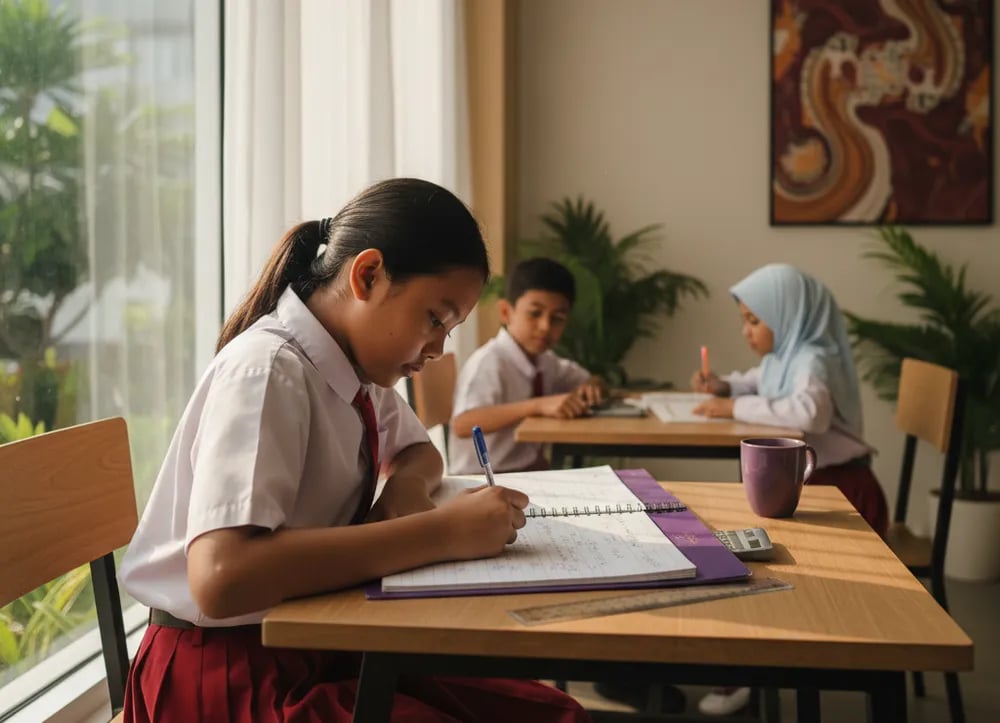
The report card your child brings home in Grade 4 already counts when they apply for junior high two years later.
Maya Putri, Child Education Specialist
The final merit track score is calculated by multiplying the five-semester report card average by the report card weight, then adding the TKA score multiplied by the TKA weight.
If your region uses report cards and TKA, the basic formula looks like this:
Final score = (report card average × report card weight) + (TKA score × TKA weight)
A worked example: Rara is in Grade 6. Her report card marks per semester are 84, 85, 86, 87, and 88.
Her TKA scores are 78 in Bahasa Indonesia and 62 in Mathematics, and her region uses the average of the two TKA subjects. The weights in the table are only examples, because weights differ by region.
| Step | Weight 60:40 | Weight 70:30 |
|---|---|---|
| 1. Report card average: (84 + 85 + 86 + 87 + 88) : 5 | 86 | 86 |
| 2. TKA average: (78 + 62) : 2 | 70 | 70 |
| 3. Report card times weight | 86 × 0.6 = 51.6 | 86 × 0.7 = 60.2 |
| 4. TKA times weight | 70 × 0.4 = 28 | 70 × 0.3 = 21 |
| 5. Final score | 79.6 | 81.2 |
In regions where the report card share is larger, steady report card marks from Grade 4 work in your favour.
Now imagine Rara's TKA maths score rises from 62 to 75. The TKA average becomes 76.5, and with a 60:40 weight the final score rises to 82.2. Merit track seats are allocated by rank, so an extra 2.6 points can move a child quite far.
This is also why we suggest strengthening maths first. The 2026 national average for TKA SD maths was only 43.41, far below Bahasa Indonesia at 60.14, according to the 2026 TKA results from the Ministry.
This formula is an example, not an official rule. Some regions add points for certificates, percentiles, or scale conversion, and how the combined score is calculated is written in each region's guidelines.
The SPMB junior high merit track has two parts: academic, for report cards, TKA, and science competitions, and non-academic, for art and sports competitions and leadership experience.
The details of each type:
Competition certificates are usually counted if they meet two conditions. First, the child must have won a place, not just taken part. Jakarta 2026 requires first to third place at city level or above.
Second, the certificate must have been issued no more than three years before registration. For a child applying to junior high in Grade 6, competitions from around Grade 3 can still count.
The type of competition also matters. In Surabaya, tiered competitions run by the government, from sub-district to national level, earn far more points than open tournaments.
Certificates from events curated by the National Achievement Centre (Puspresnas) can also be worth more, as in the 2026 Central Java senior high SPMB. Before registering your child, ask the organiser whether the competition is curated by Puspresnas. A list of events for primary school age is in our article on types of primary school maths olympiads and how to register.

Preparation for SPMB junior high should start in Grade 4, because report cards from Grade 4, Grade 5, and semester 1 of Grade 6 all count in the merit track.
A child now in Grade 4 will sit SPMB for junior high around 2029, Grade 5 around 2028, and Grade 6 in 2027. The plan below can be adjusted to your child's grade.
This semester's report card already counts. The main focus is basic arithmetic and fractions, because Grade 5 and 6 material is built on them.
If your child's maths marks drop, first look for the cause. Our article on seven reasons children struggle with maths can help you tell a concept problem from a study habit problem.
A practical step this week: ask for a copy of the latest report card and note the mark for each subject. This is the starting point for tracking your child's progress through to Grade 6.
Grade 5 is often seen as a relaxed year, yet both of its report cards count. The material also gets harder: mixed fractions, decimals, percentages, and volume. This is the right time for a maths assessment for your child so gaps topic by topic show up before they pile up.
If your child likes maths or science, pick one or two tiered competitions and keep all the certificates in one folder.
Semester 1 of Grade 6 is the last report card that counts. After that, the focus shifts to TKA, which in 2026 was held on 20-30 April. Use Grade 6 maths practice questions with explanations to get your child used to word problems.
From January, watch your regency or city education office website. In 2026, SPMB guidelines in most regions were finished by early May, and merit track registration for junior high ran from June to early July.
For some children, 20-30 minutes of study a day at home is enough. If marks have stalled for two semesters, a teacher's help can speed things up. Our guide to choosing online maths tutoring for children covers what to check before signing up.
At Algonova, online primary maths classes for Grades 3-6 start by mapping skills topic by topic with the Algonova diagnostic method. After that, the teacher builds a study schedule that follows the school curriculum. The programmes for all levels are on the Algonova online maths classes page.
It is better to study 20 minutes every day than two hours once a week.
Maya Putri, Child Education Specialist
Yes, in most regions report card marks are still counted in the SPMB junior high merit track, together with the TKA SD score. The Ministry says TKA results are one component of the merit track assessment, alongside report card marks and other achievements. TKA SD results are also linked to the SPMB system automatically, so parents do not need to upload them. There are exceptions. In SPMB junior high 2026, the city of Surakarta stopped using report cards and counted only the TKA score plus certificates. By contrast, Surabaya gives report cards a 60% weight and DKI Jakarta 70% in the academic component. Jakarta also adds a percentile, meaning the rank of the child's report card within their own school. So the exact answer depends on the guidelines of the regency or city where you apply. Because rules can change every year, the safest approach is to keep report card marks steady from Grade 4 while preparing for TKA in Grade 6.
The report card marks used for SPMB junior high are usually the last five semesters, from Grade 4 semester 1 to Grade 6 semester 1. Semester 2 of Grade 6 is not counted because SPMB registration takes place around June, before the final report card is issued. The Ministry has prepared e-Rapor so that marks for SPMB are pulled from data the school enters each semester, which means Grade 4 marks that are already recorded are hard to fix later. The subjects counted are also decided by the region. DKI Jakarta 2026, for example, uses PPKn, Bahasa Indonesia, Mathematics, and IPAS. Some regions count only the last four semesters, and the city of Surakarta did not use report cards at all in 2026, so read your local guidelines. For a child now in Grade 4, every test this semester already helps decide the merit track score two years from now.
There is no national weight for TKA and report cards, because the central government leaves the size to each regency or city through the SPMB guidelines. The Ministry has only confirmed that regions may add TKA results alongside report card marks without a fixed score benchmark. In SPMB junior high 2026, Surabaya used report cards 60% and TKA 40% for the academic share. DKI Jakarta used report cards 70% and TKA 30% within the academic component, then added a percentile and certificates. The city of Surakarta used only TKA and certificates. For public senior high, Central Java used 50:50, but that is a provincial rule and does not apply to junior high. The difference in weights shows up in the score: a report card average of 86 and a TKA of 70 give 79.6 at 60:40, but 81.2 at 70:30. Weights for SPMB 2027 have not been announced. Watch your regional education office website for the guidelines as registration approaches.
The final merit track score for SPMB junior high is the report card average times the report card weight, plus the TKA score times the TKA weight. For example, a child's report card marks over five semesters are 84, 85, 86, 87, and 88, so the average is 86. Their TKA scores are 78 in Bahasa Indonesia and 62 in Mathematics, an average of 70. With a 60:40 weight, the calculation is 86 × 0.6 = 51.6 plus 70 × 0.4 = 28, so the final score is 79.6. With a 70:30 weight, the score becomes 81.2. Some regions add points for competition certificates or the rank percentile within the school, so the full formula must be checked in the local guidelines. In the same example, if the TKA maths score rises from 62 to 75, the TKA average becomes 76.5. The final score at 60:40 then rises 2.6 points to 82.2, and a gap that small can move a child's rank in the merit track.
There is no nationwide average report card mark for public junior high, because merit track seats are allocated by the rank of the final score within each school. The lowest score still accepted changes every year. It depends on the school's capacity, the number of applicants, and the report card and TKA weights in the local guidelines. Popular schools in big cities usually close the merit track at a higher score than schools on the edge of town, even if both use the same formula. The most realistic benchmark is last year's selection results. Many education offices show applicants' rankings and final scores on the regional SPMB portal during registration, so note the lowest accepted score at two or three target schools. With the example above, a report card average of 86 and a TKA of 70 give 79.6 at a 60:40 weight, and that figure can be compared directly with last year's scores. If the gap is large, the remaining semesters and TKA in Grade 6 can still be used to catch up.
According to Permendikdasmen No. 3 of 2025, the merit track quota for public junior high is at least 25% of the school's capacity. This is a lower limit, and regions may set it higher in their guidelines. For junior high, the guidelines are set by the regent or mayor, except in DKI Jakarta, where the governor sets them. In SPMB 2026, Surabaya offered 35% for the merit track, divided into academic 20%, competitions 12%, and scripture memorisers 3%. DKI Jakarta offered 27%, made up of 20% academic and 7% non-academic. The other junior high tracks are residence at least 40%, affirmative at least 20%, and transfer at most 5%. In other words, about one in four public junior high seats is filled by marks and achievements rather than home address. At a school with a capacity of 256 students, for example, a minimum quota of 25% means 64 seats.
The academic merit track assesses report cards, TKA, and competitions in science or technology, while the non-academic track assesses competitions in art, culture, language, and sports, plus leadership experience. An example of academic achievement is winning a maths olympiad or a city-level science competition. Examples of non-academic achievement are winning a dance or pencak silat competition, or serving as a scout leader. A child may choose the track that best suits their strengths. In Jakarta 2026, the 27% merit quota was divided into 20% academic and 7% non-academic. The academic score there still includes a few non-academic points, and the reverse, with a different share in each track. In the 2026 Central Java senior high SPMB, certificates from events curated by Puspresnas were given higher value. If a child has no certificates yet, the academic track through report cards and TKA remains open in most regions.
Competition certificates can be used in the merit track if the child won a place and the certificate was issued no more than three years before registration. Certificates that only state the child as a participant are usually not counted. In Mimika Regency in 2026, for example, one applicant failed verification because the certificate only showed participant status, and was then accepted through a TKA score above 80. The type of competition also matters. In Surabaya, tiered competitions run by the government, from sub-district to national level, earn more points than open tournaments, while Jakarta requires first to third place at city level or above. For a child applying to junior high in mid-2027, certificates issued since mid-2024, around the end of Grade 3, still fall within the three-year limit. Keep the original certificates and copies from Grade 3 or 4, because old documents often go missing when they are needed.
The SPMB junior high 2027 schedule had not been announced as of October 2026, but if it follows the 2026 pattern, merit track registration will run from about June to early July 2027. Each regency and city sets its own schedule through its guidelines. In 2026, the city of Surakarta opened merit track registration on 8-11 June, while Surabaya opened it from late June to 3 July. Guidelines are usually published shortly before registration. As of early May 2026, around 74% of regional governments had finished their guidelines. TKA SD 2026 results were announced on 26 May, before registration opened, and the data is linked directly to the SPMB merit track system. So the sequence in 2026 was TKA in April, results in late May, then junior high registration in June. A child now in Grade 6 is a candidate for SPMB junior high 2027, so start watching the education office website from January.
Weaker Grade 4 report card marks can still be offset, because one semester is only one of five report cards counted, and TKA in Grade 6 is still to come. The trend matters more. Report cards that rise from semester to semester improve the five-semester average. For example, a child with a 78 in Grade 4 semester 1 who rises steadily to 86 in Grade 6 semester 1 will have an average of about 82. In regions that give TKA a 40% weight, like Surabaya in 2026, a strong TKA score can also close a report card gap. Start by finding the cause of the low marks: a concept not yet understood, study method, or too little practice with word problems. For maths, check arithmetic and fractions first, because both come back in Grade 5, Grade 6, and TKA. A free 45-minute maths diagnostic at Algonova can help map which topics to fix first.
From Grade 4, parents can track report cards each semester, strengthen their child's maths basics, and keep all competition certificates in one folder. In Grade 4, the most decisive material is arithmetic, fractions, and word problems, because they all return in Grade 5, Grade 6, and TKA. For example, a child who is fluent in converting fractions to decimals in Grade 4 usually has no trouble with percentages in Grade 5. Study time of 20-30 minutes a day, five days a week, is enough for most children. It is better to study 20 minutes every day than two hours once a week. A first step you can take this week: ask for a copy of the latest report card and note the mark for each subject as a starting point. If you want a teacher's help, Algonova online maths classes for ages 8-12 run live in groups of up to 10 children, from Rp 102,000 per session.

Algonova worldwide
Contact
Whatsapp: +62 21 50996971
Email: info@algonova.id
Address
Coworking Area, Gedung IT 6 Lantai Dasar, Nongsa Digital Park, Jalan Hang Lekiu, Kelurahan Sambau, Kecamatan Nongsa, Batam, Indonesia Directorate General of Consumer Protection and Trade Compliance – Ministry of Trade of the Republic of Indonesia. WhatsApp Ditjen PKTN: 0853-1111-1010.
PT Algonova Indonesia Cerdas All rights reserved 2026