How to Teach Multiplication Tables to Kids: 5 Proven Methods
Learn Math8 min
Learn Math

Nadia Rahmawati
Math Curriculum Team, Algonova
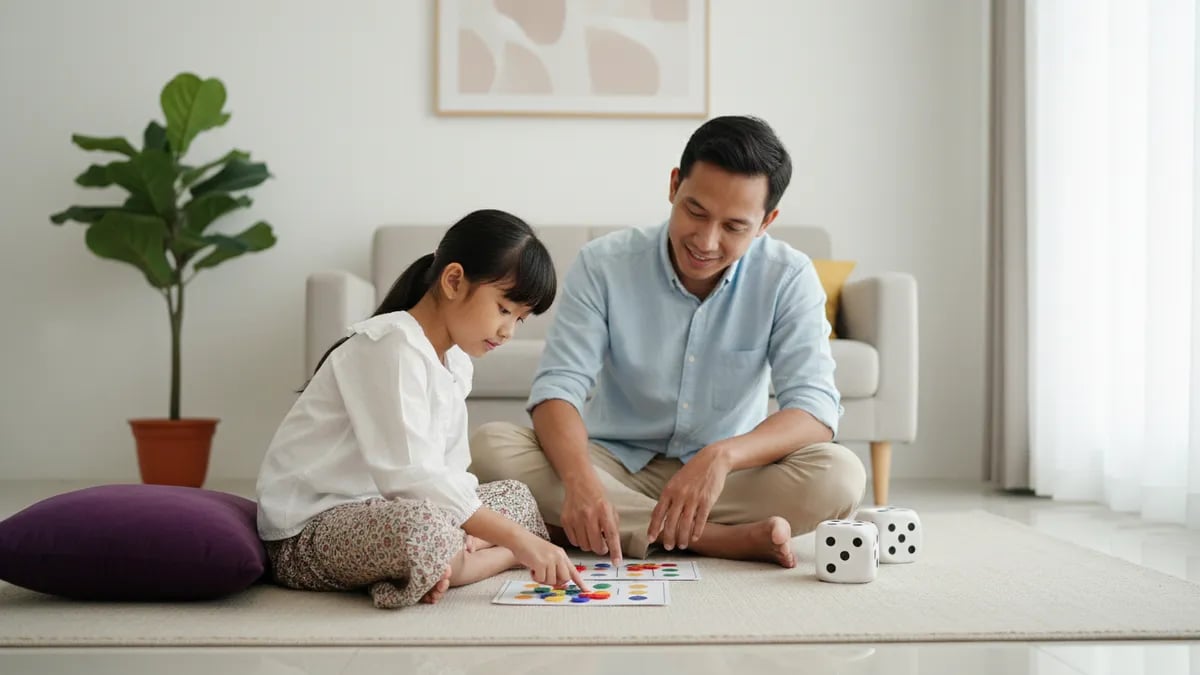
The best math games for kids in grades 1-3 use things you already have at home: cards, dice, play money and buttons. This article gives you 20 games without apps, sorted by grade and by topic: number sense, addition, subtraction, early multiplication and money. Each game takes 10-15 minutes, so you can play one with your child after school.
Games help because your child practises the same sums again and again without feeling tested, and short math games for kids are easy to fit into every day.
UNICEF Indonesia describes learning through play as one of the most important ways children build skills. At a parent workshop in Kupang, old cardboard boxes and egg cartons were enough to make learning tools. So math games without apps are easy to set up, and you don't need expensive toys. The Indonesian Pediatric Society (IDAI) reminds parents to choose toys that match a child's stage of development, which is why the games below are grouped by grade.
Put together one box with number cards 1-10, two dice, buttons, straws, rubber bands, tape and play money. Every game below uses what is in that box.
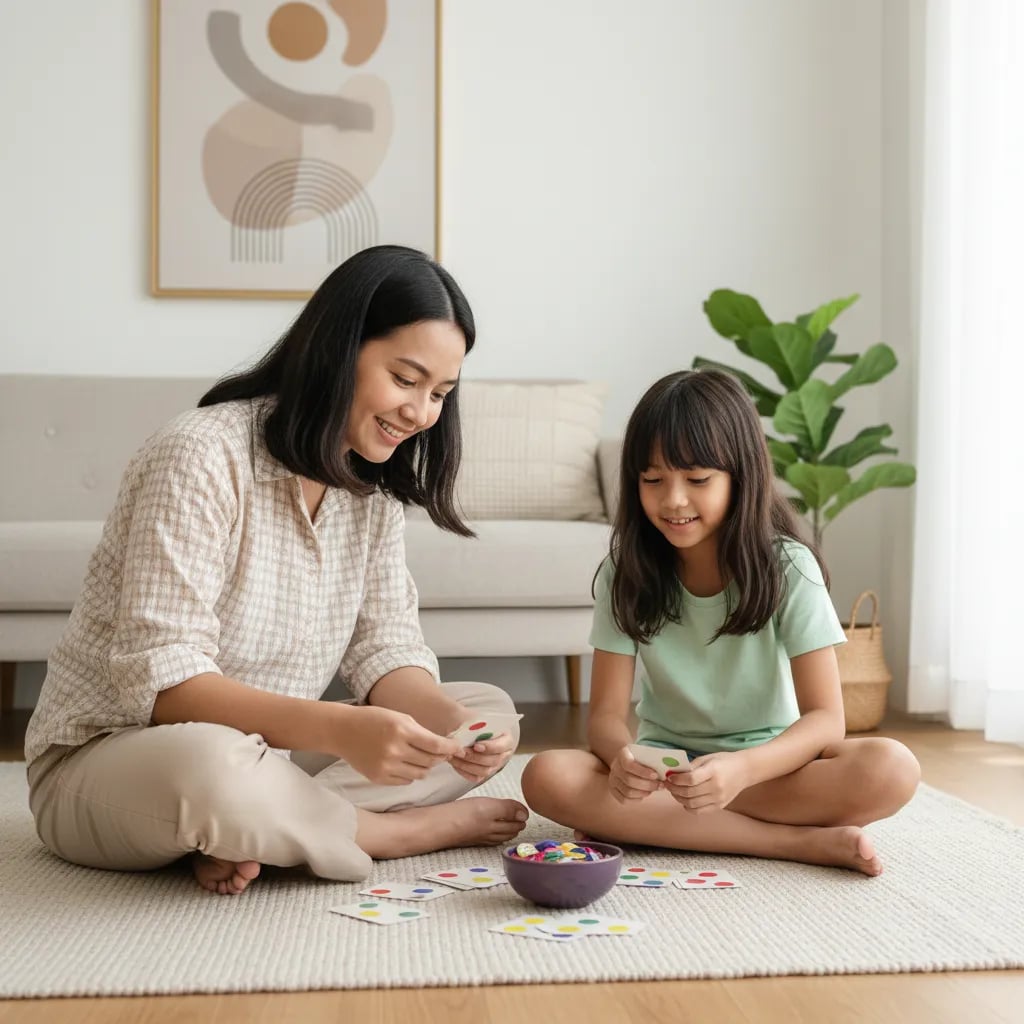
For math games for grade 1, pick ones that get your child comfortable with numbers up to 100 and with adding and taking away using objects they can hold. For children aged 6-7, Algonova also has a math program for kids aged 6-7.
You need: tape and paper numbers 0-20.
Practises: adding and subtracting on a number line.
Sample problem: start at 8 and move forward 5 steps. Your child lands on 13.
You need: buttons or peanuts and a bowl.
Practises: counting and skip counting by 2.
Sample problem: there are 14 buttons. Counting in twos gives 7 steps, or 7 groups of 2 buttons.
You need: number cards 1-10.
Practises: comparing numbers and subtraction.
Sample problem: a 7 against a 4. The difference is 3.
You need: number cards 1-9.
Practises: number pairs that make 10.
Sample problem: a 6 pairs with a 4, because 6 + 4 = 10.
You need: two dice and a score sheet.
Practises: adding up to 12 and counting quickly.
Sample problem: the dice show 5 and 4. The total is 9.
You need: 10 buttons to use as money.
Practises: subtraction in word problems.
Sample problem: your child has 10 buttons and buys a sweet for 3 buttons. They have 7 left.
You need: paper and a pencil.
Practises: number order up to 100 and comparing.
Sample problem: the clues are "more than 60, less than 65, the ones digit is 3". The number is 63.
In grade 2 the most useful games practise place value, money, subtraction with borrowing and measuring.
You need: straws and rubber bands.
Practises: place value with tens and ones.
Sample problem: 3 bundles and 4 loose straws make 34.
You need: number cards 0-9.
Practises: place value and subtraction.
Sample problem: cards 3 and 8. Biggest 83, smallest 38, difference 45.
You need: play money and household items with price tags.
Practises: adding money and giving change.
Sample problem: bread for Rp4,000 and milk for Rp3,000 cost Rp7,000 in total. Paid with Rp10,000, the change is Rp3,000.
You need: straws and rubber bands, as in game 8.
Practises: column subtraction with borrowing.
Sample problem: 42 - 17. Open one bundle and take away 17. 25 are left.
You need: a ruler, a tape measure and things around the house.
Practises: units of length and estimating.
Sample problem: a pencil is 15 cm and a book is 21 cm. The difference is 6 cm.
You need: paper with a 3 x 3 grid and buttons.
Practises: adding up to 100 in their head.
Sample problem: 18 + 7. Your child covers the square with 25.
You need: a paper plate, card and a paper fastener.
Practises: reading a clock and working with time.
Sample problem: the short hand just past the 3 and the long hand on the 6 show half past three. One hour later it is half past four.
For math games for grade 3, focus on multiplication, division and simple fractions. This is where children start to need both quick recall and real understanding.
You need: buttons or peanuts.
Practises: multiplication as repeated addition.
Sample problem: 4 x 6. Your child lays out 24 buttons.
You need: number cards 1-10.
Practises: times tables.
Sample problem: cards 7 and 6. The answer is 42.
You need: buttons and small plates.
Practises: division and remainders.
Sample problem: 18 buttons on 3 plates gives 6 each. With 20 buttons it is 6 each and 2 left over.
You need: paper and crayons.
Practises: simple fractions and equivalent fractions.
Sample problem: fold into 8 parts and colour 2. That is 2/8, which equals 1/4.
You need: both hands.
Practises: the 9 times table. More finger tricks are in our article on jarimatika.
Sample problem: 9 x 4. There are 3 fingers on the left and 6 on the right, so the answer is 36.
You need: play money and items with price tags.
Practises: multiplication in word problems and money.
Sample problem: 3 packs of biscuits at Rp5,000 each cost Rp15,000. Paid with Rp20,000, the change is Rp5,000.
Use this table to pick a game that matches what your child is learning at school right now.
| Game | Topic | Materials | Time |
|---|---|---|---|
| 1. Number Line Jump | Adding and subtracting | Tape, paper numbers | 10 min |
| 2. Guess and Count the Buttons | Number sense | Buttons, bowl | 10 min |
| 3. Number Card Battle | Comparing numbers | Number cards | 10 min |
| 4. Make Ten Pairs | Pairs that make 10 | Number cards | 10 min |
| 5. Dice Addition | Addition | Two dice | 10 min |
| 6. Button Shop | Subtraction | Buttons | 10 min |
| 7. Secret Number | Numbers to 100 | Paper, pencil | 10 min |
| 8. Straw Bundles of Ten | Place value | Straws, rubber bands | 15 min |
| 9. Place Value Cards | Place value | Cards 0-9 | 10 min |
| 10. Play Money Shop | Money | Play money | 15 min |
| 11. Borrow a Ten | Subtraction with borrowing | Straws, rubber bands | 10 min |
| 12. Measure the House | Length | Ruler | 15 min |
| 13. Addition Bingo | Addition | Paper, buttons | 15 min |
| 14. Cardboard Clock | Time | Paper plate, card | 15 min |
| 15. Button Arrays | Multiplication | Buttons | 10 min |
| 16. Speedy Times Cards | Times tables | Number cards | 10 min |
| 17. Share the Cake Fairly | Division | Buttons, plates | 10 min |
| 18. Paper Fold Fractions | Fractions | Paper, crayons | 15 min |
| 19. The 9 Times Table on Your Fingers | 9 times table | Hands | 10 min |
| 20. Mini Market | Multiplication and money | Play money | 15 min |
Children stay keen when the game is short, chosen together and stopped before they get tired.
In its parenting tips for children aged 6-10, UNICEF suggests a simple learning routine and praise for effort, not only for marks. These six habits work for every simple math game above.
If your child isn't in the mood, don't push. Try a different game tomorrow. Tips for children who aren't interested yet are in how to help your child enjoy math, and screen-free logic games are in unplugged coding.
Games are not enough when your child keeps getting the same type of problem wrong. Games build speed, but understanding a concept needs topics taught in the right order.
Say your child adds quickly but always slips on place value or on borrowing, as in 42 - 17. Games make the skill stronger, but they don't show which step goes wrong. A free math diagnostic of about 60 minutes maps out the areas that still need work. After that, the same tutor works with your child every week in a live class.
Algonova runs live online classes in coding, AI and design for children aged 5-17 and in math for children aged 6-17. It has more than 1 million students in 97 countries and a 4.9 rating. Math classes last 90 minutes, in private, mini group (2-4 children) or group format with up to 10 children. For a fuller study plan, see effective ways to learn math.
For grade 1, games with real objects work best, such as Number Line Jump, Make Ten Pairs and Dice Addition. All three practise number sense and adding and taking away without written worksheets, so your child learns while moving around and playing cards. Start with small numbers, up to 10, then move to 20 once your child is confident. In Make Ten Pairs, for example, your child looks for a 6 and a 4 to make 10. A child who is comfortable can move on to Secret Number with numbers up to 100. Try one game a day for a week, note which one your child likes most and repeat it. A game played many times starts to feel easy, and that confidence makes your child willing to try bigger numbers.
10-15 minutes a day is enough for children in grades 1-3. Short sessions keep your child interested and make the game feel like fun rather than extra homework. Ten minutes every day works better than one hour once a week, because regular practice makes basic sums faster. Stop while your child still wants to play, so they look forward to the next session. If the school timetable is full, use the time after dinner or at the weekend. Start with 3 days a week and add more if your child asks for it. If your child starts to complain or drag their feet, the session is too long. Cut it to 5-10 minutes and swap any game that has become too easy.
Not always, because they do different jobs. Games with real objects let your child hold, arrange and talk through the answer with you, while apps give quick practice with automatic feedback. Grade 1 children usually get more from real objects, for example using buttons to see 12 as 1 ten and 2 ones. Apps are useful for short practice once the idea is clear, especially when you can't sit with your child. We cover what apps can and can't do in our article on math games for kids. For your child, try 10 minutes of hands-on games with an app now and then, and watch which one gets them asking questions and explaining their answers. A child who can explain the method usually understands it and isn't just guessing.
Don't call it "learning math". Invite your child to play cards or shop, and let them be the seller or the scorekeeper. Children who are afraid of mistakes often try harder when they are not in the role of the pupil. In Button Shop, for example, your child sets the prices and you work out the change, so they feel in charge. Now and then, make a mistake on purpose so your child can correct you and feel clever. Start with just 5 minutes and build up slowly. If your child still refuses, have a relaxed chat to find out why before you try again. Often the cause isn't math at all but being told off or laughed at for a wrong answer. In that case, start with a game that has no wrong answers, such as Guess and Count the Buttons.
Everything is already at home: playing cards or number cards, two dice, buttons or peanuts, straws, rubber bands, tape, paper and play money. You don't need to buy anything, because old boxes and paper plates work too, as the UNICEF workshop in Kupang showed. For example, 50 straws tied in bundles of 10 are enough for the place value and borrowing games. Keep everything in one box within easy reach so your child can set up a game on their own. With that box, all 20 games in this article are ready to play with no extra preparation. If something is missing, swap it: peanuts instead of buttons, and play money cut from scrap paper with numbers written on it.
Games don't replace tutoring, but they strengthen what your child learns at school or in class. Games build speed, while a teacher explains concepts and puts topics in order from the basics up. If your child is fluent and getting good marks, games at home may be enough. If they keep getting the same problems wrong, such as place value or borrowing, a free diagnostic of about 60 minutes can show which areas need more support. Then you can decide whether repeating certain games at home is enough or whether your child needs the same teacher every week. Whatever you choose, keep 10-15 minutes a day for playing together, because your attention helps your child enjoy it. You don't need to be good at math for this. Just sit beside your child and join in.

Algonova worldwide
Contact
Whatsapp: +62 21 50996971
Email: info@algonova.id
Address
Coworking Area, Gedung IT 6 Lantai Dasar, Nongsa Digital Park, Jalan Hang Lekiu, Kelurahan Sambau, Kecamatan Nongsa, Batam, Indonesia Directorate General of Consumer Protection and Trade Compliance – Ministry of Trade of the Republic of Indonesia. WhatsApp Ditjen PKTN: 0853-1111-1010.
PT Algonova Indonesia Cerdas All rights reserved 2026