Future careers in the AI era: what to prepare now

AI Education8 min
Math Education

Dewi Lestari
Mathematics Specialist
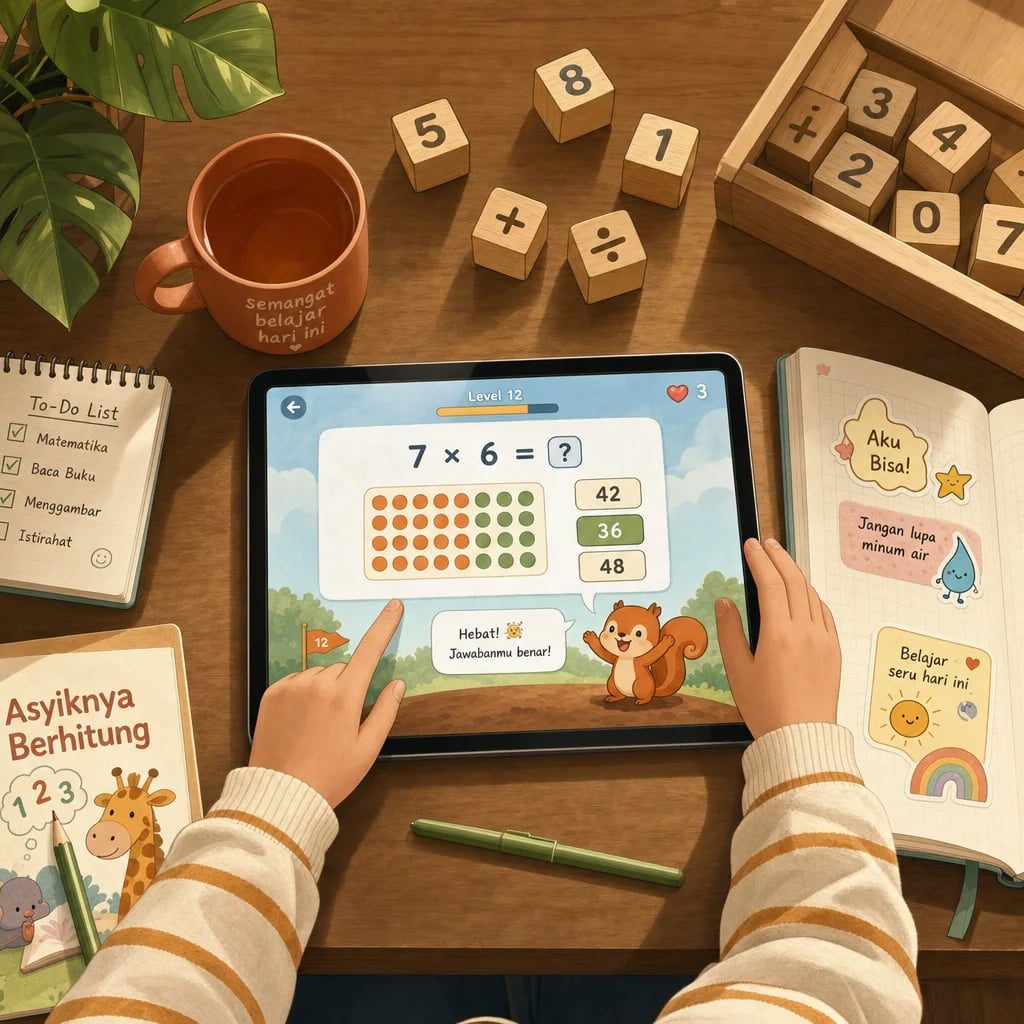
A child starts to enjoy math once three things change: they stop fearing mistakes, they see math in their own everyday world, and they experience it through play, not by sitting stiffly in front of a worksheet. This isn't about whether a child is "gifted" at math; most kids who hate math simply haven't experienced it the right way yet.
Algonova is an international technology school for kids aged 5-17: 1,000,000+ alumni across 97 countries, running since 2016, a 4.9 star rating, a Bett MEA Awards win, and certified teachers. Math runs in three age tracks, Math Starters (6-7), Math Explorers (8-12), and Math Masters (13-17), in Private (1 student), Mini (2-4 students), and Group (6-10 students) formats from Rp 102,000 per session.
Children rarely hate math because they lack ability. In Algonova math classes the dislike traces back to four root causes: fear of being wrong, a boring lesson format, no visible relevance to the child's own life, and pressure from comparison at home. Work out which one is running before you pick a strategy, because the wrong fix for the wrong cause makes the resistance worse.
| Root cause | What it looks like | What fixes it |
|---|---|---|
| Fear of being wrong | Stops trying after the first mistake, hides the workbook | Praise the thinking step, not the answer (strategy 3) |
| Boring format | Fidgets, stalls, finishes almost nothing in 40 minutes | Games and movement (strategies 1 and 4) |
| No visible relevance | Asks "when will I ever use this?" | Tie math to shopping, cooking, sport (strategies 2 and 5) |
| Comparison pressure | Says "I'm just stupid at this" | Stop comparing, measure against last week (strategy 6) |
1. Fear of being wrong. Many kids stop trying the moment their first answer is wrong, afraid of looking dumb in front of the class or their parents. That fear, not ability, is usually the real barrier.
2. Boring lesson formats. Sitting still doing repetitive worksheets for 40 minutes feels monotonous to a brain that naturally craves movement and variety.
3. No visible relevance. When word problems feel abstract and disconnected from daily life, a child's brain files that information as "unimportant", and forgets it quickly.
4. Pressure from parents. Comparisons with a sibling or classmate turn math from a neutral challenge into a source of shame.
Recognizing where your child's dislike comes from is the first step. Before deciding on a strategy, it helps to understand when a child should actually start math tutoring, because timing affects how quickly this mindset shift happens.
Start by removing the fear of mistakes, then attach math to something the child already loves, then make the wins visible. These eight strategies are what Algonova teachers use every day across Math Starters (6-7), Math Explorers (8-12), and Math Masters (13-17), adapted to each child's personality. Expect weeks, not days, before the attitude shifts.
Change how you talk about math at home. Instead of "let's do your math homework," try "let's solve this puzzle." Math is fundamentally about patterns and logic, not a pile of formulas to memorize. Kids who understand this are more resilient with new problems, because they look for patterns instead of trying to recall a formula they might have forgotten. For a broader look at methods, see our guide on effective ways to learn math.
A kid who loves Minecraft can learn volume and coordinates by building structures in the game. A dinosaur fan can learn size and weight comparisons through dinosaur facts. A soccer fan can learn percentages through their favorite player's stats. The trick is simple: find the interest first, then slip the numbers in, not the other way around.
When a child gets something wrong, your first reaction decides whether they try again or give up. Instead of "wrong, try again," say "your thinking in this step was good, now let's see where we can fix it." Kids praised for effort, not just the final answer, are far more willing to take the risk of trying harder problems.
Games designed specifically to train logic and calculation let kids practice without feeling like they're "studying." For options that actually work, check our collection of math games for kids that families can try at home right away, sorted by age group.
A child afraid of being wrong will never dare to try. Celebrate their effort, not just the right answer.
Maya Putri, Child Education Specialist
Have your child calculate change while shopping, split a recipe's ingredients while cooking together, or work out scores and odds while watching a game. Math that feels relevant to everyday life sticks far better than abstract textbook problems, because the brain holds onto information that feels "useful" much longer.
"Your sister can do it, why can't you" is a sentence to avoid entirely. Every child learns at a different pace, and comparison only adds shame without speeding up understanding. Focus on a child's progress against their own past self, not against someone else.
The right teacher doesn't just know the material, they're patient with repeated mistakes and can explain concepts visually, not just through numbers on a board. Small classes, for example Private (1 student), Mini (2-4 students), or Group (6-10 students) formats, give a teacher time to notice how each child actually thinks, instead of just racing through the curriculum. If you're comparing tutoring options in a major city, see our comparison of the best math tutoring in Jakarta, Bandung, Surabaya, and Medan.
A shift in a child's attitude toward math rarely happens overnight. It usually takes weeks to a few months of consistency before a child starts showing genuine interest, not just compliance. Being patient with the process matters as much as the strategy itself.
Get structured help when your child cries or panics before a math test, shows anxiety before even opening the homework, says things like "I'm just stupid at this", or when the gap keeps widening despite help at home. Any one of these four signals is enough to act on. The free 45 minute Algonova math diagnostic (Metode Diagnostik Algonova) maps exactly where the gap sits before you commit to anything.
If one or more of these signs show up, a math assessment for kids is the right first step, to pinpoint exactly where the gap is before deciding on the right kind of help.
A patient teacher turns math from a source of tears into a source of curiosity.
Maya Putri, Child Education Specialist
Helping a child enjoy math isn't a single magic trick, it's a combination of changing how they see mistakes, connecting numbers to things they already love, and giving that process time to work. Eight key strategies: reframe math as a logic game, start from the child's interests, celebrate the process, use educational games, connect to real life, avoid comparisons, find the right teacher, and give it time.
For some kids, the shift happens quickly after just a few of these strategies. For others, it takes the right teacher and a more personal approach, and that's normal, not a parenting failure.
To see where your child actually stands, book the free 45 minute Algonova math diagnostic (Metode Diagnostik Algonova). Algonova has taught 1,000,000+ students in 97 countries since 2016, holds a 4.9 star rating and a Bett MEA Awards win, and runs math in Private (1 student), Mini (2-4 students), and Group (6-10 students) formats from Rp 102,000 per session. Try the free session and you will leave knowing your child's interests and gaps, with no obligation to continue.
A child starts to like math when it feels like a game with visible wins rather than a stack of worksheets. Tie numbers to things the child already cares about, praise effort over speed, and let small daily successes build confidence. Coding is one of the most natural ways in, because the child sees math turn into something that moves on the screen. See the coding classes for ages 5 to 17, or try a free class so your child feels an early win through a diagnostic session.
Most kids hate math because they're afraid of being wrong, not because they lack ability. That fear builds up when mistakes get met with criticism instead of support, so the child stops trying before they truly understand the problem. Other common causes appear alongside it: monotonous lesson formats, problems that feel disconnected from real life, and pressure from being compared to siblings or classmates. These four root causes usually show up together, not alone. Watch how your child actually reacts - avoidance, anxiety, or boredom - before deciding which strategy to use to change it.
Reduce a child's math anxiety by changing how you respond to mistakes - praise their thinking process, not just a correct final answer. This is the fastest and most effective single change you can make. Beyond that, avoid comparing them to siblings or classmates, and give them time without pressing deadlines when tackling new problems. Short, regular practice works better than long, exhausting sessions. If the anxiety already includes crying or panic before tests, consider a diagnostic from a teacher experienced with math anxiety in kids.
Yes, educational games are proven to help kids practice logic and calculation without it feeling like "studying." A child's brain absorbs patterns and concepts more easily when relaxed and motivated, which is exactly the state play creates. The right games combine gradually increasing challenge with instant feedback, so a child knows exactly where they went wrong and can fix it right away - much faster than waiting for a teacher to grade a worksheet. Games aren't a replacement for structured learning, but they're a highly effective complement for building a child's confidence with numbers.
When a child gives up after a mistake, don't immediately correct the answer - ask which part of their thinking was already right. This helps them see mistakes as part of the process, not proof that they're bad at math. Also avoid rushing to give the right answer just to stop the frustration; that teaches a child that giving up gets rewarded with an instant solution. If this giving-up pattern repeats consistently, it may signal that their confidence is already damaged and they need a more personal, patient teaching approach.
A shift in a child's attitude toward math usually takes weeks to a few months of consistent effort - not overnight. The pace depends on how deep the existing fear or boredom already runs. A child with a long history of negative experiences at school needs more time than one who's just starting to show dislike. Small daily consistency works better than occasional big pushes. The first sign of change usually isn't a dramatic grade jump - it's the child starting to ask questions or try things on their own, unprompted.
Yes, a private tutor or small class can help a lot, especially for a child with a specific knowledge gap or high math anxiety. Personal attention lets a teacher adjust pace and explanation style to how that particular child thinks. What matters isn't the "private" label itself, but the teacher's quality: patience, the ability to explain concepts visually, and experience working with kids who already fear math. A mini format of 2-4 students is often the ideal middle ground - enough social interaction, while the teacher can still track each child individually.
A child's foundation for enjoying math mostly forms between ages 6 and 10 (roughly grades 1-5), when they first build an emotional relationship with numbers - positive or negative. Experiences at this age often shape their attitude for years afterward. That said, this window isn't closed: a child who's already formed dislike at an older age can still change with the right approach, though it takes more time and patience. The earlier a positive experience is built, the less effort is needed later on.
Avoid comparing a child to siblings or classmates, criticizing mistakes without acknowledging effort, and rushing them through new problems. These three habits do the most damage to a child's confidence with math. Also avoid handing over the correct answer the instant they struggle - let them wrestle with it a bit longer first, since the feeling of solving it themselves sticks far more. Finally, don't show your own fear or dislike of math in front of your child - parental attitudes toward math are highly contagious.

Algonova worldwide
Contact
Whatsapp: +62 21 50996971
Email: info@algonova.id
Address
Coworking Area, Gedung IT 6 Lantai Dasar, Nongsa Digital Park, Jalan Hang Lekiu, Kelurahan Sambau, Kecamatan Nongsa, Batam, Indonesia Directorate General of Consumer Protection and Trade Compliance – Ministry of Trade of the Republic of Indonesia. WhatsApp Ditjen PKTN: 0853-1111-1010.
PT Algonova Indonesia Cerdas All rights reserved 2026