How to Teach Multiplication Tables to Kids: 5 Proven Methods
Learn Math8 min
Learn Math

Nadia Rahmawati
Math Curriculum Team, Algonova
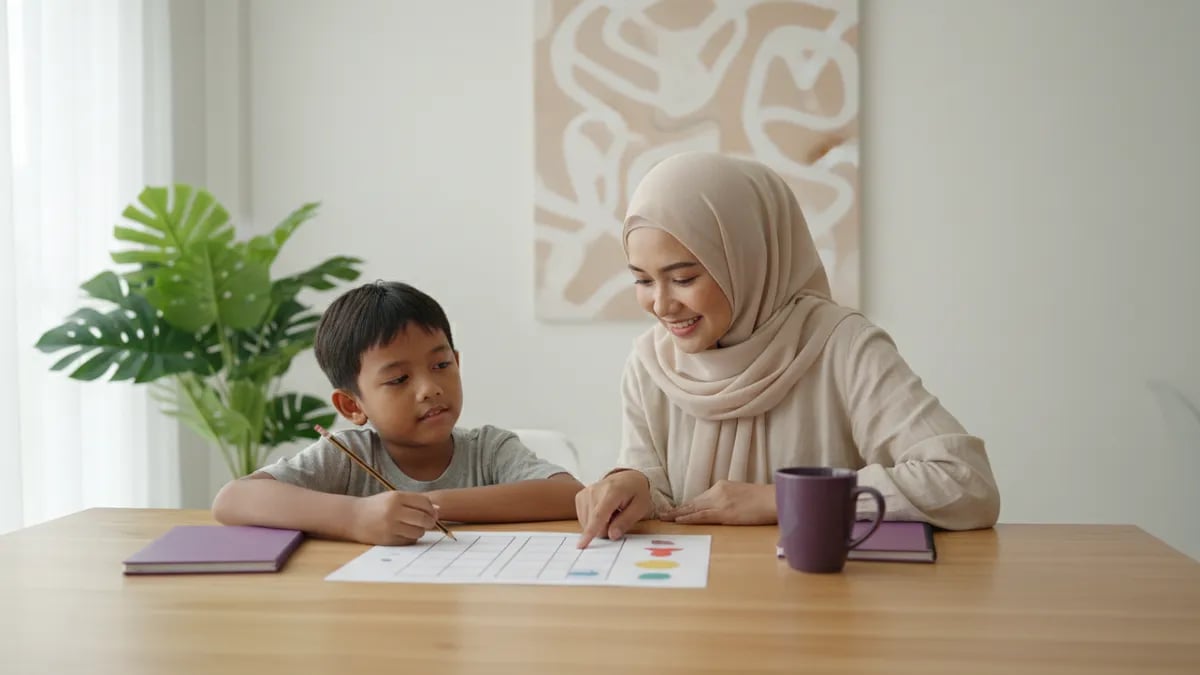
Logic puzzles for kids work best when they are short, need no equipment, and have one clear answer. This page has 25 primary school logic puzzles with answers: 8 for grades 1-2, 8 for grades 3-4, and 9 for grades 5-6, each with a one-line explanation. You need paper, a pencil, and 10-15 minutes.
Start at your child's grade, then move up or down a level. They train building an argument: what is certain, what is impossible, what is left.
Want counting games with cards and dice? See math games for kids by age.
Ages 6-8 do best with patterns they can draw.
1. A string of beads goes: red, blue, blue, red, blue, blue, red. What colors are the next two beads?
2. Continue the row: 1, 2, 4, 5, 7, 8. What are the next two numbers?
3. Dina is taller than Eko. Eko is taller than Fani. Who is the shortest?
4. Ani, Budi, and Cici each wear one hat: red, yellow, or green. Ani wears neither red nor yellow. Budi does not wear red. Who wears which hat?
5. Cat, goat, cow, chicken. Which one does not belong, and why?
6. I am a number between 20 and 30. My two digits add up to 7. Which number am I?
7. A frog sits on 3 on a number line. It jumps forward 4, back 2, then forward 5. Where does it land?
8. One apple weighs the same as two oranges. One mango weighs the same as two apples. How many oranges does one mango weigh?

Children aged 8-10 can hold several rules at once, so suggest a small table.
9. Fill a 3 x 3 grid with 1, 2, and 3 so every row and column contains all three once. Row 1 is 1 2 3. Row 2 starts with 2. Fill in the rest.
10. A pen holds chickens and goats: 4 heads and 10 legs in total. How many chickens and how many goats?
11. Two pencils and one eraser cost Rp 5,000. One pencil and one eraser cost Rp 3,500. How much is one pencil?
12. Six children meet, and each child high-fives every other child once. How many high-fives happen in total?
13. Three boxes, only one holds a prize. Box A says: "The prize is here." Box B says: "The prize is not in A." Box C says: "The prize is not here." Exactly one label is true. Where is the prize?
14. Andi finishes before Beni. Cika finishes before Andi. Dedi finishes last. In what place does Beni finish?
15. Today is Wednesday. What day is it in ten days?
16. A 20-meter road gets a tree every 5 meters, including both ends. How many trees are planted?
Ages 10-12 can follow longer chains of reasoning. Good warm-up for math word problems for primary school.
17. On an island, every person either always tells the truth or always lies. Ani says, "Budi and I are both liars." What are Ani and Budi?
18. Tap A fills a tank in 6 hours, tap B in 3 hours. How long do they take together?
19. Ibu is 4 times as old as Dika. In 5 years she will be 3 times as old as Dika. How old is Dika now?
20. With cards 1, 2, 3, 4, a child makes two-digit numbers using two different cards. How many of those numbers are even?
21. A number under 100 is divisible by both 6 and 8, and its digits add up to 6. What is it?
22. Five consecutive whole numbers add up to 65. What is the largest?
23. Ten chairs numbered 1-10 stand in a circle, evenly spaced. Which chair is directly opposite chair 3?
24. Eight coins look identical, but one is lighter. With a two-pan balance, what is the fewest weighings that always finds it?
25. Ayu, Bimo, Citra, and Dodi each pick a different dish: bakso, nasi goreng, mie ayam, or sate. Ayu eats neither bakso nor sate. Bimo eats neither nasi goreng, sate, nor bakso. Citra eats neither bakso nor mie ayam. Dodi eats neither mie ayam nor sate. Who eats what?
"Don't rush to give the answer. Ask 'what have you tried so far?' That tells you where the child got stuck." Nadia Rahmawati, Math Curriculum Team, Algonova
Copy the puzzles into a blank document without answers, leave 4 empty lines under each, print on A4.
| Worksheet | Puzzles | Time |
|---|---|---|
| Sheet 1 | 1-5 | 10 minutes |
| Sheet 2 | 6-9 | 10-15 minutes |
| Sheet 3 | 10-14 | 15 minutes |
| Sheet 4 | 15-19 | 15-20 minutes |
| Sheet 5 | 20-25 | 20 minutes |
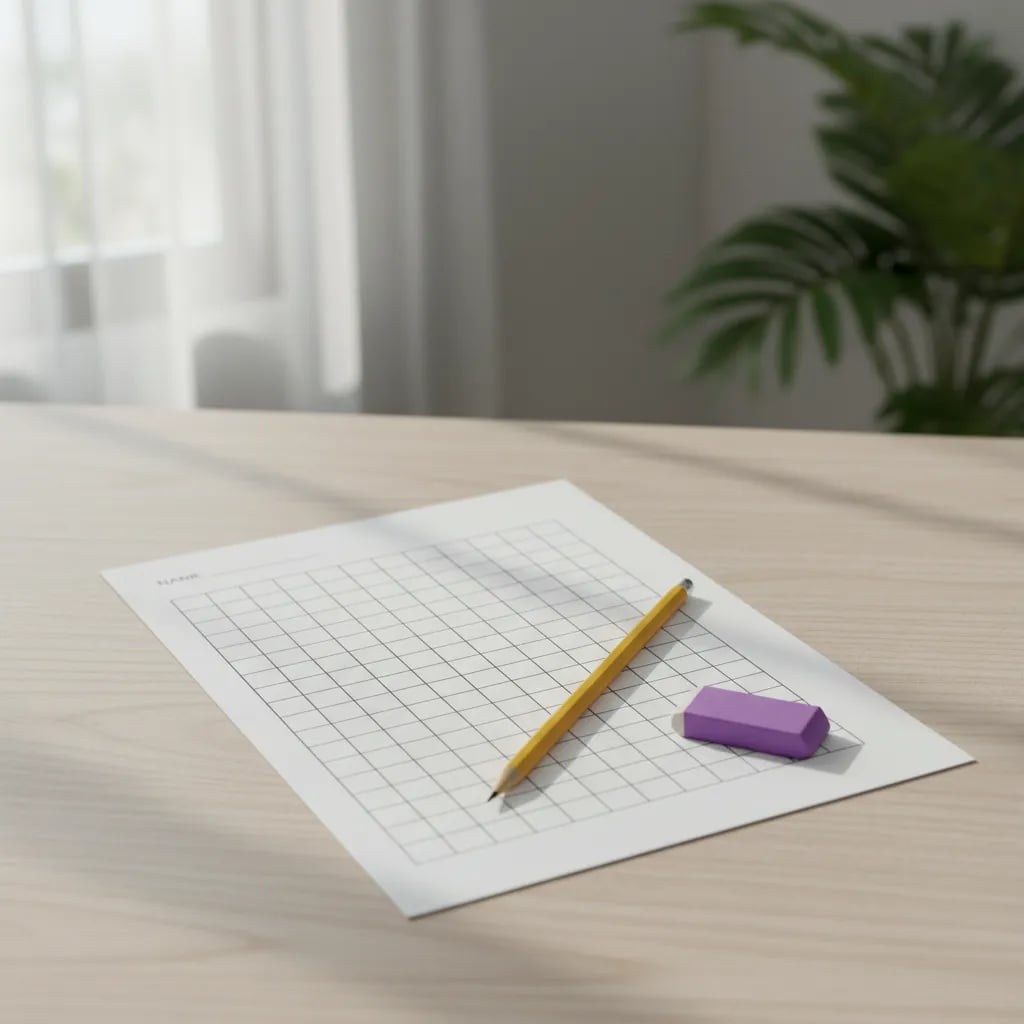
A stuck child usually understands the puzzle but not where to begin. Hint in steps: "try drawing it", then "what is definitely true? write it down", then "guess one answer and check it against every clue".
Bebras Indonesia runs similar thinking challenges through a network of organizers for school students, and what is Bebras explains the format.
If numbers worry your child too, read why kids fear math and how to help kids enjoy math. Try unplugged coding for pattern lovers. Online lessons: math classes for primary school kids, math for ages 6-7 from Rp 102,000 per lesson, and coding for primary school kids.
For grade 1, pick pattern, ordering, and elimination puzzles with small numbers, like puzzles 1-8 above. A 6-7 year old learns best from things they can draw or hold. The hat puzzle can be played with three colored papers and three toys, and the bead pattern with buttons. Avoid puzzles that stack many rules, because a child just starting primary school follows one or two clues at a time more easily. Begin with 2-3 puzzles per session and stop before boredom sets in. If your child answers fast, ask them to invent a similar puzzle for you to solve: a child who can build one usually understands the pattern, not just the guess. For a child who does not read fluently yet, read the puzzle aloud and let them answer out loud. Puzzles 3 and 7 are good starters, since the answer appears just by picturing it.
Primary school kids need only 10-15 minutes a day, or one worksheet of 3-5 puzzles per session. Short sessions keep it fun, and one puzzle thought through properly is worth more than ten done in a rush. For grades 1-2, 10 minutes is enough. For grades 5-6, a session can run to 20 minutes because the puzzles are longer, like puzzles 24 and 25. Choose a calm time, such as Saturday morning. If your child is tired or upset, skip the session. Three regular sessions a week beat one long session. A good sign is that the session ends while your child still wants more. Save the remaining puzzles for the next day, so there is something to look forward to.
Logic puzzles ask a child to reason from the clues given, while regular math problems more often ask for a procedure already taught, like a formula or long division. In the hat puzzle and the prize-box puzzle there is no formula: the child removes impossible options until one answer remains. The line is not sharp. Puzzle 20 looks like arithmetic, but the real work is listing every possibility without missing one. Puzzles 11 and 18 use calculation, and school word problems also need reasoning. That is why logic practice helps a child read word problems calmly: they get used to asking what is known, what is asked, and what is certain. If a child is fluent with puzzles but stuck on multiplication or fractions, the gap is in the school material, not in how they think, and it needs a separate check with grade-level problems such as times tables or word problems.
No, because these puzzles are made for thinking, not for grading. A wrong answer often shows how the child thinks. If a grade 3 child says 4 trees in puzzle 16, they probably counted the gaps correctly but forgot the tree at the end, and a drawn line with dots for trees fixes that quickly. Do not score the puzzles or compare with siblings, cousins, and classmates. Praise the effort, for example "you tried three different ways". The measure of success is not the score but whether the child can describe their steps. If a level feels too hard, drop down one level and come back in a month. A child who answers most puzzles at their level smoothly can move up, and a child who is often stuck should repeat the previous level first.
Copy the puzzle sections for your child's grade into a blank document and leave out the answers section. Add 4 empty lines under each puzzle so your child can draw or scribble. Add a title and name line, then print on A4 in at least 14-point type so grade 1-2 children can read it. One sheet with 3-5 puzzles is enough, and the worksheet plan above works as a guide. With no printer, copy the puzzles by hand into a notebook or onto a small whiteboard. Children in grades 5-6 can copy the puzzles themselves onto a blank sheet, since copying also trains careful reading. Keep the answers somewhere separate so your child does not peek before trying. When the sheet is done, open the answers together and read the reasoning aloud, not only the final answer. Children often understand only at that moment, when they compare their method with the explanation.
No, because logic puzzles train thinking, while school topics such as multiplication, fractions, and shapes still need to be learned step by step. Puzzles work well as light practice at home. If your child often gets school problems wrong, is falling behind classmates, or avoids homework, check which topic is weak first. At Algonova the first step is a free math diagnostic of about 60 minutes that shows which topics a child has and has not mastered, and classes run in groups of up to 10 or privately. The Math Starters track for ages 6-7 includes patterns and logical thinking through games, while Math Explorers for ages 8-12 follows the grade 3-6 school material. From the diagnostic you can decide whether practice at home is enough or whether your child needs a teacher, based on data rather than the feeling after one bad test score.
Multi-step puzzles like 13 (prize boxes), 17 (truth and lies), 24 (weighing coins), and 25 (who eats what) suit kids who love a challenge. None of them can be solved with one lucky guess, so the child has to test possibilities one at a time. Suggest a small table, or writing "possible" and "impossible" next to each option, as the answer section does. When they finish, ask them to write a puzzle of their own with one certain answer, and you solve it. Writing a puzzle is harder than solving one, because the author must make sure only one answer fits every clue. If a grade 3-4 child wants to try grade 5-6 puzzles, let them, and sit with them for the first one. If they get stuck, step back down without comment and try again next week. Puzzle 25 makes a good weekend challenge because it takes time and can be solved in stages.
Start with puzzles that can be solved in one minute, like puzzle 3 or 7, and present them as a game, not a lesson. Sit next to your child and try along, instead of watching from across the room. A child who gives up fast is often afraid of being wrong, so say before you start that wrong answers are fine and you may get some wrong too. Offer a small reward that is not food, such as choosing the next puzzle. Raise the difficulty gradually: two easy puzzles, then one medium one. If your child still refuses, do not force it. Try again another day in a different format, like spoken puzzles while waiting for food or during a car ride. Puzzles 3, 7, and 15 can be solved without paper, so they do not feel like schoolwork. A child who wins on small puzzles is usually more willing to try longer ones.

Algonova worldwide
Contact
Whatsapp: +62 21 50996971
Email: info@algonova.id
Address
Coworking Area, Gedung IT 6 Lantai Dasar, Nongsa Digital Park, Jalan Hang Lekiu, Kelurahan Sambau, Kecamatan Nongsa, Batam, Indonesia Directorate General of Consumer Protection and Trade Compliance – Ministry of Trade of the Republic of Indonesia. WhatsApp Ditjen PKTN: 0853-1111-1010.
PT Algonova Indonesia Cerdas All rights reserved 2026