How to Teach Multiplication Tables to Kids: 5 Proven Methods
Learn Math8 min
Learn Math

Nadia Rahmawati
Math Curriculum Team, Algonova
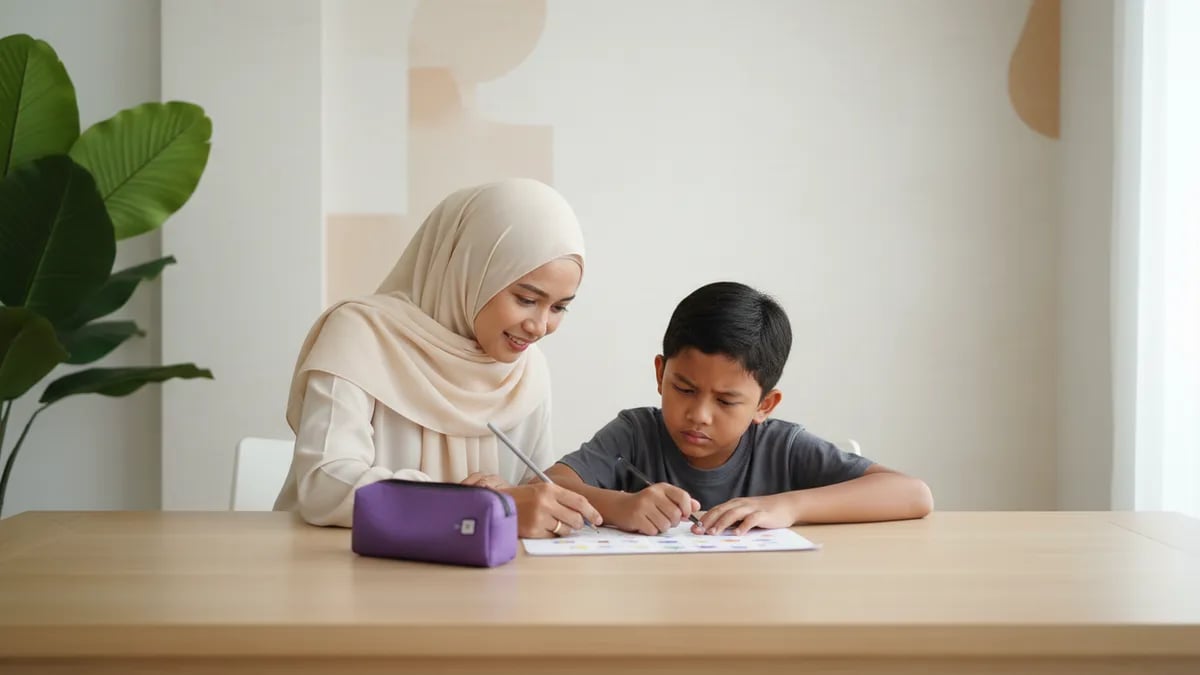
Math word problems for kids usually go wrong at the reading stage, not the arithmetic stage. A child who answers 18 − 9 in two seconds can still miss a question about marbles or pocket money that uses the same numbers. This guide is for parents of children in grades 1-6 at Indonesian schools, where these questions are called soal cerita: 6 reasons kids get stuck, a 4-step method, worked examples and a 15-minute daily routine.
Word problems test two skills at once: understanding a short text and choosing the right operation. If either one is weak, the answer comes out wrong. A 2016 study by Setiyoko of 84 Grade 4 pupils in Kulon Progo found that reading comprehension accounted for 50.4% of their word problem scores (Jurnal PGSD UNY).
| Reason | What you notice at home | What to try |
|---|---|---|
| Reading is still slow | reads in fits and starts, forgets the first sentence | read the problem aloud first, then let them reread it |
| Unsure what is being asked | uses every number in the text | ask them to point at the question sentence |
| Relying on keywords | "more" always means add, "left" always means subtract | ask "does the story go up or down?" |
| Two-step problems | stops after the first calculation | write "step 1" and "step 2" on scrap paper |
| Distractor numbers | uses a number the question does not need | cross out what is not needed |
| Number facts not automatic | slow on simple times tables | practise facts separately, 5 minutes a day |
A case study at SDN IV Wonogiri found a similar pattern: Grade 4 pupils struggled to understand the wording and to turn an everyday situation into a number sentence (UMS repository). The gap doesn't close by itself as children get older. In PISA 2022, only 18% of 15-year-olds in Indonesia reached Level 2 in mathematics, the level at which students can recognise how a simple situation can be written mathematically without being told how. The OECD average was 69%.
A practical method is the 4-step sequence from mathematician George Pólya's book How to Solve It (1945). It works for a grade 1 question and still works in junior high.
At home, steps 1 and 4 get skipped most. Kids want to reach the number fast. Slow them down: a child who cannot retell the problem is not ready to calculate yet.
The example below is a two-step problem, the type that trips up grade 3 children most often.
Problem: Mum buys 3 packs of bread rolls. Each pack has 6 rolls. The family eats 5 rolls at breakfast. How many rolls are left?
The usual wrong answers are 18 (the child stopped after step 1) and 14 (the child added 3 + 6 + 5). Both mean the child never pictured the story. The multiplication and division topics that grade 3 brings are listed in grade 3 math topics.
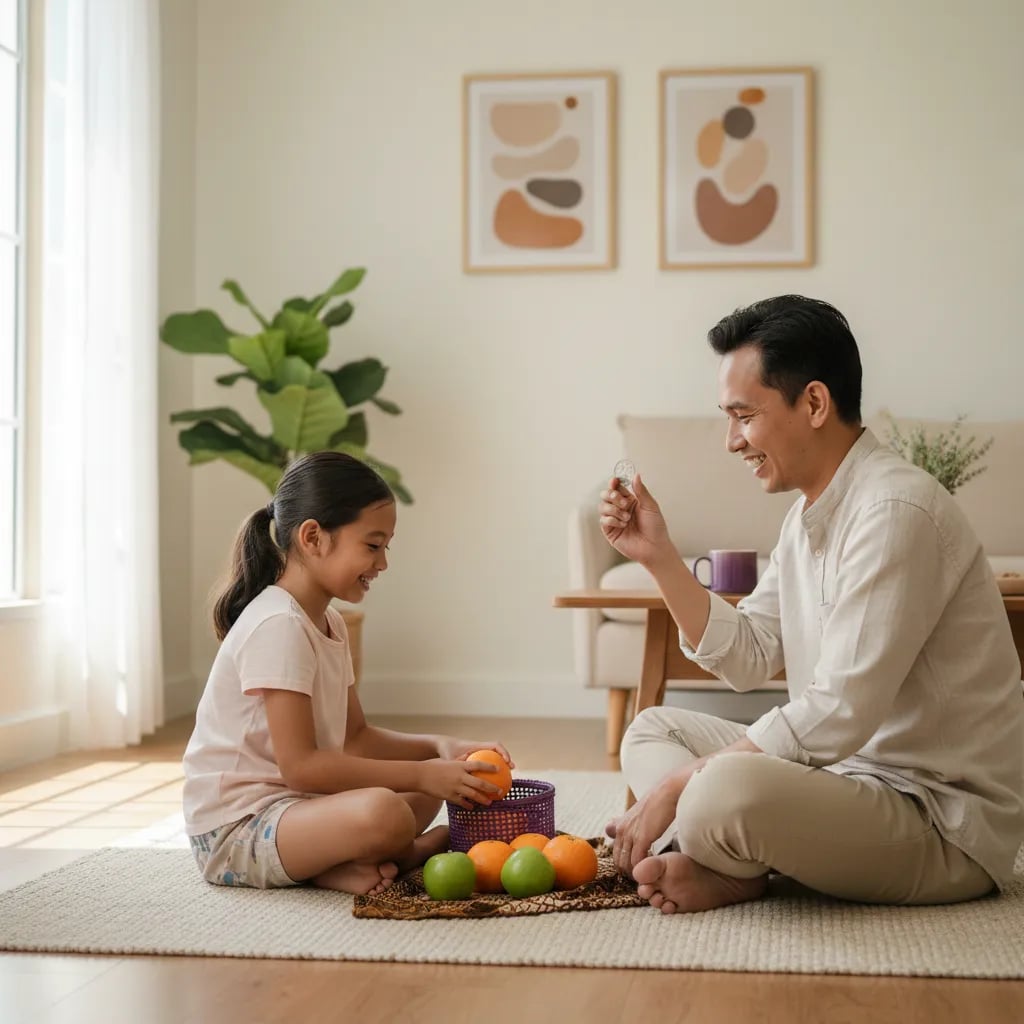
Teaching "more means add, left means subtract" feels handy, but it backfires on questions where the sentence is turned around.
Problem: Rina has 24 marbles. Rina has 9 more marbles than Doni. How many marbles does Doni have?
A keyword reader answers 24 + 9 = 33. Rina is the one with more, so Doni has fewer: 24 − 9 = 15. A bar model helps here. Draw a long bar for Rina (24) and a shorter bar for Doni, and mark the difference of 9. The child can see that Doni's bar comes from taking away.
Swap "what's the keyword?" for two questions: "who has more?" and "does the story go up or down?". Both make the child picture the situation instead of hunting for a word.
"If a child can retell the problem in their own words, half the work is done. The arithmetic usually follows." Nadia Rahmawati, Math Curriculum Team, Algonova
Each year the wording gets longer and the questions need more steps.
| Grade | Typical word problem content | Short example |
|---|---|---|
| 1-2 | adding and subtracting up to 100, money, length | "Adi has 15 sweets and gets 7 more. How many now?" |
| 3-4 | multiplication, division, time, simple fractions | "28 cakes are shared equally on 4 plates. How many per plate?" |
| 5-6 | fractions, percentages, rate, scale, LCM and GCF | "Dita has Rp 50,000 and buys 2 notebooks at Rp 7,500 and 1 pencil at Rp 4,000. How much is left?" |
Answer to the grade 5-6 example: 2 × Rp 7,500 = Rp 15,000, plus Rp 4,000 makes Rp 19,000, so Rp 31,000 is left. Grade 6 children preparing for exams can use grade 6 math practice questions and the guide to TKA SD 2027. If division is the weak spot, start with teaching long division.
In our teachers' experience, a short session every day sticks better than one long hour at the weekend. Try this order for 3 weeks:
Parents forget the last step most, and it does the most good. A child who can write their own problem understands how a story turns into numbers. If your child tenses up every time a long question appears, read about children who are afraid of math first so practice does not become one more source of stress.
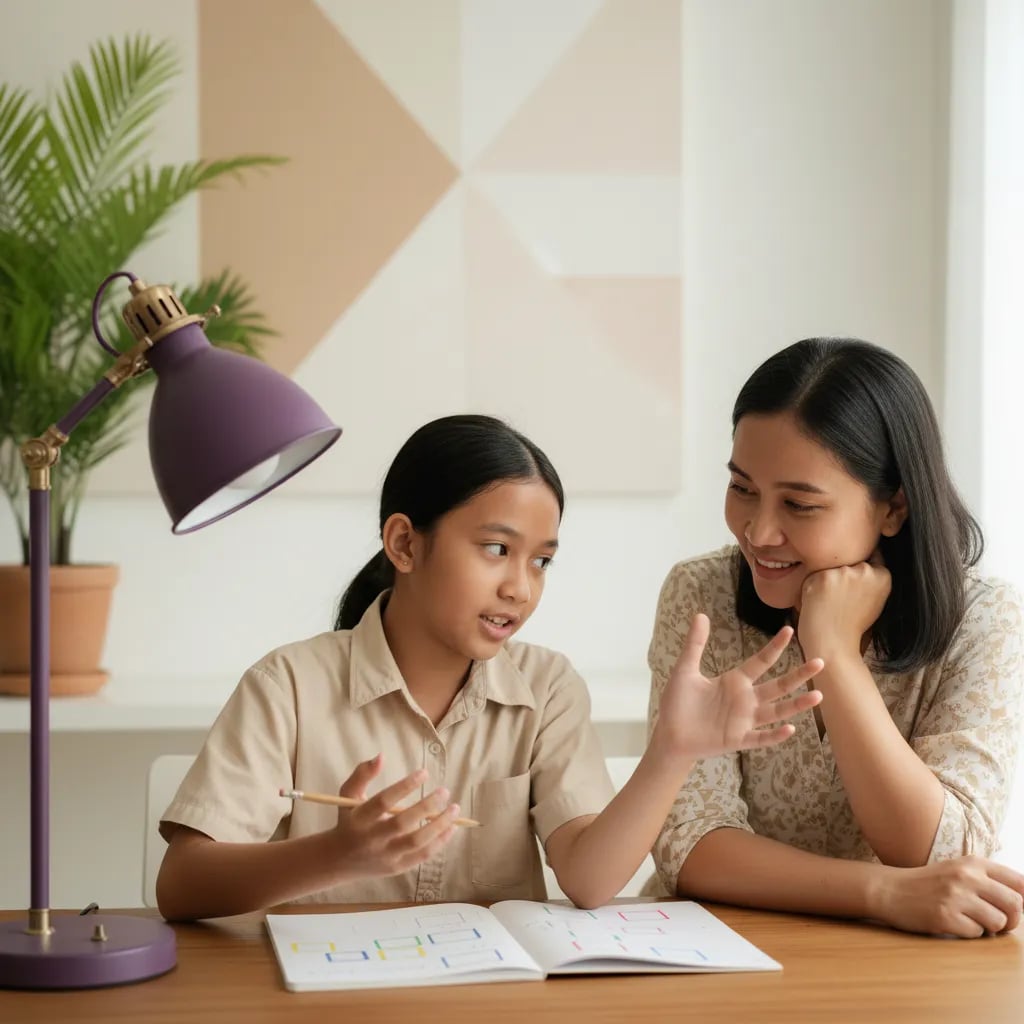
Consider a teacher if 4-6 weeks of regular practice have not changed the results. Signs to watch:
Other common causes, from gaps in earlier topics to study habits, are covered in why kids struggle with math. At Algonova the first step is a free diagnostic of about 60 minutes. The teacher sees where your child gets stuck and builds a topic-by-topic plan. Classes run live for 90 minutes with the same teacher every week, and the teacher asks children to explain their thinking in their own words. Grades 1-2 join Math Starters for ages 6-7, and grades 3-6 join Math Explorers in math classes for primary school kids.
Algonova teaches coding, AI and design to children aged 5-17 and math to children aged 6-17. More than 1,000,000 students in 97 countries have learned with us, in private lessons, mini groups of 2-4 or groups of up to 10, from Rp 102,000 per lesson.
Teach your child to retell the problem in their own words before doing any calculation. Then ask them to draw the situation, write the number sentence, calculate and check whether the answer makes sense. For "Mum buys 3 packs of 6 rolls and the family eats 5", a drawing of 3 boxes with 6 dots each and 5 dots crossed out is enough. The picture shows there are two steps, multiplication and then subtraction. Keep practice to about 15 minutes a day with only 2-3 problems, because a tired child starts guessing the operation. Finish by asking your child to invent one problem from something that happened that day. After 3 weeks you will usually see whether they read long questions more calmly than before. Praise the explanation, not only the right answer, so your child is not afraid to get the retelling wrong.
Sums and word problems use different skills. A word problem asks the child to understand a text, find the question and choose an operation before any arithmetic happens. A child who knows 7 × 8 = 56 may still not see that "7 boxes of 8 pencils" calls for multiplication. A study of 84 Grade 4 pupils in Kulon Progo found that reading comprehension accounted for 50.4% of their word problem scores. So if your child is fluent with bare numbers but fails stories, check the reading first. Ask them to read the problem aloud and notice where they pause or misread. If the reading is fine, the trouble is usually in choosing the operation, and drawing the situation will help more than extra drill on sums. Extra worksheets of bare sums will not fix it, because the arithmetic is already there.
There are 4 steps, described by George Pólya: understand the problem, make a plan, carry it out and check the answer. In the first step, the child says what they know and what they need to find. In the second, they draw a picture and pick an operation. In the third, they calculate one step at a time. In the fourth, they reread the question and judge whether the answer makes sense. Indonesian schools often write the first step as "diketahui, ditanya, jawab" (known, asked, answer), which fits Pólya's order. The most common mistake is jumping straight to the calculation. For grades 1-2, three spoken questions are enough: what is the story about, what is being asked, and does the amount go up or down? On scrap paper, one short line per step is enough.
Grade 3 word problems usually cover multiplication, division, money, time and simple fractions, often as two-step questions. Typical examples are "28 cakes shared equally on 4 plates, how many on each plate?" or a shopping question with change. Grade 3 is a hard point because problems start combining two operations in one story. A child who only had to add or subtract in grade 2 now has to decide the order of calculations alone. Help by making "step 1" and "step 2" a habit on scrap paper. Times tables up to 10 that are not yet automatic also slow children down, because their energy goes on the arithmetic before they can think about the story. Practise multiplication facts separately for about 5 minutes a day. Once it goes smoothly, reuse the same story with new numbers so the focus stays on the situation.
Children pick the wrong operation when they guess from keywords instead of the story. Many are taught that "more" means add and "left" means subtract. That rule works for some questions and fails on ones like "Rina has 24 marbles, 9 more than Doni. How many does Doni have?". The answer is 15, not 33. Replace keyword hunting with two questions: who has more, and does the story go up or down? A bar model helps too: the child draws two bars of different lengths and sees the difference. Give it 2-3 weeks before you judge the results. If the same mistake keeps coming back, write down the problems and show them to the class teacher. Another useful drill: give two problems with the same numbers but the story reversed, and ask your child why the answers differ.
About 15 minutes a day with 2-3 problems is enough for a primary school child. Short daily sessions keep children from getting tired and starting to guess. Split the time into reading and retelling, drawing, calculating and then making up one problem. For grades 1-2, 10 minutes of spoken problems is plenty. Grade 5-6 children preparing for exams can add one longer problem. The number of problems matters less than whether your child goes through all four steps every time. After 3 weeks, compare a problem that used to be hard with one from this week. If nothing has changed after 4-6 weeks, look more closely at the cause. Pick a fixed time, such as after dinner, so practice becomes a habit rather than a daily negotiation. Keep the TV off and the phone away for those 15 minutes.
Not always, but the risk is high, because a word problem is a reading task before it becomes a math task. A child who still sounds out each word often forgets the first sentence by the time they reach the third. For now, read the problem to your child and ask them to retell it. This separates the reading problem from the math problem. If your child answers correctly once the problem is read aloud, focus your help on reading fluency, for example 10 minutes of storybooks a day. If they still get it wrong after hearing it, the trouble lies in the concept or in choosing the operation. Share what you find with the class teacher, because it helps them too. For grades 1-2, pointing at each word while reading aloud also stops them skipping lines.
A tutor is worth considering if 4-6 weeks of regular practice have not changed the results, or if you cannot find where your child gets stuck. Other signs: test scores fall in chapters full of word problems, your child misses one-step problems for their own grade, or they start refusing homework. Before choosing a tutor, find the source of the problem: reading, concepts or number facts. At Algonova the free diagnostic takes about 60 minutes, online from home, and the result is a list of topics your child has mastered and those still missing. After that, your child learns in live 90-minute classes with the same teacher every week. Prices start from Rp 102,000 per lesson, in private lessons, mini groups or groups of up to 10 children. The results also help if you decide to keep practising at home, because you know which topics come first.

Algonova worldwide
Contact
Whatsapp: +62 21 50996971
Email: info@algonova.id
Address
Coworking Area, Gedung IT 6 Lantai Dasar, Nongsa Digital Park, Jalan Hang Lekiu, Kelurahan Sambau, Kecamatan Nongsa, Batam, Indonesia Directorate General of Consumer Protection and Trade Compliance – Ministry of Trade of the Republic of Indonesia. WhatsApp Ditjen PKTN: 0853-1111-1010.
PT Algonova Indonesia Cerdas All rights reserved 2026