
Online Math Tutoring for SMP Students: How to Choose and What to Check in the Trial Class

Learn Math10 min read
Checklists & Calendar

Intan Permata
Education Calendar Editor, Algonova
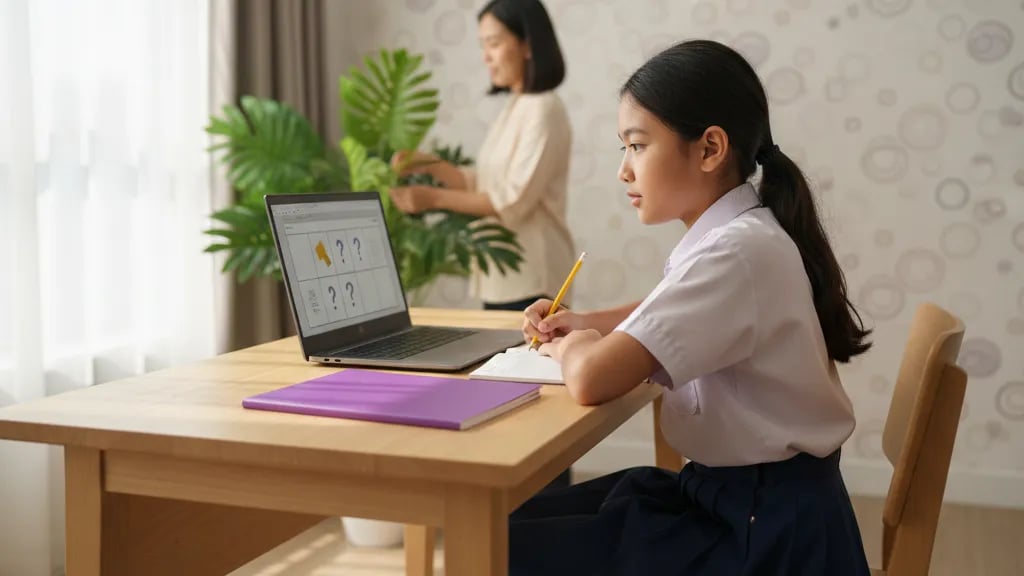
Apa itu Bebras, the question Indonesian parents type into Google, has a short answer: Bebras is a computational thinking challenge for students from primary school through high school, built from short logic stories that require no coding at all. This guide is written for parents in Indonesia with children aged 8 to 17, and it includes three worked sample tasks plus a home practice plan of 20 minutes a day for 4 to 6 weeks.
Algonova is an online school for coding, mathematics, AI, and design for children aged 5 to 17, with 1,000,000+ students across 97 countries and more than 10 years in the market. Indonesia alone has 13,000+ students. Classes run live with certified teachers in Private (1 student), Mini (2-4 students), and Group (up to 10 students) formats, never as recorded video. Parent rating is 4.9 out of 5.
Bebras measures how a child thinks through an unfamiliar problem, not memorised formulas and not the ability to write programs. The name comes from Lithuanian and means beaver, the animal used as the challenge mascot. Its official site, Bebras Organization, describes itself as the organiser of the International Challenge on Informatics and Computational Thinking.
Every task is a short story: a beaver arranging flags in order, a mouse looking for a way out, a robot moving boxes. The child reads the situation, works out the rule behind it, then picks an answer. What gets exercised is computational thinking: breaking a problem into parts, spotting patterns, ordering steps, and ignoring details that do not matter.
One thing parents should know from the start: there is no single international Bebras date. The participation window, the registration route, and the official rules are set by a national coordinator in each country, published on the official Bebras site, and usually passed to families through the school.
Bebras sits between the two: it asks for no formulas the way a math olympiad does, and no programming language the way a coding contest does.
| Aspect | Math olympiad | Programming contest | Bebras |
|---|---|---|---|
| What is scored | Accurate calculation and proof | Working, efficient code | Reasoning your way to an answer |
| Required background | Formulas and calculation technique | One language (Python, C++) | Careful reading and basic logic |
| Task format | Computation and written solutions | Write a program | Short story with answer options |
| Tools | Paper and pencil | Computer with a code editor | Computer or tablet with a browser |
| Common reason for losing points | Arithmetic slips, running out of time | Syntax, bugs, time limits | Reading too fast, misreading the rule |
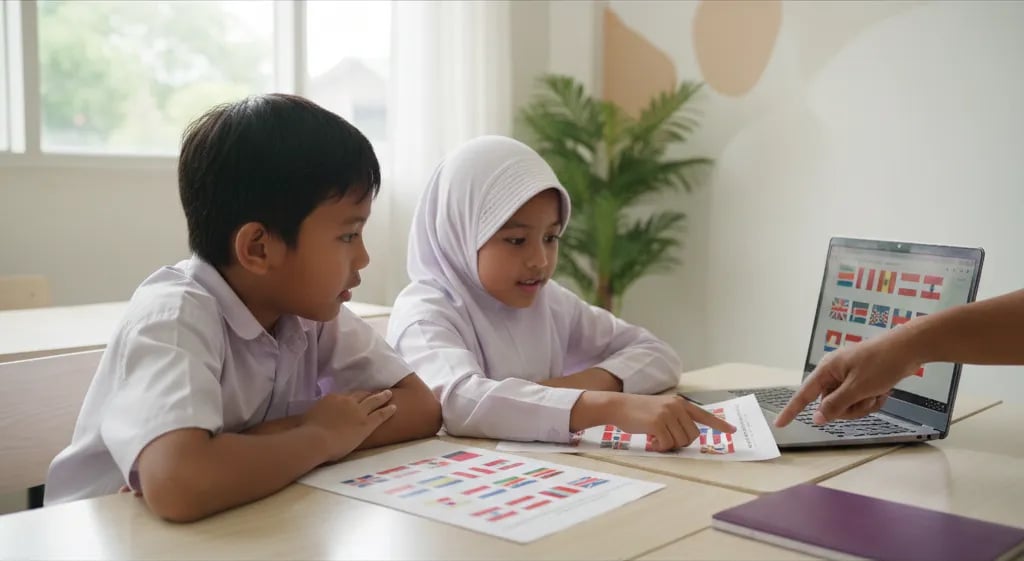
Families already familiar with the competition track usually compare it against primary school math olympiads or the wider picture in math olympiads for children. The real difference is the entry requirement: an olympiad expects material already mastered, while Bebras expects patience in reading and reasoning.
Because nothing has to be coded, a child who has never taken a coding class can still work through Bebras tasks. The reverse also holds: children who code regularly tend to spot repeating patterns and step order faster, so coding helps without being a prerequisite.
Bebras tasks do not punish a child for not knowing formulas yet. What earns points is reading twice, hunting for the rule, then committing to an answer with a reason behind it.
Arif Pratama, Coding and AI Education Specialist
Participants are grouped by school level, so a fourth grader never faces the same tasks as a high school student. The grouping in common use looks roughly like this:
The exact category names and grade cutoffs are set by the national coordinator and can differ between countries and between years, so no blog list should be treated as official. Only two sources count: the national coordinator announcement on the official Bebras site, and the teacher at your child's school.
Registration almost always goes through the school rather than individual families. Registered schools get access and enrol their own students, so a parent's first step is asking the IT teacher or class teacher. Registration deadlines and the participation window are announced each year by the national coordinator.
If your child's school does not take part yet, practice still pays off. Bebras style tasks work as an honest diagnostic: 20 minutes is enough to see whether a child is comfortable with patterns and step order or still needs guidance. The fastest way to check that alongside a teacher is a free 60 minute coding class, with the structured path continuing in our coding program for primary school children.
The three tasks below are Bebras style examples we wrote ourselves, not official tasks from previous years. The reasoning pattern matches what typically appears, and none of them needs a calculator.
A beaver hangs flags in order: red, red, blue, yellow, red, red, blue, yellow, and so on. What colour is flag number 27?
Solution: one full cycle holds 4 flags. 27 divided by 4 gives 6 with remainder 3, so flag 27 is the third flag in a cycle, which is blue. There is no need to draw 27 flags. The skill trained here: find the repeating unit, then use the remainder as a shortcut.
Box A is lighter than box B. Box C is heavier than box B. Box D is lighter than box A. Put all four boxes in order from lightest.
Solution: turn the sentences into one chain. D is lighter than A, A is lighter than B, B is lighter than C. The order is D, A, B, C. Not a single number appears in this task. The skill trained here: ordering by comparison, the basic move behind every sorting algorithm.
Hut A connects to B and C. Hut B connects to D. Hut C connects to D and E. Huts D and E both connect to F. How many different routes lead from A to F without passing the same hut twice?
Solution: trace branch by branch instead of counting while guessing. Through B there is one route: A, B, D, F. Through C there are two: A, C, D, F and A, C, E, F. Three routes in total. The skill trained here: walking a graph systematically so nothing gets missed or double counted.
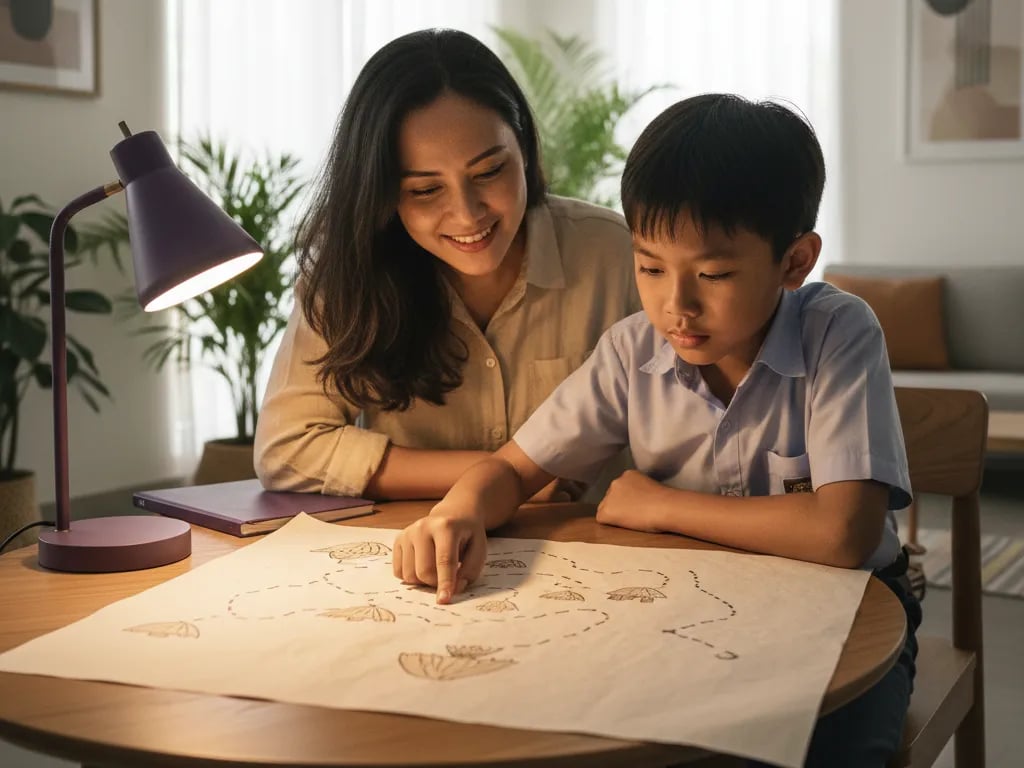
When a child explains the steps out loud, they usually catch their own mistake. That moment is worth more than twenty practice tasks a parent corrects for them.
Arif Pratama, Coding and AI Education Specialist
Twenty minutes four times a week works better than one long weekend session.
| Week | Focus | 20 minute activity |
|---|---|---|
| 1 | Meet the format | 3 tasks per session, no timer, child explains each answer out loud |
| 2 | Patterns and order | Repeating patterns, picture sequences, ordering steps |
| 3 | Logic and comparison | Balance scales, true or false tables, ordering objects |
| 4 | Maps and networks | Routes, mazes, small graphs, counting possible paths |
| 5 | Mixed simulation | 10 random tasks with a timer and no help |
| 6 | Review the misses | Child teaches their two hardest tasks back to a parent |
The rule parents break most often: do not correct too quickly. When an answer is wrong, ask your child to walk through the steps from the beginning, and the slip usually surfaces on its own. Many parents report that this habit changes how their child reads school problems, more than the number of practice tasks does.
For variety in the early weeks, game shaped tasks land more easily, and the options are covered in coding games for children. Pattern practice also opens a natural door into mathematics for primary school children, since balance and ordering tasks lean on the same reasoning.
Bebras measures computational thinking once a year, while a coding class trains it every week. The skills a child uses on a beaver task are the same ones behind building a simple game: break the problem down, find the pattern, order the steps, test, fix. UNESCO treats digital and problem solving skills as part of a child's learning readiness rather than an optional extra.
If your child is starting from zero, a sensible order is understanding what coding for children is first, then trying the small group format through a free Master Class. After that, Bebras style practice stops feeling like extra homework and starts feeling like a puzzle.
Bebras is a computational thinking challenge for school students, and a child needs no coding ability at all to take part in it. Each task is a short story with answer options: a beaver hanging flags, a mouse finding an exit, a robot moving boxes. What gets scored is the child's ability to find the rule hiding inside the story. The flag pattern task, for instance, can be solved simply by counting the cycle length and using the remainder, without ever opening a code editor. Careful reading decides the result far more than coding experience does. Children who already code tend to recognise repeating patterns and step order faster. That is an advantage, not an entry requirement, and it can be built from zero within a few weeks.
Children aged 8, or around grade 3, can usually handle the simplest Bebras style tasks, because those tasks stay visual and the text stays short. At this level a task carries only one rule, such as guessing the next picture in a sequence or picking the shortest path across a four point map. Children aged 5 to 7 can join a lighter version with a parent, where the task is read aloud and answered verbally. Readiness depends less on birthdate than on whether the child can read an instruction all the way through without giving up halfway. The clearest signal of readiness: when the answer they expected is not among the options, the child goes back to the start of the task instead of picking whatever looks closest. If your child still skips a line of instructions, start with two tasks per session. Steady frequency beats task count every time.
Twenty minutes four times a week is enough, roughly 80 minutes in total, and it works far better than a single long weekend session. Logic tasks demand full concentration, so the first 20 minutes carry much higher quality than the last 20 minutes of an hour long sitting. The easiest routine to keep is one attached to a habit that already exists, for example right after the afternoon shower: three tasks, the child explains the reasoning, done. A routine like that survives much longer than a new slot standing on its own. Four short sessions also leave gaps for the material to settle, and a task that caused a jam on Monday often feels easy by Wednesday. If the week gets crowded, three 20 minute sessions still beat one hour long cram before the participation date. If your child asks to continue, let them. The only thing to avoid is pushing on after focus is clearly gone.
A computer, laptop, or tablet with a modern browser and a stable connection covers it, since the tasks use text and simple images with nothing to install. A slightly larger screen helps with map and table tasks, so a laptop is more comfortable than a phone. For home practice, paper and pencil next to the device matter more than people expect: many children solve graph tasks far faster once they redraw the map themselves. Headphones only come into play if the child studies in a noisy room. One small step gets forgotten often: switch off notifications before the session starts, since logic tasks suffer more than anything else from interruptions mid solution. Where one laptop is shared at home, fix the same 20 minute slot every day. Online coding classes have equally light requirements, and our team checks device readiness with parents before the first session starts.
Task based challenges like Bebras have no public chat and no contact with strangers, which makes the risk profile much lower than an open online game. Personal data is the part that still needs care. Registration is normally handled by the school, so parents should not be filling in forms from links circulating in WhatsApp groups. If a link asks for a phone number or a photo of your child, confirm with the teacher before entering anything. For home practice, stick to the official site or material handed out by the teacher, and skip task files circulating without a clear source. Sitting near your child for the first few sessions helps too, less to check answers than to see which sites get opened. In Algonova classes, sessions run in a closed room in Private (1 student), Mini (2-4 students), or Group (up to 10 students) formats with a certified teacher, and parents may sit in whenever they like.
Yes, and Bebras style tasks are one of the most neutral entry points into informatics precisely because they assume no technical background whatsoever. No programming language, no hardware, no assumption that the child has already taken a computer apart. What gets used is careful reading, reasoning, and the patience to try again. In our classes, girls are often strongest at the part that decides the score most: reading the whole task before answering, and rechecking answers that felt too easy. What decides long term interest is the room rather than the tasks: girls more often drop out because no other girl is sitting there, not because the logic got hard. Lining up one classmate to practise with usually keeps interest alive to the end. The Private (1 student) and Mini (2-4 students) formats help as well, since no single dominant voice takes over the space for asking questions.
Yes, because most Bebras style tasks involve no calculation. The skills in play are reasoning and ordering rather than fast arithmetic. The weighing task in this article contains no numbers at all: the child only chains three comparison sentences into one order. The flag task does use division, but division at grade 3 level. Some children with middling maths grades actually do better here, because they are used to reading a problem carefully instead of guessing which operation to apply. Only two things are worth checking before you start: the child reads long sentences comfortably, and understands simple division. Everything else gets built along the way, since each Bebras task teaches one new way of thinking rather than testing memorised material. The effect often runs backwards too: after regular reasoning practice, school maths grades rise because the child stops misreading word problems.
Change the format before adding more tasks. Boredom almost always comes from working alone in silence, not from the material being too hard. Three fixes usually show an effect immediately: ask your child to explain the answer as if teaching you, take turns so you answer some tasks too, and redraw map tasks on large paper with coloured markers. For children who prefer a screen, game shaped tasks and small game projects tend to land better than a plain worksheet. Boredom also shows up when tasks sit well above the child's level. If more than half the answers come out wrong, drop the difficulty for a week and raise it again once confidence returns. If none of that helps, cut back to two tasks per session. A short session that always finishes builds the habit better than a long one that always gets abandoned.
Fees and payment for the Bebras challenge are set by the national coordinator and the host school, so those figures must be confirmed with a teacher rather than a blog. What we can state precisely is the cost of our own classes. Algonova classes in Indonesia start from Rp 102,000 per lesson, available in Private (1 student), Mini (2-4 students), and Group (up to 10 students) formats, with a certified teacher guiding live rather than a recorded video. Before deciding, parents can try a free 60 minute class first to see whether the format matches how their child learns. Worth separating clearly: class fees and challenge participation are two different things, so a child practising at home can still take part through school without paying for any class. If the school is not registered yet, teachers can usually raise it with the national coordinator. Bebras style practice itself costs nothing at home: paper, pencil, and 20 minutes four times a week.
Watch three signals: the child reads the whole task before answering, can explain the steps out loud, and catches their own mistake while explaining. Practice scores swing because task difficulty varies, so a score on its own misleads. A more honest method is keeping the first week's answers, giving similar tasks in week five, and comparing how the child explains them. The change that matters most often does not show up in the score: a child who starts redrawing the map before answering has already shifted how they think, even if the points have barely moved. Another easy measure: count how many times your child asks what a task means during one session. A number that falls week by week shows growing independence in reading instructions, which holds steadier than a correct answer count. In ongoing classes, progress is easier to see because there are real projects and teacher notes every few sessions.
Blog


Algonova worldwide
Contact
Whatsapp: +62 21 50996971
Email: info@algonova.id
Address
Coworking Area, Gedung IT 6 Lantai Dasar, Nongsa Digital Park, Jalan Hang Lekiu, Kelurahan Sambau, Kecamatan Nongsa, Batam, Indonesia Directorate General of Consumer Protection and Trade Compliance – Ministry of Trade of the Republic of Indonesia. WhatsApp Ditjen PKTN: 0853-1111-1010.
PT Algonova Indonesia Cerdas All rights reserved 2026
