How to Teach Multiplication Tables to Kids: 5 Proven Methods
Learn Math8 min
Parent Guides

Dimas Prasetyo
Education Analyst, Algonova
Free online classes for kids do exist: lesson videos, practice questions, open coding platforms such as Scratch, and trial classes from tutoring providers. Together they are enough to try a subject or patch one topic. What is not free is a teacher who assesses your child, a learning plan, and a schedule that holds. For children in grades 1 to 6, use the free options for 2 to 4 weeks, then decide.
A free online class is learning material or a lesson on the internet that costs nothing, usually without a teacher who watches your child's progress. There are three types. First, open content: videos, practice questions, and platforms such as Scratch. Second, limited free access to paid platforms, where terms and time limits change, so check each site directly. Third, trial classes from tutoring providers, which are free because their purpose is to introduce the class.
Each type does a different job. Open content suits independent practice. Limited access suits looking at the interface and teaching style. A trial class suits testing whether your child is comfortable learning with a live teacher.
Free sources work best when your child already knows what to practice, and worst when you do not yet know where the gap is. This table covers the five sources Indonesian families use most.
| Source | Good for | Limit |
|---|---|---|
| School materials and textbooks | reviewing the topic being taught | no personal feedback |
| Lesson videos online | seeing another way to explain a topic | a child can watch without understanding, nobody asks questions back |
| Open coding platforms (Scratch, Code.org) | trying coding at no cost | no teacher, children often stop after the second project |
| Limited free access to tutoring platforms | seeing the content and layout | limited time and content, terms change |
| Trial class from a tutoring provider | feeling a live class with a teacher | one session, not a course |
The same pattern shows up in every row: free gives material, but not a person who checks whether your child really understands. A full guide to choosing a provider is in how to choose an online tutoring class for primary school.
Free online math lessons can train one topic you already know about, such as multiplication or fractions, but they cannot find a hidden gap on their own. A child who gets fraction questions wrong is often weak in division, and a fractions video will not say so.
Example: a grade 4 child's fractions test score drops. The parents find free fractions videos and the child watches them three times, but the score stays the same. A check shows the difficulty is two-digit multiplication, which fractions build on. Without that check, weeks of practice are wasted.
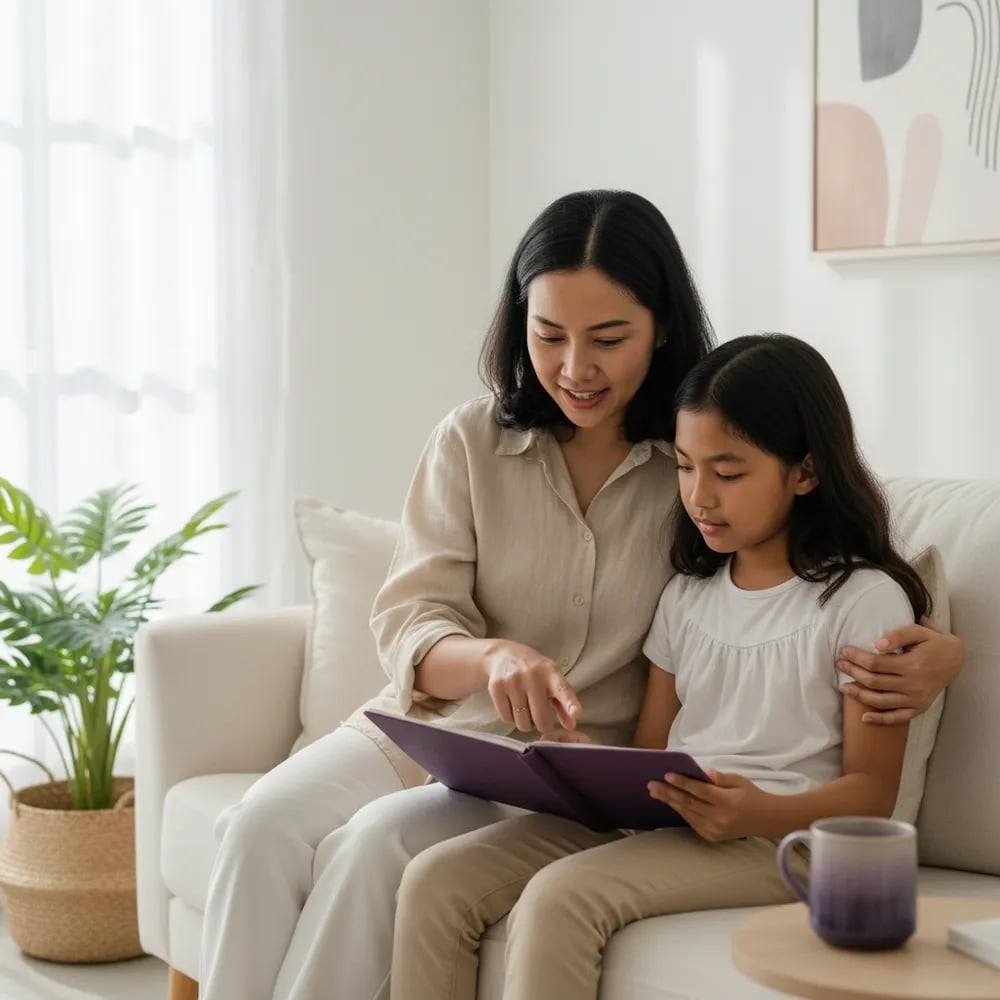
So the first step is not finding videos but finding the gap. If you want to do it yourself, a math assessment at home is a start. Or use a free diagnostic from a tutoring provider, which reports by topic.
For a child who is afraid of math, free content without a guide can deepen the fear, because nobody calms them after a mistake. Related reading: children who are afraid of math.
Primary school children can start coding at no cost with Scratch, a platform from MIT Media Lab that states it is free for everyone, and with Code.org, whose curriculum is free and available in Bahasa Indonesia. Both are enough to learn command blocks, sequences, and loops.
The limit comes at the next stage. After the first project, a child is often unsure what to build, and nobody corrects the way they think. At that point a live teacher helps: setting challenges that rise step by step and explaining why a program does not run.
If you want to see whether your child enjoys a live teacher, the Algonova coding trial is a 60-minute master class with no card and no commitment, described on the kids coding courses page. For a list of free phone apps, see coding apps on a phone for primary school kids.
A free trial class is most useful when you arrive with a clear question instead of just watching. One session is enough to see the teacher's style and your child's reaction. Use these four steps:
At Algonova, the math trial is a diagnostic of about 60 minutes with a report by topic and a learning plan. The coding trial is a 60-minute master class. Both are free and without commitment, as stated on the math page and the coding page.
Signs of a good trial class: the teacher asks your child more questions than they talk, and you leave with a result you can use, not just a brochure.
Free sources are enough when a child is motivated and only needs practice, and a paid course is worth considering when grades or interest do not move after 4 weeks. This table helps you weigh it.
| Situation | Is free enough? |
|---|---|
| Child is fluent, only needs practice questions | yes |
| Want to know if the child likes coding | yes, start with Scratch |
| Grades did not rise after 4 weeks of solo practice | not yet, a teacher needs to check the gap |
| Child often stops halfway and needs a fixed schedule | not yet, a scheduled class helps |
| Exam preparation with limited time | not yet, a plan by topic is needed |
Paid does not have to mean expensive. At Algonova prices start from Rp 102,000 per lesson, group classes of up to 10 children run 90 minutes once a week, and the private format is 60 minutes for one child. Formats are compared in private tutor or tutoring center and online math tutoring for primary and junior high.
A 4-week plan gives you real data for the decision, so you do not pay out of panic or delay out of doubt. Write down three numbers at the start: the current grade or skill, study hours per week, and one goal.
How many times a week a child should have lessons is covered in how many times a week for primary school tutoring, and the right age to start is in when to start math tutoring.
For practice and trying things out, yes. For fixing gaps you do not know about yet, usually not. Free material gives questions and explanations, but nobody checks whether the child understands or is just copying. A child who is motivated and only needs to review school topics often does well with free sources for a few weeks. A child whose grades stay low after 4 weeks of regular practice usually needs someone to look at where the mistakes are. A simple way to judge: write down the grade or skill before starting, practice one topic for 20 minutes a day, then measure again with similar questions. If the difference is clear, keep going. If not, join one trial class with a live teacher before adding more material.
Some providers offer free access or trial classes, but terms, content, and time limits change. Check each site directly before signing up and read what is free and when charging starts. Look at three things: whether card details are required, whether anything renews automatically, and whether the free part is a class with a teacher or only content. A fully free tutoring center with live teachers and a fixed schedule is almost unheard of, because teachers need to be paid. What is realistic is a one-time trial class. At Algonova the math trial is a diagnostic of about 60 minutes and the coding trial is a 60-minute master class, with no commitment.
Start by finding the weak topic, not by watching videos. Take 10 to 15 questions from a textbook or school worksheet that cover several topics, let your child solve them without help, and note which topic has the most mistakes. Then pick one topic and practice 20 minutes a day for 2 weeks. Avoid switching topics, because the child never has time to strengthen one thing. If you doubt your own reading of the results, a math diagnostic from a tutoring provider gives a report by topic. Algonova offers one free, about 60 minutes. After 2 weeks, measure again with similar questions to see whether the practice worked.
Yes. On its About page, Scratch states that it is free for everyone. Scratch was developed at MIT Media Lab and uses visual command blocks, so primary school children can make animations and simple games without typing code. The challenge comes afterwards: many children stop after the second project because they do not know what to build and nobody sets the next challenge. Parents can help by suggesting one small project a week, such as a quiz or a catch-the-ball game. If your child wants to move on to Python or build more complex games, a live teacher usually speeds things up.
Yes, the Code.org site offers Bahasa Indonesia in its language selector, and says its curriculum and tutorials are free and open. The courses are built from puzzles and step-by-step activities, so they suit children who like clear steps. Sit with your child for the first session to see which parts need an explanation. After one course, ask your child to build something of their own in Scratch so the concepts are used, not only completed. If your child gets bored because everything feels easy, that is a sign they are ready for challenges set by a teacher.
Four weeks is a reasonable guide. In 4 weeks of 20-minute daily practice you have enough data: whether your child's grade or skill moves, whether they stay consistent without being told, and whether they enjoy the process. Do not wait longer if grades keep dropping or an exam is close. On the other hand, do not rush into a paid course in week one, because your child may only need light practice. Note three things: the starting skill, the study hours actually used, and the measurement in week 4. Those three notes also help when you talk to the teacher in a trial class.
Free online lessons are material you can use any time without limit, while a free trial class is one session with a live teacher to test the fit. Free material trains, a trial class assesses. At Algonova, the math trial is a diagnostic of about 60 minutes that produces a report by topic and a learning plan, and the coding trial is a 60-minute master class with a live teacher. Both come without commitment. After the trial class you decide whether to continue. Before you join, decide on one question for the teacher so that single session produces an answer, not just an impression.
Some can, but most primary school children need someone to keep the rhythm. Without a teacher, children tend to jump between videos or games without finishing practice. A few things help: short sessions of 20 to 30 minutes, one goal per session, the same time every day, and an adult sitting nearby for the first 5 minutes. Children in grades 1 to 3 usually find it harder to work alone than grades 5 to 6. If after 2 to 3 weeks your child often forgets or refuses, that is not failure, it is a sign that a schedule and teacher feedback are needed. Small group classes of up to 10 children with a live teacher provide that rhythm.
Yes, it is free and without commitment. For math you get a diagnostic of about 60 minutes that produces a report by topic and a learning plan. For coding your child joins a 60-minute master class with a live teacher and tries a hands-on project. After that, the decision is yours. If you continue, prices start from Rp 102,000 per lesson, with group classes of up to 10 children and a private format for one child. Algonova has served more than 1 million students in 97 countries, and all classes are live online. The sign-up buttons in this article open a short quiz that finds the right track before you book the trial class.

Algonova worldwide
Contact
Whatsapp: +62 21 50996971
Email: info@algonova.id
Address
Coworking Area, Gedung IT 6 Lantai Dasar, Nongsa Digital Park, Jalan Hang Lekiu, Kelurahan Sambau, Kecamatan Nongsa, Batam, Indonesia Directorate General of Consumer Protection and Trade Compliance – Ministry of Trade of the Republic of Indonesia. WhatsApp Ditjen PKTN: 0853-1111-1010.
PT Algonova Indonesia Cerdas All rights reserved 2026