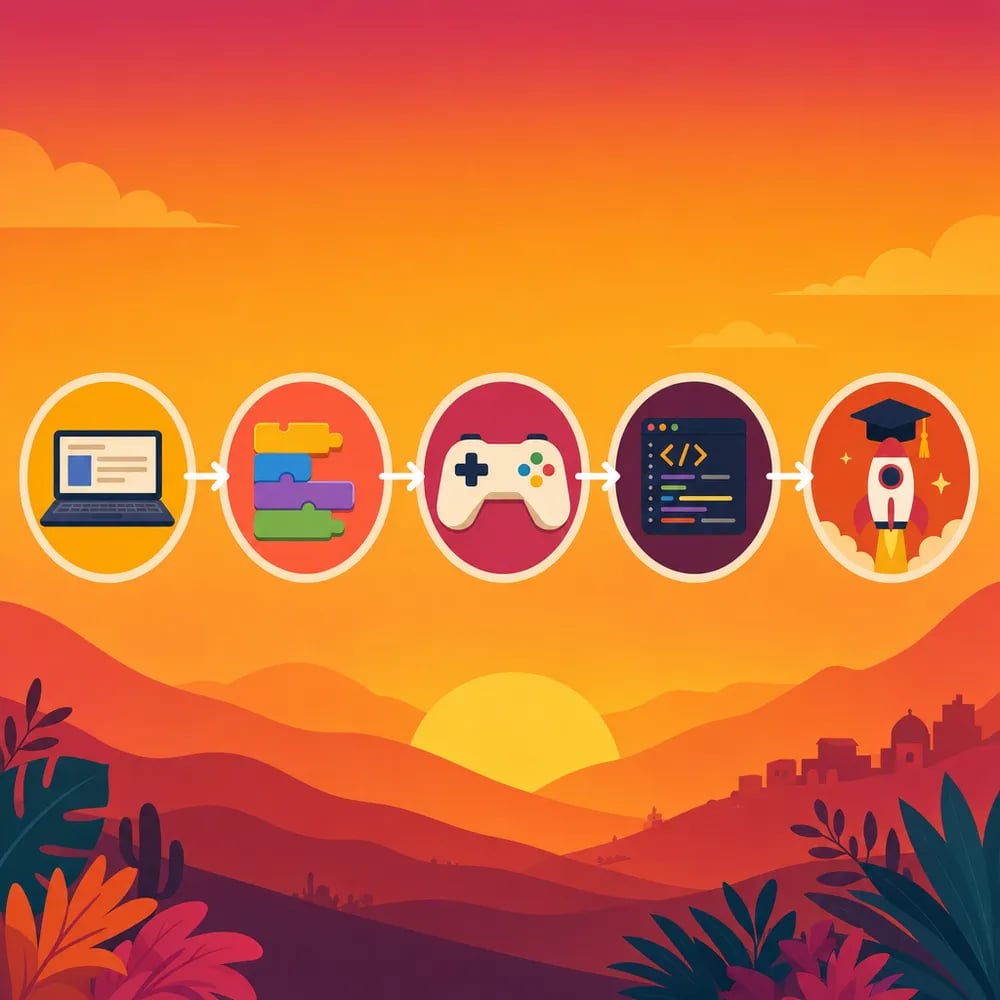
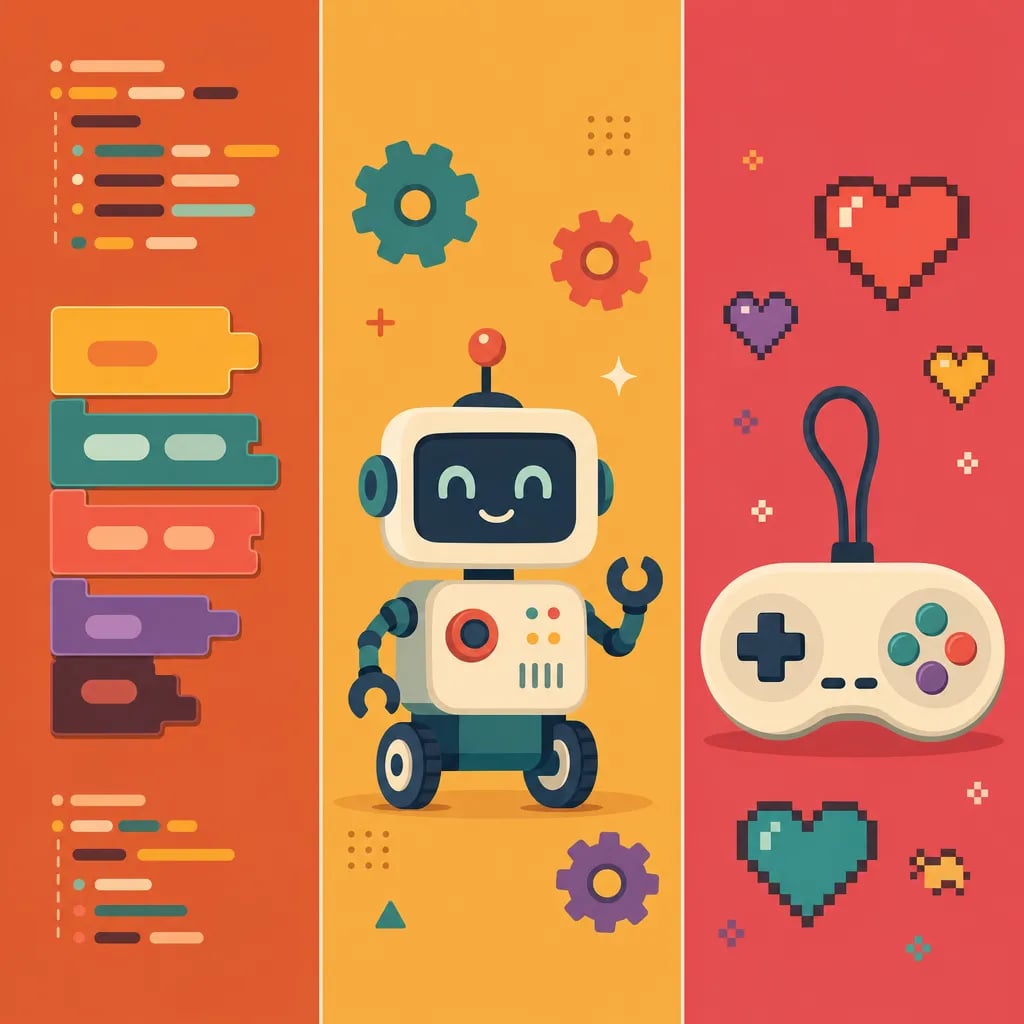
Coding, robotics and game design are the three most popular STEM paths for kids — and all three teach the same computational thinking. But their goals, costs and entry points are different. Coding is the most flexible foundation; robotics adds physical hardware; game design adds creativity and storytelling. For most Latin American families, starting with coding and then adding robotics or game design according to the child's interests is the most sensible route.
Algonova is an online school for coding, math, AI and design for kids aged 6 to 17, with more than 1,000,000 students in 97 countries and 10+ years of teaching experience. We offer all three paths, all online in a private 1-on-1, mini group of 2 to 4, or group of up to 10 students format, with certified teachers. In Latin America, we teach families in Mexico, Argentina, Colombia, Chile, Peru and across the region.
The Short Answer: Coding as the Foundation, Robotics/Game Design as the Specialization
Coding is a general skill — the digital foundation that applies to almost every technology field. Robotics and game design are more specialized, built on top of a coding foundation. A child who starts with coding keeps every option open; a child who jumps straight into robotics or game design without a coding foundation tends to stall as complexity increases.
Robotics is the best option for children who love building physical things and are curious about how machines work. Game design suits children who spend hours in Roblox or Minecraft and want to make their own version. Coding suits children who don't yet know what they're passionate about — a foundation that opens every door.
Costs differ too. Coding and game design need a laptop and internet. Robotics requires a physical kit (USD 30–300) and is usually only available in person in large cities.
What Is Coding for Kids?
Coding means writing instructions (commands) for computers in a programming language. For kids, it usually starts with Scratch (ages 8–11, visual blocks) and moves on to Python (12+, text-based code). Children learn universal concepts: loops, conditions, variables, functions.
Coding needs no physical hardware. All it takes is a laptop and internet. Learning outcomes typically include: simple games, calculators, chatbots, data visualizations — depending on the child's creativity.
Advantages: the most flexible foundation (it applies to AI, web, data, automation, and even to robotics/game design later), low cost, a mature curriculum. Drawback: less "tangible" for children who need to see physical results.
What Is Robotics for Kids?
Robotics is about building and programming physical robots that move, sense their surroundings and interact with the world. Children use kits such as LEGO WeDo (ages 7–10), mBot (8–12), VEX IQ (10+) or Arduino (12+), combined with sensors, motors and programming software.
Beginner robotics kits (LEGO WeDo, mBot) cost around USD 30–130. Advanced kits (VEX, Arduino with a full sensor set) can reach USD 200–300. Because they need hardware, robotics classes are usually held in person — the child attends a center that provides the kits.
Advantages: highly visual and tactile, combines coding with physics/mechanics, has competitions (WRO, First Lego League). Drawbacks: higher cost, limited availability outside large cities, and hardware that can break or become obsolete.
What Is Game Design for Kids?
Game design means creating video games — including mechanics, story, characters, art and code. For kids, it typically uses Roblox Studio with the Lua language (ages 10–14) or Unity 2D with C# (12+). Children learn not only coding, but also narrative design, digital art and player psychology.
Game design runs on an ordinary computer — no special hardware needed. A child can build a complete multi-level game from home and publish it on Roblox for millions to play.
Advantages: highly motivating (kids usually already love games), combines technical and creative skills, and the results are immediately shareable. Drawbacks: it can turn into a "rabbit hole" (the child fixates on a single favorite game), and it touches fewer non-game fields such as data/AI.