For most kids, it isn't about choosing between Scratch or Python: it's about the order. The strongest recommendation is to start with Scratch (from ages 6-7) and make the jump to Python later (around age 10). Scratch teaches kids to think like a programmer without the friction of writing code; Python turns that logic into a real language used by professionals. They don't compete: they form a path.
If you want to see where this fits within the bigger picture, we recommend our guide to coding for kids. Here we focus on the specific question many parents ask: which one first, and why?
What is Scratch?
Scratch is a free block-based programming language developed at the MIT Media Lab and released publicly in 2007. It came out of the Lifelong Kindergarten research group led by Mitchel Resnick, and it has since passed 90 million registered users worldwide. Children build programs by dragging blocks that control on-screen characters called sprites, so a working project needs no typed code at all.
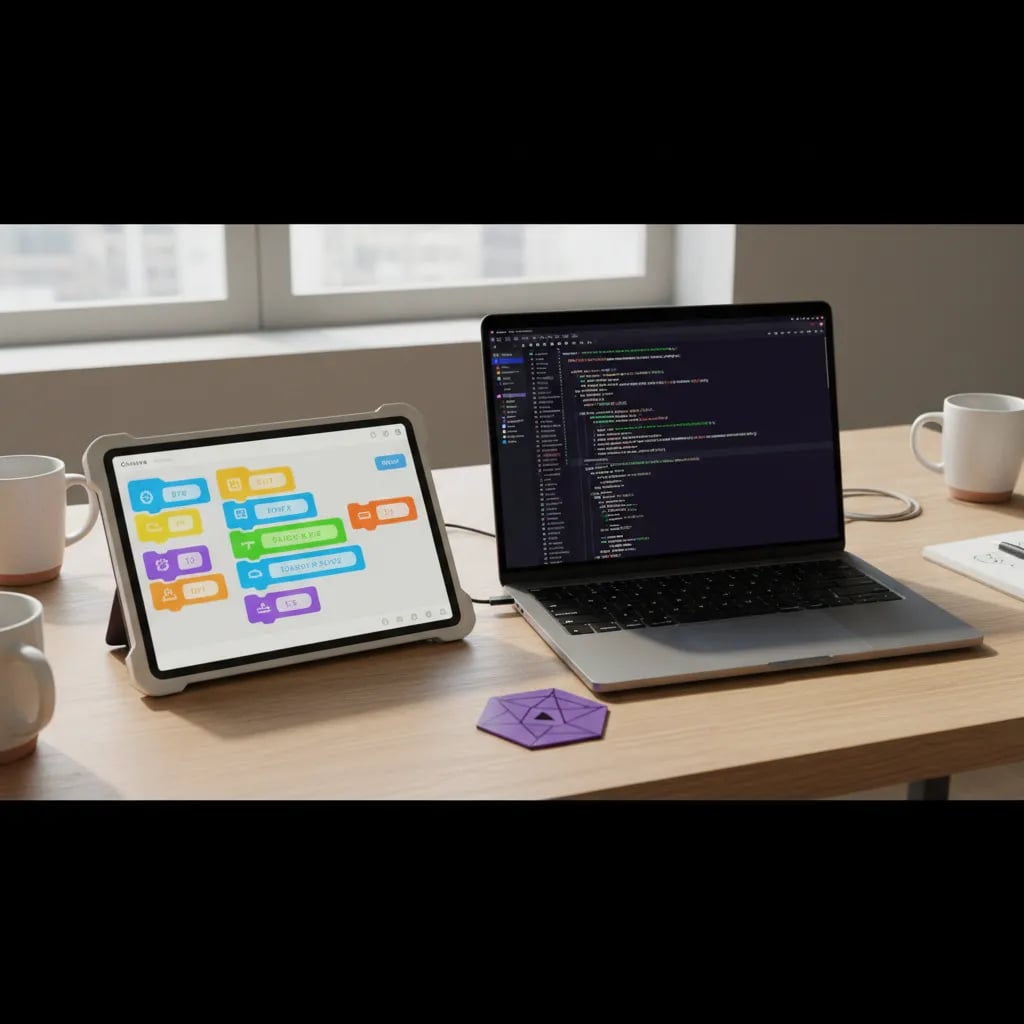
Instead of typing commands, your child snaps together colorful blocks that fit like Lego pieces. Each block is an instruction: "move 10 steps," "wait 1 second," "repeat 5 times." Finished projects can be published to the Scratch community, where other children play them and open the blocks to see how they were made.
- Ideal age: 6 to 9 years old. Younger children can begin with ScratchJr, the tablet version released in 2014 by Tufts University together with MIT, designed for ages 5 to 7 and usable before a child reads fluently.
- What they create: simple games, animations, interactive stories, digital cards.
- Strengths: it eliminates typing errors, gives immediate visual results, and keeps motivation high because the child sees their creation come to life in seconds.
If you'd like to dig deeper, read what Scratch is and how it works step by step.
What is Python?
Python is a text-based programming language used by professionals, and one of the easiest to read for beginners. Here the child does write code, but with a syntax so clean that many instructions read almost like plain English. It is the same language used at Google, Netflix, and NASA, which makes it a tool that keeps growing alongside your child for years rather than a toy they outgrow.
- Ideal age: from age 10 (or earlier, if they already read and write fluently).
- What they create: more complex games, useful programs, automations, first artificial intelligence projects, and data analysis.
- Strengths: it's a real-world language with a clear professional payoff, and it develops attention to detail and text-based logic.
We have a complete guide to Python for kids if this is the next step.
What is the difference between Scratch and Python?
The difference is how instructions are written and who uses them. Scratch, built at the MIT Media Lab and launched in 2007, uses drag-and-drop blocks and sprites, so a six-year-old can finish a working game before learning to touch-type. Python uses typed text and runs real products in industry. Scratch wins on early accessibility, Python on professional reach.
| Aspect | Scratch | Python |
|---|---|---|
| Type | Visual, block-based | Text (you write code) |
| Created by | MIT Media Lab, led by Mitchel Resnick, 2007 | Guido van Rossum, 1991 |
| Ideal age | 6 to 9 years old | 10 years and up |
| Learning curve | Very gentle, immediate results | More demanding, requires solid reading and writing |
| What you can create | Games, animations, stories | Apps, automations, AI, data analysis |
| Professional use | Educational (not used in industry) | Very high (one of the most in-demand languages) |
How should you read this table? Scratch wins on accessibility and early motivation; Python wins on future potential and real-world use. That's exactly why they don't contradict each other: one prepares the ground and the other builds on it. The right question is almost never "which one?" but "when each one?"
Which one should my child learn first?
As a general rule, Scratch first and Python later. Children aged 6 to 9 start with Scratch, because blocks remove the typing barrier and let them concentrate on logic. Between 10 and 12, a child who has already used Scratch is ready to move on to Python. From 13 up, starting straight with Python is a perfectly valid option, since the visual stage adds less at that age.
- Ages 6 to 9: start with Scratch, no question. At this age, writing code would be a barrier; blocks let the child focus on what matters: the logic. If your child is 5 or 6 and not yet reading, ScratchJr is the gentler entry point.
- Ages 10 to 12: if they've already done Scratch, this is the ideal moment to move on to Python. If they've never coded but read and write with ease, they can start directly with Python.
- Ages 13 and up: going straight to Python is a perfectly valid option; at this age, the transition from a visual tool no longer adds as much.
Why does Scratch first make Python easier later? Because the hard concepts in programming, loops, conditionals, variables and events, are the same in both. Scratch lets the child master them visually, without wrestling with syntax at the same time. By the time they reach Python, they already understand what a loop is; they just learn how to write it. It's like learning to think in a language before learning to spell it.
If you're interested in seeing the full range, here's an overview of the most recommended programming languages for kids by age.
When should you make the transition from Scratch to Python?
Most children move from Scratch to Python around age 10, but the signs matter more than the birthday. The jump makes sense once the child builds Scratch projects with loops and conditionals unaided, reads and writes fluently, and starts asking how real apps and games are made. Until those signs line up, more time with blocks is usually the better investment.
- Have mastered Scratch projects and start to get bored or look for bigger challenges.
- Read and write fluently, without typing being too much of a struggle.
- Ask how "the real stuff" is made: apps, websites, more serious video games.
- Are 10 or older and already understand loops, conditionals, and variables in Scratch.
- Feel frustrated by the limits of blocks and want more control over what they create.
If you see two or three of these signs together, it's a good time. And it's perfectly fine if they want to keep using Scratch alongside Python for a while: the transition can be gradual, not an overnight switch.
Conclusion: it's not a competition, it's a journey
Scratch and Python aren't rivals; they're two stages of the same journey. Scratch, created at the MIT Media Lab under Mitchel Resnick and opened to the public in 2007, lights the spark and teaches kids to think logically. Python takes that foundation and turns it into a real skill for the future. For almost any child the route is clear: blocks first, text later, always at the child's own pace.
What matters isn't which language they choose, but that they start creating, making mistakes, and solving problems. That mindset, not the language, is the real gift they'll carry for life.
Where can a child learn Scratch and Python?
A child can learn Scratch and Python in live online classes that follow exactly that order: blocks first, text later, with a teacher who decides when the jump makes sense. It works better than tutorials alone, because someone corrects mistakes and adjusts the pace to each child. At Algonova that route from Scratch to Python is built into the coding course for kids, and you can start with a free coding class to see where your child stands.