Roblox Studio for Kids: How to Start Making Their Own Games (Age, Phone or Laptop)
Learn Coding14 min read
Learn Math

Nadia Rahmawati
Math Curriculum Team, Algonova
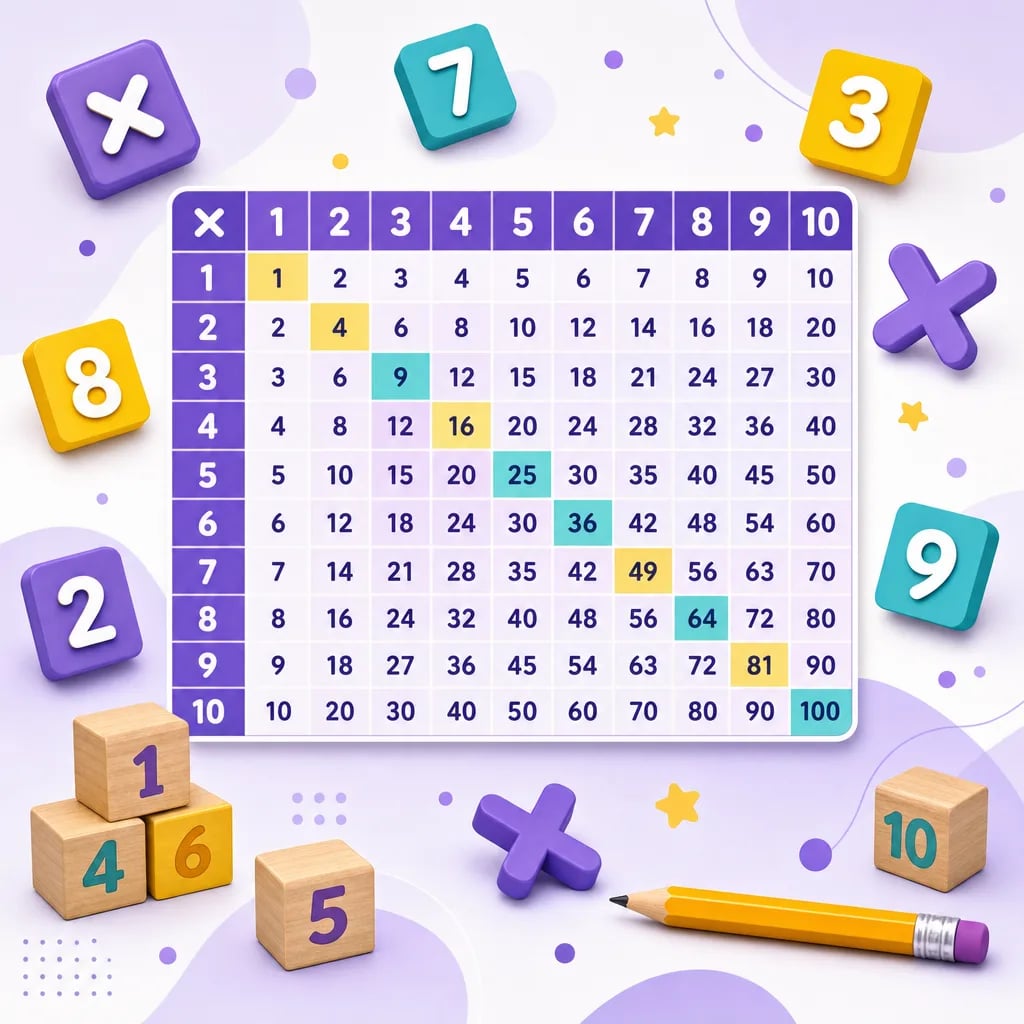
A multiplication table is a grid of the products of the numbers 1 to 10, and the fastest way for a primary-schooler to memorize it isn't blind rote but patterns: master ×2, ×5, and ×10 first, and the rest follow within 4-6 weeks with 15 minutes of daily practice. This guide gives you the full 1-10 multiplication table, 7 quick tricks per number, and worked examples, written for parents of children aged 7-10.
Algonova is an online course platform for coding, math, AI, and design for kids aged 5-17, with 1,000,000+ alumni across 97 countries since 2016. Classes are held live with certified teachers in Private (1 student), Mini (2-4 students), and Group (up to 10 students) formats, not pre-recorded videos.
A multiplication table lists the products of two numbers. The version primary-schoolers use most is a 10 × 10 grid: rows and columns run from 1 to 10, and each cell is the product. Many parents call it the "1-100 multiplication table" because the largest result is 10 × 10 = 100, so the whole table runs from 1 to 100.
The 100 here doesn't mean a child must memorize multiplication up to the number 100. It means the 100 facts inside a 10 × 10 grid (from 1×1 to 10×10). There are indeed a hundred cells, but half are duplicates thanks to the commutative property (3 × 4 equals 4 × 3). So a child really only needs to truly memorize about 55 unique facts, not a hundred.
Under Indonesia's Kurikulum Merdeka from Kemendikbudristek, multiplication is introduced in Grade 2 (phases A/B): ×2, ×5, and ×10 first, then ×3 through ×10 in Grade 3. So this table isn't a one-night target but a step-by-step roadmap across two or three school years.
My son panicked at the 1-to-100 table, saying 'that's a hundred, no way I can memorize it'. When I showed him half of it is just repeats and there's a finger trick for the 9s, he calmed down right away. Two weeks later he knew up to the 5 table while playing cards.
Dewi, mother of Bima (Grade 3), Surabaya
Tricks only stick when they're used to solve problems. Here are four examples with step-by-step solutions.
Example 1: 7 × 8 = ? This is the fact that trips kids up most. Use decomposition: 7 × 8 equals 8 × 8 minus one group of 8. 8 × 8 = 64, then 64 - 8 = 56. So 7 × 8 = 56.
Example 2: 6 × 9 = ? Use the ×10-then-subtract trick: 6 × 10 = 60, then subtract one group of 6, so 60 - 6 = 54. Check with the digit sum: 5 + 4 = 9, the signature of the ×9 table. Correct, 6 × 9 = 54.
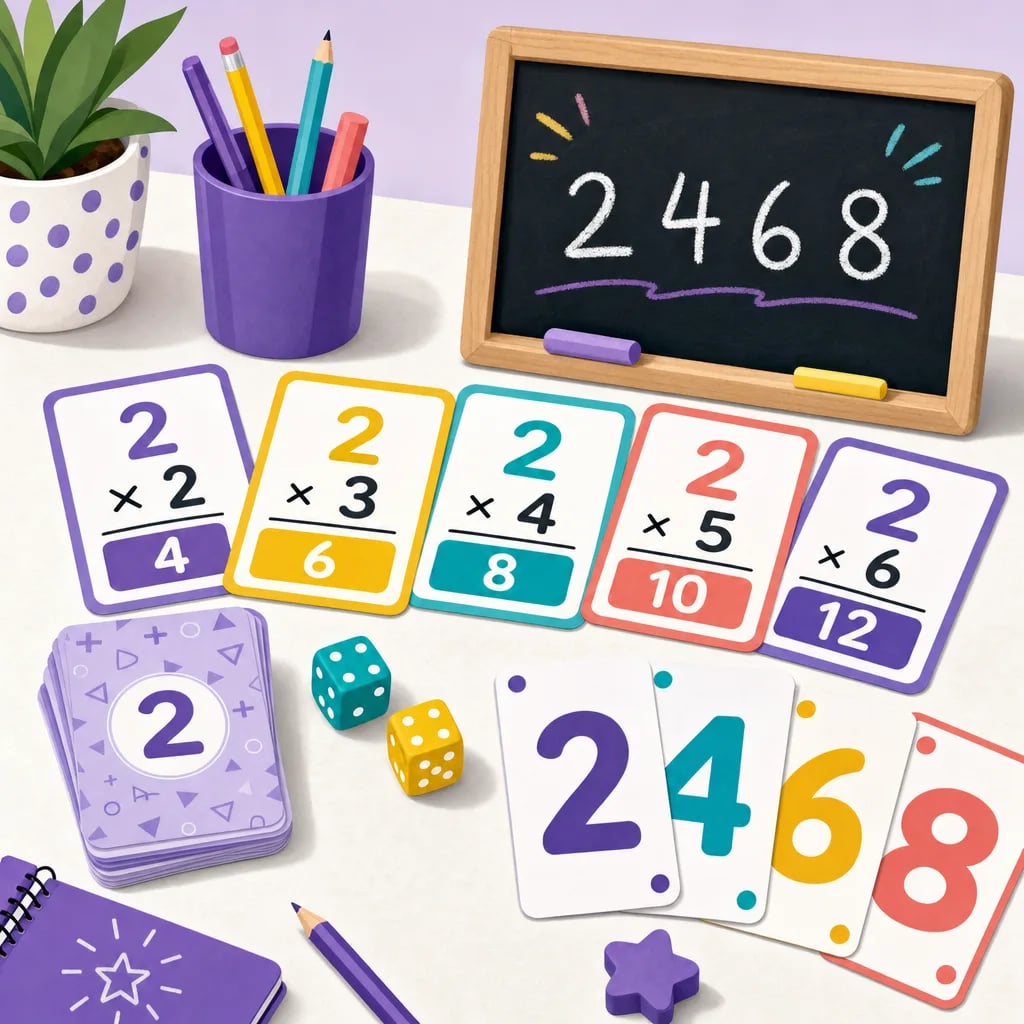
Example 3: A word problem. There are 8 pencil boxes, each holding 6 pencils. How many pencils in total? Turn the sentence into multiplication: 8 groups of 6, that is 8 × 6 = 48 pencils. The key to word problems is finding "how many groups" and "how many in each group".
Example 4: 12 × 4 = ? For numbers above 10, break them into easy parts: 12 × 4 = (10 × 4) + (2 × 4) = 40 + 8 = 48. This breaking-apart is called the distributive property, and it's an important foundation before column multiplication in Grade 4.
Kids I ask to draw 4 × 6 as an array almost always remember the answer longer than those who only memorized it. The multiplication table isn't about how fast you can recite, but about seeing the pattern.
Pak Andi, math teacher at Algonova
With consistent 15-minute daily practice, most children memorize the 1-10 multiplication table in 4-6 months, and can become fluent in one table per week for the patterned ones like ×2, ×5, and ×10. What speeds things up isn't practice duration but understanding patterns before memorizing. A child who understands that multiplication is repeated addition can reconstruct an answer when they forget, so the memory lasts far longer. This kind of step-by-step thinking is also trained in coding. See Algonova's coding classes for ages 5-17, or try a free math diagnostic so your child starts at the right level.
Here is the 1 to 10 multiplication grid. How to read it: pick a number in the top row and one in the left column, then find where they meet. For example, column 7 meeting row 6 gives 42.
| × | 1 | 2 | 3 | 4 | 5 | 6 | 7 | 8 | 9 | 10 |
|---|---|---|---|---|---|---|---|---|---|---|
| 1 | 1 | 2 | 3 | 4 | 5 | 6 | 7 | 8 | 9 |
The key to fast memorization is attacking the table from the most patterned to the hardest. Here is the order and the tricks.
1. The ×2, ×4, ×8 tables - the doubling trick. ×2 is adding a number to itself (6 × 2 = 6 + 6 = 12). ×4 is double ×2: work out ×2 first, then double it. For 6 × 4, start from 6 × 2 = 12, then double to 24. ×8 is double ×4. So once a child gets good at doubling, three tables open at once.
2. The ×5 table - the 0 and 5 pattern. ×5 results always end in 0 or 5, alternating: 5, 10, 15, 20, 25. The clock trick helps too: the numbers on a wall clock (5 minutes each) are exactly the multiples of 5.
3. The ×10 table - just add a zero. 7 × 10 = 70. This is the easiest table and great for building a child's confidence first.
4. The ×9 table - finger trick and digit sum. Spread 10 fingers. For 9 × 3, fold the third finger: the fingers on its left (2) are tens, on its right (7) are units, giving 27. Another pattern: every ×9 result has a digit sum of 9 (2+7=9, 3+6=9, 4+5=9).
5. The ×3 and ×6 tables. Practice ×3 with skip-counting: 3, 6, 9, 12. ×6 is double ×3: work out ×3 first, then double it. For 6 × 4, start from 3 × 4 = 12, then double to 24. A child strong in ×3 gets ×6 almost for free.
6. The ×7 table - save it for last. ×7 is the hardest table because it has the fewest patterns. Good news: once every other table is mastered, the only truly new facts in ×7 are 7×7, 7×8, and 7×9. The rest were practiced from the reverse side (7×3 equals 3×7).
A child doesn't need to conquer the whole table at once. The most efficient order: ×2, then ×5 and ×10, then ×4, ×3, ×6, ×8, ×9, and finally ×7. Each table is mastered to fluency before moving to the next.
A proven daily routine takes just 15 minutes: 3 minutes of skip-counting as a warm-up, 7 minutes of one trick or game (cards, dice, Lego arrays), and 5 minutes of retrieval with mixed flashcards. The key is consistency, not duration: 15 minutes a day beats an hour once a week. Research from Purdue University (Karpicke & Roediger, 2008) shows that recall through retrieval strengthens memory 2-3 times more effectively than simply re-reading the table.
Want your child guided directly by a certified teacher?

Algonova worldwide
Contact
Whatsapp: +62 21 50996971
Email: info@algonova.id
Address
| 2 | 2 | 4 | 6 | 8 | 10 | 12 | 14 | 16 | 18 | 20 |
| 3 | 3 | 6 | 9 | 12 | 15 | 18 | 21 | 24 | 27 | 30 |
| 4 | 4 | 8 | 12 | 16 | 20 | 24 | 28 | 32 | 36 | 40 |
| 5 | 5 | 10 | 15 | 20 | 25 | 30 | 35 | 40 | 45 | 50 |
| 6 | 6 | 12 | 18 | 24 | 30 | 36 | 42 | 48 | 54 | 60 |
| 7 | 7 | 14 | 21 | 28 | 35 | 42 | 49 | 56 | 63 | 70 |
| 8 | 8 | 16 | 24 | 32 | 40 | 48 | 56 | 64 | 72 | 80 |
| 9 | 9 | 18 | 27 | 36 | 45 | 54 | 63 | 72 | 81 | 90 |
| 10 | 10 | 20 | 30 | 40 | 50 | 60 | 70 | 80 | 90 | 100 |
Before asking a child to memorize, show them the table is full of patterns. Once a child sees the pattern, the amount to memorize drops sharply.
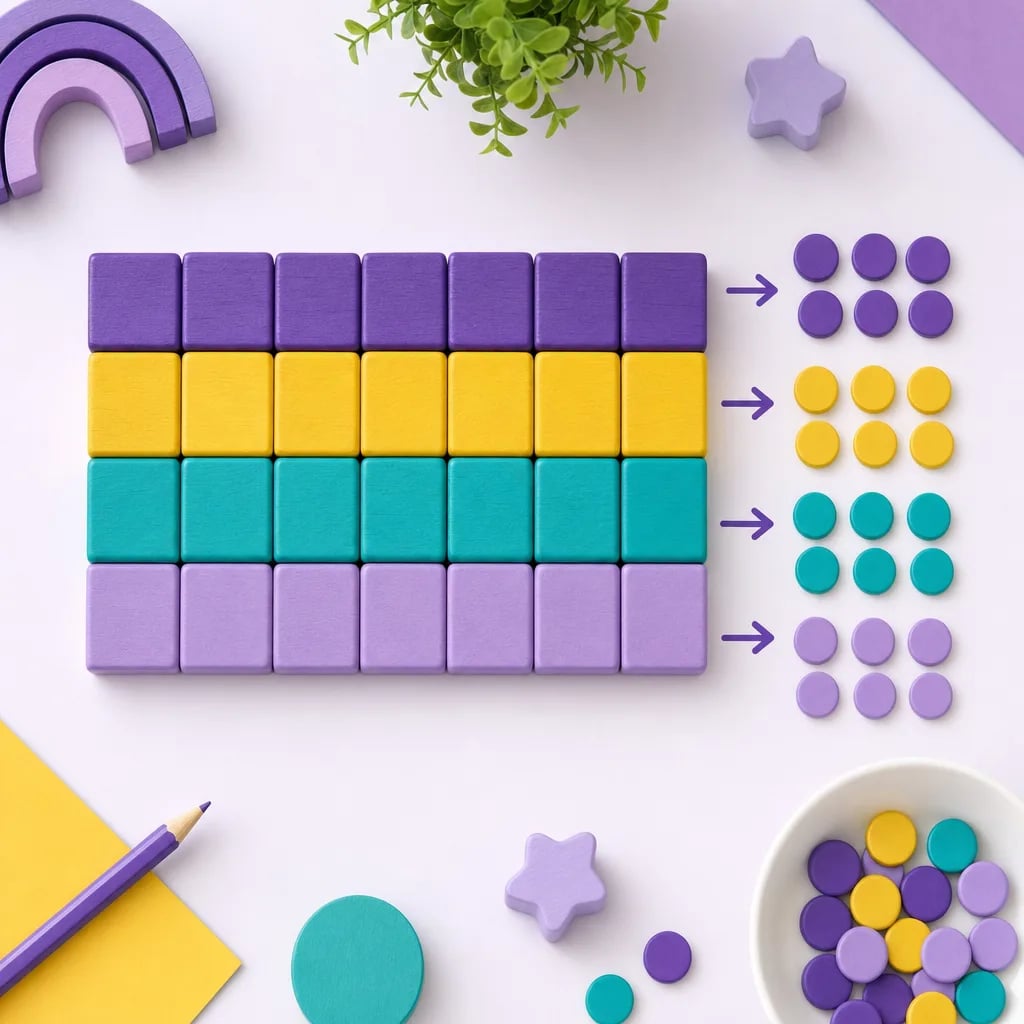
Notice the diagonal from top-left to bottom-right: 1, 4, 9, 16, 25, 36, 49, 64, 81, 100. Those are the square numbers (a number times itself). Notice too that the table is symmetric across that diagonal, because 3 × 4 and 4 × 3 are the same. Once a child understands this symmetry, they realize half the table is a repeat, and the load immediately halves.
7. The ×11 table - twin digits. For 11 × 1 to 11 × 9, just write the digit twice: 11 × 4 = 44, 11 × 7 = 77. This trick makes a child feel like an expert in a minute.
The fastest way isn't memorizing a hundred facts at once, but attacking the table from the most patterned. Start with x2 (doubling), then x5 (the 0 and 5 ending pattern), then x10 (just add a zero). These three tables can be mastered in one to two weeks and immediately cover most of the grid. After that come x4, x3, x6, x8, x9, and finally the hardest, x7. With 15 minutes of daily practice, most children become fluent in the 1-10 tables within 4-6 months. The key is daily consistency, not occasional long sessions.
Not exactly. The 1-100 multiplication table means the 10 x 10 grid whose largest result is 10 x 10 = 100, so it contains 100 facts. But half are duplicates because 3 x 4 equals 4 x 3, so a child really only needs to memorize about 55 unique facts. For primary-schoolers, the realistic target is tables 1 to 10. Tables 11 and 12 are a bonus, usually from Grade 4 onward.
The finger trick is the one kids love most. Spread 10 fingers; for 9 x 3, fold the third finger: the fingers on its left (2) are tens, on its right (7) are units, giving 27. This works for 9 x 1 through 9 x 10. A supporting pattern: every result in the 9 table has a digit sum of 9, for example 3 + 6 = 9 in 36, or 4 + 5 = 9 in 45. A child can use this pattern to check their own answers.
Ideally in Grade 2, around ages 7-8, in line with Kurikulum Merdeka phase B. The prerequisite is that the child is fluent in repeated addition (5 + 5 + 5 = 15) and can group objects into equal groups. If that foundation is weak, strengthen skip-counting and grouping before introducing the multiplication symbol. Some children are ready earlier in Grade 1, usually visible in how easily they arrange objects into rows and columns.
That's a sign the child has only memorized, not understood. A child who only memorized knows 6 x 7 = 42 but gets confused when the question becomes 6 boxes with 7 marbles each, how many marbles. The fix is returning to the concept: ask the child to draw the multiplication as an array or groups, then turn word problems into the questions how many groups and how many in each group. Practicing word problems 2-3 times a week usually closes this gap within a month.
Coworking Area, Gedung IT 6 Lantai Dasar, Nongsa Digital Park, Jalan Hang Lekiu, Kelurahan Sambau, Kecamatan Nongsa, Batam, Indonesia Directorate General of Consumer Protection and Trade Compliance – Ministry of Trade of the Republic of Indonesia. WhatsApp Ditjen PKTN: 0853-1111-1010.
PT Algonova Indonesia Cerdas All rights reserved 2026