Kumon Fees in Indonesia 2026: Monthly Cost, How the Method Works, and Online Alternatives
Parent Guides12 min
Learn Math

Nadia Rahmawati
Math Curriculum Team, Algonova

Fast mental math for kids is built most effectively through 7 simple mental tricks - making ten, rounding then adjusting, up to the finger trick for the 9 times table - practiced 10 minutes a day. This guide is for parents of children aged 6-13 who want their child to calculate without fingers and without a calculator: faster, more accurate, and more confident when facing a problem.
Algonova is an international technology school for kids aged 5-17: 1,000,000+ alumni across 97 countries, 10+ years of experience, Private (1 student), Mini (2-4 students), and Group (up to 10 students) formats, and a 4.9-star rating with certified teachers.
Mental math is the ability to solve calculations in your head - without long written steps, without fingers, and without a calculator. The point is not memorizing answers; it is recognizing number patterns and picking the most efficient shortcut for each problem.
A child who calculates quickly is not necessarily "gifted" at math. They have simply mastered a few strategies anyone can learn: breaking numbers into easy parts, finding pairs that make 10, and rounding a number before correcting the result. If your child still counts on their fingers at age 8-9, it is not a sign of weakness - just a sign no one has shown them the tricks yet.
Before the tricks themselves, one thing matters: speed grows from understanding, not pressure. Pushing a child to be fast before they grasp the concept is often one of the reasons kids struggle with math.
These seven tricks are ordered from the most basic to the more challenging. Teach them one at a time, not all at once - a child needs to master one trick until it is automatic before moving to the next.
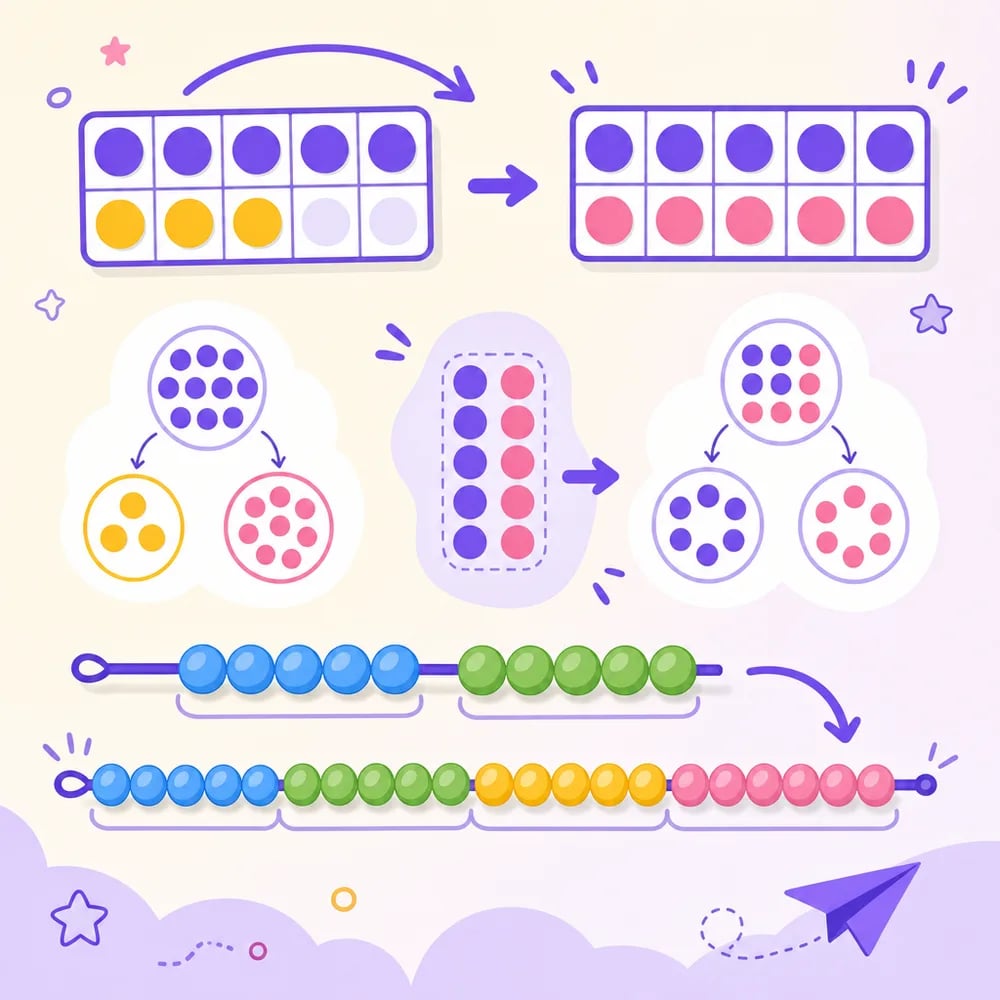
This is the foundation of all fast calculation. A child needs to know by heart the pairs of numbers that add up to 10: 1+9, 2+8, 3+7, 4+6, 5+5. Once these pairs are automatic, an addition like 8+5 becomes easy: take 2 from the 5 to turn 8 into 10, 3 is left, and the answer is 13. Practice with flashcards or math games for kids until the child no longer has to think.
At school, kids are taught to add from the right (ones first). For mental math, left to right is actually easier. Take 46 + 37: add the tens first (40 + 30 = 70), then the ones (6 + 7 = 13), then combine (70 + 13 = 83). This feels more natural because the child knows the rough answer from the very first digit.
The 9 times table often feels scary. The trick: hold up all ten fingers. For 9 x 4, fold down the fourth finger from the left. The fingers to the left of the fold are the tens (3 fingers), the fingers to the right are the ones (6 fingers), giving 36. This works for 9x1 through 9x10 and instantly makes a child feel capable.
To multiply a two-digit number by 11, add its two digits and place the sum in the middle. Take 11 x 24: take the 2 and 4, add them (2 + 4 = 6), and slot it in the middle to get 264. Kids usually love this one because the result feels like magic.
No child is born fast at math. They get fast because they know the tricks - and tricks can be taught to anyone.
Rina Hartanti, Algonova Math Teacher
For numbers that are "almost round," round first and correct afterward. Take 47 + 29: turn 29 into 30 (easier), compute 47 + 30 = 77, then subtract the 1 you added, giving 76. The same works for subtraction: 63 - 19 = 63 - 20 + 1 = 44. This trick is especially handy for shopping and working out change.
Multiplying by 5 is the same as multiplying by 10 then halving. Take 5 x 18: compute 10 x 18 = 180, halve it to 90. In reverse, dividing by 5 means divide by 10 then double. A child who is fluent with 10s will feel like this trick is "cheating" but perfectly legal.
To square a number ending in 5 (like 25, 35, 45): take the tens digit, multiply it by the next number up, then stick 25 on the end. Take 35 x 35: take the 3, multiply by 4 (3 x 4 = 12), append 25 to get 1225. This advanced trick suits kids aged 11-13 who already have strong multiplication.
These seven tricks are not a substitute for understanding concepts; they are shortcuts once the concept is solid. For a more complete learning framework, see our guide on effective ways to learn math.
Ten minutes every day beats one hour once a week. A child's brain needs repetition, not a marathon.
Rina Hartanti, Algonova Math Teacher
Fast mental math for kids is not about talent, it is a combination of seven learnable tricks: making ten, adding left to right, the finger trick for 9s, multiplying by 11, rounding then adjusting, multiply/divide by 5, and squaring numbers ending in 5. Teach them one at a time, practice 10 minutes a day, and match the trick to the child's age.
Most important: speed grows from confidence, and confidence grows from practice that feels like play, not pressure. A child who enjoys the process will start calculating quickly on their own.
Want your child to practice fast mental math with a teacher's guidance and a play-based approach? Try a free Algonova class - a short diagnostic session that maps your child's ability before deciding on next steps.
Teach a child fast mental math by starting with the number pairs that add up to 10, then adding one new trick each time the previous one is automatic. Practice 10 minutes a day in a game-like mood, not a test, and use real objects like number cards or a ten-frame for younger kids. Avoid forcing speed before the child understands the concept, because pressure actually slows them down. For children aged 6-13, a combination of seven simple mental tricks is usually enough to get them calculating without fingers and without a calculator within a few weeks of consistent practice.
The key to fast calculation is not one long session a week, it is a short daily practice. Ten minutes a day is far more effective than an hour on the weekend, because the brain needs spaced repetition to make a trick automatic.
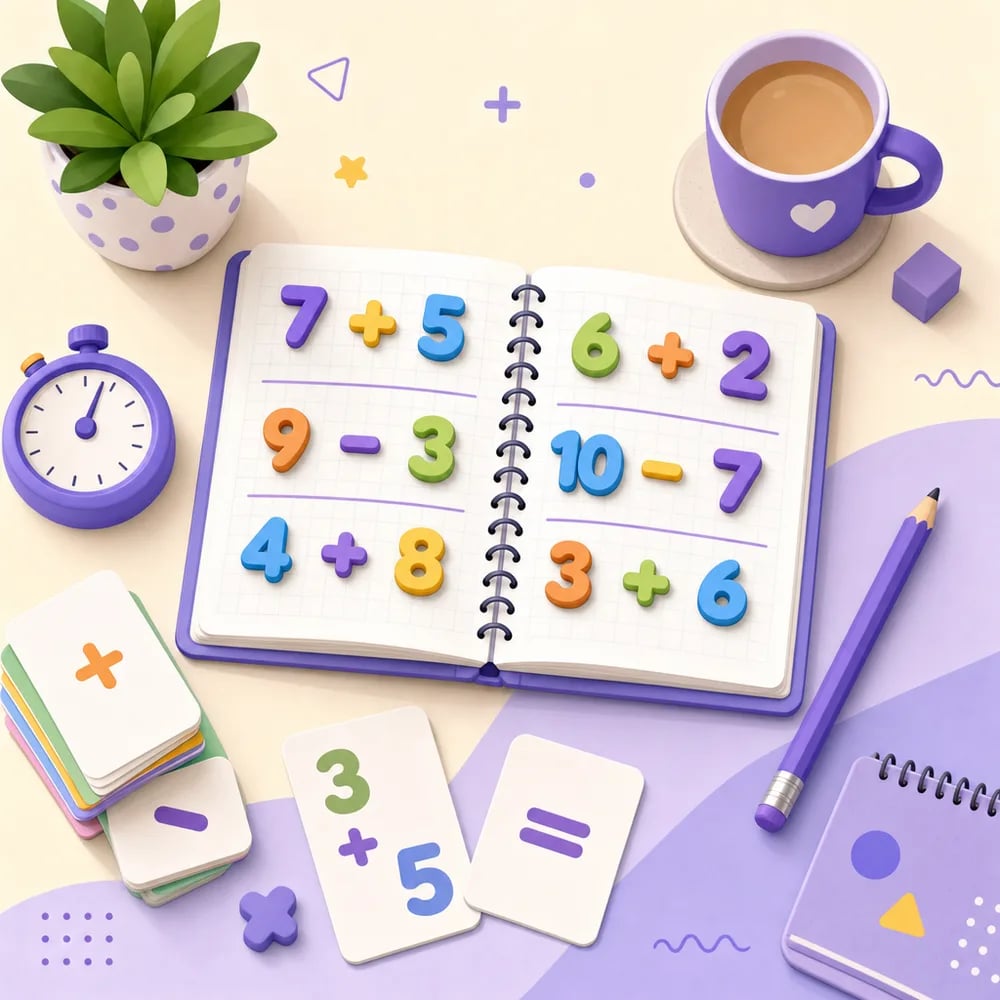
A 10-minute routine to try: 3 minutes reviewing number bonds with flashcards, 4 minutes of mixed problems (addition and multiplication), 3 minutes of a "speed challenge" with a stopwatch. Make it feel like a game, not a test.
Some kids need more than home practice. Consider professional help if a child still counts on fingers for simple problems at age 9-10, gets unusually anxious when asked to calculate quickly, or falls far behind classmates despite regular practice.
The right first step is not immediately adding tutoring, but mapping exactly where the difficulty lies through a math assessment for kids. For a structured method focused on speed, many parents also compare the

Algonova worldwide
Contact
Whatsapp: +62 21 50996971
Email: info@algonova.id
Address
A child can start with the basics of fast mental math from age 5-6, beginning with the number pairs that add up to 10 using real objects like beads or cards. More complex tricks like multiplying by 11 or squaring numbers ending in 5 are better left until ages 10-13, once basic multiplication is solid. What matters is not the exact age but the order: one trick mastered until automatic before moving to the next.
No, finger counting is a normal and important stage at ages 5-7 because it helps a child build the concept of numbers. The thing to watch is if a child still relies heavily on fingers for simple problems at age 9-10. That is not a sign of weakness, but a sign they have not been taught mental strategies like making ten or rounding. The solution is not banning fingers, but teaching the tricks that make fingers unnecessary.
With consistent 10-minute daily practice, most kids start looking faster within 2-4 weeks for a single trick. Mastering all seven tricks automatically usually takes a few months, depending on age and how strong their multiplication base is. Daily consistency matters far more than session length. The first sign of progress is usually not speed, but the child starting to attempt calculations in their head without immediately reaching for paper or a calculator.
Fast mental math through tricks focuses on understanding number patterns and logical shortcuts, while the abacus trains visualization of a tool and Kumon emphasizes repetition through graded worksheets. All three can make a child fast, but through different paths. Mental tricks are the most flexible because they need no tools and apply directly to daily life. No single method fits every child, so many parents compare these options before deciding.
If a child gets stressed, drop the speed element for a while and focus on understanding. Anxiety usually comes from feeling judged, not from inability. Replace the stopwatch with a relaxed game, praise their thinking process rather than just the right answer, and avoid comparing them to siblings or friends. If the stress persists even without time pressure, consider an assessment from an experienced teacher to rule out an underlying learning difficulty.
Coworking Area, Gedung IT 6 Lantai Dasar, Nongsa Digital Park, Jalan Hang Lekiu, Kelurahan Sambau, Kecamatan Nongsa, Batam, Indonesia Directorate General of Consumer Protection and Trade Compliance – Ministry of Trade of the Republic of Indonesia. WhatsApp Ditjen PKTN: 0853-1111-1010.
PT Algonova Indonesia Cerdas All rights reserved 2026