Sakamoto Math Fees in Indonesia 2026: Cost Items, How to Calculate and Online Alternatives
Which Is Better?10 min
Learn Math

Nadia Rahmawati
Math Curriculum Team, Algonova
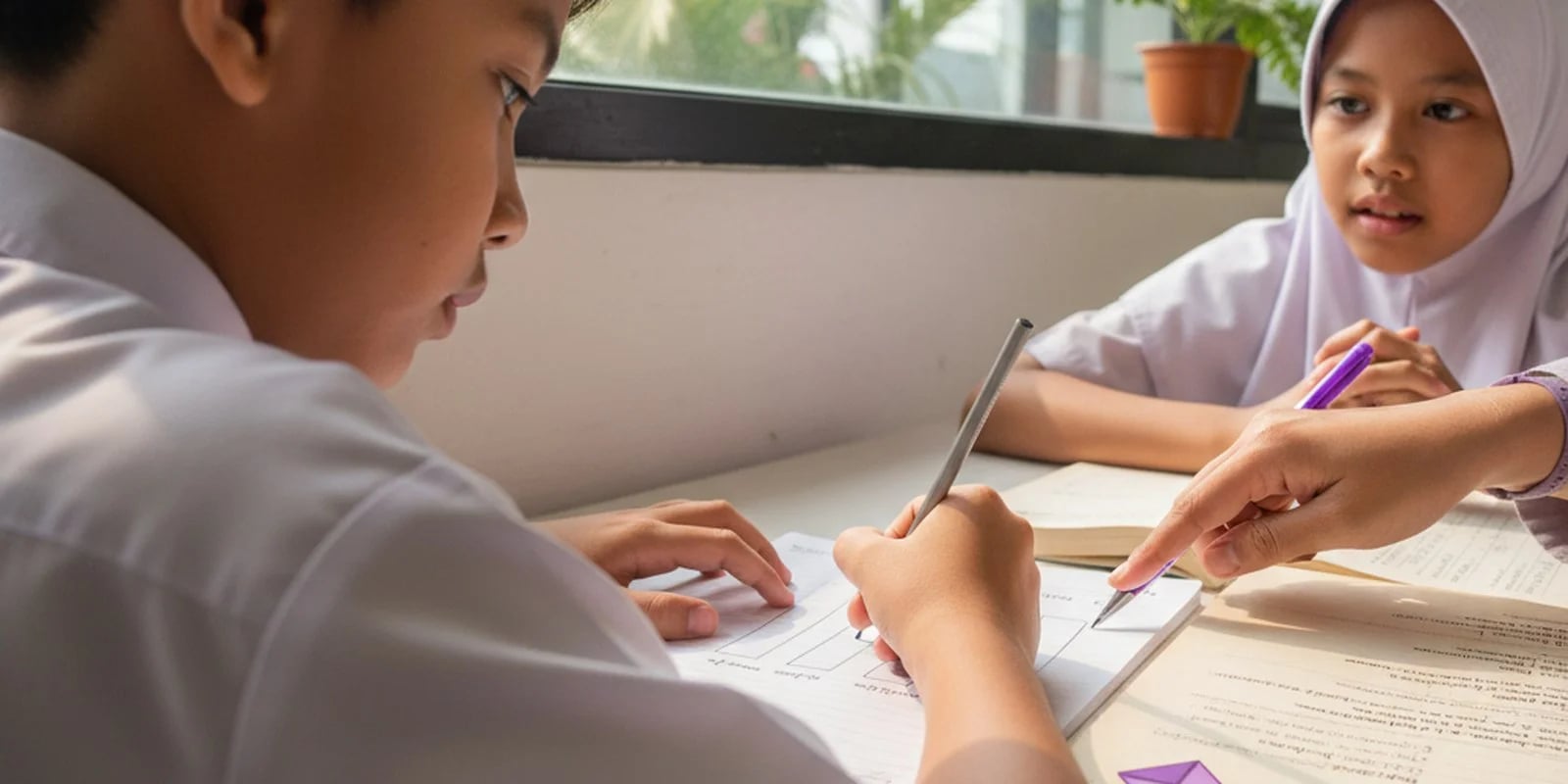
The Sakamoto method is a Japanese approach to mathematics focused on solving word problems — by turning the problem into a visual diagram, and then translating that diagram into an equation.
Among the four methods popular in Indonesia — sempoa, Kumon, jarimatika, and Sakamoto — Sakamoto is the only one that targets understanding rather than calculation speed. That makes it an answer to an entirely different problem.
We do not teach the Sakamoto method, so this explanation is neutral — including on where its scope ends.
The method's official brochure states its focus quite firmly:
"THE SAKAMOTO METHOD focuses more on developing a student's ability to understand the problem (be able to understand) rather than merely the ability to answer it (able to answer)."
The difference between understanding a problem and being able to answer it sounds subtle, but for parents it is an extremely practical one. A child can know the entire multiplication table by heart and still not know whether to multiply or divide when the problem is written as a story.
The sequence runs roughly like this:
The heart of the method is in the second step. The diagram forces the child to show what they have understood from the problem — and if their understanding is wrong, it becomes visible in the drawing straight away, before they have calculated anything at all.
This is useful for parents too: the child's drawing shows where they got lost. A test score only shows that they got lost.
Word problems are the most common place where Indonesian children lose marks in mathematics — not because the arithmetic is wrong, but because they do not know which operation the problem is asking for.
This is also exactly what reasoning-type assessments test. A child who calculates quickly but cannot read the problem will still struggle, however fast the arithmetic.
Like other methods, Sakamoto's scope is specific.
It handles word problems. It is not a complete mathematics curriculum: geometry, statistics, advanced algebra, and trigonometry are not covered by it as a system. A child who is generally behind in mathematics will not catch up on Sakamoto alone.
| What it trains | A good fit if your child… | |
|---|---|---|
| Sakamoto | Understanding word problems | Can calculate, but is lost reading the problem |
| Sempoa | Mental calculation speed | Understands, but is slow and often miscalculates |
| Jarimatika | Basic calculation speed | Is slow at arithmetic in the early SD years |
| Kumon | Persistence and independence | Needs the discipline of regular practice |
| Maths tutoring | Full conceptual understanding | Does not understand the material in general |
A full discussion of all four is in our guide comparing arithmetic methods. For each one separately: sempoa and jarimatika.
Take one word problem from your child's book, then ask them to do just one thing: explain what the problem is asking, without calculating.
We are the last row of the table: Algonova maths classes build full conceptual understanding rather than a single technique. Reading and unpacking word problems is part of that, but not the whole of it.
Three formats are available — Private (1 student), Mini (2-4 students), and Group (up to 10 students) — all online with a teacher, with diagnostic tests as the programme runs and regular reports for parents. There are separate programmes for primary school children and for the SMP–SMA years.
If your child's difficulty really is only with word problems and the concepts are already solid, a specialised approach like Sakamoto is indeed more targeted — and we will say so.
The easiest way to find out which problem it is, is a free diagnostic class of about 60 minutes with a teacher. There is no obligation to continue afterwards.
Sumber: brosur resmi Metode Sakamoto (sakamoto.id).
The Sakamoto method is a Japanese approach to learning mathematics that emphasises understanding logic and solving problems through diagrams rather than memorising formulas. It suits children who can already read and think in steps, usually from primary school age upwards. The same foundation of logical thinking is also trained in coding. To start learning in a structured way, see the programme options on the Algonova classes page, or try a free math diagnostic so your child can start at the right level.
The Sakamoto method is a Japanese approach to mathematics focused on solving word problems. The child turns the problem into a visual diagram or set of boxes, then translates that diagram into a mathematical equation. Its official brochure states that the focus is on developing the ability to understand the problem (be able to understand) rather than merely the ability to answer it (able to answer).
Sakamoto targets the understanding of word problems. Sempoa and jarimatika train calculation speed. Kumon trains persistence through daily worksheets. Of the four methods popular in Indonesia, Sakamoto is the only one aimed at understanding rather than speed — so they answer different problems.
For a child who can already calculate but gets lost when the problem is written as a story — not knowing whether to multiply or divide. If a child does not understand the underlying concepts at all, or is generally behind in mathematics, Sakamoto will not fix it, because its scope is specific to word problems.
Take one word problem from your child's book and ask them to explain what the problem is asking, without calculating. If they can explain it but calculate wrongly, the issue is speed and accuracy. If they cannot explain what is being asked, the issue is understanding the problem.
No. Sakamoto handles word problems, not a complete mathematics curriculum. Geometry, statistics, advanced algebra, and trigonometry are not covered by it as a system.

Algonova worldwide
Contact
Whatsapp: +62 21 50996971
Email: info@algonova.id
Address
Coworking Area, Gedung IT 6 Lantai Dasar, Nongsa Digital Park, Jalan Hang Lekiu, Kelurahan Sambau, Kecamatan Nongsa, Batam, Indonesia Directorate General of Consumer Protection and Trade Compliance – Ministry of Trade of the Republic of Indonesia. WhatsApp Ditjen PKTN: 0853-1111-1010.
PT Algonova Indonesia Cerdas All rights reserved 2026