How to Teach Multiplication Tables to Kids: 5 Proven Methods

Learn Math8 min
Learn Math

Nadia Rahmawati
Math Curriculum Team, Algonova
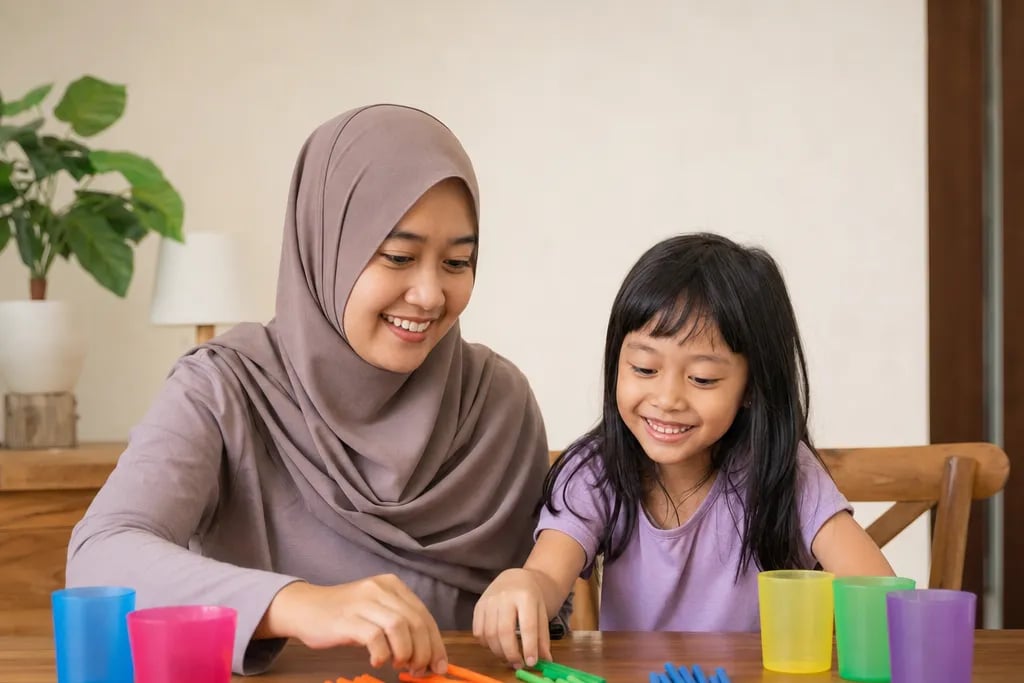
How to teach addition and subtraction to kids in grades 1-2 comes down to three stages: real objects first, then pictures or a number line, and only then written numbers. Start small with marbles or spoons, move to the "make ten" trick, then teach place value so carrying and borrowing make sense. Ten minutes a day is enough, as long as it is regular and a wrong answer never ends in a scolding.
Kids in grades 1-2 learn fastest in a fixed order: hold the objects, look at the picture, then write the numbers.
Many parents open a workbook straight away, and the child memorises "7 + 5 = 12" without knowing where 12 comes from. The Learning Objectives and Sequence for Mathematics, Phase A on the belajar.id platform builds grade 1 the same way: children count with objects first, and the + and = symbols come later.
| Stage | Tools | Example 6 + 3 | Move up when |
|---|---|---|---|
| 1. Real objects | Marbles, spoons, buttons | Take 6 marbles, add 3, count them all | The child can do it alone |
| 2. Pictures | Dots, a number line | Draw 6 circles and 3 circles, count | 5 problems in a row are correct |
| 3. Numbers | Paper and pencil | Write 6 + 3 = 9 | The child can explain the method in words |
A simple rule of thumb: if a child gets two in a row wrong at one stage, go back one stage. Going back is normal, the foundation just needs time to set.
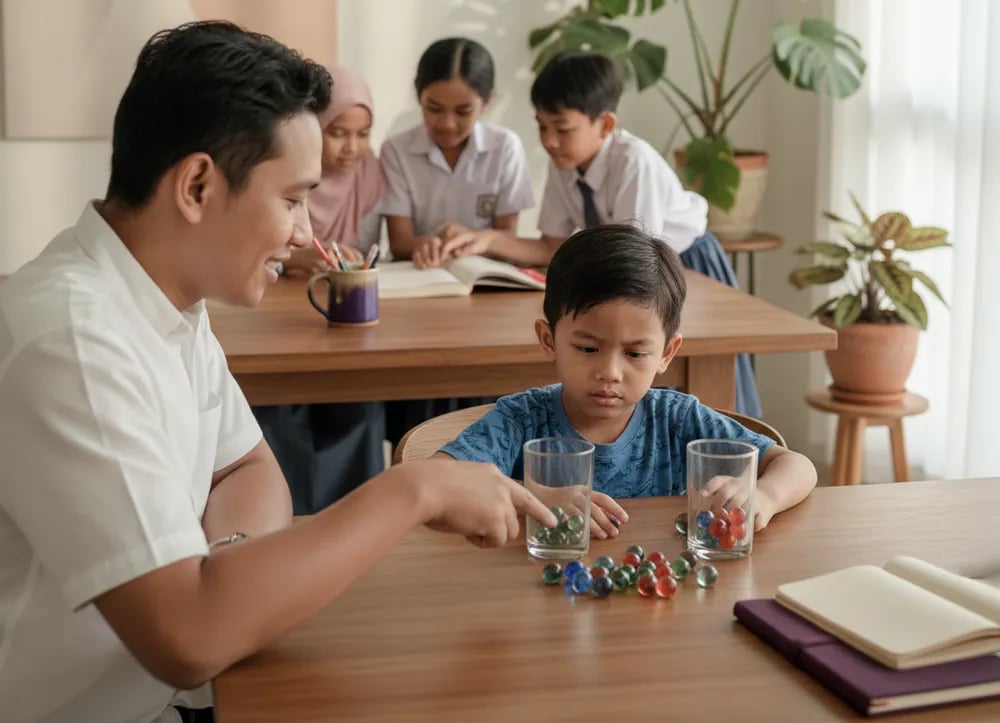
Addition up to 10 gets easy once a child knows "number pairs": two numbers that together make a given number, such as 10 = 3 + 7.
Give the child 10 marbles and two cups. Ask them to split the marbles between the cups in every way they can find: 1 and 9, 2 and 8, 3 and 7, 4 and 6, 5 and 5. Write the results side by side. The child will see for themselves that 3 + 7 and 7 + 3 give the same answer.
A second trick for a problem like 2 + 7: start from the bigger number. The child says "seven, eight, nine" instead of counting from one. It saves time and cuts counting slips.
A problem like 8 + 5 is easiest when you fill one number up to 10 and then add what is left.
Practise it with an egg carton or a box that holds 10:
Repeat with 9 + 4, 7 + 6 and 8 + 7 until the child can explain why they split the second number. This lasts longer than memorising, because the child has a way to find the answer when they forget.
A child who understands why does not need to memorise hundreds of facts, only a handful of patterns.
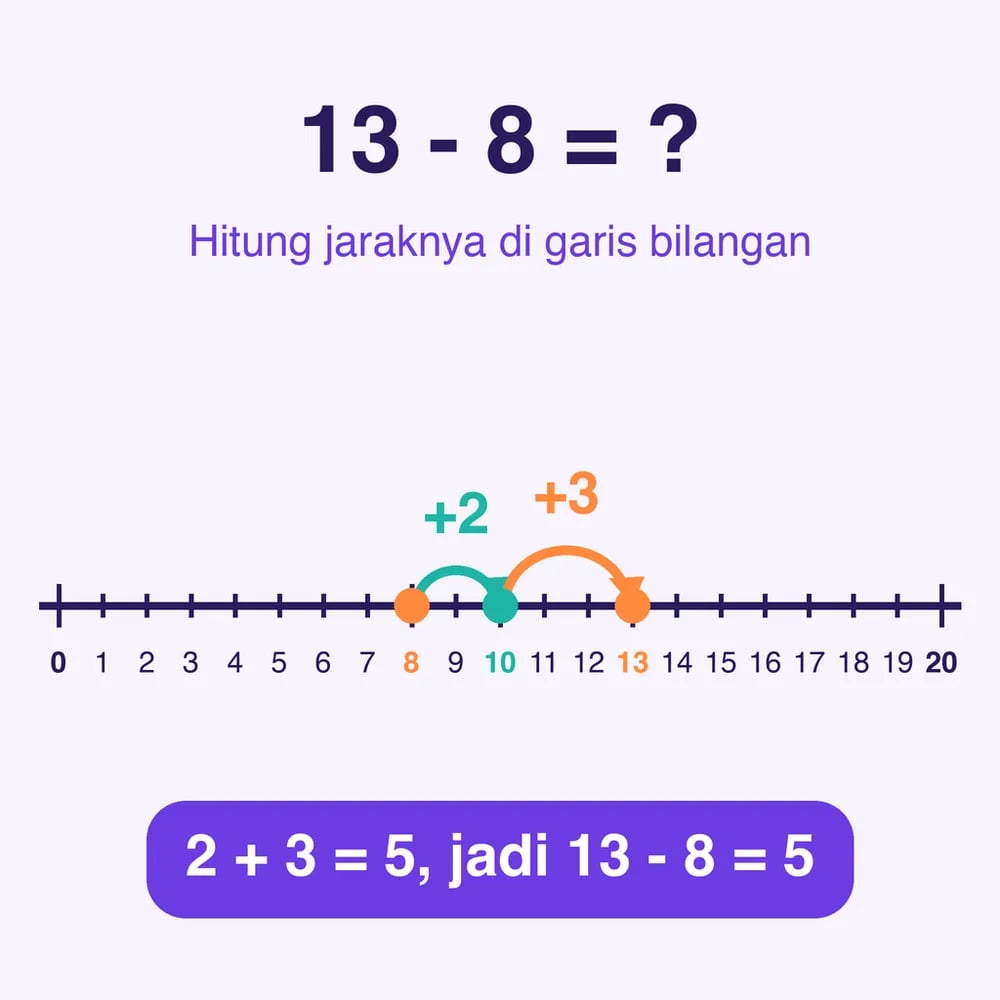
Subtraction is often easier to understand as "how far apart are these numbers" than as "taking away", especially for a problem like 13 - 8.
Draw a number line and mark 8 and 13. Ask the child to jump from 8 to 10 (2 jumps), then from 10 to 13 (3 jumps). The answer is 2 + 3 = 5. This uses the same "make ten" trick as addition, so there is no new strategy to learn.
Then show that addition and subtraction come as a pair. The three numbers 5, 8 and 13 form a "fact family": 5 + 8 = 13, 8 + 5 = 13, 13 - 8 = 5 and 13 - 5 = 8. A child who sees this link can check a subtraction answer by adding back.
A child is ready to learn carrying and borrowing only after they understand that 10 ones make 1 ten, so do not jump to written column addition before that.
The easiest tool is drinking straws. Bundle 10 straws as one "ten" and leave the rest loose as "ones". You can also use play money: a Rp 10,000 note as a ten and Rp 1,000 coins as ones.
Addition example, 47 + 38. The child has 4 bundles and 7 loose straws, plus 3 bundles and 8 loose. The loose straws now number 15, which is 1 new bundle and 5 loose. The bundles are 4 + 3 + 1 = 8. The answer is 85. On paper, that "1 new bundle" step is what we call carrying.
Subtraction example, 52 - 27. There are only 2 loose straws, but we need to take away 7. Open one bundle, so the loose straws become 12 and 4 bundles remain. Loose: 12 - 7 = 5. Bundles: 4 - 2 = 2. The answer is 25. Opening the bundle is what we call borrowing.
Word problems get easier when the child draws the story before deciding whether to add or subtract.
Some worksheets suggest keywords: "more" means add, "lost" means subtract. This often fails. Try this one: "Dina has 12 stickers. Dina has 4 more stickers than Raka. How many stickers does Raka have?" The word "more" is there, but the answer is a subtraction: 12 - 4 = 8.
A safer habit is three questions: who is in the story, what do we know, what are we asked. Then the child draws a box or circle for each person. From the drawing it is usually clear whether the missing part is the total or one of the parts.
A short session every day is easier to keep going than one long weekend session, especially when the child is already tired after school.
One pattern to try:
Stop when time is up, even if the child still has energy. Tomorrow they will start more willingly. If you want more game ideas, see math games for kids, and for faster counting tricks there is a guide to quick mental math. Once addition and subtraction feel smooth, the next step is teaching multiplication.
Most errors in addition and subtraction trace back to weak place value.
| Mistake | Example | How to fix it |
|---|---|---|
| Forgetting to carry | 47 + 38 = 715 | Go back to the straws and have the child bundle 10 loose ones into 1 |
| Taking the small digit from the big one regardless of position | 52 - 27 = 35 | Ask the child to write "2 - 7, is that enough?" and then borrow |
| Trouble with zero | 40 - 7 = 47 | Use play money: 4 notes of Rp 10,000, swap 1 note for 10 coins |
| Adding when the problem says subtract | 13 - 8 = 21 | Draw the story and ask "what are we looking for?" |
If your child still slips after 2-3 weeks of regular practice, or starts refusing every time they see a math problem, find out which part is really not solid yet. Causes vary, and we cover them in why kids struggle with math. Difficulty that persists despite practice is worth raising with the class teacher, and dyscalculia in children explains the signs.
For ages 6-7, the Math Starters track for grades 1-2 covers addition and subtraction up to 100 with a visual approach close to the one above. Kids in grades 3-6 who are still behind on the basics can look at math classes for grades 3-6. Classes start with a free diagnostic of about 60 minutes, groups of up to 10 kids, from Rp 102,000 per lesson.
Children are usually ready for simple addition and subtraction around age 5-6, and in primary school the topic formally starts in grade 1. There is no rigid age rule. Readiness matters more: the child counts objects one by one correctly, knows that a bigger number means more, and can say the numbers up to 10 without skipping. If the child still miscounts objects, strengthen that first before introducing plus and minus signs. You can start with daily life, such as counting spoons on the table or shoes on the rack. For preschool-age kids, the guide on math for kindergarten kids covers what is worth doing before grade 1. Do not rush into column problems until the child is comfortable with numbers up to 20 and understands what the equals sign means.
Yes, especially in grade 1. Fingers are the first counting tool a child always has, and kids who are forbidden to use them often just guess. What you want is a gradual shift: from counting one by one, to counting on from the bigger number, to number pairs of 10 that are simply known. For 7 + 3, a child who knows the pairs of 10 will answer without raising a finger. You can mark the progress with a challenge: "Guess first, then check with your fingers." If a grade 3 child still counts one by one for problems up to 20, the number pairs need practising again. For a more structured finger method, read about jarimatika. The goal stays the same: fingers help at the start, then understanding slowly takes over.
Addition first, but do not wait until it is perfect before introducing subtraction. Children usually get addition up to 10 within a few weeks, then can begin subtraction up to 10 while still practising addition up to 20. The best approach is to teach both as a pair, for example through the fact family of 3, 4 and 7: 3 + 4 = 7, 4 + 3 = 7, 7 - 3 = 4 and 7 - 4 = 3. The child then sees that subtraction is addition turned around, and one known fact opens four problems. If a child is fluent in addition but stuck on subtraction, go back to the number line and have them jump from the small number up to the big one. This takes only a few minutes a day and often works better than repeating the same problems without knowing where the confusion sits. Knowing 6 + 4 = 10 also gives 10 - 4 and 10 - 6.
Quick recall is useful, but it works best as a result of understanding rather than a shortcut around it. Facts such as 6 + 4 or 7 + 3 should be quick, because they appear inside almost every bigger problem. The lightest way to practise is card games, rolling two dice, or quick guessing on a car ride. Do not turn memorising into a punishment or a race against the clock, because a tense child gets slower and starts avoiding math. For facts not yet remembered, the child can still fall back on the "make ten" trick. With practice, answers that were once worked out slowly become automatic. As a rough guide, a grade 2 child is fluent enough if most facts up to 10 come without long thinking. If not, just add more short games and do not add written problems.
Explain with things the child can hold, not with rules. Use straws bundled in tens or play money. For carrying, show that when the ones reach 10, we swap them for one bundle or one note of ten. For borrowing, show that when the ones are not enough, we open one bundle into 10 ones. Let the child do the swapping with their own hands many times before moving to paper. Many kids memorise "borrow one from the neighbour" without knowing what it means, then get lost when a zero shows up. Once the child understands why, a problem like 40 - 7 stops being confusing, because they know to open one bundle out of the four. Start with two-digit problems that need only one carry or borrow. Then move up to three digits and problems that need two.
All three can help, and the answer depends on your goal. Jarimatika and the abacus train fast calculation with a physical aid. Online math classes focus on understanding concepts and follow the school syllabus. If your goal is for the child to feel comfortable with addition and subtraction at school, what matters most is place value and strategies for splitting numbers, and both can be practised at home or in class. A fuller comparison is in abacus, jarimatika, or online math. One thing worth checking whichever you choose: can the child explain the method, not only answer fast? A child who can explain usually copes better when the problem changes shape, for example from a number problem to a word problem. If unsure, start by checking where your child is now, then pick the tool that fits that need, not a trend.
For grade 1, 10 minutes a day is enough, and 15 minutes is the upper limit for grade 2. The attention span of a 6-7 year old is short, so a longer session lowers the quality of practice. It is better to stop while the child still wants more than to push until they get annoyed. Vary the format: cards one day, a number line on the floor another, play money in a pretend shop on another. Keep one focus per session, for example only addition past 10. If the child looks tired after school, move practice to a weekend morning. After 3-4 weeks, check three things: is the child answering faster, trying more readily, and able to explain the method? If nothing has changed at all, review the stage you are using, because the child may need to go back to real objects.
Consider classes if you have practised regularly for 3-4 weeks with the methods above and the child still struggles, or if you cannot sit with them every day. Other signs: the child starts saying "I am bad at math", refuses homework, or math marks drop in two tests in a row. Before choosing a class, find out which part is weak, so lessons do not repeat what the child already knows. At Algonova, classes start with a free diagnostic of about 60 minutes that shows results by topic, and then the teacher builds a learning plan. Groups have up to 10 kids and prices start from Rp 102,000 per lesson. The guide on when a child should start math classes helps you weigh the timing, and math assessment for kids explains how to check the level at home. Bring the child's latest homework to the first session, so the teacher can see the error pattern right away.

Algonova worldwide
Contact
Whatsapp: +62 21 50996971
Email: info@algonova.id
Address
Coworking Area, Gedung IT 6 Lantai Dasar, Nongsa Digital Park, Jalan Hang Lekiu, Kelurahan Sambau, Kecamatan Nongsa, Batam, Indonesia Directorate General of Consumer Protection and Trade Compliance – Ministry of Trade of the Republic of Indonesia. WhatsApp Ditjen PKTN: 0853-1111-1010.
PT Algonova Indonesia Cerdas All rights reserved 2026