Roblox Studio or Scratch: Which First for an 8 to 10 Year Old?

Learn Coding8 min read
Learn Math

Nurul Izzati
Math Curriculum Team, Algonova Malaysia
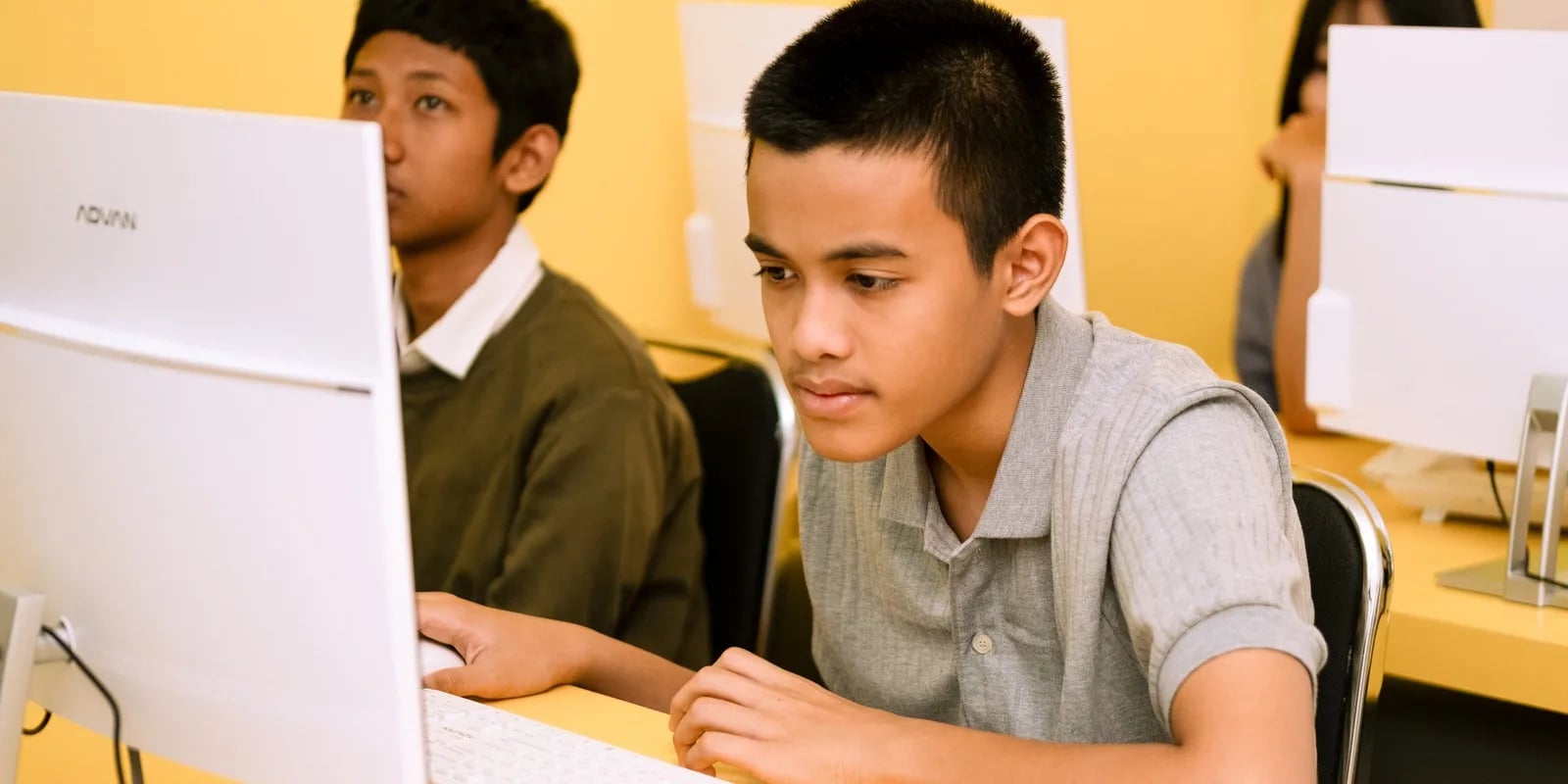
UASA Year 4 maths is the end-of-session school assessment for Standard 4 pupils in Malaysia, and it tests the whole Year 4 KSSR syllabus: numbers up to 100,000, fractions, decimals and percentages, money, time, measurement, shapes, coordinates and data. Below are 8 sample questions with worked answers, the usual paper format and a 4-week revision plan you can run at home.
Most English-speaking parents meet the term UASA for the first time on a school notice written in Bahasa Melayu. UASA stands for Ujian Akhir Sesi Akademik, which means the end-of-session test. There is no national exam at the end of primary school any more, so the UASA paper and your child's classroom assessment are now the main signals of how they are doing in maths.
Year 4 is a good year to pay attention. The numbers get bigger, percentages appear for the first time, and the 24-hour clock comes in. Children who fall behind here usually feel it in Year 5. This guide is written in English for parents, but remember that the real paper is set in Bahasa Melayu (or Chinese or Tamil in SJKC and SJKT schools), so some practice should happen in the language your child is tested in.
We wrote it from what Algonova's maths teachers see in Malaysian Year 4 classes. Algonova has taught 1,000,000+ students aged 6 to 17 in 97 countries.
The UASA Year 4 maths assessment usually has two written papers: Paper 1 with objective questions and Paper 2 with subjective questions where your child must show the working. Each school sets its own paper under Ministry of Education guidelines, so the number of questions and the time allowed can vary between schools. Ask the class teacher for the exact format.
| Part | Malay name | What it checks | How your child answers |
|---|---|---|---|
| Paper 1 | Kertas 1 | Quick recall and calculation across all topics | Picks one answer from several options |
| Paper 2 | Kertas 2 | Problem solving and reasoning | Writes the steps and the final answer |
| Classroom assessment | PBD | Mastery of each topic during the year | Teacher records a level from TP1 to TP6 |
Paper 2 is where Year 4 children lose the most marks. Many of them can find the right answer in their head but have never practised writing the steps down. Teachers give method marks for the working, so a child who writes "50 - 37 = 13, so the change is RM13" can still score something even if the final number is wrong.

The PBD part runs all year. Your child's teacher gives a mastery level, called Tahap Penguasaan or TP, for each topic. If you see TP2 or TP3 on a report and are not sure what it means, our guide to what TP2 means in maths explains the six levels.
Year 4 is the first year many children have to explain their answer on paper. Practise saying the steps out loud first, and the writing gets much easier.
Aina Rashid · Education Specialist at Algonova Malaysia
These 8 questions cover one topic each from the Year 4 KSSR maths syllabus, at roughly the level of a real UASA paper. Let your child try each one first, then go through the working together. On the real paper the questions are in Bahasa Melayu, so it helps to know a few key words such as jumlah (total), beza (difference) and baki (balance or change).
1. Numbers and operations. A durian farm in Raub picked 36,480 durians in June and 27,950 in July. How many durians did it pick in the two months? Answer: 36,480 + 27,950 = 64,430 durians.
2. Place value. What is the value of the digit 7 in 47,215? Answer: The 7 is in the thousands place, so its value is 7,000.
3. Fractions. Siti ate 3/8 of a pizza and her brother ate 2/8. What fraction of the pizza is left? Answer: 3/8 + 2/8 = 5/8 eaten. 8/8 - 5/8 = 3/8 left.
4. Decimals and percentages. Write 0.35 as a percentage. Answer: 0.35 = 35/100 = 35%.
5. Money. A school bag costs RM37.50 and a pencil case costs RM12.90. Amir pays with a RM100 note. How much change does he get? Answer: RM37.50 + RM12.90 = RM50.40. RM100 - RM50.40 = RM49.60.
6. Time. A bus leaves Ipoh at 2:45 p.m. and the trip takes 2 hours 30 minutes. What time does it arrive? Write the answer in the 24-hour system. Answer: 2:45 p.m. + 2 h 30 min = 5:15 p.m. = 1715 hours.
7. Shapes and area. A rectangular classroom notice board is 6 m long and 2 m wide. Find its perimeter and area. Answer: Perimeter = 6 + 2 + 6 + 2 = 16 m. Area = 6 x 2 = 12 m².
8. Data handling. A bar chart shows 24 pupils chose nasi lemak, 18 chose mee goreng and 9 chose roti canai. How many more pupils chose nasi lemak than roti canai? Answer: 24 - 9 = 15 more pupils.
In our classes, questions 5 and 6 are the ones Year 4 children get wrong most often. In question 5 the mistake is usually in the subtraction from RM100. In question 6 it is converting 5:15 p.m. into 1715.
Any topic from the Year 4 KSSR maths syllabus can appear in UASA, so your child needs to cover all of them, not just the last chapter taught. The table below lists each topic with the skill most likely to be tested and the mistake we see most often.
| KSSR Year 4 topic | What your child should be able to do | Common mistake |
|---|---|---|
| Whole numbers to 100,000 | Read, write, round and calculate with five-digit numbers | Losing a zero in numbers like 40,705 |
| Fractions, decimals and percentages | Add and subtract fractions, convert decimals to percentages | Adding the bottom numbers of fractions |
| Money | Add, subtract and give change up to RM100,000 | Borrowing wrongly when subtracting sen |
| Time | Use the 24-hour system, work out durations | Treating an hour as 100 minutes |
| Measurement | Convert between mm, cm, m, km, g, kg, ml and l | Forgetting to convert before calculating |
| Shapes and space | Find perimeter and area of squares and rectangles | Mixing up perimeter and area |
| Coordinates | Read and plot points on a grid | Reading the up axis before the across axis |
| Data handling | Read pictographs and bar charts | Misreading the scale of the chart |

If the full syllabus is new to you, our Year 4 maths syllabus guide goes through each chapter with examples. For children who still count on their fingers for multiplication, start with times tables tricks for kids before moving on to money and measurement, because almost every Year 4 topic relies on fast multiplication.
Not sure which topics to start with? Book a free class and a teacher will check your child's level in one session.
When a Year 4 child mixes up perimeter and area, it is rarely a memory problem. They have usually never measured anything real. Get a tape measure out and let them try.
Aina Rashid · Education Specialist at Algonova Malaysia
The best way to prepare for UASA Year 4 maths is 15 to 20 minutes of practice, three or four times a week, for about 4 weeks, focused on your child's two or three weakest topics. Short sessions work better than a long weekend cram, because a 9- or 10-year-old loses focus after about 20 minutes.
A 4-week plan that fits around school and homework:
Everyday life gives you free practice: ask your child to work out the change at the pasar malam, read the train times at the LRT station in 24-hour format, or measure a room for a new carpet. These small tasks cover money, time and area without feeling like homework.
If your child gets anxious before tests, our guide on helping a child with maths anxiety has practical steps. And if you would like a teacher's view, Algonova's online maths classes run in groups of up to 10 children, from RM 48 per lesson, and start with a free 60-minute trial class.
UASA (Ujian Akhir Sesi Akademik) is the end-of-session test that Malaysian primary schools give in each subject, including Year 4 maths. It became the main written test of primary school after UPSR was abolished in 2021, and it is set and marked by each school under Ministry of Education guidelines rather than by a national exam board. For maths, it usually has an objective paper and a subjective paper. Alongside UASA, teachers run classroom assessment (PBD) all year and record a mastery level from TP1 to TP6 for each topic. So your child's maths result in Year 4 comes from two places: the written UASA paper and the teacher's ongoing assessment. Ask the class teacher how the two are reported at your child's school. If your child changed schools this year, check again, because two schools can report the same subject quite differently.
The UASA Year 4 maths paper is set in the language of instruction of your child's school: Bahasa Melayu in national schools (SK), and Chinese or Tamil in SJKC and SJKT schools. Some schools that run the Dual Language Programme (DLP) teach maths in English and may set the paper in English too, so check with the teacher. For most children, the maths itself is not the hard part. The problem is reading a word problem quickly in the test language. If you practise at home in English, also go through the key words in Malay, such as jumlah (total), beza (difference), baki (balance), luas (area) and perimeter. Five minutes of vocabulary practice a week saves marks on the day. Some parents keep a small card of these words on the fridge in the weeks before the test.
There is no single national number, because each school sets its own UASA paper under Ministry of Education guidelines. Many schools follow a similar pattern: an objective paper with multiple-choice questions across all topics, and a subjective paper with fewer, longer questions where your child writes the working. The time allowed also differs from school to school. The best source is your child's class teacher or the school's exam notice, which normally lists the papers, timing and date a few weeks ahead. If the school shares a past paper, use it as a timed practice in week 4 of revision, so your child gets used to the length before the real test. Some schools also add a short oral or practical task through PBD, which does not appear on the written paper at all.
The Year 4 KSSR maths syllabus has about 8 topics. They are whole numbers up to 100,000 and the four operations; fractions, decimals and percentages; money; time, including the 24-hour system; measurement of length, mass and volume; shapes and space, including perimeter and area; coordinates; and data handling with pictographs and bar charts. Any of these can appear in UASA. Percentages and the 24-hour clock are new in Year 4, so children often need extra practice there. Our Year 4 syllabus guide breaks down each chapter with examples. A quick way to check readiness is to give your child one question from each topic and see which ones they cannot start on their own. Coordinates are new for many Year 4 children, so a few grid games at home are worth the time.
Focus on two habits: fast recall of times tables and writing out the working. Times tables matter because multiplication sits inside money, area and measurement questions. The working matters because Paper 2 gives method marks for each correct step. A good routine is 15 to 20 minutes, three or four times a week, on your child's weakest topics, with your child saying each step out loud before writing it. Keep sessions calm and praise the method, not only the answer. Use daily life for extra practice: change at the shop, train times in 24-hour format, measuring furniture. Give it about 4 weeks before you judge whether it is working. If times tables are still slow, fix that first, because it makes every other topic on this list easier to practise.
TP stands for Tahap Penguasaan, which means mastery level. Teachers use it in classroom assessment (PBD) to show how well your child has mastered each topic, on a scale from TP1 to TP6. TP1 means your child knows the basic idea, TP3 means they can use it to solve a familiar problem, and TP6 means they can apply it confidently in new situations. The level is given topic by topic, so your child can be TP5 in money and TP2 in fractions at the same time. A low TP on one topic is a signal to practise that topic, not a sign your child is weak at maths overall. Ask the teacher which topics are lowest and start there. Many schools include PBD levels in the report card or go through them at parent-teacher meetings.
Tuition makes sense if your child is still stuck on the same topics after a few weeks of practice at home, or if you do not have time to sit with them regularly. It is less useful if it only repeats worksheets your child already finds easy. Look for small groups, a teacher who asks your child to explain the steps, and a clear check of your child's level at the start. Year 4 is a good time to start, because the gaps are still small and the Year 5 syllabus builds directly on fractions, decimals and large numbers. Algonova runs live online maths classes for groups of up to 10 children, from RM 48 per lesson, with a free 60-minute trial class. Before paying for a term, ask for a trial lesson and watch how the teacher reacts when your child makes a mistake.
Because each school sets its own UASA paper, there is no official national set of past papers like there was for UPSR. Your child's school is the best source: many teachers share past papers or practice sheets before the test, so ask directly. Your child's maths textbook and activity book also follow the same KSSR syllabus, and the end-of-chapter exercises are close to the level of the real paper. You can also use the 8 sample questions in this guide as a quick check. Be careful with random PDFs online: some follow the old pre-2017 syllabus and include topics your child has not learned, which can worry them for no reason. Textbook exercises also have the advantage of using the same Malay terms your child will see on the day.
Start your child's tech journey
Book your free 60-minute trial class with an Algonova certified tutor. No payment, no obligation, just discover what your child can build.

Algonova worldwide
Contact us
Email: int_legal@alg.team
Visit us
Suite 8634, 1021 E Lincolnway, Cheyenne, WY, Laramie, US, 82001
Algonova online LLC International tech school for kids and teens