KSSR Math for Darjah 1–2: What Your Child Should Know (and How to Help at Home)
Learn Math7 min read
Learn Math

Nurul Izzati
Math Curriculum Team, Algonova Malaysia
Under Malaysia's KSSR, math in Year 3 and Year 4 (Tahun 3 dan Tahun 4) is where the real jump happens: whole numbers grow from 10,000 up to 100,000, the 6-9 times tables need to become automatic, and fractions and decimals arrive for the first time. This guide for parents of 9-10 year-olds walks through every topic, shows where children usually get stuck, and gives simple ways to help at home, plus a free 60-minute diagnostic.
If your child has just finished the early years, you already know the rhythm from our KSSR math Tahun 1-2 guide: count, add, subtract, name shapes. Year 3 and Year 4 take those same foundations and stretch them fast, with bigger numbers, longer calculations, and the first properly abstract ideas in fractions. Children who are still counting on their fingers, or shaky on place value, tend to feel the pressure here first. Below is a clear, topic-by-topic map of what's covered and how to support it at home.

In Year 3, children work with whole numbers up to 10,000, reading and writing them, understanding place value to the thousands, rounding to the nearest 10, 100 or 1,000, and spotting number patterns. Year 4 pushes the range to 100,000, applying the same skills to much larger numbers with more confident estimation.
Mastery looks like a child who can explain why 40,500 is bigger than 40,050 by pointing to the place value, not just guessing. If place value itself still feels shaky, our short guide to place value for kids explains it with examples. They can round sensibly ("about 8,000") and continue a pattern by working out the rule behind it.
At home: read big numbers off petrol prices, house prices in the news, or a car's odometer. Ask "round this to the nearest thousand" while shopping. Write a number and have your child say the value of each digit out loud.
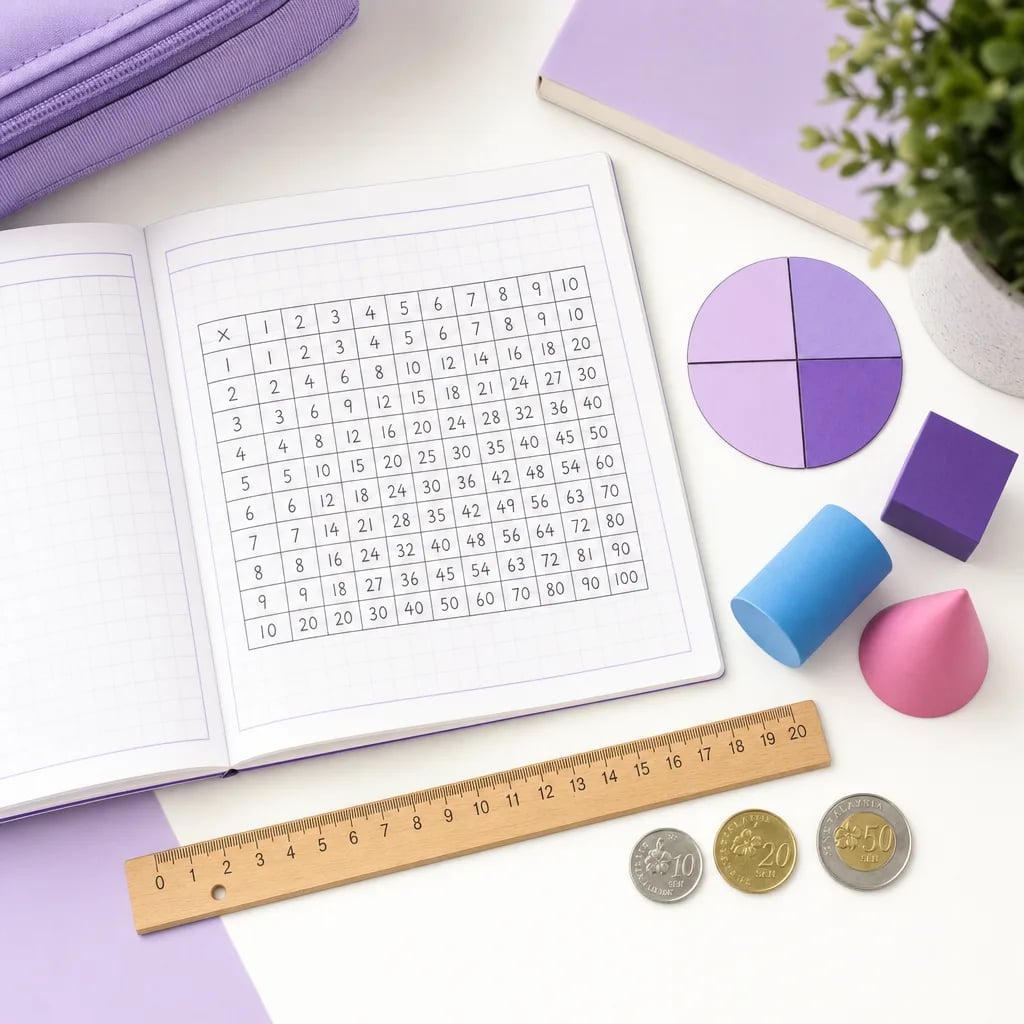
This is the topic that decides how the rest of primary math feels. In Year 3, children learn the 6, 7, 8 and 9 times tables (on top of the 2, 3, 4, 5 and 10 they already know) and start multiplying two- and three-digit numbers by a single digit. Division moves on to dividing by a single digit with remainders. By Year 4, they multiply up to four-digit numbers by one- and two-digit numbers, and divide larger numbers using the longer written methods most parents remember.
Here is the part worth knowing: almost every child who struggles with Year 4 math is really struggling with times-table recall. If the 7x and 8x facts are not automatic, long multiplication and division become slow and error-prone, and the child quietly decides they are "bad at math" when the real gap is far smaller.
At home: practise one table at a time in short bursts. Three minutes in the car beats a long worksheet. Use skip-counting and arrays (rows and columns of objects) so the facts carry meaning instead of being empty sound. For division, share things out physically and talk about the leftover as the remainder.
Times tables not quite automatic yet? A free diagnostic shows exactly which facts are missing so practice targets the real gap. Book a free Master Class.
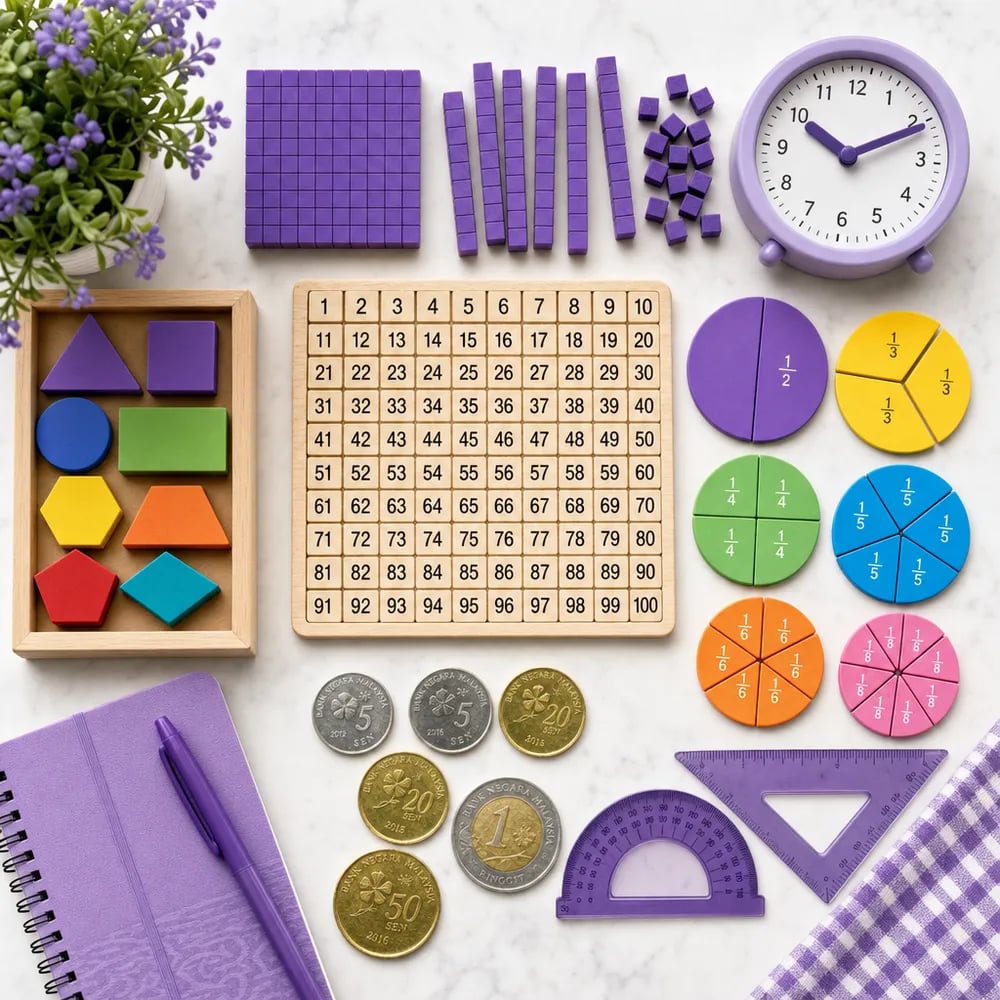
Year 3 and Year 4 introduce the idea that a number can be part of a whole, the first genuinely abstract concept many children meet. Year 3 covers proper fractions (halves, thirds, quarters, fifths and so on), comparing simple fractions, and seeing them in real objects. Year 4 adds equivalent fractions (why one-half equals two-quarters), mixed numbers, adding and subtracting fractions with the same denominator, and the first decimals, tenths and hundredths, and how they link back to fractions and to money.
Mastery is a child who can show a fraction: fold paper into quarters, shade three of them, and explain that three-quarters means three of four equal parts. Decimals click faster when tied to Ringgit, because RM2.50 is two ringgit and fifty sen, which is two and a half.
At home: cut fruit, roti or pizza into equal parts and name the fractions out loud. Use money to make decimals concrete. Fold paper to show that two quarters cover the same space as one half.
Fractions or times tables tripping your child up? See exactly which skill is missing in a free 60-minute session. Book a free Master Class.
Nearly every child who looks 'bad at Year 4 math' is really just missing automatic times tables. Fix that one gap and the whole subject gets lighter.
Algonova Math Team
Everyday math grows up in Year 3 and Year 4. Money extends to RM100 in Year 3 and RM10,000 in Year 4, with all four operations, giving change, and rounding to the nearest ringgit. Time moves from reading the clock to working with durations, the 24-hour format, and converting between hours, minutes and seconds. Measurement covers length, mass and volume of liquid, and, crucially, converting between units: metres and centimetres, kilograms and grams, litres and millilitres.

Mastery shows up in word problems: "A movie starts at 2:15 p.m. and lasts 95 minutes, when does it end?" or "You buy items for RM7.80 and pay with RM10, how much change?"
At home: cook using a scale and a measuring jug, and let your child do the converting. Time how long chores or journeys take. Handle real Ringgit at the kedai and work out the change together before the cashier does.
Geometry gets more precise. Children name and describe 2D and 3D shapes, then in Year 4 calculate the perimeter and area of squares and rectangles and explore lines of symmetry. Data handling grows from simple pictographs to reading and drawing bar charts, and answering questions from them ("how many more chose durian than mango?").
At home: measure rooms and furniture, then work out the perimeter together. Turn a quick family survey, favourite fruit or daily screen time, into a bar chart your child draws.
Four gaps cause most of the trouble in Year 3 and Year 4: times-table recall that is not automatic, regrouping ("carrying" and "borrowing") in long multiplication and division, the leap into abstract fractions, and multi-step word problems that mix operations. None of these mean a child is weak at math. They are normal pinch points, and each one is fixable once you can see exactly which is the problem.
The trap is piling on more worksheets before knowing the real gap. A child who is slow at long division because of missing 8x facts does not need more division practice, they need the 8x table.
Keep math calm, short and connected to real life, and praise the thinking rather than the answer. If your child has started to dread math or calls themselves "stupid" at it, that matters, and our guide on helping a child with math anxiety has practical steps. Many parents also wonder whether speed-drilling programmes are the fix; it is worth reading how the approaches differ in abacus vs Kumon vs conceptual math before deciding. And if you are weighing plain tuition against something that builds deeper reasoning, math tuition vs math and coding lays out the trade-offs.
In Year 3 and 4, a child who can explain why one-half equals two-quarters understands more than one who only computes the answer. That understanding is what carries them into secondary math.
Algonova Math Team
Algonova runs live, small-group online math classes with certified teachers, not pre-recorded video, aligned with the Malaysian Sekolah Rendah KSSR curriculum. The approach is visual and project-based: concepts come before formulas, and understanding is valued over memorisation. An AI diagnostic first finds your child's real gaps, the missing 8x facts or the shaky fractions, so lessons rebuild only what is actually needed instead of repeating what your child already knows.
If you would like to see where your child stands against KSSR Year 3-4 expectations, book a free 60-minute Master Class, with no obligation, and you will leave with a clear picture of strengths and gaps. Algonova teaches 1,000,000+ students across 97 countries, with 10+ years of experience and a 4.9-star rating.
By the end of Year 3, most children read and write whole numbers to 10,000, add and subtract with regrouping, know the 6 to 9 times tables, divide by a single digit with remainders, understand simple proper fractions, handle money to RM100, tell time to the minute, and measure length, mass and volume.
Proper fractions such as halves, thirds and quarters begin in Year 3. Year 4 extends this to equivalent fractions, mixed numbers, adding and subtracting fractions with the same denominator, and the first decimals in tenths and hundredths, which link directly to Ringgit and sen.
Often yes, because long multiplication and division depend on automatic times tables. If the 7 and 8 tables are not instant, larger calculations become slow and error-prone. Short daily table practice usually fixes the speed without extra pressure.
Keep it real and short: read big numbers on signs, practise one times table at a time, cut food into fractions, handle real Ringgit and work out change, and cook with a scale and jug. Praise the thinking, not just the answer, and let small mistakes happen.
Yes. Under the KSSR, the grades once called Darjah 3 and Darjah 4 are now officially labelled Tahun 3 and Tahun 4. The syllabus and the expected skills are identical, only the naming changed.
Start by finding the exact gap rather than adding more worksheets. Most Year 4 struggles trace back to shaky times tables or fractions. A free AI diagnostic can pinpoint the missing skill so your support targets the real problem, and rebuilding that one foundation usually lifts everything above it.
Blog
Start your child's tech journey
Book your free 60-minute trial class with an Algonova certified tutor. No payment, no obligation, just discover what your child can build.

Algonova worldwide
Contact us
Email: int_legal@alg.team
Visit us
Suite 8634, 1021 E Lincolnway, Cheyenne, WY, Laramie, US, 82001
Algonova online LLC International tech school for kids and teens