Online vs Physical Coding Classes in Malaysia: Which Works Better?
Course Guides7 min read
Math Education

Aina Rashid
Coding Education Specialist at Algonova Malaysia
Math anxiety is a feeling of tension, worry, or fear that interferes with doing maths — it can appear as early as age 7 (Darjah 1) and is separate from a child's actual ability. The best first step is to lower the pressure: treat mistakes as normal, slow down, and rebuild understanding from concrete, visual examples before any timed drills or memorisation. A calm child thinks more clearly, and clearer thinking is what brings maths back within reach.
Math anxiety is an emotional response, not a measure of intelligence. Researchers describe it as a feeling of apprehension that disrupts the working memory a child needs to solve problems, so capable kids freeze, blank out, or make errors they would not make at home. It can appear as early as Darjah 1, and it tends to grow when speed and right answers are valued over understanding.
Importantly, anxiety and ability are not the same thing. A child can understand a concept on Monday and panic over the same question on a Friday test. Recognising this distinction matters, because the fix is rarely "more practice." It is usually less pressure, more clarity, and a chance to rebuild confidence one small success at a time.
Math anxiety usually comes from experience, not from a child being "bad at maths." A few common roots:
None of these are about a child's potential. They are about the environment around the learning, which is something parents and teachers can change. Understanding the cause helps you respond to the feeling rather than just drilling the topic.
Math anxiety often shows up in behaviour before a child can name the feeling. Watch for a cluster of these signs, especially around homework or test days:
One bad day is normal. A repeating pattern across weeks is the signal worth acting on. The goal is not to diagnose your child but to notice early, respond gently, and keep maths from becoming a feared subject.
Worried your child is developing math anxiety? A calm, free 60-minute diagnostic shows you exactly where they stand — no pressure, no obligation. Book it here.
You don't need to be good at maths to help your child feel calmer about it. The most useful changes are about tone and approach, not advanced teaching:
For Darjah 1–2 parents wondering where the gaps are, our guide to catching up on the syllabus maps the KSSR basics step by step.
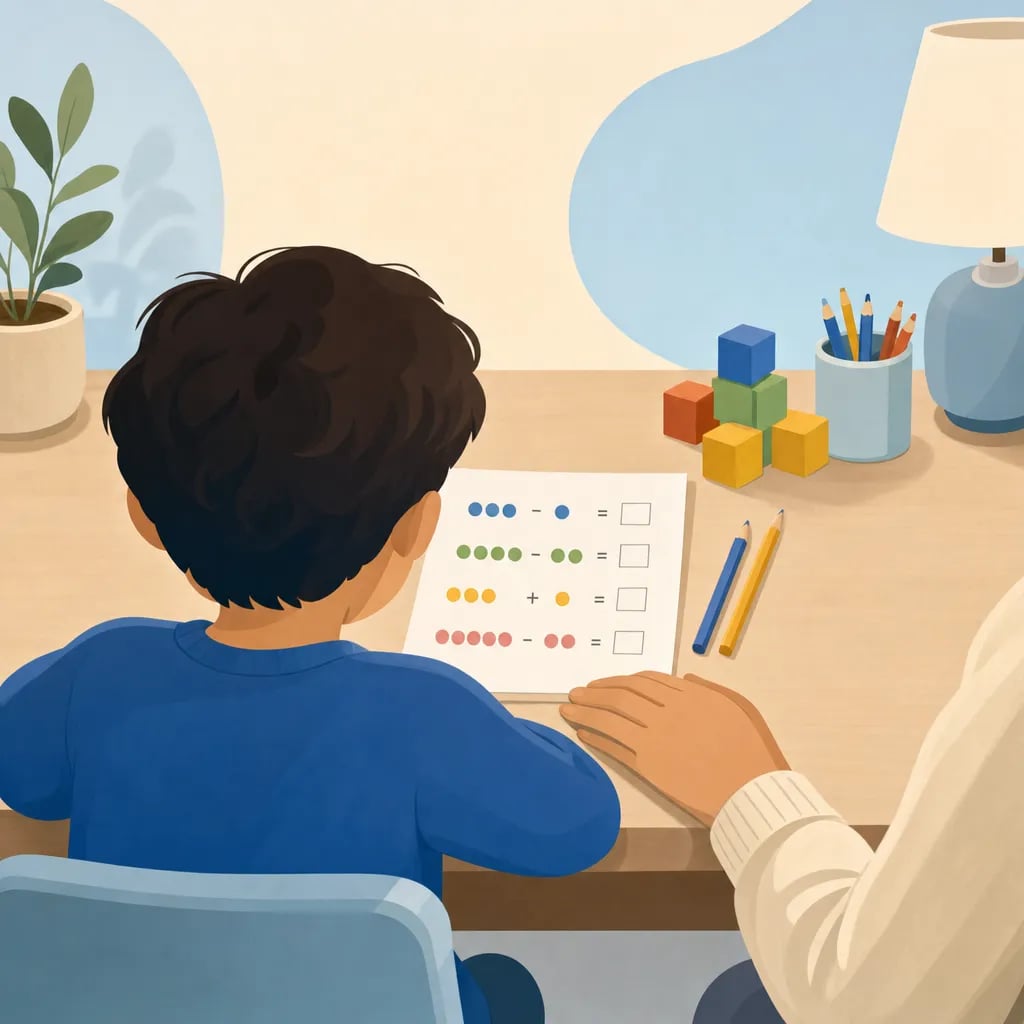
The method matters as much as the effort. Anxiety eases fastest when a child understands why something works before being asked to memorise how. That is the heart of a visual, project-based approach: concepts come to life through pictures, objects, and small projects, so maths feels like something to explore rather than a test to survive.
Small groups help too. In a calm class of a few children with a certified teacher, no one is racing and no one is singled out. Different teaching traditions handle this differently, and it's worth understanding how teaching methods compare before choosing one. At Algonova, our live online math course for ages 6–8 is built this way: understanding over memorisation, supportive pace, and an AI diagnostic that finds a child's real gaps so lessons target what's actually missing, not a generic worksheet.
Try a free 60-minute diagnostic. See exactly where your child stands and leave with a clear plan, no obligation. Book the free session here.
The aim is simple: a child who once said "I hate maths" starts saying "let me try." That shift comes from safety and understanding, and it's well within reach.
The fastest way to calm a child in maths is to slow down. Ten unhurried minutes that end on a small win rebuild more confidence than an hour of drills ever will.
Algonova Math Team
Math anxiety isn't a verdict on ability — it's a signal that the pressure got ahead of the understanding. Lower the pressure first, and the ability that was there all along starts to show.
Algonova Math Team
No. Math anxiety is an emotional response that disrupts focus and memory, while ability is what a child can actually do. Anxious children often understand more than their test results show once the pressure is removed.
It can appear as early as Darjah 1 (around age 7), often once maths becomes timed or test-focused. Catching it early, before maths becomes a "feared subject," makes it much easier to reverse.
Stop the session calmly and end the pressure for the day. Keep future sessions short, remove time limits, and rebuild from easy, visual examples so your child experiences a small success.
Yes. The most powerful help is emotional, not technical. Stay calm, avoid saying "I'm bad at maths," praise effort, and treat mistakes as normal. For the teaching itself, a supportive class can carry the load.
A small group with a certified teacher means no racing and no being singled out. A visual, understanding-first method lets a child rebuild confidence step by step, while a diagnostic targets their real gaps.
Usually not on its own. Extra drills on a shaky foundation tend to deepen the fear. It works better to lower pressure, rebuild missing concepts visually, and let confidence return before increasing the workload.
In most cases, yes — especially when it is caught early. With lower pressure, understanding-first teaching, and a series of small successes, many children move from dread to willingness within a term or two. The goal is not to make maths stress-free forever, but to rebuild enough confidence that a hard problem feels like a challenge rather than a threat.
Algonova teaches maths live online in private 1-on-1 lessons, mini groups of 2–4, or groups of up to 10 students with certified teachers, so no child is rushed or singled out. Lessons are visual and understanding-first, and a free AI diagnostic pinpoints each child's real gaps so time is spent on what's actually missing — not a generic worksheet. You can see it in a free Master Class before deciding.
Start your child's tech journey
Book your free 60-minute trial class with an Algonova certified tutor. No payment, no obligation, just discover what your child can build.

Algonova worldwide
Contact us
Email: int_legal@alg.team
Visit us
Suite 8634, 1021 E Lincolnway, Cheyenne, WY, Laramie, US, 82001
Algonova online LLC International tech school for kids and teens