Roblox Studio or Scratch: Which First for an 8 to 10 Year Old?

Learn Coding8 min read
Parent Guides

Aina Rashid
Parent Education Editor, Algonova Malaysia
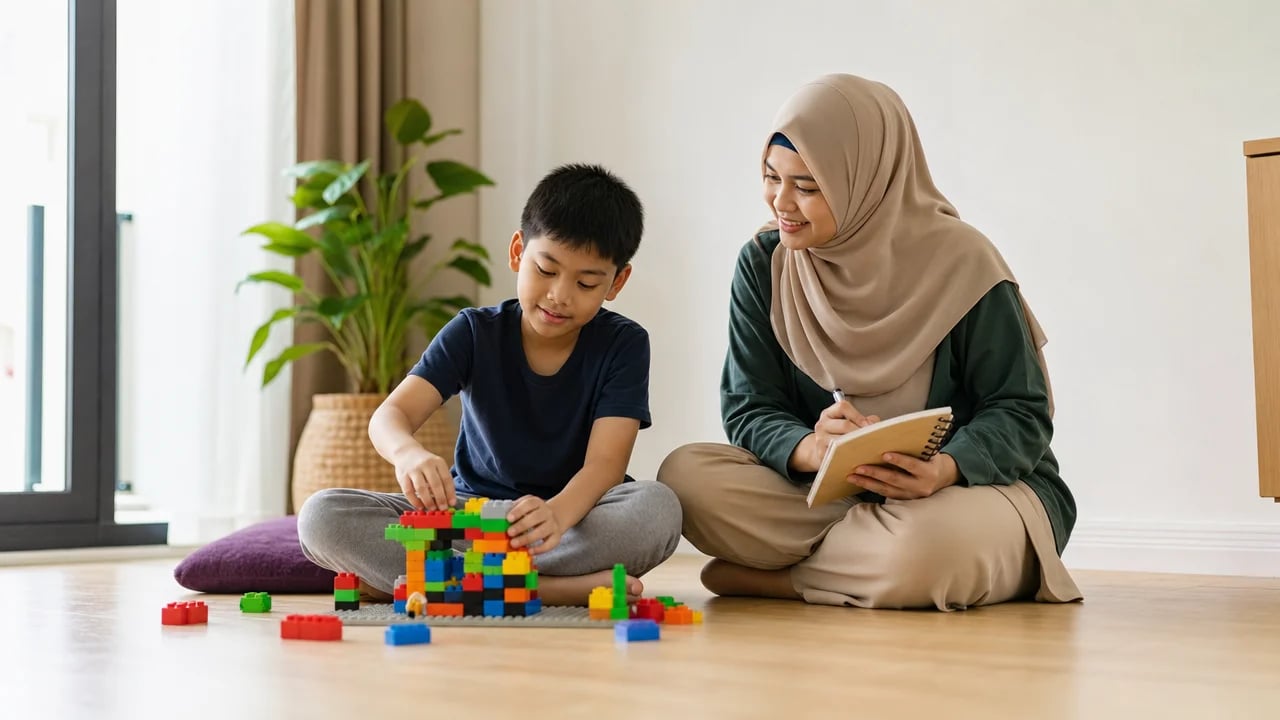
To learn how to know your child's talent, watch what your child goes back to without being asked for 4 to 6 weeks, and write down how quickly that skill improves. For children aged 6 to 14, seven signs tell you the most, from losing track of time to inventing their own rules. The strengths checklist below turns those signs into weekly notes you can compare.
You find a child's talent by seeing the same strength appear again and again over several weeks, in different settings, and not from one good afternoon or one quiz score.
A talent is an ability that grows faster than usual once a child practises it. Interest is what the child enjoys. The two often go together, but a child can love football and still improve slowly, or be quick at drawing and rarely choose to draw.
Imran, 9, in Tahun 3, spends 40 minutes on a Lego build on Saturday and 50 minutes on Sunday, then takes it apart on Wednesday to build a different version nobody asked for. That's three sessions in one week, and nobody reminded him. A 2-hour burst after a birthday present, followed by nothing for a month, doesn't count.
Set yourself a window of 4 to 6 weeks and 2 or 3 short notes a week. Parents who decide after 1 week usually record the novelty, not the talent.
A talent usually shows in behaviour before it shows in results. These 7 signs describe what your child does, not the marks they bring home.
Two or three signs in one area across 3 weeks is worth noting. One sign once is not.
A talent is a pattern across weeks, and one impressive afternoon tells you very little.

Interest is about enjoyment, talent is about fast progress in one area, and giftedness is a formally assessed ability that is well above age level, usually in thinking or learning.
| Term | What it means | What you see at home | Example |
|---|---|---|---|
| Interest | The child enjoys it and chooses it | Comes back often, progress is average | Watches Roblox videos daily, builds little |
| Talent | Faster growth with practice in one area | Improves quickly, goes deeper on their own | Builds a working Roblox obstacle course after 3 weekends |
| Giftedness | High general ability, confirmed by assessment | Reads or reasons far ahead of age, very intense curiosity | Reads novels written for teenagers at age 7 |
Lists of the signs your child is gifted often include early reading, a large vocabulary, strong memory and intense questions. Such lists only flag a possibility. If you suspect giftedness, talk to the class teacher first, and ask about an assessment by an educational psychologist. Most children aren't gifted in this formal sense and still have clear strengths.
No single child talent test can tell you what your child is good at, because talent depends on practice, interest and opportunity, and those change between ages 6 and 14.
IQ tests measure reasoning, and school results measure what was taught. Free online quizzes that promise to reveal a talent in 10 questions don't publish any checks behind them. Treat the result as a conversation starter.
Psychologist Howard Gardner proposed the theory of multiple intelligences in his 1983 book Frames of Mind with 7 intelligences, among them linguistic, logical-mathematical, musical and bodily-kinesthetic, and later added an eighth, naturalist. The theory is popular in schools, but it is disputed. A critical review by Lynn Waterhouse in the journal Educational Psychologist (2006) concluded that the theory lacks enough empirical support to guide teaching, and Gardner and Moran replied in the same issue.
Use the 8 categories as words for what you observe, and avoid treating them as a diagnosis. Label a 7-year-old "a musical child" after one quiz and you may stop offering them anything else.
The strengths checklist below helps you find your child's strengths through observation: tick what you see each week, add one short example, and compare the 4 weeks at the end. If you want a paper copy for the fridge, print this page from your browser.
| Strength area | What you observe | Example from home | What to try next |
|---|---|---|---|
| Logic and patterns | Spots rules, enjoys puzzles and sorting | Solves a 100-piece puzzle alone, explains the strategy | Logic games, Scratch projects |
| Building and making | Takes things apart, builds new versions | Turns a cardboard box into a working marble run | Game building, simple robotics kits |
| Visual and drawing | Notices colours, layouts, faces | Redesigns the family birthday card 3 times | Digital drawing, graphic design |
| Words and stories | Invents stories, plays with words | Writes a 2-page story with chapters at age 8 | Story writing, comic making |
| Music and rhythm | Remembers tunes, taps rhythms | Plays a song by ear after 2 listens | Music lessons, rhythm apps |
| Movement and sport | Coordinated, keeps practising a move | Practises a football trick 20 times in a row | A sport club for 1 term |
| People and leading | Organises friends, notices feelings | Sets up a game for 6 cousins and settles arguments | Group projects, team activities |
| Technology | Asks how apps and games work | Changes settings to make a game harder | Coding for beginners, AI basics |
How to read your results: an area with ticks in 3 or 4 of the weeks is a likely strength. An area with many ticks in week 1 only is usually novelty.
The quickest way to test a talent is to give your child a short, real taste of the activity and watch what happens during it and in the 2 days after.
Example: Mei Ling, 10, ticked building and technology in 3 of 4 weeks. Her parents booked a 60-minute coding masterclass. By the end she had moved characters in her first Scratch game, and two days later she was still adding levels at home.
At Algonova, the free trial class for coding and design is a 60-minute masterclass online with a live teacher and a group of up to 10 children. It's an interest check, and your child leaves with something they made. In the coding classes for kids, Visual Programming in Scratch and Game Design in Roblox suit ages 8 to 12. In the graphic design classes, Junior suits ages 8 to 12 and Senior suits 11 to 14. The December school holiday is a good time for this test, see the cuti sekolah 2026 dates and plan ideas.
Most hidden talents stay hidden because adults decide too early or measure the wrong thing. Check your own habits as well as your child's.
Free time is where talent shows, so a fully booked week leaves you nothing to observe.
If your child already shows the technology and building signs, our checklist on whether coding is right for your child goes deeper. If the visual signs win, read the guide to digital drawing for kids or compare coding and graphic design side by side.
Many parents start to see stable interests around age 6 or 7, and a clear talent often shows later, somewhere between 8 and 12, when children can practise on their own for longer. Before 6, preferences change every few months and are mostly about play, so early notes are useful but not final. A 5-year-old who loves dinosaurs this term may move on to cars next term, and that is normal. By 9 or 10, a child who keeps returning to drawing or building over a whole year is showing something steadier. Some strengths, such as music or sport, can appear earlier because of early exposure at home. The age matters less than the length of observation. Watch for at least 4 weeks at any age, and expect your notes to change again around 12 to 14, when teenagers try new identities and hobbies.
Every child has relative strengths, even if none of them stands out compared with classmates. A talent in the everyday sense means an area where your child improves faster than in other areas, so the comparison is with the child, not with the class. A girl who is average at maths, drawing and sport may still be noticeably quick at organising friends and settling arguments, and that people strength is easy to miss. Children who seem to have no talent often just haven't tried the right activity yet. A family that only offers tuition and sport never sees whether a child would enjoy design or music. Widen the range with 2 new short formats per month for 3 months, chosen from areas your child hasn't tried, and keep a weekly checklist to see which area collects the most repeated ticks.
There is no free test that reliably finds a child's talent, and paid tests also measure narrower things than their names suggest. IQ and reasoning tests measure thinking speed and logic. Strength surveys for older children measure what a child reports about themselves, which changes with mood and age. Online quizzes that promise to reveal a talent in 10 questions usually have no published validation. A more useful free method is a 4-week observation checklist, like the one in this article, combined with short real experiences. For example, a free 60-minute class gives a teacher and a parent one hour to see how a child focuses, asks questions and handles mistakes. If you suspect formal giftedness, speak with the class teacher first, then ask for an assessment by an educational psychologist.
Common signs your child is gifted include reading or reasoning well ahead of age, a large vocabulary, strong memory, intense curiosity and a preference for complex questions. Gifted children often learn new material with very few repetitions and may get bored with routine work. Some show it through behaviour that looks like trouble: arguing about rules, finishing early and then disrupting, or refusing tasks that feel too easy. A 7-year-old who reads novels meant for teenagers and asks how numbers work in other countries is showing more than one sign. Checklists only suggest a possibility. Many gifted children underachieve at school, especially when the work feels too easy, so their signs are easy to miss. If several signs appear across months, ask the class teacher, and consider an assessment by an educational psychologist.
You find a child's strengths and weaknesses by recording the same activities over several weeks and noting where progress is fast, where it is slow, and where your child avoids the task. Strengths show as quick improvement, long focus and returning without reminders. Weaknesses show as slow progress despite effort, frustration after the first mistake, or constant avoidance. For example, a 9-year-old may finish a 100-piece puzzle alone but avoid reading aloud. That points to a logic strength and a reading area that needs gentle support. Ask the class teacher for one strength and one weakness at your next meeting, since teachers see your child next to a whole class of peers every school day. Then compare their view with your 4-week notes and pick one strength to grow and one weakness to support.
Interest is what your child enjoys and chooses, while talent is an ability that improves faster than usual with practice. The two overlap often, but not always. A child can be deeply interested in football and improve at an average pace, or be quick at drawing and rarely choose to draw. Both matter. Interest keeps a child practising long enough for a skill to grow, and talent makes practice pay off sooner. Malaysian parents searching in Bahasa Malaysia often type bakat anak or minat dan bakat kanak-kanak, and the second phrase is a good reminder to watch for both. The practical test is simple: if your child returns to an activity on their own and also gets visibly better within 4 weeks, you probably have both. If only one is present, keep offering the activity without pressure for another month.
You should support a talent with time, materials and a good teacher, but pushing hard usually backfires, especially before age 10. Children keep practising when the activity still feels like theirs. When a hobby turns into daily drills with targets, many children start avoiding it or hide it from parents. A better balance is 1 or 2 structured sessions a week plus free time to explore the same activity in their own way. For example, a 10-year-old who loves building games can take a weekly class and spend a weekend afternoon on their own project. Watch for warning signs: tears before sessions, lost interest in other things, or comments like "I have to." If you see them, reduce the load for 2 weeks and ask your child what they enjoy most about the activity.
A practical target is 4 to 6 different areas over a year, but only 1 to 3 regular activities at any one time. Trying many things in short formats widens the range without overloading the school week or your family budget. A good rhythm is one new short experience a month, such as a workshop, a library book on a new subject, or a free trial class, alongside 1 or 2 regular activities. For example, a family might keep swimming and add a coding masterclass in October, a drawing workshop in November and a music taster during the December holiday. Record each new experience in the checklist on the day it happens. After 6 months you will have enough notes to see which areas your child keeps returning to on their own.
Start your child's tech journey
Book your free 60-minute trial class with an Algonova certified tutor. No payment, no obligation, just discover what your child can build.

Algonova worldwide
Contact us
Email: int_legal@alg.team
Visit us
Suite 8634, 1021 E Lincolnway, Cheyenne, WY, Laramie, US, 82001
Algonova online LLC International tech school for kids and teens