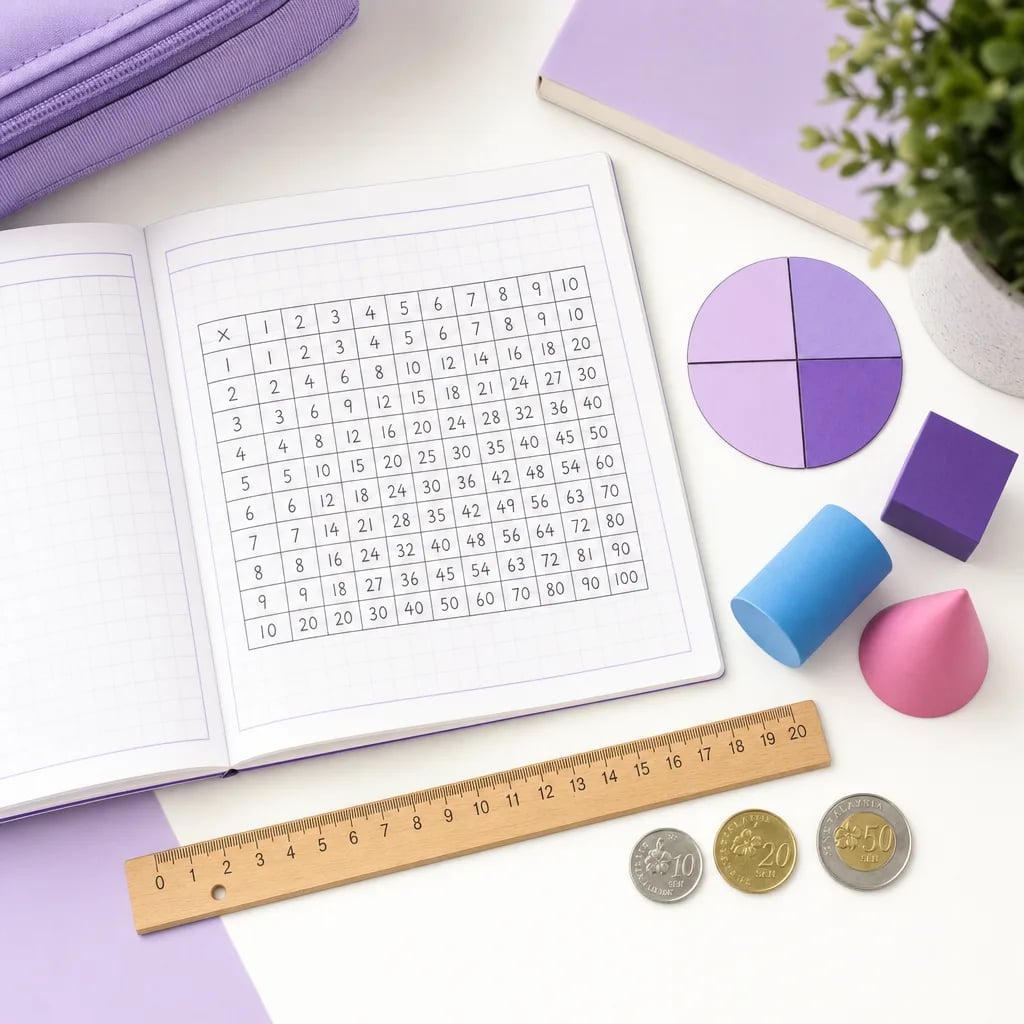
Sifir 1 to 12 for Kids: How to Help Your Child Memorise Times Tables

Learn Math8 min read
Learn Math

Nurul Izzati
Math Curriculum Team, Algonova Malaysia

Fractions for kids means learning to see one whole broken into equal parts, like 1/2 or 3/4, and comparing or combining those parts with confidence. Malaysia's KSSR syllabus introduces fractions formally in Year 4, then builds towards addition of unlike denominators by Year 6. This guide is for parents of children aged 8 to 12 who want clear examples, common mistakes to avoid, and a simple weekly practice routine.
Fractions are usually the first maths topic where a child cannot just count their way to the answer, they have to reason about a relationship between numbers, and that shift trips up even confident learners. The good news: fractions stop feeling abstract the moment you show them as something a child already understands, like sharing a pizza fairly or splitting a chocolate bar between friends. Algonova is a live online school for mathematics and coding with more than 1,000,000 students across 97 countries and a 4.9 star parent rating over 10+ years, and this guide shares the same visual, step-by-step approach our tutors use with children across Malaysia. Below you will find what a fraction actually means, the KSSR fraction skills by year, seven ways to teach fractions with everyday objects, the mistakes that slow children down, and a short practice plan you can start this week.
Children rarely struggle with fractions because the maths itself is hard. They struggle because nobody let them touch, cut or share something real before the numbers arrived on a worksheet. Give a child a pizza before you give them a page of exercises, and half the difficulty disappears.
Aina Rashid, Education Specialist at Algonova Malaysia
The parents who see the fastest progress rarely buy the most workbooks. They are the ones who keep a fraction wall on the fridge and turn dessert into a two-minute maths conversation.
Aina Rashid, Education Specialist at Algonova Malaysia
Start your child's tech journey
Book your free 60-minute trial class with an Algonova certified tutor. No payment, no obligation, just discover what your child can build.
A fraction describes equal parts of one whole. The bottom number, the denominator, tells you how many equal parts the whole is cut into. The top number, the numerator, tells you how many of those parts you actually have. Take 3/4: the whole is cut into 4 equal parts, and you have 3 of them. That single idea is the foundation for everything else in this guide.
In the KSSR Mathematics curriculum, fraction skills are introduced gradually rather than all at once:
| Year | KSSR fraction focus |
|---|---|
| Year 3 | Simple fractions like 1/2 and 1/4, recognising equal parts of a shape |
| Year 4 | Proper fractions, equivalent fractions, comparing fraction size |
| Year 5 | Adding and subtracting fractions with the same denominator, mixed numbers |
| Year 6 | Adding and subtracting fractions with different denominators, finding a fraction of a quantity |

These seven techniques work because they replace abstract rules with something a child can touch, cut and compare. Pick two or three that suit your child rather than trying all of them in one sitting.
1. Start with halves and quarters, not tenths. Halves and quarters are visually obvious, a child can see the equal split. Only move to thirds, fifths and other denominators once halves and quarters feel automatic.
2. Use food, always. Pizza, chocolate bars, oranges and sandwiches are naturally divided into equal parts, and eating the fraction makes the concept concrete and fun instead of abstract.
3. Say the fraction out loud as you cut. "I'm cutting this into 4 equal pieces, so each piece is 1/4" links the physical action to the vocabulary before your child ever sees it written down.
4. Show equivalent fractions with the same object. Cut one apple into halves and a second identical apple into quarters. Two quarters take up the same space as one half, so 2/4 equals 1/2, no worksheet required.

5. Use a number line or fraction wall. Mark 0 and 1 on a strip of paper, then ask your child to place 1/2, then 1/4, then 3/4. Seeing fractions as points between two whole numbers stops many later mistakes with mixed numbers.
The most common mistake is jumping straight to abstract rules, like cross-multiplying to compare fractions, before a child has ever compared two physical pieces of something. A better approach is one small fraction skill a week, always ending each session on something your child gets right. Here is what tends to go wrong, and what to do instead.
Three mistakes to avoid:
Most fraction confusion is not really about fractions. It is about a child trying to hold an abstract rule in their head without ever having seen it acted out with something real. Slow down, go back to a physical object, and the rule usually clicks within minutes.
Not sure which fraction skill your child is stuck on? An Algonova tutor pinpoints the exact gap in a single free maths diagnostic.
At Algonova Malaysia, mathematics is taught live by certified tutors in small groups or one-to-one, never as recorded video. For fractions specifically, a tutor does what a worksheet cannot: they see immediately whether a child understands the physical meaning of a fraction or is just guessing at a rule, they switch to a different object or visual the moment one approach stops working, and they keep sessions short and encouraging so confidence builds instead of anxiety. Every lesson follows the KSSR syllabus, so what your child practises with us lines up with what they meet at school.
Because classes are online and small, a child in Kuala Lumpur, Penang or Johor Bahru gets the same one-on-one attention as a child sitting beside the tutor. If fractions have been a source of tears over homework, a single free maths diagnostic is usually enough to show whether the gap is about understanding or about confidence, and both are fixable. Book a free maths diagnostic of about 60 minutes and watch your child work through real fraction problems with a tutor before deciding anything.

Algonova worldwide
Contact us
Email: int_legal@alg.team
Look at the chocolate bar above. It has 8 equal pieces. If your child eats 2 of them, they have eaten 2/8 of the bar, and that is exactly the same amount as 1/4. One simple example teaches two ideas at once: what a fraction is, and how two different-looking fractions, 2/8 and 1/4, can describe the same amount. That second idea is the equivalent fractions skill Year 4 children are expected to master, and it is the single biggest stumbling block on the way to Year 6.
This matters because by Year 6, KSSR expects children to add fractions with different denominators, such as 1/3 + 1/4, which requires finding a common denominator first. A child who already understands that different fractions can represent the same amount finds this step far less mysterious than one who has only memorised isolated facts.
6. Compare fractions with the same denominator first. 3/8 versus 5/8 is easy: same-size pieces, just count which has more. Save different-denominator comparisons for later, once same-denominator comparison feels natural.
7. Let mistakes happen with pizza, not on paper. If your child says half a pizza is bigger than three-quarters of a smaller pizza, let them see both pizzas side by side. A mistake that gets corrected by the child's own eyes sticks far better than one corrected by a red pen.
A simple 6-week fraction plan you can start this week:
| Week | Focus | Daily routine (10 to 15 min) |
|---|---|---|
| 1 | Halves and quarters | Cut real food, name each piece out loud |
| 2 | Comparing same-denominator fractions | Number line practice, quick comparisons |
| 3 | Equivalent fractions | Two objects, two different cuts, same amount |
| 4 | Adding same-denominator fractions | Simple word problems with pizza or sweets |
| 5 | Mixed numbers | Whole objects plus a part, naming the total |
| 6 | Unlike denominators (Year 6 preview) | Fraction wall comparisons, light review |
Keep each session short and end on a win. Most children who follow a rhythm like this move from confused to confident within six to eight weeks, and the confidence usually carries over into decimals and percentages later on.
Malaysian children usually meet simple fractions like half and quarter informally around age 7, then KSSR introduces fractions formally in Year 3 and 4, around ages 9 to 10. That said, a curious 6 or 7 year old can start early with everyday sharing, like splitting a sandwich or an orange into equal parts, long before the formal vocabulary appears in school. By age 10 or 11, most children should be comfortable comparing fractions and adding those with the same denominator. If your child is older and still unsure, that is common and easy to fix with short daily practice using real objects rather than worksheets alone. There is no missed window, only the day you decide to start building the visual understanding underneath the rules.
The easiest way is to use food or objects your child already understands rather than starting with written numbers. Cut a sandwich, an apple or a chocolate bar into equal pieces, name each piece out loud as a fraction, and let your child eat or hold the parts. This turns an abstract idea into something they can see and touch. Once halves and quarters feel natural, move to a number line marked from 0 to 1, then introduce the written numerator and denominator. Keep early sessions short, around 10 minutes, and always end on a fraction your child gets right. Confidence built through hands-on examples transfers far more reliably to written maths than rules explained without a real object behind them.
Equivalent fractions confuse children because two fractions can look completely different, like 2/8 and 1/4, while describing exactly the same amount, and that feels contradictory if a child has only learned fractions as isolated facts. The fix is physical proof rather than explanation: cut two identical objects into different numbers of equal pieces and let your child see that 2 out of 8 pieces takes up the same space as 1 out of 4. Fraction walls and number lines make this visible without any calculation. Once a child has seen equivalence with their own eyes a few times, the written rule, multiplying top and bottom by the same number, stops feeling like an arbitrary trick and starts feeling like a description of something they already know is true.
With short, consistent daily practice of 10 to 15 minutes, most Malaysian children move from confused to confident with core fraction skills, halves, quarters, comparing and simple addition, within 6 to 8 weeks. Equivalent fractions and adding fractions with different denominators, the Year 6 skills, usually take a few extra weeks on top of that because they build on everything before them. What matters most is consistency rather than intensity: a calm 10-minute daily routine beats one long stressful session before a test. If a specific skill, like unlike-denominator addition, stays stubborn, slow down and stay with physical objects a little longer rather than pushing ahead to the next topic before the foundation is solid.
Yes, visual tools work because fractions are fundamentally about relationships in size and position, not just numbers on a page. A fraction wall, stacked bars showing halves, quarters, eighths and more lined up underneath each other, lets a child see at a glance that 2/4 lines up exactly with 1/2. A number line does something similar by showing fractions as points between 0 and 1, which helps enormously with mixed numbers and comparing fraction sizes later on. Children who build this visual model early tend to make fewer errors in secondary school algebra and ratio problems, because they carry a real mental picture of what a fraction represents instead of a memorised, disconnected rule.
Visit us
Suite 8634, 1021 E Lincolnway, Cheyenne, WY, Laramie, US, 82001
Algonova online LLC International tech school for kids and teens