Best Drawing Apps for Kids in Malaysia (Free, Phone and Tablet)

Learn Design9 min read
Learn Math

Nurul Izzati
Math Curriculum Team, Algonova Malaysia
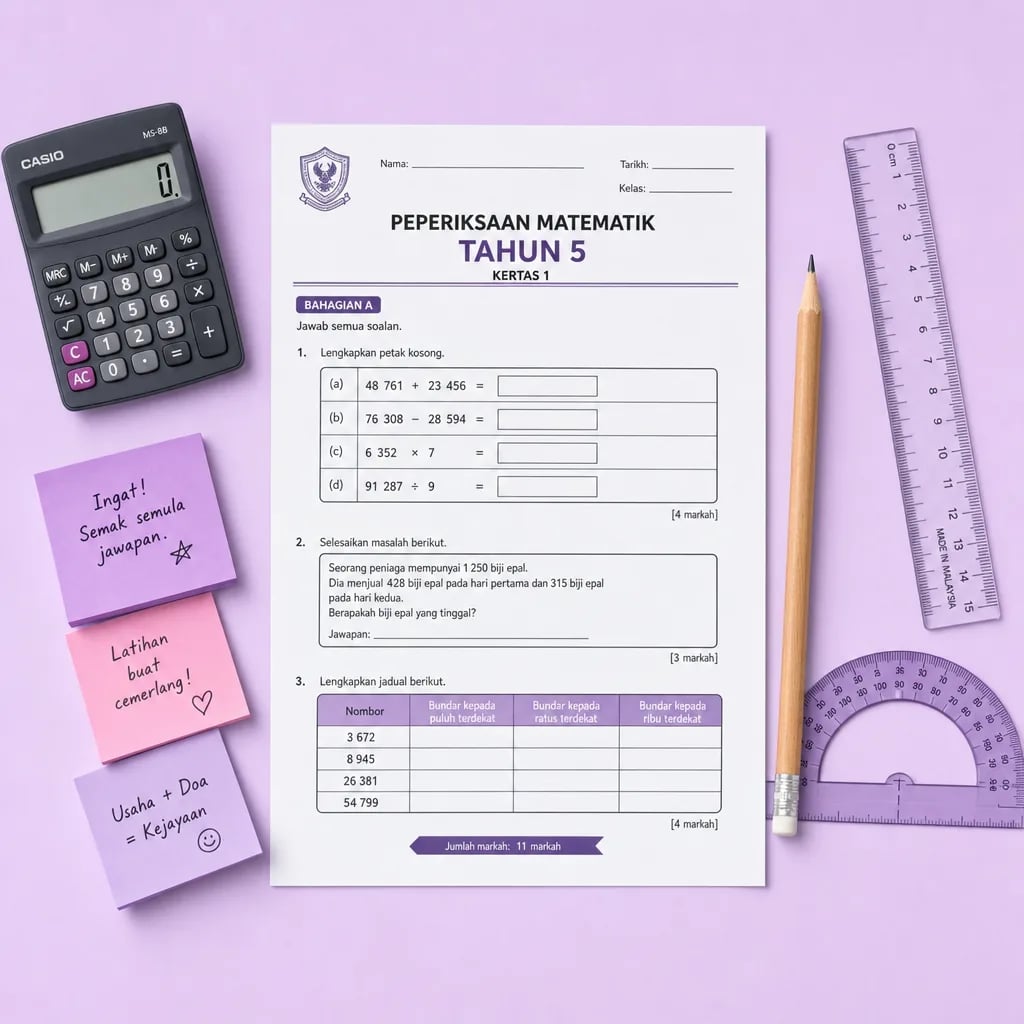
UASA Year 6 maths is the last school maths test of primary school in Malaysia, and it can cover anything from the Year 6 KSSR syllabus: numbers up to 1,000,000, fractions, decimals and percentages, money, time, measurement, space, coordinates, ratio and data handling. This guide gives you 8 practice questions with full working, the usual paper format and a 6-week revision plan for parents.
Since UPSR was abolished in 2021, there is no national exam at the end of Year 6. Many parents find this harder, not easier. Without one national score, it is difficult to tell whether a child is ready for Form 1 maths, where algebra and negative numbers start almost immediately.
The UASA paper is now the clearest checkpoint you have. It is set by your child's school, usually in Bahasa Melayu (or Chinese or Tamil in SJKC and SJKT schools), so English-speaking families often prepare in English at home and then go through the Malay terms before the test. This guide is in English and points out the key Malay words where they matter.
Algonova runs live online maths classes for ages 6 to 17 and has taught 1,000,000+ students in 97 countries; the mistakes below are the ones our teachers see most in Year 6.
In Year 6, most lost marks come from two-step questions. The child does the first step correctly and forgets that the question asked for something else.
Aina Rashid · Education Specialist at Algonova Malaysia
A Year 6 child who can explain why 20% of RM85 is RM17 will handle a new discount question. A child who memorised the steps often will not.
Aina Rashid · Education Specialist at Algonova Malaysia
Start your child's tech journey
Book your free 60-minute trial class with an Algonova certified tutor. No payment, no obligation, just discover what your child can build.
The UASA Year 6 maths assessment normally has two written papers, an objective paper and a subjective paper, plus the teacher's classroom assessment during the year. Schools set the papers themselves under Ministry of Education guidelines, so the number of questions and the timing differ from school to school. Your child's teacher or the school exam notice will have the details.
| Part | Malay name | Question type | What earns marks |
|---|---|---|---|
| Paper 1 | Kertas 1 | Multiple choice across all topics | Choosing the correct option |
| Paper 2 | Kertas 2 | Structured and word problems | Correct steps plus the final answer |
| Classroom assessment | PBD | Tasks and observation all year | Mastery level TP1 to TP6 per topic |
These 8 questions follow the Year 6 KSSR maths topics and are pitched at the level of a typical UASA Paper 2. Ask your child to write the working for each one, then compare with the answers below. Useful Malay words for the real paper: peratus (percentage), nisbah (ratio), purata (average), isi padu (volume) and diskaun (discount).
1. Large numbers. Round 846,250 to the nearest ten thousand. Answer: The ten thousands digit is 4 and the next digit is 6, so round up: 850,000.
2. Fractions. Mei Ling spent 2/5 of her RM60 savings on books. How much money does she have left? Answer: 2/5 x RM60 = RM24 spent. RM60 - RM24 = RM36 left.
3. Decimals. A bottle holds 1.25 litres of water. How much water is in 6 bottles? Answer: 1.25 x 6 = 7.5 litres.
4. Percentages.
The Year 6 UASA maths paper can test every topic in the Year 6 KSSR syllabus, and many questions also rely on skills from Year 4 and Year 5. The table shows what to check in each topic.
| KSSR Year 6 topic | What your child should be able to do | Common mistake |
|---|---|---|
| Whole numbers to 1,000,000 | Round, compare and calculate with six- and seven-digit numbers | Rounding to the wrong place value |
| Fractions, decimals and percentages | Convert between all three, find a percentage of an amount | Writing 3/8 as 0.38 instead of 0.375 |
| Money | Work out discounts, profit and savings | Subtracting before finding the percentage |
| Time | Use the 24-hour system across midnight and across days | Counting an hour as 100 minutes |
A realistic plan for UASA Year 6 maths is 20 to 30 minutes of practice, four times a week, for 6 weeks, starting with your child's weakest topics and ending with full timed papers. Year 6 children can focus longer than younger pupils, but they also have more subjects to revise, so keep maths sessions short and regular.
Outside of revision time, let your child calculate the discount on a sale item, split a restaurant bill by ratio, or work out the arrival time of a long-distance bus that leaves late at night.
If you are thinking about tuition for the final months, our guide on Year 6 maths tuition and exam preparation

Algonova worldwide
Contact us
Email: int_legal@alg.team

Since 2024 the Ministry has reported UASA results as percentages and grades, while classroom assessment still uses mastery levels. If your child's report shows a grade on one page and TP levels on another, both are normal. Our guide to what TP2 means in maths explains the levels in plain English.
5. Time. A flight leaves Kuala Lumpur at 2140 and lands in Kota Kinabalu 2 hours 35 minutes later. What time does it land? Answer: 2140 + 2 h = 2340. 2340 + 35 min = 0015, which is 0015 the next day (12:15 a.m.).
6. Volume. A box is 20 cm long, 15 cm wide and 10 cm high. What is its volume? Answer: 20 x 15 x 10 = 3,000 cm³.
7. Ratio. The ratio of boys to girls in a class is 3:4. There are 28 pupils. How many girls are there? Answer: 3 + 4 = 7 parts. 28 ÷ 7 = 4 pupils per part. Girls = 4 x 4 = 16 girls.
8. Average. Five pupils scored 72, 85, 64, 90 and 79 in a quiz. What is the average score? Answer: 72 + 85 + 64 + 90 + 79 = 390. 390 ÷ 5 = 78.
Questions 5 and 7 catch the most children in our classes. In question 5, many forget that time passes midnight. In question 7, many divide 28 by 4 instead of by the total number of parts.
| Measurement |
| Convert units of length, mass and volume |
| Calculating before converting units |
| Space | Find perimeter, area and volume of shapes and solids | Using the area formula for volume |
| Coordinates, ratio and proportion | Plot points, share amounts in a ratio | Dividing by one part instead of the total |
| Data handling | Read charts and find the average | Forgetting to divide by the number of items |

Fractions and percentages show up inside money, ratio and data questions, so a weak spot there spreads. If your child struggles with fractions, go back to our fractions guide for kids first. For a topic-by-topic view of both upper primary years, see the Year 5 and Year 6 maths syllabus guide.
Want a quick check before the exam? Book a free class and a teacher will tell you which topics to focus on.
There is no national Year 6 exam any more. UPSR, the old national primary school exam, was abolished in 2021. Instead, each school runs UASA (Ujian Akhir Sesi Akademik), an end-of-session test for each subject, set and marked by the school under Ministry of Education guidelines. Teachers also run classroom assessment (PBD) during the year and record a mastery level from TP1 to TP6 for each topic. So a Year 6 child still sits a written maths paper, but the result is not compared nationally. For parents, this means the school report and the teacher's comments are the main sources of information. Ask the teacher which topics your child is weakest in, because that is more useful than the overall grade. Your child's result usually arrives as a percentage and a grade on the UASA report, with PBD levels shown separately for each topic.
Most schools set two written papers for UASA Year 6 maths. Paper 1 (Kertas 1) has multiple-choice questions across all topics and checks quick, accurate calculation. Paper 2 (Kertas 2) has structured and word problems where your child must show the working, and marks are given for correct steps as well as the final answer. Because the school sets the paper, the number of questions, timing and marks vary, so check the school's exam notice. Classroom assessment (PBD) runs alongside the papers and gives a mastery level for each topic. For revision, Paper 2 deserves more time: practise two-step problems and always write the working, even for questions that feel easy. If your child finishes Paper 1 early, teach them to use the spare minutes to check units and decimal points.
The paper is usually in the language your child is taught maths in. In national schools (SK) that is Bahasa Melayu, in SJKC schools it is Chinese, and in SJKT schools it is Tamil. Schools running the Dual Language Programme (DLP) teach maths in English and may set the paper in English, so it is worth asking. If your child revises in English at home, plan at least one week to go through word problems in the language of the real paper. The key terms to know in Malay include peratus (percentage), nisbah (ratio), purata (average), isi padu (volume), diskaun (discount) and baki (balance). Knowing these words avoids losing marks on questions your child can actually solve. Ask the teacher directly which language the paper will be in, because DLP arrangements can differ between classes in the same school.
For most Malaysian children, the hardest Year 6 topics are ratio and proportion, percentages in money problems, and time calculations across midnight. Ratio is difficult because children divide by one part instead of the total number of parts. Percentage questions often have two steps, such as finding a 20% discount and then the final price, and children stop after the first. Time questions that cross midnight confuse many pupils because the answer moves to the next day. Volume of cuboids also causes mistakes when units are mixed. A good approach is to practise each of these with 5 short questions per session, always with written working, until your child gets 4 out of 5 right without help. Add one or two cross-midnight time questions to every revision session in the last month, since they are quick to practise.
Start about 6 weeks before the test with 20 to 30 minutes of practice, four times a week. In week 1, find the weakest topics with a short diagnostic set, like the 8 questions in this guide. Spend the next two weeks on the two weakest topics, then a week on mixed questions that combine topics, a week on word problems in the language of the real paper, and a final week of timed practice papers. Ask your child to write every step and to check units before finishing. Go through each mistake together and decide whether it was a method error or a careless slip. Six weeks is long enough to see whether the plan is working, as long as sessions are short and regular. Keep a simple log of which mistakes repeat, because the pattern often points to one habit, such as skipping unit checks.
There is no official national bank of UASA past papers, because each school writes its own paper. The best source is your child's school: many teachers give out past papers or practice sets before the test, so ask the class teacher. The Year 6 textbook and activity book follow the same KSSR syllabus and are a reliable guide to the level. You can also use the practice questions in this guide. Be careful with old UPSR papers and random PDFs online. UPSR papers are still useful for practice, but some include older syllabus content or a different format, so use them for topic practice rather than as a guide to the real UASA paper. Your child's own marked homework from this year is also a good source of practice, because the teacher has already shown what counts as correct.
For most children, the UASA Year 6 result does not decide which secondary school they attend. Placement into regular national secondary schools is mainly based on where you live. Some selective schools, such as fully residential schools (SBP) and MRSM colleges, use their own entry tests and criteria, and these change from year to year, so check the latest requirements on the official websites before you plan. Even when UASA is not used for placement, it is still worth taking seriously. Form 1 maths starts quickly with negative numbers and algebra, and children with gaps in fractions, percentages and ratio usually struggle in the first term. Use the result as a list of topics to fix before Form 1. Ask the school for the latest Form 1 placement rules in writing if a particular school matters to your family.
Tuition is worth it if your child has clear gaps that are not closing with practice at home, or if you want the last months of primary school to build a solid base for Form 1. It is less useful if it only drills past papers without explaining why methods work. Look for small groups, a teacher who checks your child's level first, and lessons where your child explains the steps out loud. Start at least a term before the test if you can. Algonova runs live online maths classes for groups of up to 10 children aged 6 to 17, from RM 48 per lesson. The first 60-minute trial class is free, so you can see the teaching before you decide. If your child is already confident, a short course on Form 1 topics can be a better use of the money than more Year 6 drilling.
Visit us
Suite 8634, 1021 E Lincolnway, Cheyenne, WY, Laramie, US, 82001
Algonova online LLC International tech school for kids and teens