Math Anxiety in Kids: How to Help a Child Who Fears or Hates Maths

Parent Guides6 min read
Common Mistakes

Arjun Menon
Education Analyst, Algonova Malaysia

If you are wondering why is my child weak in math, the honest answer is almost never a lack of ability. In the vast majority of cases it traces back to one of seven fixable causes, from small gaps in the foundations to quiet math anxiety. Algonova has taught math and coding to over 1,000,000 students across 97 countries, and the same seven patterns repeat again and again. This guide is for Malaysian parents of children ages 6 to 17 who want to find the real cause and fix it.
If your child dreads math homework, hides their marks, or says "I'm just bad at maths," it is easy to assume they were simply born without a "maths brain." Decades of learning research, and 10+ years of Algonova classrooms with a 4.9★ parent rating, say otherwise. Very few children are genuinely incapable of math. Most are stuck on a specific, identifiable problem that has a specific, identifiable fix.
The signs parents in KL, Selangor, Penang and Johor describe are remarkably consistent: falling KSSR Matematik marks, homework that takes twice as long as it should, tears at the kitchen table, or a bright child who suddenly "switches off" the moment numbers appear. None of these mean your child cannot do math. They mean something further back needs attention. Below are the seven most common causes we see, and what actually helps for each one.
Almost every child sent to us as 'weak at maths' is simply standing on a missing step from a year or two ago. Find that step, rebuild it, and the confidence comes back faster than most parents expect.
Aina Rashid, Education Specialist at Algonova Malaysia
The next two causes are about how a child studies, not who they are, which is good news, because how you study is completely changeable.
Math is a skill, like swimming or piano. You learn it by doing, not by watching. A child can nod along in class, understand every word the teacher says, and still fail the test, because understanding a method and being able to execute it under time pressure are two different things. Many children simply do not get enough reps: they do the minimum homework, avoid the questions they find hard, and never practise the exact skill that trips them up. Passive review, such as re-reading notes or watching a video, feels like studying but builds very little real ability.
A child who memorises "flip and multiply" for dividing fractions, without knowing why it works, is fine until the question is phrased in a way they have not seen before. Then the memorised rule does not fit, and they are stuck. Our parent guide to fractions for kids shows how to teach the idea behind the rule with examples. Rote learning gets a child through this week's test and quietly sets up next month's failure. Conceptual understanding, knowing why a method works, is what lets a child adapt when a problem looks unfamiliar. This is the single biggest difference between children who stay strong at math and those who plateau around PT3 and SPM.
There is no such thing as a child who is not a maths person. There are only children who lost confidence somewhere and were never shown the way back. That is a teaching problem, not a talent problem.
Aina Rashid, Education Specialist at Algonova Malaysia
A "weak at maths" label almost never means what parents fear it means. In more than 10 years and 1,000,000+ students, the children who turn things around are rarely the ones with more natural talent. They are the ones whose real cause got found and fixed. Start by finding your child's cause, and the rest becomes a plan you can follow.
Start your child's tech journey
Book your free 60-minute trial class with an Algonova certified tutor. No payment, no obligation, just discover what your child can build.
Children rarely struggle with math because they "can't do it." Far more often the cause is one of seven specific things, and the first three are the ones parents overlook most. Read them as a checklist: usually one or two will feel uncomfortably familiar.
Math is unusually cumulative. Every new topic sits on the one before it: you cannot understand fractions without solid multiplication, and you cannot handle algebra without confident fractions. When a child misses a week of school, rushes through one KSSR topic, or never quite mastered their times tables, a small hole opens up. Months later that hole shows up as "weak at math" in a topic that looks unrelated. The child is not slow. They are standing on a missing step. Find the gap, fill it, and the "weakness" often disappears.
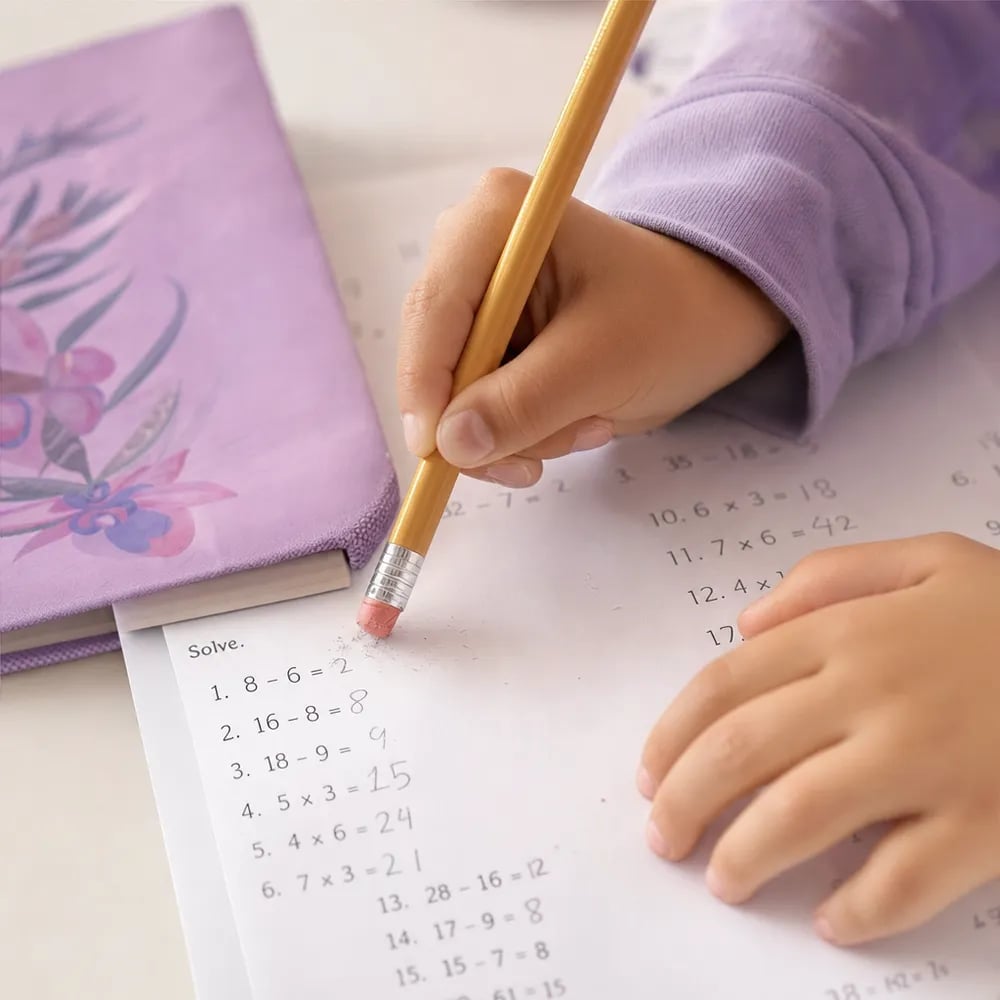
Math is the one school subject where answers are visibly right or wrong, fast. For an anxious child that feels dangerous, and the body responds: working memory shrinks, the mind goes blank, and a child who knows the method freezes in a test. This is math anxiety, and it is real, not laziness. A frozen child looks exactly like a "weak" child, but the cause is fear, not ability. The fix starts with lowering the stakes, not adding more drills.
In a national-school class of 35 to 40, the teacher has to move at the pace of the syllabus, not the pace of your child. If your child needs one more example to understand long division, but the class has already moved to the next topic, they quietly fall a step behind, every single lesson. Over a term, those steps add up. A child who would thrive with a few extra minutes of explanation can look "weak" simply because nobody had the time to give those minutes.
The last two causes are the most damaging because they compound. A child who believes they are "bad at maths" stops trying, which makes them worse, which confirms the belief.
This is the most common and the most harmful cause of all. Once a child decides they are simply "not a maths person," they stop putting in effort, because effort feels pointless. Every low mark becomes proof. But the belief is almost always false. It usually started with one of the earlier causes, a foundation gap, a fast class, a bad test day, and hardened into an identity. Rebuilding confidence, usually through a run of small wins a child can actually see, is often the turning point that fixes everything else.
Every child understands math slightly differently. Some need pictures, some need real-world examples, some need to talk it through. A classroom of 40 gets one explanation, one pace, one method. A child whose brain works differently from that single method can be perfectly capable and still lost. This is not a criticism of teachers, who do heroic work with large classes; it is simply a limit of the format. It is also why small-group and one-on-one classes so often unlock a child who looked "weak" in a big room.
You can do a surprising amount at home, and the goal at every step is the same: rebuild confidence by rebuilding real understanding, one small win at a time. Here is a simple five-step plan Malaysian parents can start this week.
1. Find the gap, don't blame the child. Look at recent Matematik work and find the earliest topic that feels shaky, not the current one. The real problem is usually one or two topics behind where the trouble shows up.
2. Lower the emotional stakes. Stop timing homework, stop reacting to wrong answers, and separate "getting it wrong" from "being bad at it." A calm child can think; an anxious child cannot. This step alone fixes many "weak" children.
3. Rebuild from the gap with active practice. Go back to the shaky topic and practise it properly. A little every day beats a long weekend cram. Focus on the exact questions your child avoids, because those mark the real weak spot.
4. Ask "why," not just "what." When your child gets an answer, ask them to explain how they know. If they cannot, that is memorisation, not understanding, so gently rebuild the concept underneath.
5. Get targeted help if the gap is wide. If the foundation gap is more than a year deep, or if math anxiety is strong, a few weeks of focused one-on-one or small-group teaching does what a busy classroom cannot.

Algonova worldwide
Contact us
Email: int_legal@alg.team
Not sure which of these is holding your child back? In a free 60-minute Algonova master class, a certified tutor works one-on-one with your child and can often spot the real gap in a single session. Book a free master class
| The cause | The quick fix at home |
|---|
| Foundation gap | Go back one or two topics and rebuild before moving on |
| Math anxiety | Remove timers and pressure; praise effort, not just correct answers |
| Class too fast | Add one extra worked example per tricky topic at home |
| Not enough practice | Short daily practice on the exact skills your child avoids |
| Rote memorisation | Ask "why does this work?" until they can explain it |
| Low confidence | Engineer small, visible wins to rebuild belief |
| No personal attention | Small-group or 1-on-1 teaching for the weak topics |
At Algonova Malaysia, math classes are built around exactly this: live certified tutors, small groups or one-on-one, and a curriculum that meets a child where they actually are, not where the syllabus assumes they should be. Across 1,000,000+ students in 97 countries, the pattern holds: fix the cause, and the "weakness" fades.
The most useful first step is simply to see where your child stands. You can explore the Algonova math programme or book a free 60-minute master class, where a certified tutor works with your child, pinpoints the real cause, and shows you a plan, with no pressure to continue.
Working hard on the wrong thing rarely helps in math. If your child studies by re-reading notes or redoing questions they already find easy, they put in effort without touching the real weak spot. Math is cumulative, so a gap from a year or two ago quietly undermines everything built on top of it, no matter how many hours go in now. Effort also collapses under math anxiety: a child can revise all week and still freeze in the test. The fix is not more hours but better-aimed ones. Find the earliest shaky topic, rebuild it with short daily practice on the exact questions your child avoids, and lower the pressure around getting things wrong. A free Algonova master class can help pinpoint where the effort should actually go.
Almost never. Decades of learning research, and more than 10 years of Algonova classrooms with over 1,000,000 students, point the same way: genuine mathematical inability is rare. Most children labelled weak at maths are held back by something specific and fixable, such as a foundation gap, math anxiety, too little active practice, or simply a class that moved faster than they could follow. These causes look like a lack of talent from the outside, but they respond quickly once addressed. The belief that some people just are not maths people is one of the most damaging ideas in education, because it makes children stop trying. Treat weakness as a signal to investigate the cause, not as a fixed limit on what your child can do.
Math anxiety shows up as a strong emotional reaction to math specifically, not to school in general. Watch for a child who goes blank on problems they can solve at home, who avoids or delays math homework, who says I am stupid or I hate maths with real distress, or who performs far worse in tests than in relaxed practice. Physical signs like a racing heart, stomach aches before math class, or tears at the kitchen table are common. The tell is the gap between what your child can do calmly and what they can do under pressure. Anxiety shrinks working memory, so a capable child freezes. The first step is to lower the stakes at home: stop timing, praise effort over correct answers, and rebuild confidence with small wins.
Yes, and usually faster than parents expect. Because math is cumulative, a child who is behind is normally missing a small number of specific building blocks rather than the whole subject. Once those exact gaps are found and rebuilt, the topics that sat on top of them often click into place at once. A few weeks of focused one-on-one or small-group teaching can close a gap that took a year to open, especially when confidence returns alongside understanding. The children who turn things around are rarely the most naturally gifted; they are the ones whose real cause got identified and fixed. The key is targeting the true weak spot instead of simply repeating the current syllabus, which is what a busy classroom is forced to do.
The best time is as soon as you notice a persistent pattern, not a single bad test. If marks are steadily falling, homework causes regular stress, or your child has started saying they are bad at maths, that is the moment to look at the cause, whatever the age. Younger children, around 7 to 10, often need only small, playful support to close a gap before it widens, which is why early help is so efficient. Older students approaching PT3 and SPM benefit from targeted help on specific weak topics rather than general revision. There is no age at which it is too late to start, but the earlier you act, the smaller the gap and the quicker the recovery. A free master class is a low-pressure way to see where your child stands.
Visit us
Suite 8634, 1021 E Lincolnway, Cheyenne, WY, Laramie, US, 82001
Algonova online LLC International tech school for kids and teens