
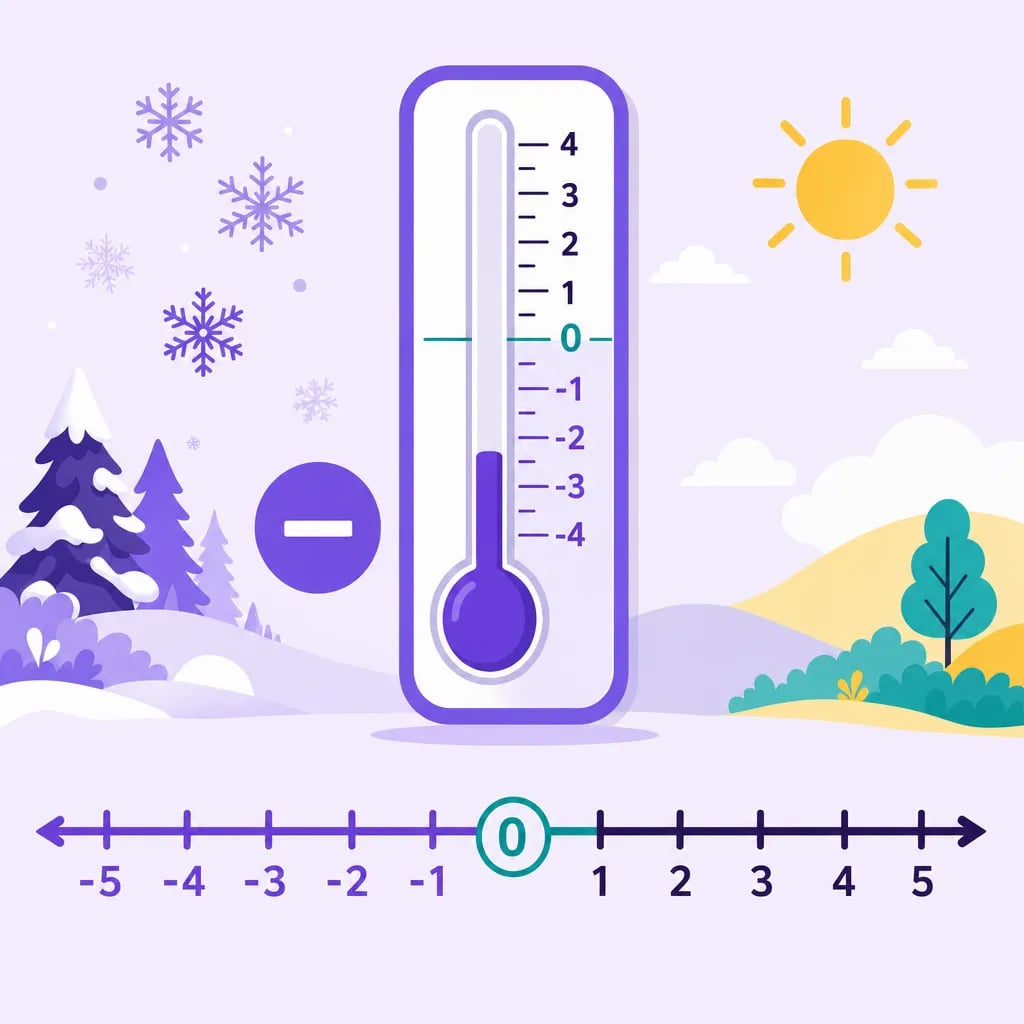
Negative numbers are values less than zero: they represent quantities below a reference point, like a temperature below freezing, a debt, or a floor below ground level. They're written with a minus sign in front (for example, -5) and sit to the left of zero on the number line. Kids usually meet them around 5th-6th grade (ages 10-12), and understanding them well is the foundation for algebra later on. This guide explains what negative numbers are, how to add, subtract, multiply and divide them, and where they show up in everyday life.
What are negative numbers?
Negative numbers are every number smaller than zero: -1, -2, -3... including negative decimals like -0.5. Together with zero and the positive numbers (1, 2, 3...) they form the set of integers.
The core idea is simple: if positive numbers represent "having" or "going up", negatives represent "owing" or "going down". A thermometer reading -3°C doesn't mean "minus zero degrees minus three" — it means three degrees below zero.
To write a negative number you just put a minus sign (−) in front of it: −7, −20, −100. Without the sign, that same number (7, 20, 100) is positive.
Tip: once your child sees a negative as "the opposite" rather than just "a subtraction", the rest of the rules click into place. In a game, negative coordinates move the character: try it in a free coding class.