Which Is Better?

7 min read

Coding Classes for Kids in Chile: Prices, Options and How to Choose (2026)

Published: 14.10.2026·Updated: 15.10.2026
Daniela Herrera

Daniela Herrera

Education Analyst, Algonova

Coding Classes for Kids in Chile: Prices, Options and How to Choose (2026)

Coding classes for kids in Chile cost between CLP 0 and about CLP 115,000 a month in 2026. There are free public workshops, private tutors at around CLP 10,000 an hour, in-person academies in Santiago at CLP 65,000 to 115,000 a month and live online classes from US$ 7 (about CLP 6,900) per class. For a child aged 8 to 12, what changes the result most is a live teacher and a small group.

Algonova is an online school of coding and graphic design for kids and teens aged 6 to 17, with more than 1,000,000 students in 97 countries. Classes are live with a certified teacher, one-to-one or in groups of up to 10 students.

How much do coding classes for kids cost in Chile?

An in-person workshop in Santiago costs CLP 65,000 to 115,000 a month; a live online class starts at about CLP 6,900 per session. We reviewed prices published in October 2026. Treat them as a reference, since every school adjusts them during the year.

FormatPrice in Chile (Oct. 2026)Teacher corrects liveCommuteGood fit if...
Free public workshopCLP 0SometimesDepends on the workshopYou want to try without spending
Recorded courseFree or one-off paymentNoNoYour child already works alone
Private tutor~CLP 10,000 per hourYesBy arrangementYou need one-off support
In-person academy in SantiagoCLP 65,000 to 115,000 a monthYesYes, every weekThey want robotics with real parts
Live online classes (Algonova)From US$ 7 per class (~CLP 6,900)YesNoYou want an age-based path and a low price per class

An academy in Las Condes publishes CLP 65,000 a month for one weekly 1.5-hour class, about CLP 16,000 per session, and charges CLP 5,000 for the trial class. A robotics school in the same district charges CLP 100,000 to 115,000 a month, according to Diario Financiero (July 2026). On private tutoring portals, the average for kids' coding is around CLP 10,000 an hour, with rates from CLP 6,000 to 35,000.

Algonova's price is set in US dollars: US$ 7 is about CLP 6,870 at the official exchange rate of CLP 980.79 on 14 October 2026. With one group class a week, a month starts at about CLP 27,500. To compare schools, use the price per class rather than the monthly fee; we explain it in how much coding courses for kids cost.

If you want to start without spending, Chile's Ministry of Education has promoted the National Digital Languages Plan since 2019, and free workshops for school students have opened under it. Places are limited and open by season.
Online or in-person in Santiago: which suits your child?

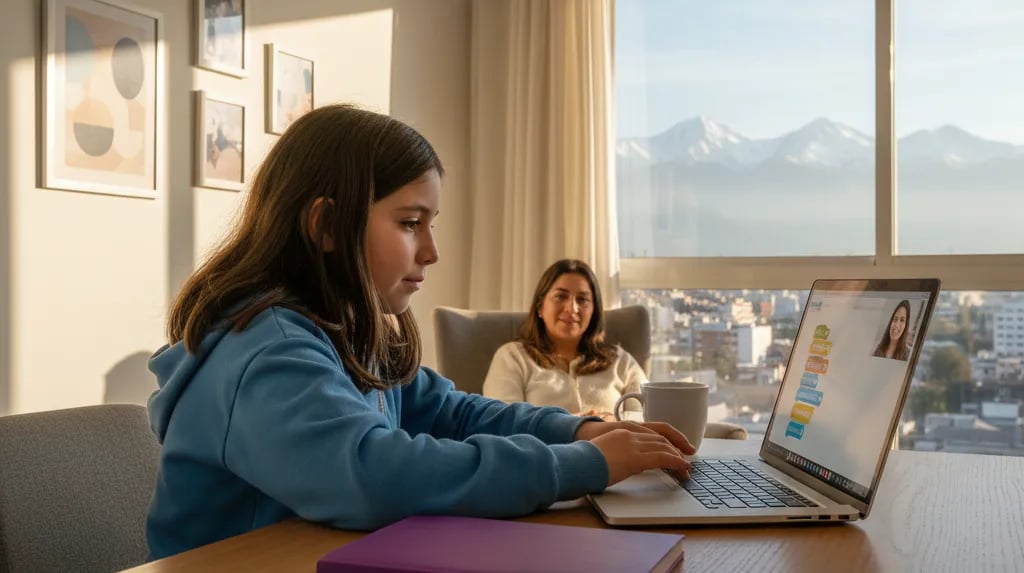
For a child aged 8 to 12, a live online class usually wins on price and time; in-person wins if they want to build robots.

In Santiago, in-person options are concentrated in a few districts, mostly in the east of the city. If you live in Maipú, Puente Alto or outside the capital, a weekly 90-minute class can add another hour of travel in rush-hour traffic. Online, your child joins from home and spends that time coding.

In-person classes have real advantages: robotics kits, face-to-face teamwork and a space without home distractions. If your child drifts off in front of a screen, that matters. Online options also differ: a recorded course cannot answer when a 9-year-old's character will not jump, while a live teacher with a small group sees it on the screen and explains what is missing. We compare both formats in more detail in online vs in-person coding for kids.

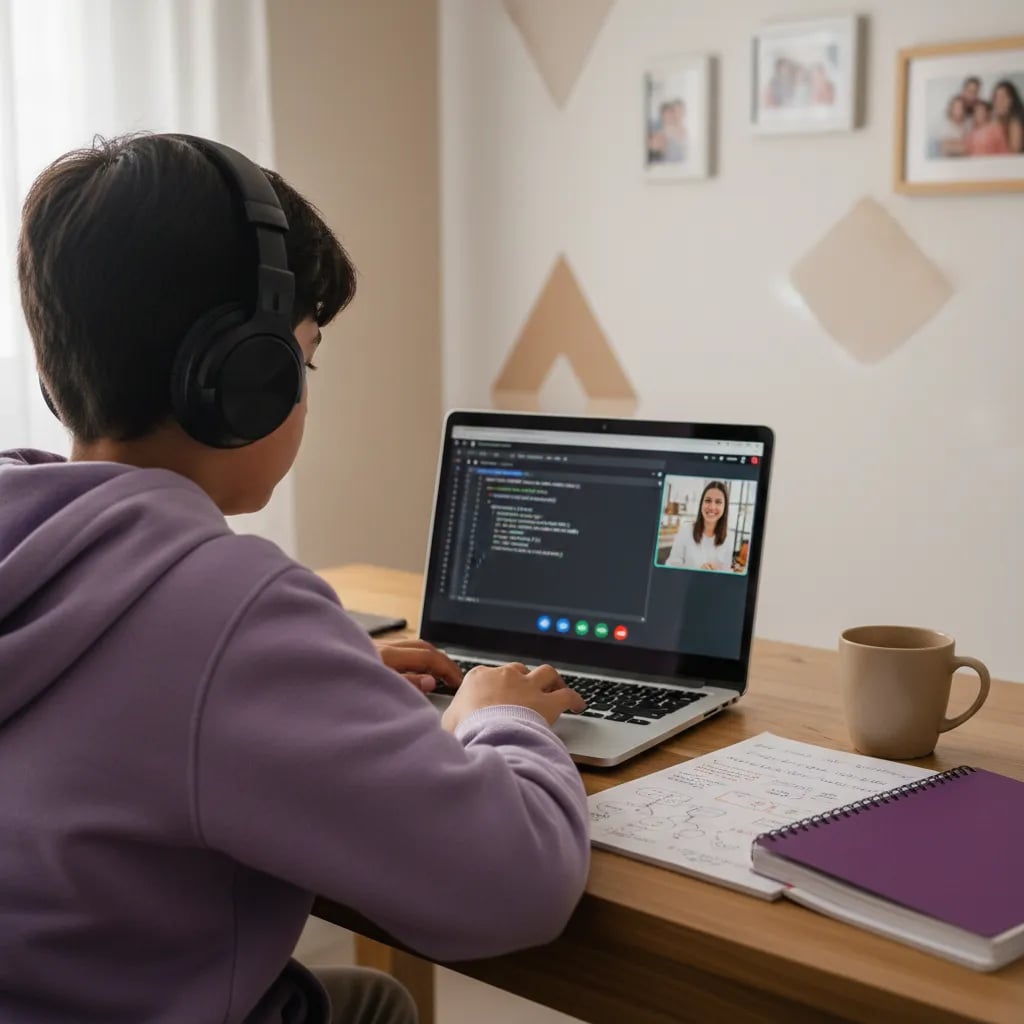
11-year-old boy in a live online coding class with his teacher

When a 9-year-old gets stuck, they need someone to look at their screen right then. If they have to wait until next week, they often drop the project.

Neftalí Cázares, Senior Programming Instructor

How to choose a coding school in Chile: an 8-point checklist

Before paying, check eight points: live teacher, group size, age path, projects, schedule, price per class, refunds and a trial class.

  1. Live teacher. Ask whether someone corrects the code during class or whether your child only watches videos.
  2. Group size. With more than 10 students, the teacher can barely look at each screen.
  3. Age path. There should be a clear route, for example from Scratch to Roblox Studio and then Python, not loose workshops.
  4. Own projects. After a month, your child should be able to show you a game or an animation they made.
  5. Schedule. The class should not clash with the school day or other activities.
  6. Price per class. Divide the monthly fee by the real number of classes, counting public holidays and winter break.
  7. Refunds and pauses. Ask what happens if your child gets sick or you go on holiday.
  8. Free trial class. Your child should try before you pay. Some academies charge for it.

There are more criteria in our guide how to choose an online coding school for kids. If you are torn between an app and a class with a teacher, read coding apps vs live classes.

Want to see how your child works with a live teacher? Book the free 60-minute masterclass

What does a child aged 8 to 12 learn in coding classes?

From 8 to 12, a child moves from Scratch blocks to building games in Roblox Studio and writing code in Python.

In Chile, that age roughly covers 3rd to 7th grade (3° to 7° básico). This is the path at Algonova:

  • Ages 8 and 9: Scratch. They build animations and games with blocks and learn sequences, loops and conditions without fighting syntax.
  • Ages 10 and 11: Roblox Studio with Lua. They design levels and write their first scripts inside a game they already know.
  • Age 12: Python Start. They write real code, first simple programs and then text games.

If your child would rather draw than build games, the graphic design course for kids starts at age 9 with digital illustration, logos and 3D modelling in free tools. To compare languages, read Scratch vs Python for kids. The full programme, with levels and ages, is on coding courses for kids.

What motivates a 10-year-old most is finishing something they can show at home. That is why in every module we aim for them to finish a game or animation that works, even a simple one.

Neftalí Cázares, Senior Programming Instructor

What is Algonova's free class like, and what does it cost afterwards?

The first class is a live 60-minute masterclass, free and with no card. After that, classes start at US$ 7, about CLP 6,900.

In the masterclass your child meets the teacher and builds a mini project for their age: an animation, a simple game or their first lines of code. At the end we tell you which level to start at and which format suits them. All you need is a computer with internet and a quiet hour. Details of each format are on the free coding class page.

If you continue, there are two formats: one-to-one classes of 60 minutes, 1 to 3 times a week, or 90-minute group classes once a week. Paid classes that were not taken are refunded, and the course can be paused for up to 3 months without losing your place.

Summary

  1. In Chile, coding classes for kids range from CLP 0 in public workshops to about CLP 115,000 a month in in-person academies.
  2. Compare by price per class: an in-person academy at CLP 65,000 a month works out at about CLP 16,000 per session.
  3. Live online classes save the commute in Santiago and open the door to families outside the capital; in-person suits robotics with real parts.
  4. Between 8 and 12, the typical path is Scratch, Roblox Studio and Python.
  5. Try before you pay: Algonova's masterclass lasts 60 minutes and is free.

Sources

  • Chile's Ministry of Education (Mineduc), launch of the National Digital Languages Plan, 23 September 2019.
  • Central Bank of Chile, official US dollar rate (dólar observado) on 14 October 2026: CLP 980.79 per dollar.
  • Diario Financiero, report on a children's robotics school in Las Condes, 1 July 2026.
  • Prices published by an in-person academy in Las Condes and by private tutoring portals in Chile, reviewed on 15 October 2026.

Updated: October 2026

How much do coding classes for kids cost in Chile?

In 2026, coding classes for kids in Chile range from CLP 0 in public workshops to about CLP 115,000 a month in in-person academies in Santiago. A private tutor charges around CLP 10,000 an hour on average. An academy in Las Condes publishes CLP 65,000 a month for one weekly 1.5-hour class, about CLP 16,000 per session. Robotics schools with kits reach CLP 100,000 to 115,000 a month. Algonova's live online classes start at US$ 7 per class, about CLP 6,900 at the October 2026 exchange rate. To compare properly, divide the monthly fee by the real number of classes and add the cost of travel.

Are there free coding classes for kids in Chile?

Yes, there are free options with limited places: workshops from public bodies, recorded courses online and trial classes at private schools. Since 2019, Mineduc has promoted the National Digital Languages Plan, and free coding workshops for school students have opened under it. Recorded courses are free too, but nobody reviews the child's work. Algonova's trial masterclass lasts 60 minutes, is live with a teacher and needs no card.

Is an online or in-person class better for a child aged 8 to 12?

For most children aged 8 to 12, a live online class with a small group works as well as an in-person one and costs less. What matters most is that a teacher looks at the child's work during class and helps when they get stuck. Online there is no commute, which in Santiago can save an hour per class. In-person suits children who want robotics with real parts or who struggle to focus at home.

How much does Algonova cost in Chilean pesos?

Algonova classes start at US$ 7 per class, about CLP 6,870 at the official rate of CLP 980.79 on 14 October 2026. The final price depends on the format and on how many classes a week your child takes: one-to-one classes of 60 minutes or 90-minute group classes. With one group class a week, a month starts at about CLP 27,500. The first class is free and untaken classes are refunded.

From what age can my child start coding?

A child can start coding from age 6 with visual blocks, and between 8 and 12 they progress quickly because they already read fluently. At 8 or 9, Scratch lets them build their own games and animations. From 10, many move on to Roblox Studio, and around 12 they start Python. No prior experience is needed.

Which programming language does a child aged 8 to 12 learn first?

Most children aged 8 to 12 start with Scratch, continue with Roblox Studio and reach Python around age 12. Scratch uses blocks instead of text, so the child understands the logic without fighting syntax. An 11-year-old who has never coded does not have to go back to the very basics: the teacher places them at the right level after the trial class.

What does my child need to take online classes from Chile?

To take online classes from Chile, your child needs a computer, a stable internet connection and a quiet place during class. The tools we use, such as Scratch, Roblox Studio and Python, are free. A headset with a microphone helps. The free 60-minute masterclass is also a good way to check that the computer and connection work well.

How many classes a week should my child take?

For a child aged 8 to 12, one or two classes a week are usually enough to progress without coding feeling like more homework. One 90-minute group class a week is a good pace to start. One-to-one classes of 60 minutes can be taken up to 3 times a week. Consistency matters more than hours.

How does Algonova's free trial class work?

Algonova's trial class is a live 60-minute masterclass, free, with no card and no obligation to enrol afterwards. Your child joins a real teacher and builds a mini project for their age. At the end we tell you which level to start at and which format suits them, one-to-one or group.

What if my child does not adapt or we need to pause classes?

If your child does not adapt, you can change format or stop, and at Algonova paid classes that were not taken are refunded. For holidays, trips or exam periods, the course can be paused for up to 3 months without losing your place or the classes you paid for.