Canva Projects for Kids: 5 First Projects for Primary School (and How to Start)
Learn Design9 min read
Learn Coding

Fajar Hidayat
Coding Curriculum Team, Algonova

The benefits of coding for kids are logic and problem-solving, creativity, perseverance, self-confidence, digital literacy, and career preparation - six life skills that go far beyond just writing code.
Algonova is an online platform for coding, math, AI, and design courses for kids aged 5-17: 1,000,000+ alumni in 97 countries since 2016. Live classes with certified teachers in Private (1 student), Mini (2-4 students), and Group (up to 10 students) formats.
The main benefits of coding for kids fall into six areas: logic and problem-solving, creativity, perseverance (grit), career preparation, self-confidence, and digital literacy. These benefits are cumulative - the more consistently a child learns, the deeper the foundation.
What makes coding different from other activities: its benefits don't stop at the screen. The logic trained while building a game transfers to maths problems; the perseverance of debugging transfers to hard homework; the confidence of building things transfers to class presentations.
It's never too late. Benefits show up both in children who start in kindergarten and those who begin in grade 5 or middle school. For a guide on starting from zero, see Learning to Code for Beginners.
The fastest-visible benefit of coding is logical thinking and problem-solving - the child learns to break big problems into small steps that can be solved one at a time. This is called computational thinking, and its impact reaches far beyond the screen.
In coding, each line produces a specific output. The child sees the direct link between decision and consequence - clearer than in almost any other school subject. When code breaks, the child doesn't give up; they trace it step by step to find where the problem is.
This skill transfers to maths, writing, and even everyday life. The score variable in a Scratch game the child built is the same x in algebra - just in a context that makes sense.
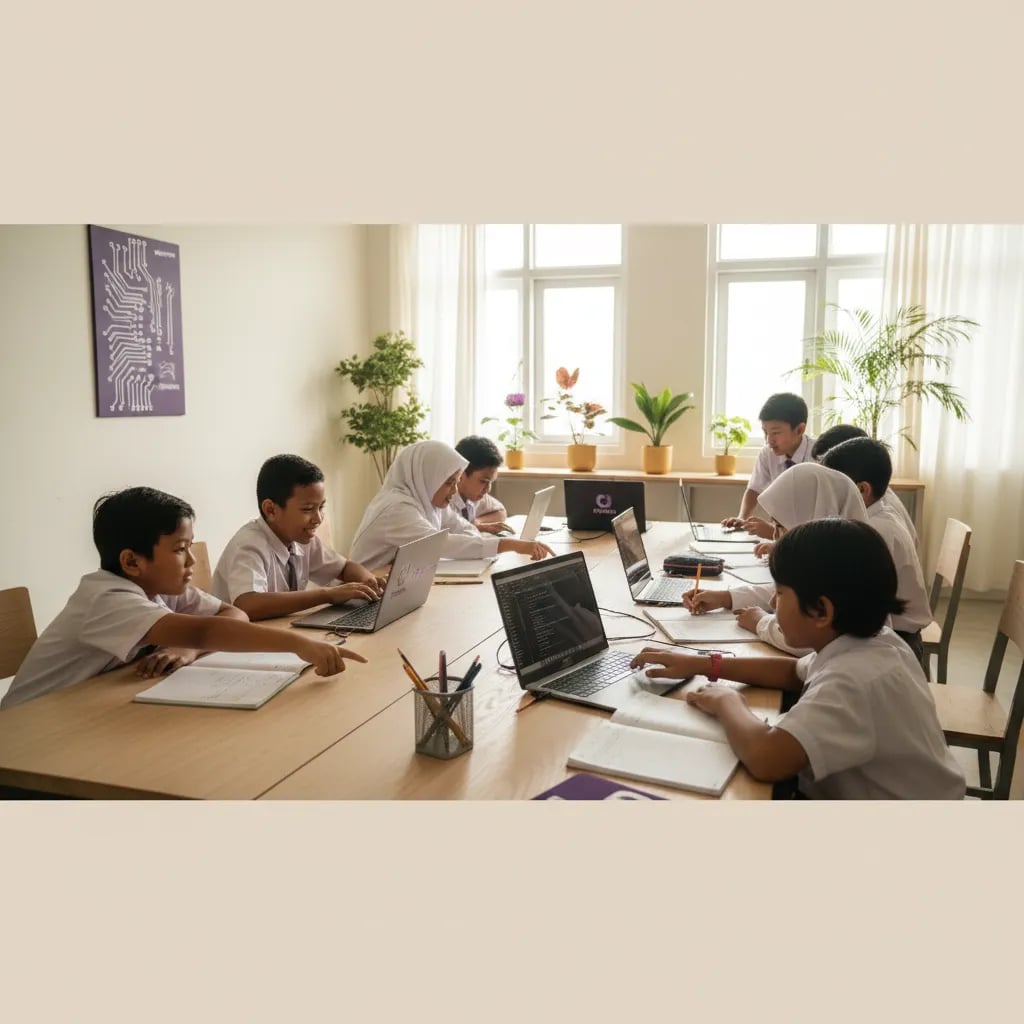
According to the Future of Jobs Report 2025 by the World Economic Forum, analytical thinking is the #1 most-demanded skill in the job market through 2030 - and coding is one of the most practical ways to build it in children early.
The second major benefit of coding is creativity - the child shifts from being a tech consumer to a creator who can turn ideas into something real. Many Indonesian children grow up as YouTube viewers and game players; coding flips that position.
In coding there's no single right answer. One game idea can be built in dozens of different ways. The child is free to experiment: change colours, add characters, alter the rules of play. Each experiment trains the same creative muscle as drawing or writing stories - just with an interactive result that can be played.
This creativity carries beyond coding. A child used to thinking "what if I try another way" tends to be more flexible facing open-ended schoolwork, art projects, or everyday problems.
For a concrete picture of how coding applies to primary school kids, see Coding for Primary School Kids.
Children learning to code aren't really learning to build programs - they're learning a way of thinking that will stay with them for life.
Bayu Nugraha, Children's Coding Specialist
The third benefit of coding is perseverance - the child learns that mistakes are information, not verdicts, so they keep trying until it works. This is what researchers call grit, and coding trains it in a very natural way.
Broken code isn't personal failure - just a bug to find. The child tries, fails, fixes, then tries again - sometimes dozens of times in a single session. This cycle, which feels frustrating in other subjects, feels like a fun puzzle to solve in coding.
This perseverance carries into the classroom. A child used to not giving up on bugs tends to be more resilient facing hard maths problems or long assignments. They know that "can't yet" is different from "can't".
Building one project from scratch also trains the child to focus 30-60 minutes without distraction - a rare skill in the short-screen era.
Coding benefits change shape with the child's developmental stage - what a kindergarten child experiences differs from a high schooler. This table summarises the differences to help calibrate your expectations.
| Age | Main benefit | Evidence at home |
|---|---|---|
| 5-7 (Kindergarten) | Cognitive foundation, self-confidence | Child can explain what they built |
| 8-12 (Primary) | Cause-effect logic, focus, transfer to maths | Maths grades up, homework done faster |
| 13-17 (Middle & High School) | Systems thinking, teamwork, career preparation, real project portfolio | Child becomes a tutor for friends or siblings; apps and projects shareable with universities |
Details per stage:

These benefits are cumulative - a child consistent from kindergarten will have 12 years of foundation by high school graduation, while a child starting in middle school can still build a strong foundation in 4-5 years.
The fourth benefit of coding is career preparation - nearly every profession from 2030+ will touch technology, and a child comfortable with coding logic won't be overwhelmed when new tools arrive. This isn't about turning every child into a programmer.
Concrete career benefits built from coding:
Future doctors will work with medical AI, teachers with edtech platforms, designers with generative tools. Understanding how technology works becomes a basic skill across professions.
The fifth benefit of coding is self-confidence - a child who has built their own game or app has real proof that "I can build things". This feeling lasts and carries into other areas.
At Algonova, every project ends with show-and-tell: the child explains to classmates what they built and how it works. Every child gets their own turn, so speaking in front of others about their work becomes a routine part of the class.
This confidence isn't empty - it's rooted in real work. The child isn't just told "you're great"; they see for themselves a working result on screen. This foundation is what makes a child brave enough to try other hard things in school and life.
The most valuable benefit of coding isn't technical skill - it's the child's confidence that they can build something from nothing.
Bayu Nugraha, Children's Coding Specialist
The sixth benefit of coding is digital literacy - a child who understands how technology works from the inside becomes a more critical and safe user, not just a passive viewer. In the AI era, this is no longer an optional skill.
A child who has built a program understands that apps and games don't just appear - there are humans and logic behind them. This understanding makes them more aware when facing ads, social media algorithms, or AI-generated content. They tend to ask "how was this made" instead of swallowing it whole.
Digital literacy also covers safe habits: managing screen time, recognising misleading information, and using technology as a tool, not just entertainment. For a full guide on this topic, read Digital Literacy for Children.
All six benefits are cumulative - a child consistent from kindergarten has years of foundation by high school graduation, while a child starting in middle school can still build a strong foundation in 4-5 years. For an exploration specific to primary school kids, see Benefits of Coding for Primary School Kids.
To start with professional support, join the free Algonova Master Class - one 60-minute session for a level recommendation.
The main benefit of coding for a child isn't being able to write programs; it is a way of thinking that carries into every area: logic, problem solving, perseverance, and creativity. Coding trains a child to break big problems into small, manageable steps.
At what age do these benefits start forming? From age 5 through visual coding, growing stronger as the child moves up to text-based languages.
Does a child have to become a programmer to benefit? No. The thinking skills from coding are useful in any career. See Algonova's coding classes for ages 5–17, or try a free coding class to see the benefits first-hand.
The fastest benefits to show are logic and self-confidence - usually within the first 1-2 months a child starts talking about what they want to build, not just passively watching screens. At months 3-4, focus starts improving: the child sticks with homework longer without distraction. The child's questions also become more systematic - instead of "why is this?", the child asks "what happens if I change this?". In an Algonova class, a child completes a first project - a simple game, for instance - within the early sessions and then explains how it works in their own words. Confidence usually grows before school grades do. Academic benefits like maths grades only appear after 5-6 months of weekly consistency. Sign up for a free Master Class to see your child's first reaction.
Yes, coding can help a child's maths grades - but the mechanism is subtle rather than direct, and results take several months of consistent practice. Often-abstract maths concepts (variables, functions, coordinate systems) become tangible in Scratch or Python. The score variable in a game the child built is the same x in algebra, just in a context that makes sense to them. Example from class: when a child builds a "test score calculator" in Scratch, percentages stop being an abstract formula and become a real operation they use themselves. Note: coding strengthens the foundation, it doesn't replace practice. The child still needs to do maths homework. The combination of both - coding and regular maths practice - gives the best results.
No. This is one of the most common myths - a child doesn't need to be good at maths to start coding; often the opposite happens: coding makes maths feel easier. On visual platforms like Scratch, the child assembles command blocks without complex formulas. Maths appears naturally and playfully - not as an entry requirement. In a visual coding class, numbers appear as a tool to make characters move, not as exam questions. Even a child who feels they "don't like maths" can follow along. Even children aged 5-6 can start with picture-based coding without fluent reading or arithmetic. All they need is curiosity. Algonova class spec: 1-on-1 private, a mini-group of 2–4, or a group of up to 10 students so each child gets attention suited to their level.
Very much yes. Most children won't become professional software engineers - but all benefit from the foundation of thinking, creativity, and perseverance that coding trains. Future doctors will work with medical AI, designers with generative tools, business people with data and automation. Understanding tech logic gives an edge in nearly every profession. A child who wants to become a doctor, for example, still benefits: the perseverance and structured thinking trained through coding help with complex biology and chemistry. Even if a child chooses a fully non-digital career, cognitive benefits like logic and failure resilience still transfer. Coding is an investment in thinking, not just a university major.
Not automatically - coding counts as high-quality screen time because the child creates rather than passively consumes. The danger is excessive total screen time from all sources. Coding still needs limits: for primary kids, keep each session reasonably short with short breaks in between. A healthy mix is a few coding sessions per week plus non-screen activities like sports and outdoor play. One easy rule to apply at home: coding only on weekends after physical activity, so the child values the session more. Signs of a healthy child: they stop on their own and proudly show their project. Unlike passive video watching, coding trains the child to be a creator - the core of healthy digital literacy.
For initial benefits like enjoying it and talking about projects: 1-2 months with 2 weekly sessions. For cognitive and academic benefits: 3-6 months of consistency. Optimal dose: 2 sessions per week, with session length matched to the child's age stage - shorter for kindergarten, longer for middle-high schoolers. The key isn't marathon duration but weekly consistency. Example: a child who practises 30 minutes every Saturday for a year is far more advanced than a child who codes 4 intensive hours every two months. A child's brain needs steady repetition, not sporadic bursts. The lifelong "I can build things" identity usually forms in 1-2 years. A free Master Class can be the first step to finding a rhythm that fits.
There's no upper limit - coding benefits from kindergarten (age 5) into adulthood. But the benefits change shape with the child's age stage. Ages 5-12 are the strongest cognitive-foundation period - the child's brain is still highly flexible. Ages 13-17 still have 4-5 years to build a portfolio and prepare for STEM university. Many top engineers only got serious about coding in middle or high school, so a child starting "late" still has enough time before university. Optimal benefit: starting from kindergarten or early primary and staying consistent for 5-10 years. But the word "too late" rarely applies to kids' coding - what matters isn't when you start, but how consistent you are afterward. Algonova classes adapt the level for children aged 5 to 17.
Blog

Algonova worldwide
Contact
Whatsapp: +62 21 50996971
Email: info@algonova.id
Address
Coworking Area, Gedung IT 6 Lantai Dasar, Nongsa Digital Park, Jalan Hang Lekiu, Kelurahan Sambau, Kecamatan Nongsa, Batam, Indonesia Directorate General of Consumer Protection and Trade Compliance – Ministry of Trade of the Republic of Indonesia. WhatsApp Ditjen PKTN: 0853-1111-1010.
PT Algonova Indonesia Cerdas All rights reserved 2026