

Online Math Tutoring for Primary & Middle Schoolers: Options & Pricing 2026
Math Education8 min
Coding Education

Rina Kusuma
Senior Coding Instructor
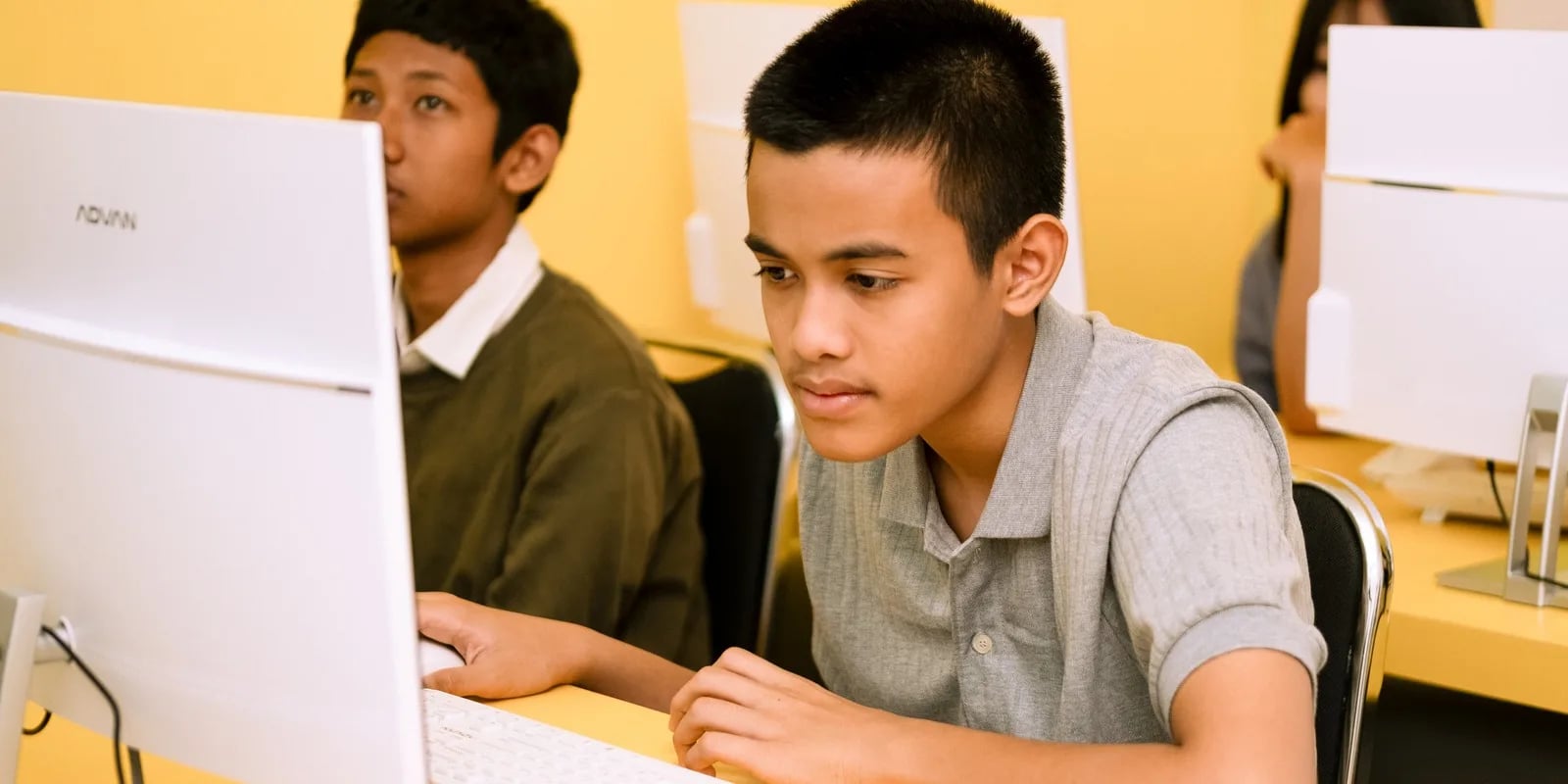
Learning to code as a beginner can start from zero with just 20–30 minutes of practice per day — beginning with basic logic, then one simple programming language, and practicing through small projects, rather than memorizing thousands of lines of code. The good news: you can start today, even with nothing but a phone. This guide breaks that whole journey into clear steps, complete with language choices, tools, apps, and a realistic 3-month roadmap.
Whether you're a curious adult or a parent wanting to set your child (elementary, middle, or high school age) up for a digital future, this article is written so you know exactly where to begin — without getting lost in an ocean of tutorials.
Coding (or programming) is the act of writing instructions a computer can understand to complete a task — from moving a character in a game, to calculating numbers, to building an app. At its core, coding is a way of thinking logically and in structure: breaking a big problem into small, ordered steps.
Why start now? Because coding is no longer an exclusive skill for professional programmers. In the digital era, computational thinking helps in almost every field. For children, the benefits run even deeper: it builds problem-solving, patience, and creativity. If you'd like to understand the foundations first, read what coding is for kids and coding explained.
Reassuring news for beginners: you don't need advanced math or an expensive computer to start. All you really need is curiosity and a willingness to practice regularly.
Many beginners fail not because they aren't smart, but because they get the order wrong — jumping straight into a hard language before grasping the logic. Follow this sequence so learning to code from zero feels natural:
Want a faster head start? Instead of trial and error alone, a child can learn with clear guidance from a teacher. Try a free Master Class — a 60-minute session where an AI-based talent diagnostic shows exactly where to begin.
Choosing a first language often confuses beginners. The key: pick one with simple syntax and plenty of learning material. Here's a comparison:
| Language / Tool | Best for | Strengths | Note |
|---|---|---|---|
| ScratchJr | Ages 5–7 | Visual, no reading required, drag-and-drop | Logic foundations without typing |
| Scratch | Ages 8–12 & total beginners | Colorful visual blocks, instant results | A bridge to text-based code |
| Python | Teens & adults | English-like syntax, versatile | The #1 language for serious beginners |
| HTML & CSS | Those who love web design | Results visible instantly in the browser | Technically not full "programming" |
| JavaScript | Intermediate stage | For interactive web | Best after you grasp the basics |
For children, the proven path is ScratchJr → Scratch → Python. Start with fun visual blocks, then gradually move up to text-based code. Learn more about what Scratch is and why Python for kids is a favorite.
For adult beginners who want to be productive quickly, Python is the safest choice: clean syntax, a massive community, and used everywhere — from data analysis to AI.
Yes, you can learn to code using only a phone — no laptop required. That's great news for many families in Indonesia who don't yet have a computer at home. While a small screen has its limits, a phone is more than enough for the early phase: grasping logic and writing simple code.
App categories beginners can use:
A key tip for learning to code on a phone: use it for short daily practice (on the commute or while waiting), then occasionally switch to a bigger screen for more complex projects. The phone is a remarkably low-barrier entry point — use it to build the habit.
You don't need many tools to start. This minimal list is enough:
For elementary-age children, resources like coding for elementary kids and a summary of the benefits of coding for kids can guide parents in choosing the right path and explaining why this skill matters.
So you don't lose direction, follow this phased roadmap. It's a framework, not a rigid rule — adapt it to your own pace:
After three months, beginners usually have a solid foundation and a clearer sense of where their interest lies — web, data, games, or AI. At that point, structured learning with a teacher becomes far more efficient than continuing solo.
Self-teaching is possible, but many beginners give up midway because they get stuck with no one to guide them. This is where a structured class makes a big difference.
At Algonova, children learn through LIVE online classes with certified teachers (not recorded videos), in Private (1 student), Mini (2-4 students), and Group (up to 10 students) formats so every child gets real attention. Since 2016, over 1,000,000 alumni across 97 countries have learned with our step-by-step curriculum. For students in Indonesia, this approach aligns with the spirit of the Kurikulum Merdeka, which emphasizes active, project-based learning. See our full programs on the coding page.
You don't have to decide anything right away. The best way to know whether a child clicks with coding is to let them try it directly.
Learning to code as a beginner doesn't require special talent — only a first step and consistency. Start with logic, pick one language, build small projects, and practice regularly even if it's just on your phone. The roadmap above will keep your direction clear.
Ready to turn curiosity into a real skill? Try a free 60-minute Master Class with an Algonova teacher. Your child will go through an AI-based talent diagnostic and immediately feel the thrill of building something themselves — free, with no commitment.
Before you start, get familiar with these basics in the Algonova Coding Glossary: what is programming, programming language, programming logic, variable, debugging, and computational thinking. See the full list in the Coding & Technology Glossary for Kids.
Want your child to start coding? Try a free Master Class.
The order for learning coding as a beginner is simple: master the basic logic first, pick one language, then practice through small projects for 20 to 30 minutes a day. Anyone can start from zero, even on just a phone without a laptop. If you want your child to learn with a clear direction and a teacher's guidance, see the programs on the coding classes page, or try a free coding class to see where they should start.
Yes, Algonova Indonesia runs a full coding program for kids aged 5 to 17, covering kindergarten through senior high. It splits into three age tracks: Little Coders for ages 5 to 7 using visual block based coding, Junior Coders for ages 8 to 12 using Scratch and the fundamentals of programming logic, and Teen Coders for ages 13 to 17 using Python and game development. Every class is live online with certified teachers in small groups of up to 10 students. Kids build a real project from the first session rather than memorising syntax. Algonova has taught more than 1,000,000 students across 97 countries since 2016.
Yes. For the coding track Algonova Indonesia offers a free 60 minute master class with no commitment. No credit card is needed and there is no auto subscription afterwards. Note that these 60 minutes are an introductory master class, not a regular lesson. A regular coding class runs 90 minutes. During the master class the child works directly with a certified teacher, tries the online learning platform, and finishes a first small project matched to their age. After the session parents receive a personal learning track recommendation plus a transparent explanation of program, schedule, and pricing from Rp 102,000 per lesson. To book, fill in the form on the website.
Algonova Indonesia coding classes come in three formats: Private with one student per teacher, Mini group of 2 to 4 kids, and Group of 6 to 10 kids of similar age and level. The small group format exists because coding gets stuck on very specific lines of code, and a child needs a teacher who can look at their screen when it happens. In a Mini group the teacher checks each child's screen several times per session. The Private format is the most intensive and suits competition preparation, independent projects, or a child who wants to move faster than the group.
Kids coding at Algonova Indonesia starts from Rp 102,000 per lesson. The price covers the live session with a certified teacher, digital learning materials, online platform access, and an official certificate once the child completes each program level. The starting rate is the same across all age tracks. The final quote depends only on class format, meaning Private, Mini, or Group, and on how many sessions per week you choose. Group is the most affordable option and Private is the most intensive. Full pricing is shared after the free master class and before formal enrolment, with no surprise fees. To get a quote, fill in the form on the website.
Yes, every Algonova Indonesia coding program runs fully online with live sessions taught by certified teachers, not recorded videos. Kids learn in real time in small groups, with live Q&A and code written alongside the teacher during the class. To join, a child needs a computer or laptop with a camera, a stable internet connection, and a headset. The Algonova platform runs directly in the browser, so no special software installation is required and no expensive machine is needed. Because everything is online, families anywhere in Indonesia can join and easily fit lessons around school.
Three things make Algonova coding effective for Indonesian kids: project based learning, a staged track, and small groups. Every session produces something that runs and can be shown to a parent, which keeps motivation alive far longer than theory alone. The track climbs gradually from visual block based coding to Python, so a child never jumps into a text language before their logic is ready. Small groups of up to 10 students let the teacher adjust pace: faster kids get extra challenges and stuck kids get help inside the same session. The material also lines up with coding and artificial intelligence entering the Indonesian school curriculum.
That is fine, most Algonova students start from zero with no coding experience at all. Every new child begins with the free master class, where the teacher watches how they solve problems and picks the right starting point. Kids aged 5 to 7 start with visual block based coding and do not need to type fast yet. Older kids can start with Scratch and move up to Python once their logic is solid. All that is required is basic reading and curiosity. Parents do not need to understand programming to support the child, because every task is explained by the teacher during class.

Algonova worldwide
Contact
Whatsapp: +62 21 50996971
Email: info@algonova.id
Address
Coworking Area, Gedung IT 6 Lantai Dasar, Nongsa Digital Park, Jalan Hang Lekiu, Kelurahan Sambau, Kecamatan Nongsa, Batam, Indonesia Directorate General of Consumer Protection and Trade Compliance – Ministry of Trade of the Republic of Indonesia. WhatsApp Ditjen PKTN: 0853-1111-1010.
PT Algonova Indonesia Cerdas All rights reserved 2026
