
Online Math Tutoring for SMP Students: How to Choose and What to Check in the Trial Class
Learn Math10 min read
Q&A

Maya Putri
Early Childhood Education Specialist
Is Roblox safe for kids depends on three things: account settings, spending limits, and a parent who stays involved. With account restrictions on, a parent PIN in place, and chat narrowed down, Roblox works for children aged 9 and up. The real risk is not the game itself, it is strangers in chat and unsupervised Robux purchases. This guide is for parents in Indonesia whose child already plays daily.
Algonova is an online school for coding, mathematics, AI, and design for children aged 5-17, with 1,000,000+ students across 97 countries and 10+ years on the market. Indonesia alone has 13,000+ students. Classes run in Private (1 student), Mini (2-4 students), and Group (up to 10 students) formats, live with a certified teacher, not as recorded video. Parents rate us 4.9 out of 5.
Roblox risk comes from other people and from your wallet, not from the game itself. Roblox is not a single game, it is a platform holding millions of user built worlds. Content, quality, and violence levels vary widely from one world to the next.
| Risk | How it shows up in Roblox | What to do |
|---|---|---|
| Contact with strangers | In game chat, private messages, invitations to move to another chat app | Limit chat to a known friend list, or switch it off |
| In game purchases | Robux for items, paid access to worlds, subscriptions | Remove saved cards, set a spending cap |
| User generated content quality | Horror or violent worlds that surface easily through search | Turn on account restrictions so only curated worlds appear |
| Session length | Sessions with no natural ending because a new world is always one tap away | Agree on session length before your child starts |
The first two are what parents report most often. An invitation to continue the conversation on another app deserves an immediate talk, because outside the platform there is no moderation at all.
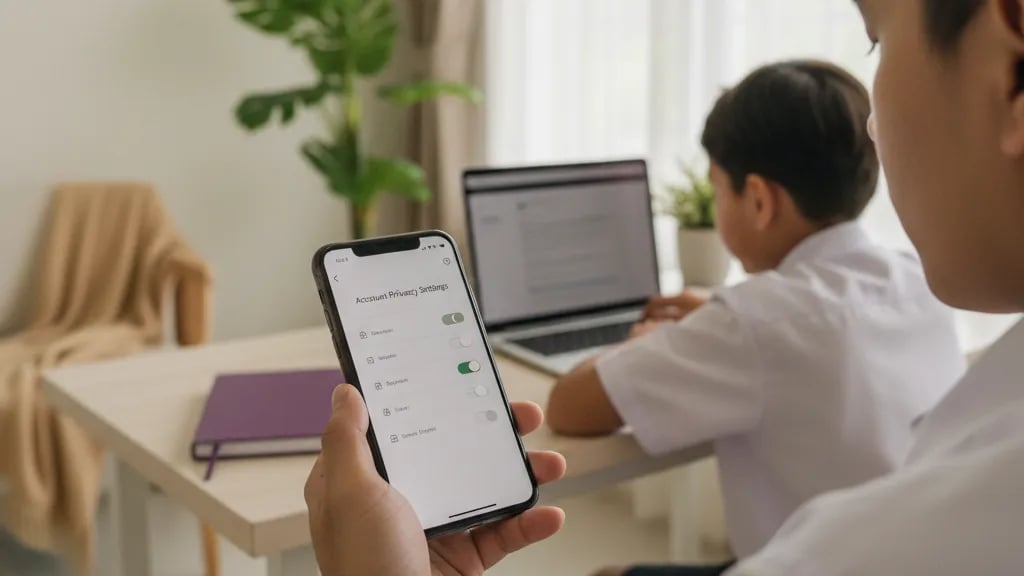
Almost every Roblox safeguard sits in one place: the privacy and parental control menu inside your child's account. A sensible order:
Menu names and locations shift between app versions. The accurate reference is always the official Roblox page for parents, not a year old YouTube walkthrough.
Settings alone do not solve this. UNICEF stresses that the strongest protection is open conversation free of blame, so a child speaks up when something feels wrong, as explained in its guide on how to keep your child safe online. A child who expects to be scolded hides suspicious messages, which is far riskier than chat being switched on.
A child who expects a scolding will not mention the strange message. Chat filters hold back part of the risk, and trust at home holds back the rest.
Bayu Nugraha, Coding Education Specialist
Age 9 is a reasonable point for a child's own account, with chat restricted and sessions still monitored. Readiness is less about the number and more about whether your child tells you when something feels uncomfortable.
Spotting scams and guarding personal data are teachable skills, and they belong to digital literacy for children far beyond Roblox. On enforcing rules without a nightly argument, see parenting in the digital era.
The rule that lasts: parents buy Robux, children do not. Robux is the in platform currency used for items and access, explained in full in what Robux is.
Surprise bills nearly always trace back to one cause: a card or payment account saved on the child's device. Remove the card, disable in app purchases at device level, and agree on a fixed monthly allowance your child knows about from the start.
If building turns out to interest your child more than buying, that interest can be redirected. Primary school children can start with coding classes for primary school kids, and the cheapest way to test the fit is a free coding class of 60 minutes with a teacher.
The most effective way to cut playing hours is not a ban, it is giving your child a reason to open Roblox Studio. Roblox Studio is the free editor for building your own worlds, introduced in what Roblox Studio is.
What parents usually notice is not fewer hours but different hours. A child who builds a world measures sizes, tests logic, and fixes their own mistakes, using the same skills that school mathematics asks for. A child who is not ready for Roblox Studio yet can warm up with free coding games for kids that use blocks.
Roblox scripts are written in Lua, whose syntax is friendly enough for beginners, see what Lua is. For a first project, there is a step by step walkthrough in how to make a Roblox Studio game for beginners.
A child drawn to visuals rather than script logic can enter from the other side through game design classes for children, and pick up scripting once the first project exists.
Once a child opens Roblox Studio, the question shifts from how much longer can I play to how do I make this door open by itself.
Bayu Nugraha, Coding Education Specialist
Rules hold when they are built with your child rather than announced at them. Four points usually cover it:
After 2-3 consistent weeks, most families report fewer arguments about screens, because the limit is clear instead of depending on a parent's mood that evening.
For an 8 year old, Roblox works if account restrictions are on, chat is limited to friends known offline, and sessions still happen with a parent nearby. At this age a child cannot judge whether the person chatting is really another child, and that is the hard part. A common pattern: another player invites the child to continue on a chat app outside Roblox in exchange for free items. When private messages have already been switched off, an invitation like that never reaches the child. Technical restrictions do narrow the experience, and at 8 that is exactly the point, since a child has no track record yet for spotting scam patterns. Around age 10 the restrictions can loosen step by step, and the right moment to loosen them is when your child reports a strange message on their own.
The agreement that usually works is 45 minutes per session on school days and a maximum of 2 hours a day during holidays, with the weekly total agreed in advance. How a session ends matters more than the total. Roblox has no natural finish line, because another world is always one tap away. Families who set a 5 minute warning report far less drama than those who switch the device off mid game. One simple move helps a lot: let the child pick the last world they play before stopping, so ending a session does not feel like a punishment. The choice costs nothing and removes most of the argument. When part of those hours goes into building in Roblox Studio, many parents stop counting minutes, because the result is something the child can open and explain.
Chat is switched off in the privacy menu of your child's account, and each channel is set separately: in game chat, private messages, and group invitations can each be limited to friends or disabled. Once everything is configured, the step most parents forget is the parent PIN. Without it, a child can restore those settings in seconds and you will never know. Filters that seem to switch themselves off usually have a simple explanation: the child turns chat back on to play with classmates and then forgets to turn it off again. The PIN closes that gap without daily device checks. Menu names and positions change between app versions, so check the official Roblox page for parents whenever a step in an older walkthrough no longer matches.
Save screenshots as evidence, block and report the account through the report button inside Roblox, then talk the incident through with your child without blame. The order matters, and the last part is where it usually goes wrong. Anger or a confiscated device teaches your child that reporting backfires, so the next incident stays hidden. A frequent pattern: a child is asked to send a code, click a link, or move to another app in exchange for free Robux. The clearest scam signal is any request to leave the platform, because outside Roblox there is no moderation and no trail left to report. Afterwards, review the friend list together and remove accounts nobody knows offline. There are usually more of them than parents expect, and removing them rarely causes an argument.
Remove payment cards from the account and from the device, disable in app purchases in the device settings, then agree on a monthly allowance that you buy yourself. Surprise bills almost always come from a saved card rather than from a child deciding to break a rule. When paying is one tap away, a limit does not feel real to a ten year old. A practical setup: give a fixed monthly allowance as a voucher, and if it is spent in week one, the child waits for the next month with no renegotiation. After a few months children usually start saving the allowance for a more expensive item. Vouchers make the limit visible, so it cannot be topped up quietly. A fixed allowance doubles as a first lesson in managing money, and that lesson outlasts any item inside the game by years.
Playing works on a phone or tablet, but building in Roblox Studio needs a laptop or PC with a mouse, because the editor has no phone version. Specifications do not need to be high. A mid range laptop a few years old with 8 GB of RAM handles beginner projects, and a stable internet connection matters more than the graphics card. A second hand laptop generally copes too, as long as other apps are closed while the editor runs. A slightly larger screen helps as well, since the editor shows several panels at once. An external mouse often makes the biggest difference, because arranging 3D objects on a trackpad tires children out and ends sessions earlier than planned.
Yes, both are a good fit for girls, and in Algonova classes girls and boys follow the same curriculum with no separate track. What differs is usually the entry point rather than the ability. Some children are drawn to story, characters, and how a world looks, then learn scripting because their idea needs to run. A route we see often: a child starts by designing the interior of a cafe in Roblox Studio, then writes a first script so the cafe door opens when a player walks up, and ends up asking the most questions about conditional logic in the group. Because classes run in Private (1 student), Mini (2-4 students), and Group (up to 10 students) formats, teachers match projects to each child's interest instead of pushing everyone through the same theme, which is why children stay longer.
No, your child does not need to be good at maths first, because beginner projects only use coordinates, addition, and comparing numbers, which a third grader already handles. The interesting effect runs the other way. A child building a world meets coordinates, angles, and variables inside a task with a clear purpose, so school material starts making sense. Nothing needs memorising in advance. Coordinates that felt confusing in class often click once a child has to move an object to an exact spot in their own world, because a wrong number shows its consequence on screen immediately. That instant feedback is hard to get from a worksheet. A child's attitude towards maths usually shifts before the grades do, often within the first few weeks of building.
Shrink the project, because boredom usually comes from a target that is too large, such as wanting a complete game before ever finishing one small mechanic. A single session should aim at something visible right away: a door that opens, a score counter that goes up, a character that jumps higher. A child who stalls on a big project often comes back to it after a task as small as building one button that changes the floor colour, and picks the old project up again the following week without prompting. A small finished win restores the sense of being capable. A teacher breaks a big idea into steps that finish inside one session, and that is what decides whether a child keeps going past the first month.
Classes at Algonova start from Rp 102,000 per lesson, and progress shows up in real projects your child can demonstrate plus regular feedback from the teacher. The most honest measure of progress is the work itself. Every few sessions your child finishes something you can open and try, so there is no need to guess from a grade. After roughly a month a child usually has one simple world with a working mechanic, and can explain which parts they wrote and which parts they still want to fix. Screenshots of the project are worth more than a score. Asking one question a week works too: which part was hardest to build. A free 60 minute trial class is the fastest way to see whether the format suits your child, with no package to decide on first.
Blog

Algonova worldwide
Contact
Whatsapp: +62 21 50996971
Email: info@algonova.id
Address
Coworking Area, Gedung IT 6 Lantai Dasar, Nongsa Digital Park, Jalan Hang Lekiu, Kelurahan Sambau, Kecamatan Nongsa, Batam, Indonesia Directorate General of Consumer Protection and Trade Compliance – Ministry of Trade of the Republic of Indonesia. WhatsApp Ditjen PKTN: 0853-1111-1010.
PT Algonova Indonesia Cerdas All rights reserved 2026
