How to Teach Multiplication Tables to Kids: 5 Proven Methods
Learn Math8 min
Parent Guides

Maya Putri
Early Childhood Education Specialist

Updated: November 2026
A child who can't sit still is very often normal, because primary school children are active and their attention goes up and down. A child needs to be checked when the behavior happens often, lasts about 6 months or longer, shows up at home and at school, and gets in the way of learning or friendships. This article helps parents tell the difference. Only a pediatrician, psychologist or child psychiatrist can make a diagnosis.
Yes, an active child who finds it hard to sit calmly is often normal, especially when it happens only in certain situations.
The CDC (the US Centers for Disease Control and Prevention) says it is normal for children to sometimes struggle to focus and manage their behavior. Some things make a child look unable to sit still when there is no disorder:
If a child sits quietly drawing or building blocks but fidgets at homework, the cause is often the situation, not the child. We cover other common causes in the article on children who struggle to focus on studying.
Hyperactivity is a behavior of moving too much and is not a diagnosis, while ADHD is a medical diagnosis that only a trained professional can make.
ADHD (attention-deficit/hyperactivity disorder) is often called GPPH in Indonesia, Gangguan Pemusatan Perhatian dan Hiperaktivitas. According to the American Psychiatric Association (page reviewed October 2025), ADHD symptoms begin in childhood, must be clearly present for at least 6 months, and cause real difficulty. The estimated share of children affected is about 8.4%.
There are three presentations: mainly inattentive, mainly hyperactive and impulsive, or a combination. A child who is mainly inattentive can look quiet yet often daydream and forget things, so it is easy to miss. So a child who can't sit still does not necessarily have ADHD, and a quiet child is not automatically ruled out.
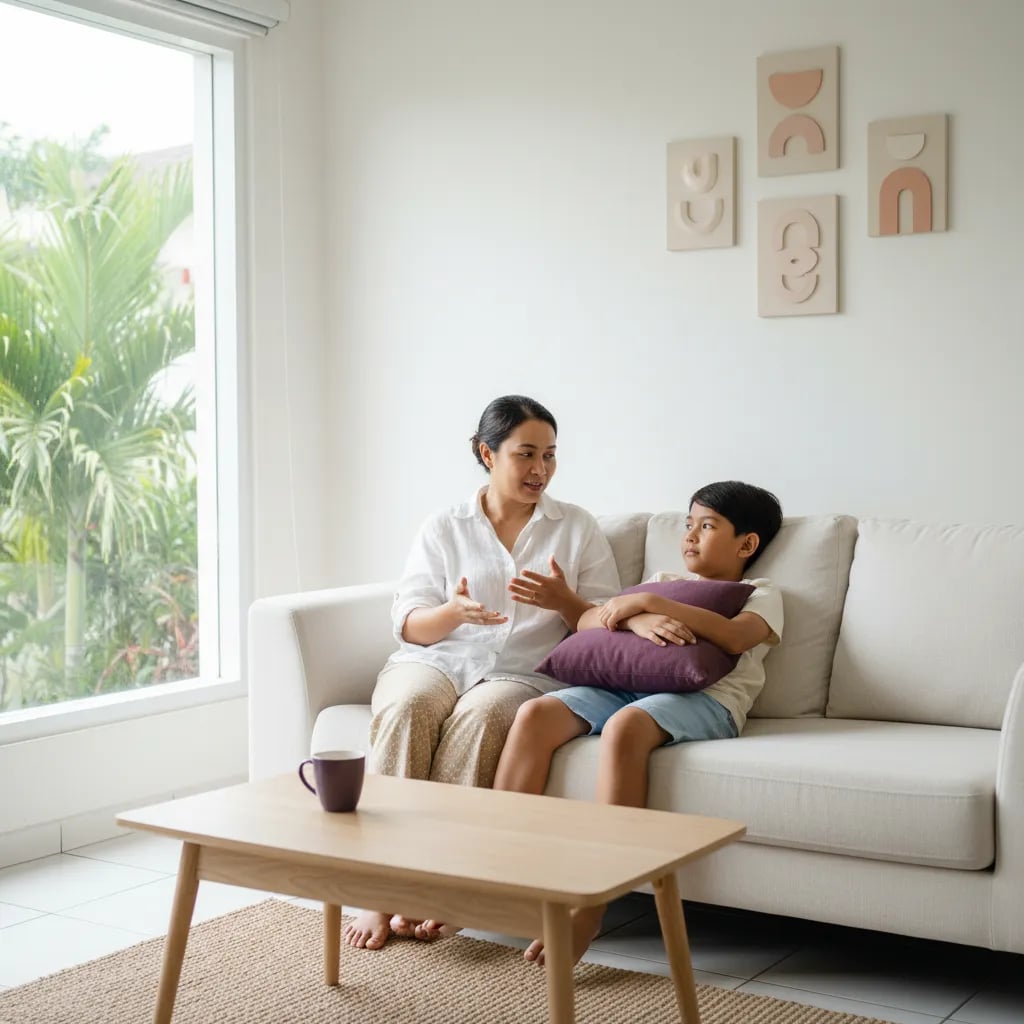
The difference is not how much the child moves but how often, where, for how long, and how much it affects daily life.
| What to look at | More often seen in an ordinary active child | Worth discussing with a doctor or psychologist | | How often | Appears at certain times, such as when tired or bored | Appears often and during many activities | | Where | Only in one place, such as during homework | At home and at school, and with friends | | How long | Days or weeks, following the situation | Lasts about 6 months or longer | | Impact | The child can still learn and make friends | Gets in the way of learning, friendships or safety | | Since when | Appears after a change around the child | Has been there since early childhood |
This table helps organize what you observe. It is not a diagnostic tool. At this stage, the most useful thing is taking notes.
According to the CDC symptoms page (reviewed 30 July 2026), the commonly listed signs fall into two groups: trouble paying attention, and hyperactivity or impulsivity.
Trouble paying attention can look like:
Hyperactivity and impulsivity can look like:
Almost every child shows some of these at some point. According to the APA, an assessment looks at six or more symptoms that occur often, and only a professional can judge that. So this list is not for counting on your own.
See a pediatrician, psychologist or child psychiatrist when the behavior is frequent, long-lasting, seen in more than one place, and getting in the way of the child's life.
Consider an evaluation if:
IDAI (the Indonesian Pediatric Society) advises seeking professional help promptly, meaning a pediatrician, psychologist or child psychiatrist, when a child or teacher raises signs of a learning problem. An early evaluation also helps a child avoid labels such as lazy or naughty. The evaluation usually involves a team.
According to the CDC (reviewed 21 October 2026), there is no single test for ADHD. The evaluation includes a medical exam with hearing and vision checks, plus information from parents and teachers about the child's behavior at home, at school and with peers. Other conditions such as sleep problems and anxiety can look similar, so professionals check for those too.
Before you go, prepare two weeks of notes: when the child is restless, where, what happened beforehand, and the teacher's report. These notes help the doctor see the pattern sooner.
Home steps do not replace an evaluation, but basic habits help every child.
Things to avoid: drawing your own conclusions from videos or online tests, comparing the child with siblings, and scolding the child for not sitting still. Online tests cannot replace a professional evaluation. If your child is hooked on devices and restless when told to stop, read children addicted to phones.
According to IDAI, most children with GPPH can learn normally, especially with adequate treatment. So a prompt evaluation opens the way to the right help.
A child who finds it hard to sit still can still learn, and short sessions with breaks are usually easier to follow.
If a child is restless because some math topics were missed, schoolwork that feels too hard can look like refusing to focus. At Algonova, online math classes run live in groups of up to 10 children, with durations of 45, 60 or 90 minutes, from Rp 102,000 per lesson. The first step is a free diagnostic of about 60 minutes to see which topics need strengthening in the primary school math program.
Lessons do not replace an evaluation by a doctor or psychologist. If you are worried about your child's development, talk to a professional first, then choose the kind of lessons that fit. If your child fears a particular subject, children afraid of math offers steps you can try.
Hyperactivity is a behavior of excessive movement, restlessness or difficulty staying still compared with other children of the same age. Hyperactivity is not a diagnosis but a description of behavior. It can come from many things, such as lack of sleep, lack of movement or anxiety, and it can also be one sign of ADHD. That is why the assessment looks at how often, where, for how long, and what the impact is. Only a pediatrician, psychologist or child psychiatrist can judge whether there is a disorder.
ADHD is a developmental condition marked by trouble paying attention, hyperactivity and impulsivity that last a long time and get in the way of daily life. In Indonesia it is called GPPH. According to the American Psychiatric Association, the symptoms begin in childhood and must be clearly present for at least 6 months. There are three presentations: mainly inattentive, mainly hyperactive and impulsive, or combined. The diagnosis is made by a trained professional who looks at the child's behavior in different places.
Many children that age are simply active, and that is not necessarily a sign of a disorder. The CDC notes that it is normal for children to sometimes struggle to focus and manage their behavior. What matters is the pattern: frequent, in many places, and getting in the way of learning or friendships. If you are unsure, note your child's behavior for two weeks and talk to a pediatrician. An evaluation does not mean the child definitely has a disorder.
It cannot be assumed to go away on its own, because in many children the symptoms continue into the teen years and adulthood. According to the CDC and NIMH, children with ADHD do not simply outgrow the behavior, and symptoms can continue into adolescence. That is why a timely evaluation matters, so the child gets help that fits their needs. Do not delay in the hope that the child will change by themselves if the symptoms already get in the way.
A pediatrician, psychologist or child psychiatrist. According to the CDC, the diagnosis is made by a mental health professional or a primary care provider such as a pediatrician. IDAI also names pediatric specialists, psychologists and child psychiatrists. The process usually involves a medical exam, information from parents and teachers, and checks for other conditions that look similar. Start with your regular pediatrician, who can refer you to a psychologist or child psychiatrist if needed.
Online tests cannot replace an evaluation, because there is no single test for ADHD. The CDC explains that an evaluation includes a medical exam, information from parents and teachers, and checks for other conditions such as sleep problems and anxiety. An online questionnaire sees only a small part of that picture. A questionnaire can be used as notes to bring to the doctor, but do not use it to draw conclusions on your own.
Most children with GPPH can learn normally, especially with adequate treatment, according to IDAI. Support from school and family also matters. Give short instructions, movement breaks and a quiet place to study. If the child has other learning difficulties, a professional team can help work them out. Avoid labels such as stupid, lazy or naughty, because those labels harm the child.
Start by asking what the teacher sees in class, rather than naming a diagnosis. Ask when the child is restless, in which lessons, and how they get along with classmates. Share your notes from home, then compare the patterns. If a similar pattern shows up in two places, that is important information for the doctor. Ask the teacher to write down concrete examples, such as dates and situations, so the doctor has a clear picture.
Lessons can help if the difficulty is with the material, but they do not replace an evaluation by a doctor or psychologist. Short sessions with breaks and a teacher who watches the child are easier to follow. At Algonova, online classes run live in groups of up to 10 children, and we do not make any medical diagnosis. If your concern is about behavior, talk to a pediatrician first. You can choose lessons after that, starting with a free diagnostic of about 60 minutes.

Algonova worldwide
Contact
Whatsapp: +62 21 50996971
Email: info@algonova.id
Address
Coworking Area, Gedung IT 6 Lantai Dasar, Nongsa Digital Park, Jalan Hang Lekiu, Kelurahan Sambau, Kecamatan Nongsa, Batam, Indonesia Directorate General of Consumer Protection and Trade Compliance – Ministry of Trade of the Republic of Indonesia. WhatsApp Ditjen PKTN: 0853-1111-1010.
PT Algonova Indonesia Cerdas All rights reserved 2026