How to Teach Multiplication Tables to Kids: 5 Proven Methods
Learn Math8 min
Parent Guides

Maya Putri
Early Childhood Education Specialist
Child phone addiction usually shows up in three ways: your child cannot stop on their own, the phone wins over sleep, meals and homework, and taking it away ends in a meltdown. The Indonesian Pediatric Society (IDAI) recommends no more than 2 hours of screen time a day for children over 2. The habit can come down step by step over 4 weeks, with clear rules and better things to do.
A child has a phone problem when the phone gets in the way of sleep, school, meals or family life, and they cannot stop even after several tries.
Loving the phone is not the same thing. A child who enjoys it can still put it down when asked, even with a sulk, and still has other things they like doing. In this article "addiction" is the everyday word parents use, not a diagnosis. Only a pediatrician or a child psychologist can diagnose.
Here are the signs of phone addiction in children you can watch for at home. If 4 or more fit for several weeks in a row, it is time to reset the habits at home:
Too much screen time hits a child's sleep first, then mood and focus at school.
A phone in the bedroom pushes bedtime later, yet children aged 6-12 need 9-12 hours of sleep a night, according to the American Academy of Pediatrics.
Tired children snap more easily and struggle to concentrate in class. Grades may hold up for a while, but the child runs out of energy faster and blows up over small things.
The phone also takes time away from moving. WHO advises that children and teenagers aged 5-17 get an average of 60 minutes of physical activity a day and spend less time sitting, especially recreational screen time.
For focus, watch how your child handles homework. Kids used to short videos often find homework or a storybook painfully slow. Punishment won't fix this. Instead, help them practise finishing one thing before starting the next. If schoolwork is your main worry, read kids lazy to study because of gadgets.
Kids struggle to put the phone down because many apps have no natural stopping point: the next video plays on its own, notifications keep coming, and every swipe brings something new.
A book ends on the last page. A feed of short videos never does. Boredom is the second trigger. When "I'm bored" is always answered with a phone, and nothing else on offer looks fun, the child goes back to the screen.
Children also copy adults. If they see their parents scrolling through dinner and every queue, a rule that applies only to kids rarely lasts. For the bigger picture, see parenting in the digital age.
The safest way to deal with child phone addiction is to cut back gradually over 4 weeks rather than confiscating the phone overnight.
The same plan works for tablets and game consoles. So if you are looking for how to reduce screen time for kids, including a child who has been hooked for a long time, start with week 1 and don't jump ahead. Here is the plan:

Keep your voice calm when you ask for the phone: "Time's up. Do you want to close it yourself or shall I help?" A child given a small choice usually cooperates more than one whose phone is simply grabbed. If they cry, wait a moment and keep the rule as it is.
A clear daily schedule helps too, because your child knows when phone time comes. There is an example in a daily routine for kids.
Family phone rules work best when you make them with your child, write them down and follow them yourself.
The American Academy of Pediatrics offers a Family Media Plan, an online tool for writing down your family's media rules, and you can use it as a template. The examples below can be adjusted to your home and still stay under IDAI's 2-hour limit:
| Age | Sample agreement | Parent's role |
|---|---|---|
| 6-8 | Phone used in the living room with a timer, no phone at meals or in the hour before bed | Sit with them, choose what they watch, set the timer together |
| 9-10 | Child helps set the schedule, phone goes on a shelf before bed | Review the agreement once a week, turn on a web filter |
| 11-12 | Child manages part of their own time within agreed limits, phone put away at a set time at night | Talk about what they watch and who they chat with online, keep the final say on settings |
IDAI also advises against children being alone with a gadget in the bedroom and notes that web filtering software can help parents. To go further on online safety, start with digital literacy for kids.
On the legal side, Indonesia's Government Regulation 17/2025, known as PP Tunas, governs electronic systems with the aim of protecting children. According to the Ministry of Communication and Digital Affairs (Komdigi), it has been in effect since 28 March 2026. The regulation helps, but what happens at home still matters most.
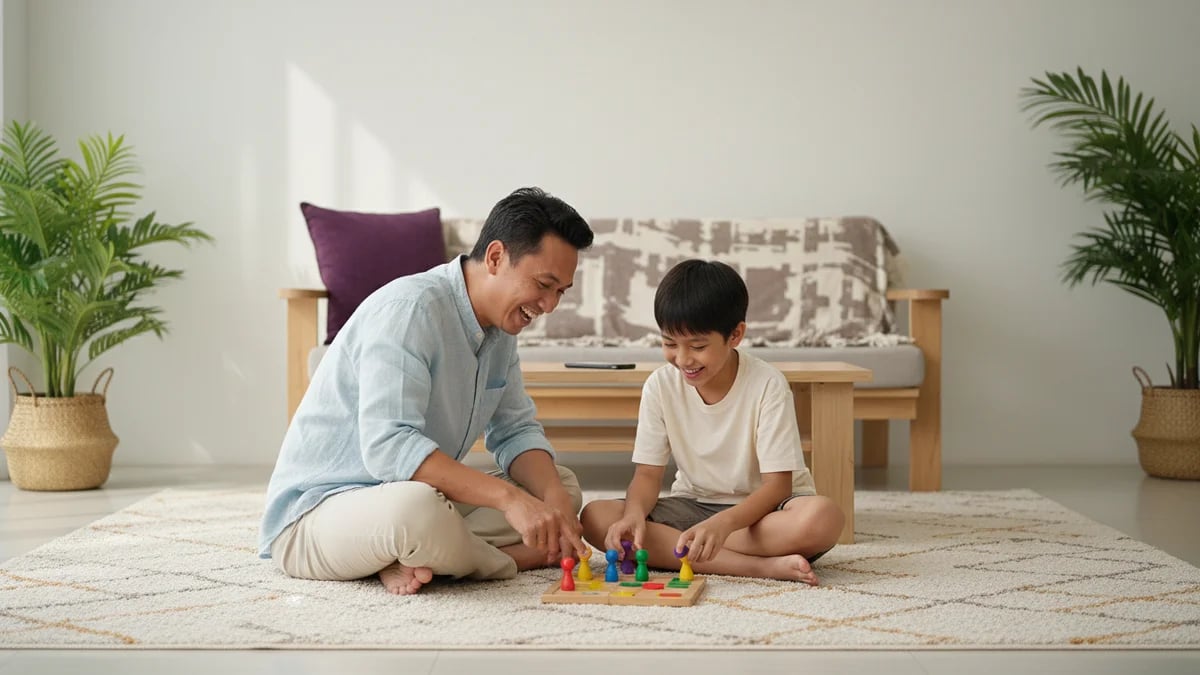
Passive screen time, like scrolling videos, is easiest to replace with something that gives a real result, such as a game played together or a puzzle finished.
A few ideas for primary school kids:
Some screen time is active. In an Algonova live class your child doesn't scroll. They think and answer out loud, with the same tutor every week. Algonova teaches coding, AI and design to children aged 5-17 and math to children aged 6-17, live online, with more than 1 million students in 97 countries and a 4.9 rating. Math classes run for 90 minutes in groups of up to 10 children or mini groups of 2-4.
Before signing up, your child can take a free diagnostic of about 60 minutes to see their level, and then you decide whether to join online math classes for primary school kids. If your child would rather build games than just play them, have a look at coding classes for primary school kids.
See a pediatrician or a child psychologist soon if the phone makes your child refuse school, badly disrupts their sleep or leaves them very distressed, and several weeks of changes at home have not helped.
Other signs to watch are pulling away from friends and family, being low most of the time, or getting physically aggressive when the phone is taken. For some kids the phone is an escape from something else, such as anxiety, bullying at school or a learning difficulty. If the cause isn't clear, don't guess.
Start with a pediatrician or child psychologist at a Puskesmas, a hospital or a practice you trust. Bring your notes from week 1 of the plan: when your child used the phone, for how long and what happened when they stopped. These notes help the specialist see the pattern.
IDAI recommends no more than 2 hours of screen time a day for children over 2. That covers shows, games and videos together. So if your child watched for an hour after school, there is one hour of entertainment screen time left that day. Our article on screen time covers this in more detail. As a first step, write down your child's phone use for one week.
Heavy phone use rarely fades without changes at home. Children follow the routine around them, so consistent rules and appealing alternatives work better than waiting. A child who gets the phone every afternoon with no limit has no reason to stop. The 4-week plan above is a good place to start. If nothing changes, talk to a pediatrician or child psychologist.
Warn first and offer a small choice. Say "10 more minutes", then "5 more minutes", and ask whether they want to close the phone themselves or have your help. Children who know the rule in advance are less shocked than those whose phone disappears without warning. If they cry, stay calm and don't argue. Have the next activity ready, such as dinner together.
Phone use at night can cut into your child's sleep. Children aged 6-12 need 9-12 hours of sleep according to the American Academy of Pediatrics, so every hour on the phone at night can come out of that. A child who falls asleep at 10 pm and wakes at 5:30 am gets only about 7.5 hours. Keep the phone outside the bedroom at night and stop screens about an hour before bed.
There is no single right age for every child. Readiness matters more: can they stop when asked, do they know how to keep personal data private, and will they tell you if they see something upsetting? For primary school kids, many parents start with a shared family phone under supervision. Indonesia also protects children on electronic systems through PP Tunas, but parents still need to supervise. Use the three questions above to judge readiness.
The difference is control and impact. A child who simply likes the phone can stop when asked and still goes to school, sleeps and does other things. An addicted child struggles to stop, explodes when the phone is taken and lets other activities slide. A child who still eats with the family and finishes homework despite loving the phone is not a worry yet. Check the 8 signs above: if 4 or more appear for several weeks, reset the habits at home.
See a child psychologist if the phone makes your child refuse to go to school, pull away from family and friends, sleep very badly or turn aggressive when it is taken, and several weeks of the home plan have not helped. One example is a child who refuses to go to school for weeks because they want to stay on the phone. Bring notes on phone use from the last 1-2 weeks so the assessment is more focused.

Algonova worldwide
Contact
Whatsapp: +62 21 50996971
Email: info@algonova.id
Address
Coworking Area, Gedung IT 6 Lantai Dasar, Nongsa Digital Park, Jalan Hang Lekiu, Kelurahan Sambau, Kecamatan Nongsa, Batam, Indonesia Directorate General of Consumer Protection and Trade Compliance – Ministry of Trade of the Republic of Indonesia. WhatsApp Ditjen PKTN: 0853-1111-1010.
PT Algonova Indonesia Cerdas All rights reserved 2026