
Abacus vs Kumon vs Conceptual Math: Which Is Right for Your Child?
Which Is Better?6 min read
Learn Math

Nurul Izzati
Math Curriculum Team, Algonova Malaysia
Is math ability genetic? Partly. In one 2009 twin study of 10-year-olds, about half (53%) of the differences in high maths performance traced to genes, and the rest came from environment. But a gene share describes groups of children, not your child's limit. For parents of 6 to 8 year olds, the better question is which exact step is missing, not whether your child is a "maths person".
Genes play a real part in maths results, but twin studies show that they do not decide where an individual child ends up. Researchers compare identical twins, who share all their genes, with fraternal twins, who share about half, and see how closely their scores match.
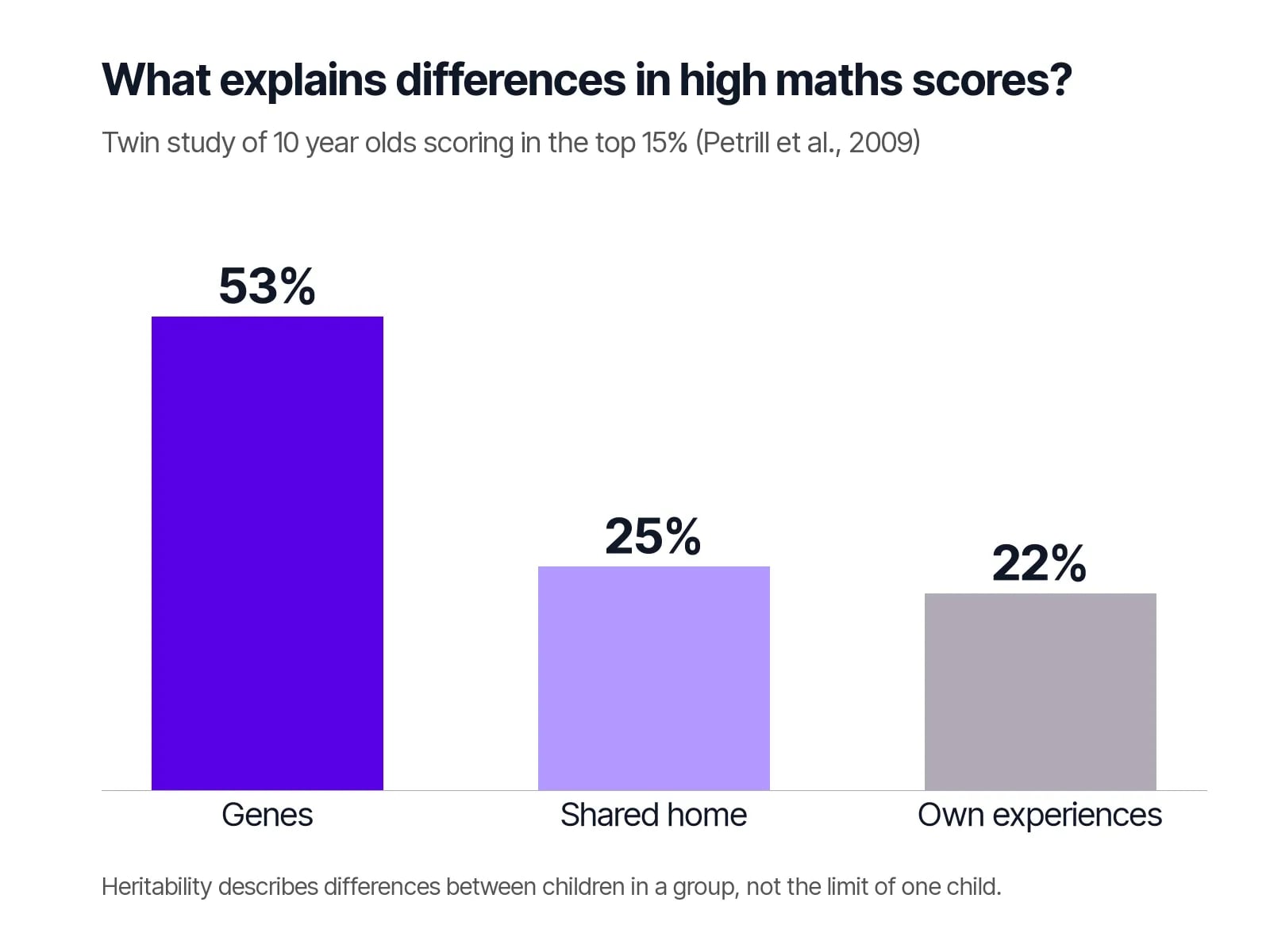
Petrill, Kovas, Hart, Thompson and Plomin ran this kind of study in 2009 on more than 3,500 pairs of 10-year-old twins in England and Wales. For children scoring in the top 15% in maths, genes accounted for 53% of the differences between children, shared home environment for 25% and each child's own experiences for 22%. The larger monograph from the same Twins Early Development Study (Kovas, Haworth, Dale and Plomin, 2007) reached a similar picture at ages 7, 9 and 10: a sizeable genetic share and a modest shared-environment share.
The catch is what "heritability" means. It is a statistic about differences between children in one population at one time. It doesn't say that 53% of your child's ability is fixed. The study authors themselves stress that it describes what is in a population, not what could be, and that it shifts if schooling and opportunity change.
A child who starts Year 1 with a weaker number sense is not locked in. That's a starting point, and a good teacher can work with it.
Growth mindset is the belief that abilities can grow with effort and good strategies, and the evidence for it is real but smaller than the hype suggests. Carol Dweck and Claudia Mueller found in 1998 that fifth graders praised for intelligence persisted less, enjoyed the task less and did worse after a setback than children praised for effort.
The bigger tests are more modest. A 2018 meta-analysis by Sisk and colleagues pooled 273 studies and 365,915 students and found a correlation of r = .10 between mindset and achievement. Their second analysis, of 43 intervention studies with 57,155 students, found an average effect of d = 0.08. The authors called both effects weak, though some results suggested more benefit for children from lower-income families or those at academic risk.
Then came the large trial. Yeager and colleagues (2019, Nature) randomly assigned 12,490 ninth graders in 65 US schools to a short online growth mindset lesson. Lower-achieving students earned 0.10 more grade points, and enrolment in higher maths rose from 33% to 36%. The effect was larger in schools where classmates backed taking on challenges.
So mindset is no cure. It helps most next to a good teacher and a class where mistakes are normal. Our view: skip the wall posters and fix the step your child is stuck on.
A child who believes "I can learn this" still needs someone to show them the next step.
Each finding gives parents one small rule they can use this week.
| What the science says | What it means at home |
|---|---|
| Genes explain part of the differences in maths scores (Petrill et al., 2009: 53% for high performance) | Your own school maths marks don't decide your child's. Don't say "you got it from me" |
| Heritability describes groups, not one child's ceiling (Kovas et al., 2007) | Treat a low mark as information about today, not a prediction |
| Growth mindset has a small average effect: r = .10, d = 0.08 (Sisk et al., 2018) | Don't expect a slogan to raise marks. Pair encouragement with practice |
| Effects were larger for lower-achieving students in supportive schools (Yeager et al., 2019) | Struggling children can gain most, so a calm class where mistakes are normal matters |
| Praising effort beat praising intelligence in fifth graders (Mueller and Dweck, 1998) | Praise the strategy: "You tried 3 ways", not "you're so smart" |
| Maths anxiety links to lower scores from Year 1 (Ramirez et al., 2013) | Watch for avoidance and stomach aches before maths, not only for wrong answers |
The sentence "I'm not a maths person" does harm because it turns one missing skill into a permanent identity, and children stop trying so they can't fail again. It's a feeling, not a measurement.
Maths anxiety gives this feeling a name. Ramirez, Gunderson, Levine and Beilock tested 154 first and second graders in 2013. The link between maths anxiety and lower maths scores appeared in the children with stronger working memory. In other words, some capable children pull back quietly, and parents may read it as "not interested".
Parents matter too. In a 2015 study, Maloney and colleagues found that children of maths-anxious parents learned less over the school year and became more anxious, but only when those parents often helped with homework. If you feel tense about sums, you don't have to hide it. Say "this was hard for me too, so let's work it out together", and keep your voice calm.
For a full guide to the signs, see maths anxiety in kids: how to help.
The most useful replacements name the effort or the missing step. Try one a day for a week rather than all seven at once.
Hadi, 7, is in Year 2. After a school test he says, "I'm just bad at maths", and his mother answers, "Same as me". (This is an illustrative case, not a real family.) He scored 12 out of 20. Going through the paper, his mother saw that every wrong answer was a subtraction where the top digit was smaller, like 52 take away 38.
That is one skill, subtraction with regrouping, not a whole subject. The family tried 10 minutes a day, 3 days a week, with ten-frames and sticks of 10 and loose ones. Flash cards came first and ended in tears at the fifth card, so they dropped them. After 4 weeks Hadi said, "I'm bad at borrowing, not at maths". A child who can name the exact skill usually feels braver about it.
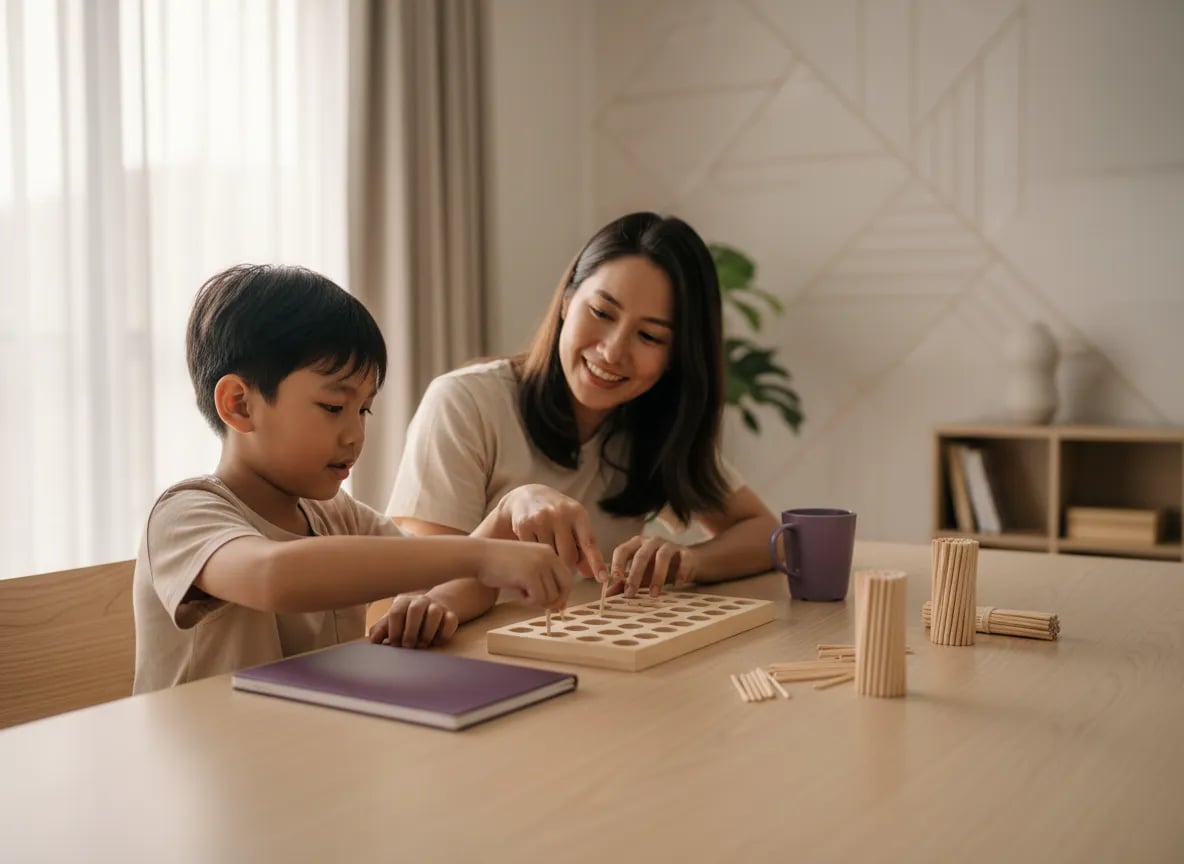
For ideas to try with sticks and blocks, see how to teach maths to a 6 year old.
Not every gap is this easy to see on a page. If you can't name it, that is where a diagnostic helps. Our free maths diagnostic takes about 60 minutes and gives parents a written report on which topics need work, for children aged 6 to 8 (Darjah 1 to 2).
Look for a gap when your child keeps saying "I can't" or loses marks on the same kind of question. That is more often a missing step than a missing talent.
A simple order works for most families:
If the difficulty is severe or lasts for years, speak to the school. Nothing in this article replaces advice from your child's teacher or a specialist. More ideas in why is my child weak in maths and how to help your child catch up in maths.
For children aged 8 and older, whose maths is not covered by our course, other strengths may show elsewhere. Our guide to spotting your child's talent helps, and a free 60-minute coding master class lets an 8 to 17 year old try building something new. See coding classes for kids.
Most children can reach a solid level in school maths with good teaching and regular practice, but "good" varies and nobody can promise one result for every child. Twin research finds that genes explain part of the differences between children, and that the rest comes from environment, teaching and effort. The Petrill study found 25% from shared home environment and 22% from each child's own experiences. That leaves a lot of room for change. A child who finds numbers hard in Year 1 often has a gap in number sense, not a fixed limit. Short daily practice with real objects and a patient teacher make the biggest difference at ages 6 to 8. Think of the aim as steady progress from your child's own starting point, not a place in the class ranking.
Partly, but the idea that "maths runs in the family" mixes genes with habits and attitudes. Heritability is a population statistic: it describes how much of the differences between children in a group is linked to genetic differences. It does not tell you how much of your own child's ability comes from you. Families also pass on talk about maths, books, games and anxiety. In a 2015 study, children of maths-anxious parents learned less over the year, but only when those parents often helped with homework. That points to behaviour, not only genes. If you struggled with maths at school, your child can still do well. Show curiosity, ask them to explain things to you and avoid "I was bad at it too" as an excuse. Your attitude travels further than your marks ever did.
A growth mindset is the belief that abilities can grow with effort, good strategies and help, and it is the idea Carol Dweck made well known. A child with this view says "I can't do it yet" instead of "I can't do it". In practice it shows up as how your child handles mistakes: trying again, asking for a hint or changing the method. You can encourage it by praising the process and by showing that adults also learn slowly. It is not the same as just working harder. A child who repeats the same method 20 times without understanding it needs a different approach, not more effort. In the research, mindset supports learning but does not replace good teaching, which is why the effects in large studies are small.
Growth mindset works a little, on average, and more for some children than others. A 2018 meta-analysis (Sisk et al.) of 43 intervention studies and 57,155 students found an average effect of d = 0.08, which the authors called weak. In 2019, Yeager and colleagues ran a national US trial with 12,490 ninth graders. Lower-achieving students gained 0.10 grade points and more students enrolled in higher maths, from 33% to 36%. The effect was larger in schools where classmates supported taking on challenges. So it is not a cure for low marks, and a poster on the wall will not change much. It works as one part of good teaching, clear feedback and a class where mistakes are treated as normal. All of these were US students, so treat the numbers as a guide for Malaysia, not a forecast.
One comment is not a reason to worry, but a repeated one deserves attention. Children say it for many reasons: a bad test, a classmate's remark, a tired day or a real gap. First, listen and ask which part feels hard. Then look at a few recent papers for a pattern, such as the same kind of question going wrong again and again. If you find one, practise that skill for 10 minutes, 3 times a week. If your child also avoids homework, complains of a stomach ache before maths or cries over sums, think about maths anxiety and talk to the teacher. Avoid arguing with the sentence ("yes you are!"). Ask what happened that made them feel this way, and work from the answer. Often it is one test or one comment, and it fades once your child has a small win.
Maths anxiety is a feeling of tension or fear when facing maths that gets in the way of thinking, and it can appear as early as Year 1. Ramirez and colleagues tested 154 first and second graders in 2013 and found a link between maths anxiety and lower scores, strongest in children with better working memory. Signs include avoiding homework, saying "I can't" before trying, rubbing out answers repeatedly, headaches or stomach aches before maths, and sudden tears during timed work. It differs from simply disliking maths. Keep practice short and low-pressure, avoid timing every task and praise methods, not speed. If the signs last for weeks, speak to the class teacher. More support is in our guide to maths anxiety in kids. Nothing here is a diagnosis, and a teacher or counsellor is the right person for lasting worries.
It is better to share your effort than your label. "I was bad at maths" tells your child that being bad at it is normal and permanent, and it gives them a reason to stop. A more helpful version is "I found fractions hard and learned them by drawing them." That shows that difficulty is a stage. The 2015 study by Maloney and colleagues also found that children of maths-anxious parents learned less when those parents helped often with homework, so if you feel anxious, breathe first and work through the problem together. You do not need to know all the answers. Say "let's check how the example in your book does it", and show your child how you find out what you do not know. That habit teaches more than a right answer given too fast.
A short routine beats long sessions: 10 to 15 minutes, 3 to 4 days a week, is enough for most children aged 7. In Darjah 2, the focus is usually numbers to 1,000, addition and subtraction with regrouping, simple multiplication and money in Ringgit. Choose one skill per week, such as subtraction with regrouping, and practise it with objects or a number line before moving to written sums. Games like shop play with real coins fit well. Stop when your child is still interested, not when they are tired. If your child can't explain a skill after 4 weeks of steady practice, that is a good moment to ask the class teacher or to book a diagnostic. Our KSSR guide for Darjah 1 and 2 lists the topics, so you can match practice to what the class is doing this term.
No. A good diagnostic maps what a child can already do and which topics are shaky, and it is not a test with a pass or fail. At Algonova, the free diagnostic for ages 6 to 8 takes about 60 minutes online with a teacher, and parents get a written report on the topics that need work and a suggested plan. It is meant to show where the gap is, not to put a "not a maths person" label on a child. For example, a report might say that a Year 2 child counts well to 100 but loses track when regrouping tens. That is something a family can practise. The diagnostic is free, so you can try it before deciding anything. Maths at Algonova Malaysia is for ages 6 to 8, from RM 48 per lesson.
Blog

Start your child's tech journey
Book your free 60-minute trial class with an Algonova certified tutor. No payment, no obligation, just discover what your child can build.

Algonova worldwide
Contact us
Email: int_legal@alg.team
Visit us
Suite 8634, 1021 E Lincolnway, Cheyenne, WY, Laramie, US, 82001
Algonova online LLC International tech school for kids and teens

