
AI or coding first: which should your child learn?
Course Guides7 min read
Math Education

Aina Rashid
Coding Education Specialist at Algonova Malaysia
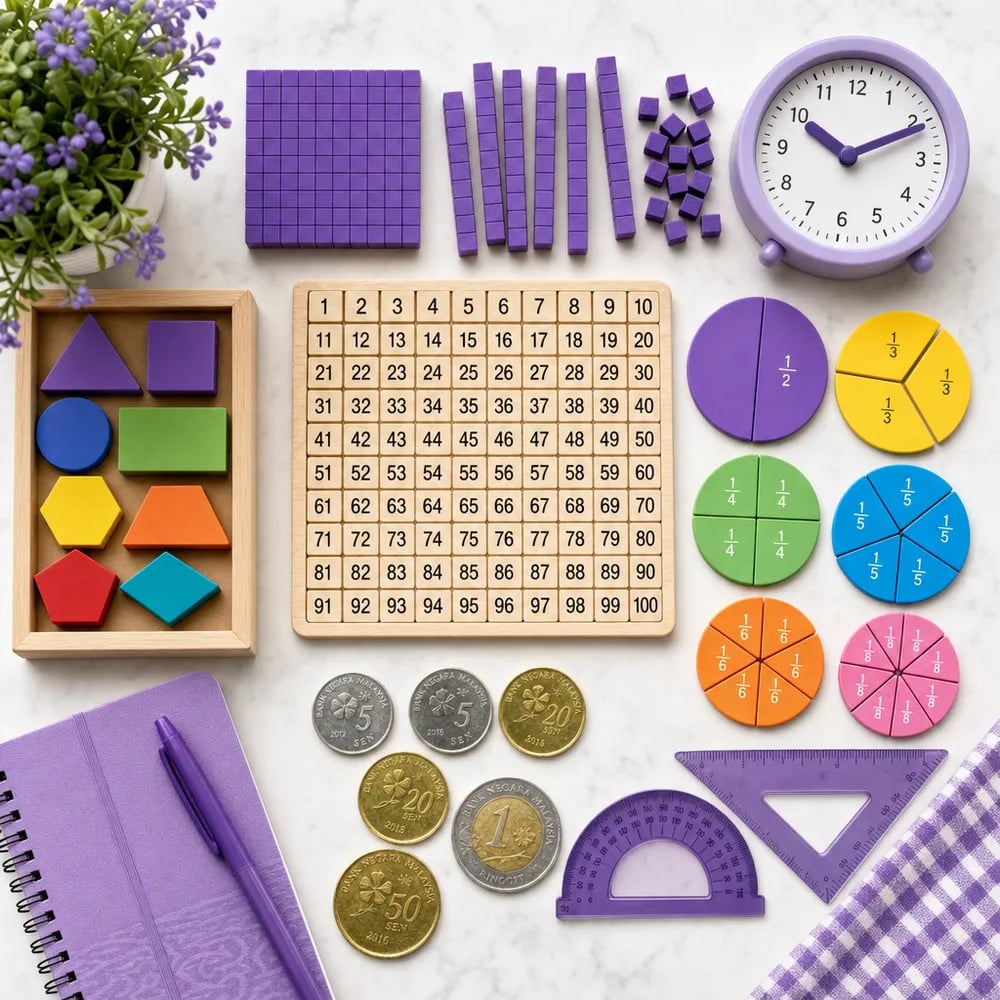
Under Malaysia's KSSR (Kurikulum Standard Sekolah Rendah), Darjah 1 and Darjah 2 children build the foundations of mathematics: reading and writing whole numbers, adding and subtracting, beginning multiplication and division, and handling money in Ringgit, time, length, mass, basic shapes, and simple data. The goal is understanding, not memorisation.
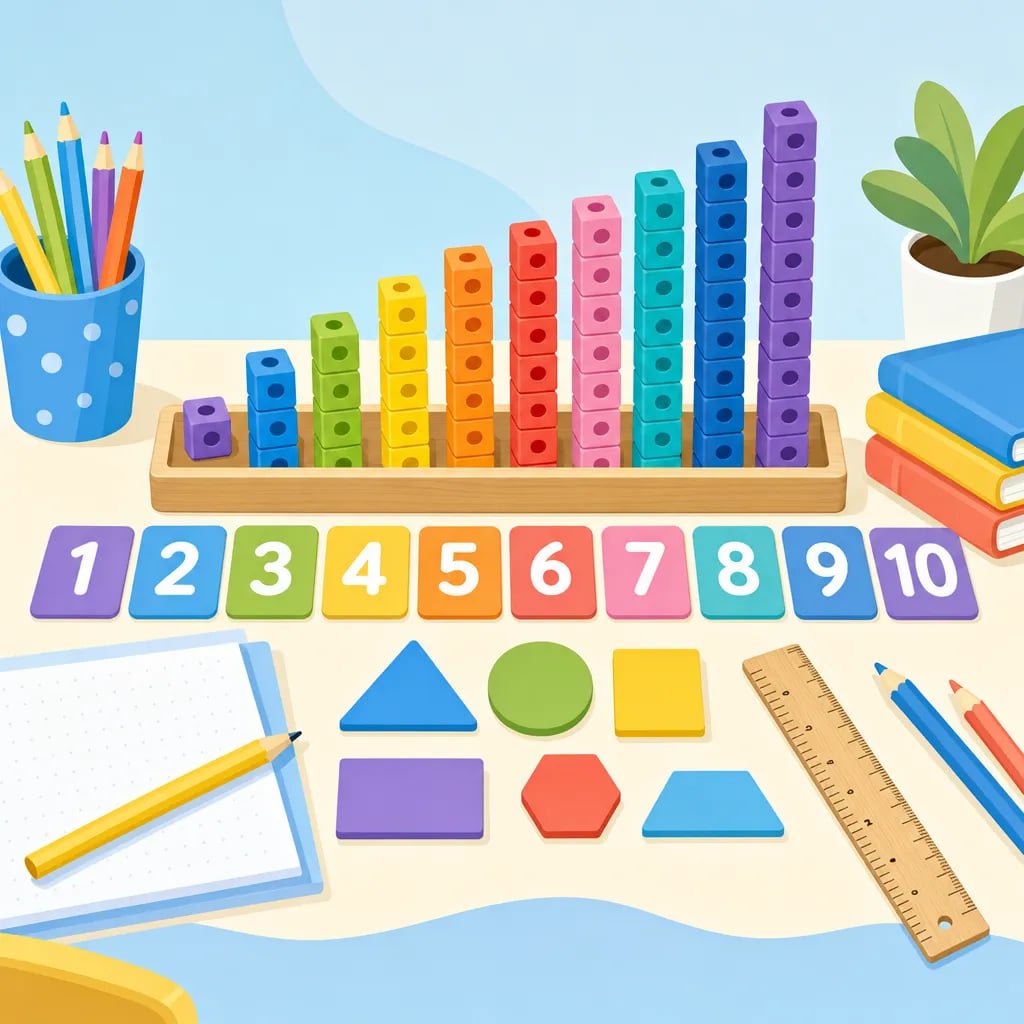
These early years matter more than most parents realise. A child who truly understands why 7 + 5 = 12 — rather than reciting it — carries that confidence into harder topics later. Below is a clear, topic-by-topic guide to what's typically covered, what mastery looks like, and small things you can do at the kitchen table to help.
By the end of Darjah 1, most children work confidently with whole numbers up to 100 — counting forwards and backwards, reading and writing them in numerals and words, comparing which is bigger, and understanding tens and ones. In Darjah 2 the range typically extends to 1,000, with stronger place-value understanding (hundreds, tens, ones) and skip-counting in 2s, 5s, and 10s.
Mastery looks like a child who can say why 34 is smaller than 43 — because the tens digit decides — not just point to the answer. They can also estimate ("about how many sweets are in this jar?") and round simple numbers.
At home: count stairs, count cars of one colour on the road, or ask your child to read house numbers aloud. Use small objects — buttons, beans, coins — grouped into tens to make place value visible rather than abstract.
Darjah 1 focuses on addition and subtraction within 100, usually with concrete objects and number lines before written methods. Children learn that addition and subtraction are linked (if 6 + 4 = 10, then 10 − 4 = 6). By Darjah 2, they typically add and subtract with regrouping ("carrying" and "borrowing") and are introduced to multiplication and division as repeated addition and equal sharing — often starting with the 2, 5, and 10 times tables.
Mastery is shown when a child explains their thinking: "I split 8 into 5 and 3 to make a ten." Understanding the idea of multiplication (4 groups of 3) matters more than fast recall at this stage.
At home: share snacks equally ("12 grapes between 3 of us — how many each?") to make division real. For multiplication, arrange objects in rows and columns to show groups.
Not sure if your child has the Darjah 1–2 basics locked in? A free 60-minute diagnostic checks their real level against KSSR expectations — no obligation. Book it here.
In daily life, math means money, time, and measuring — and KSSR introduces all three early. Darjah 1 children typically recognise Malaysian coins and notes and read time to the hour and half-hour. By Darjah 2, they usually add and subtract simple amounts in Ringgit and sen, give change, read time to five-minute intervals, and measure length and mass using both informal units (hand spans, blocks) and standard units (centimetres, kilograms).
Mastery looks like a child who can plan a tiny "shopping" task: "This costs RM3, you have RM5 — how much change?"
At home: let your child handle small real purchases at the kedai runcit, count change, and read the clock to know when a favourite show starts. Weigh fruit together and compare which is heavier.
Geometry and data round out the early-primary curriculum. Children learn to recognise and name basic 2D shapes (circle, square, triangle, rectangle) and 3D shapes (cube, sphere, cylinder, cone), describe their features (corners, sides), and spot shapes in the world around them. In Darjah 2 they typically begin sorting objects and reading very simple pictographs — for example, a chart showing how many classmates like each fruit.
Mastery is a child who can say why a shape is a triangle ("it has three straight sides") and can read a basic picture graph to answer "which has the most?"
At home: go on a "shape hunt" around the house, and make a simple chart of family members' favourite foods using stickers or drawings.
| Topic | Darjah 1 (typically) | Darjah 2 (typically) |
|---|---|---|
| Numbers | Whole numbers to 100; tens and ones; compare and order | Whole numbers to 1,000; hundreds/tens/ones; skip-counting |
| Operations | Add and subtract within 100; link the two | Regrouping; intro to multiplication and division (2, 5, 10) |
| Money & Time | Recognise RM coins/notes; time to the hour and half-hour | Add/subtract RM and sen, give change; time to 5-minute intervals |
| Shapes | Name basic 2D and 3D shapes; describe corners and sides | Sort shapes; read simple pictographs |
The pattern is clear: Darjah 1 builds concrete familiarity, and Darjah 2 stretches the same ideas into larger numbers and a little more abstraction. If a child is shaky on Darjah 1 foundations, Darjah 2 quickly feels hard — which is why filling small gaps early matters far more than rushing ahead.
The most helpful thing you can do is keep math calm, concrete, and connected to real life. Talk through everyday numbers out loud, let your child make small mistakes and self-correct, and praise the thinking ("good, you explained how you got it") rather than just the right answer. If your child seems anxious or avoids math, that's worth addressing gently — our guide on helping a child with math anxiety offers practical steps.
Parents often ask whether drill-based programmes are the answer. It's worth understanding the difference between speed-drilling and conceptual learning before choosing — we compare the main approaches in abacus vs Kumon vs conceptual math. If gaps persist, a structured online math course built around understanding can help rebuild the specific foundations your child is missing.
Algonova's Math Junior (ages 6–8, Darjah 1–2) is a live, small-group online course with certified teachers — not pre-recorded video — aligned with the Malaysian Sekolah Rendah KSSR curriculum. The method is visual and project-based: concepts come before formulas, and understanding is valued over memorisation. An AI diagnostic first finds your child's real gaps, so lessons rebuild only what's actually missing rather than repeating what they already know.
If you'd like to see exactly where your child stands against KSSR expectations, book a free 60-minute diagnostic — there's no obligation, and you'll leave with a clear picture of strengths and gaps. Algonova teaches 1,000,000+ students across 97 countries, with 10+ years of experience and a 4.9★ rating.
If the Darjah 1 foundations are shaky, Darjah 2 feels hard almost overnight. Filling small gaps early beats rushing ahead — every single time.
Algonova Math Team
In Darjah 1 and 2, a child who can explain why 34 is smaller than 43 has learned more than one who just recites the answer. Understanding at this stage is the foundation everything else is built on.
Algonova Math Team
Typically: whole numbers to 100, adding and subtracting within 100, recognising Ringgit coins and notes, telling time to the hour and half-hour, and naming basic 2D and 3D shapes.
Multiplication and division usually begin in Darjah 2, introduced as repeated addition and equal sharing — often starting with the 2, 5, and 10 times tables, with understanding prioritised over fast recall.
Yes, gently. KSSR values understanding over memorisation. A child should grasp why 43 is bigger than 34. Use real objects grouped in tens to make place value concrete rather than abstract.
Keep it everyday and concrete: count stairs, share snacks equally, handle real coins at the shop, read the clock. Praise the thinking, not just the answer, and let small mistakes happen.
A live, small-group online math course for ages 6–8 (Darjah 1–2) with certified teachers, aligned with the KSSR curriculum. It's visual and project-based, and starts with a free diagnostic to find your child's real gaps.
It depends on your goal. Speed-drilling builds fast calculation; conceptual learning builds understanding that supports later topics. Our blog compares the approaches so you can match the method to your child's needs.
Yes. Under the KSSR, the grades once called Darjah 1 and Darjah 2 are now officially labelled Tahun 1 and Tahun 2. The syllabus and the expected skills are the same — whole numbers, basic operations, money, time, measurement, shapes and simple data — only the naming changed.
Start by finding the exact gap rather than piling on more worksheets. Rebuild the shaky concept with concrete objects — tens and ones with buttons, sharing snacks for division — keep sessions short and calm, and confirm understanding before moving on. A free AI diagnostic can pinpoint which specific foundation is missing so your support targets the real problem instead of guessing.
Start your child's tech journey
Book your free 60-minute trial class with an Algonova certified tutor. No payment, no obligation, just discover what your child can build.

Algonova worldwide
Contact us
Email: int_legal@alg.team
Visit us
Suite 8634, 1021 E Lincolnway, Cheyenne, WY, Laramie, US, 82001
Algonova online LLC International tech school for kids and teens