December School Holiday 2026 Coding Plan for Kids 7-12: 4 Weeks From Scratch to Roblox

Learn Coding13 min read
Which Is Better?

Arjun Menon
Education Analyst, Algonova Malaysia
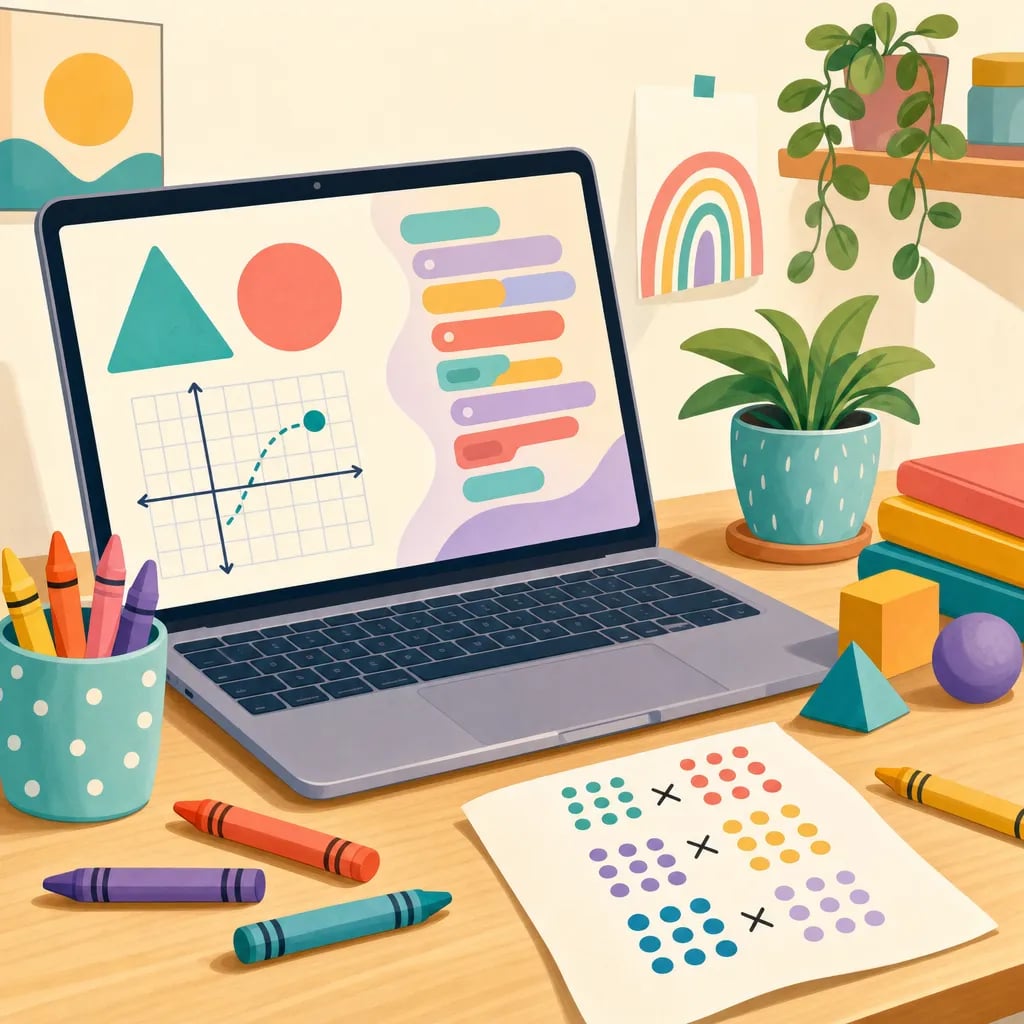
For most Malaysian children, pairing math with coding builds deeper understanding than math tuition alone. Coding forces a child to use a concept — a loop becomes repeated multiplication, a variable becomes algebra, coordinates become geometry. Traditional tuisyen matematik sharpens exam technique and KSSM coverage; adding pengaturcaraan makes those concepts concrete. In private 1-on-1 lessons, mini groups of 2–4, or groups of up to 10 students, children apply math instead of only memorising it.
When Malaysian parents look for math tuition, the exam is usually the trigger — a slipping UASA result, an approaching SPM, a child who "used to be good at Maths." But talk to parents a little longer and the real wish comes out: they want their child to understand, not just to score. They want the kind of understanding that survives after the exam hall, that carries into Add Math, into Physics, into whatever the child studies next.
The gap between "getting marks" and "understanding" is where a lot of quiet worry lives. A child can memorise the steps to solve a quadratic equation and still have no idea what a quadratic is or where it shows up in the real world. That child may pass this year and stall next year, because each new topic assumes the previous one was truly understood.
Understanding also protects motivation. Children who grasp why a method works tend to stay curious; children who only drill tend to burn out. So the honest question for parents is not "which tuition gets the highest marks" but "which approach builds understanding that lasts." That reframing changes everything — including whether tuition alone is enough. Our math programme for kids is built around that exact idea: understanding first, marks as a by-product.
Let's be fair to tuition, because it genuinely does several things well. Structured drilling builds fluency: a child who has worked through fifty similar problems answers the fifty-first faster and with fewer mistakes. Good tuisyen matematik also builds exam familiarity — students learn how KSSM questions are phrased, how marks are allocated, how to manage time under pressure. And systematic coverage means no topic in the syllabus gets skipped. For a child facing an exam in a few weeks, that focused preparation is valuable, and we won't pretend otherwise. If you're weighing your options, it's worth understanding what math tuition costs in Malaysia alongside what it delivers.
But every method has an edge where it stops. The plateau of drilling is repetition without transfer. A child can become excellent at the type of question they've practised and freeze the moment a problem is dressed differently. Math on paper also stays abstract — the symbols never do anything, so the concept never becomes tangible. And crucially, drilling rarely teaches transfer: the ability to take an idea learned in one context and apply it somewhere new.
That's not a failure of tuition; it's a limit of the format. Repetition alone can only take understanding so far. To push past the plateau, a child needs to use the concept — to make it move, produce a result, and break when it's wrong. That is exactly what coding adds.
Coding turns math from something you read into something you build. When a child writes a small program, every mathematical idea inside it has to actually work — or the program won't run. There's nowhere to hide a half-understood concept, and that pressure is a gift. It converts vague familiarity into real, tested knowledge.
Consider a child animating a character across the screen. To do it, they must set a starting position (coordinates), decide how far to move each step (arithmetic), and repeat the movement (a loop). Suddenly geometry and multiplication aren't abstract symbols on a worksheet — they are the difference between the character moving smoothly and the character flying off the screen. The child feels the math working.

Then there's debugging, which is quietly one of the best math trainers there is. When a program produces the wrong answer, the child has to reason backwards: What did I expect? What actually happened? Where does the logic break? That is precisely the reasoning a strong mathematician uses. Debugging teaches children that being wrong is information, not failure. Our coding classes for kids are structured around this learn-by-building loop, so math stops being a subject to survive and becomes a tool to create with.
The link between math and coding isn't marketing — it's structural. The same ideas appear in both, just wearing different clothes. Here are the concepts that transfer most directly:
When a child meets these ideas twice — once in math class, once while building something they care about — understanding roughly doubles in depth. The concept stops being a rule to recall and becomes a tool they know how to use.
Want to see math finally click for your child? Book a free maths diagnostic: about 60 minutes, live, no commitment. Your child learns math by building something real.
My biggest worry isn't her marks — it's that she'll never get the chance to find out what she's actually good at. I want her to discover her strengths, not just survive the syllabus.
A Malaysian parent
None of this pulls a child away from the Malaysian syllabus — it reinforces it. The KSSM Mathematics curriculum, from Darjah level through Tingkatan, is built on exactly the concepts coding makes concrete: number operations, algebra, geometry, and problem-solving. A child who has been writing loops and using variables walks into these topics with an intuition already in place.
The alignment gets stronger higher up. Additional Mathematics leans heavily on functions, logic, and generalisation — the same structures a young coder practises constantly. And Malaysia's own curriculum has been moving this direction for years: Asas Sains Komputer and the broader STEM push reflect a national recognition that computational thinking belongs alongside traditional math. This is a world well beyond the old UPSR era; today's classroom expects reasoning, application, and problem-solving, not just recall.
So math plus coding isn't a competitor to school — it's a complement that speaks the same language. When a child understands why an algebraic method works because they've built something using that logic, they perform better in the exact assessments KSSM sets. The understanding and the marks stop being in tension. Coding gives children a second doorway into the same room the Malaysian classroom is trying to lead them toward — and children who enter through two doors tend to know the room far better.

It's easy to oversell "coding for the future," so let's keep this grounded. Malaysia's MyDIGITAL Blueprint sets a national direction toward a digital economy, and the practical meaning for parents is simple: comfort with logic, data, and computational thinking will be a baseline competency across many careers — not only for programmers, but for engineers, scientists, analysts, designers, and entrepreneurs.
This matters for the pathways Malaysian families care about. Strong mathematical and computational reasoning underpins competitive university routes — the engineering, computer science, and quantitative programmes at institutions like UM, USM, and UTM all reward students who can think, not just recall. A child who has learned to reason through problems, break them into parts, and build solutions is better prepared than a child who has only practised answering exam questions.
The honest framing is competency, not hype. We're not promising your child will become a software millionaire. We're saying that the ability to think computationally — to approach a messy problem methodically and solve it — is quietly becoming as fundamental as literacy. Building that ability early, while it's still play rather than pressure, gives a child options later.
The right choice depends on your situation, so here's honest guidance:
If you're in an exam crunch — SPM in a few weeks, a specific topic that's slipping — focused tuition is the sensible short-term move. When time is short and the goal is a specific paper, drilling and exam technique deliver. Don't overhaul everything mid-crisis.
If you're playing the long game — building understanding that lasts through secondary school and beyond — math plus coding is the stronger investment. It develops the transfer and reasoning that carry from topic to topic, year after year.
If your child is disengaged — bored, anxious, or convinced they're "not a maths person" — coding is often the best re-entry point. Building something real can rekindle interest that no amount of worksheets will.
For most families, the answer isn't tuition or coding — it's combine, don't replace. Keep the exam support if you need it, and add coding to deepen understanding and rebuild motivation. This is where Algonova fits: we teach math and coding together in online classes — private 1-on-1, mini groups of 2–4, or groups of up to 10 students — so every child gets attention while learning to apply concepts, not just repeat them. Every family starts with a free maths diagnostic of about 60 minutes that shows where a child's strengths lie. With 9+ years of experience, 1,000,000+ alumni, and students in 97 countries, our approach is proven at scale. If you're also comparing hands-on options, our guide on coding vs robotics and what age to start coding can help.
Starting is meant to be low-pressure. Every family in Malaysia begins with a free maths diagnostic of about 60 minutes: a single session that works as both an introduction and a check of your child's level. Your child gets a taste of learning math through building, and you get an honest read on where their strengths and interests actually lie. There's no commitment required to attend, and no exam to prepare for.
Algonova is fully online, so children learn from home anywhere in Malaysia — Kuala Lumpur, Petaling Jaya, Penang, Johor Bahru — and classes are kept small: private 1-on-1, mini groups of 2–4, or groups of up to 10 students. That size matters: it's large enough for children to learn from one another and small enough that a teacher notices when one child is quietly stuck. We teach children from ages 6 to 17, with the pathway adjusted to each stage — playful, visual building for younger children; real programming and applied math logic for teenagers approaching SPM and beyond.
The goal throughout is the one we started with: real understanding, not just marks. Math becomes something your child uses to make things happen, coding becomes the place they see math come alive, and the two reinforce each other year after year.
Want to see whether math + coding fits your child? Try a free maths diagnostic, live, about 60 minutes, no commitment, and get a learning path matched to your child.
We don't drill children until they memorise — we let them build until they understand. When a child makes a concept *do* something, they own it for life.
Algonova methodology
It depends on your goal, but for building lasting understanding, math combined with coding usually wins. Traditional tuition is excellent for short-term, exam-focused needs — it drills technique, covers the KSSM syllabus systematically, and builds familiarity with question formats. Math plus coding works differently: it forces a child to actively use concepts, turning loops into multiplication, variables into algebra, and coordinates into geometry. That active use builds transfer and reasoning that carry across topics and years. For most families the best answer is to combine them — keep tuition if an exam is near, and add coding to deepen understanding and rebuild motivation. They solve different problems, so pairing them is stronger than choosing one alone.
Yes, though indirectly and durably rather than as an overnight fix. Coding improves math results by strengthening the understanding underneath the marks. When a child builds a program, mathematical concepts have to genuinely work or the code fails — this converts vague familiarity into tested knowledge. Debugging trains the exact backwards reasoning strong mathematicians use: what did I expect, what happened, where's the error. Over time, children who code tend to grasp why methods work, so they handle unfamiliar exam questions better instead of freezing when a problem is worded differently. It won't replace exam-technique practice in a final crunch, but across a school year it builds the deeper comprehension that produces more reliable results.
Yes — coding reinforces KSSM rather than competing with it. The KSSM Mathematics curriculum, from Darjah through Tingkatan, is built on number operations, algebra, geometry, and problem-solving, and these are exactly the concepts coding makes concrete. A child who writes loops is practising multiplication; one who uses variables is practising algebra; one who positions objects on screen is working with the coordinate plane. The alignment deepens with Additional Mathematics, which relies on functions, logic, and generalisation — core coding structures. Malaysia's curriculum has also moved this way through Asas Sains Komputer and the national STEM emphasis. So coding gives children a second, hands-on route into the same concepts the Malaysian classroom teaches, which tends to improve performance in KSSM assessments themselves.
Children can begin as early as age 6, with the approach matched to their stage. For young children around 6 to 7, coding looks like playful, visual, drag-and-block building that quietly teaches sequencing, counting, and patterns — the roots of mathematical thinking. From around 8 to 12, children move into more structured logic, loops, and variables that connect directly to school math. Teenagers from 13 to 17 can take on real programming and applied problem-solving that supports Add Math and future study. There's no single "right" age — the key is matching the challenge to the child. At Algonova we teach ages 6 to 17 and adjust the pathway to each stage, and the free maths diagnostic helps identify the right starting point for your child specifically.
Absolutely — for many families this is the ideal setup. Coding and tuition solve different problems, so they complement rather than clash. Your current tuition handles exam technique, syllabus coverage, and immediate assessment preparation, while coding builds the deeper understanding, transfer, and motivation that drilling alone can't reach. Because Algonova classes are online and small — private 1-on-1, mini groups of 2–4, or groups of up to 10 students — they're straightforward to fit around an existing schedule. Many parents keep tuition through an exam period and use coding to strengthen the conceptual foundation underneath — so marks improve in the short term while understanding grows for the long term. The free Master Class is a low-commitment way to test whether adding coding works for your child before changing anything else.
Blog
Start your child's tech journey
Book your free 60-minute trial class with an Algonova certified tutor. No payment, no obligation, just discover what your child can build.

Algonova worldwide
Contact us
Email: legal@algonova.com