
Abacus vs Kumon vs Conceptual Math: Which Is Right for Your Child?
Which Is Better?6 min read
Common Mistakes

Nurul Izzati
Math Curriculum Team, Algonova Malaysia
If you're working out how to teach maths to a 6 year old, start with real objects and 10-minute sessions, and leave written sums for later. Most trouble at home at ages 6 to 8 comes from 5 habits: worksheets too early, banning fingers, sharing your own fear, rescuing during homework, and one long weekend session. Each has a fix that fits Tahun 1 and Tahun 2 maths.
At 6, the way you teach maths at home decides whether your child treats it as a puzzle or as a test they keep failing. That attitude forms early, and by Tahun 3 it's much harder to shift.
The question is more pressing in Malaysia now. From the 2027 school session, six-year-olds can start Tahun 1 voluntarily, without a screening test (Free Malaysia Today, January 2026). Many families will meet school maths a year earlier than they planned. The 2027 school curriculum also raises maths time for Tahun 1 and 2 to 3.5 hours a week (The Star, February 2026). The ministry says maths concepts will be taught through a concrete, then pictorial, then abstract approach (Bernama), which is the order this article recommends.
Under the current KSSR, Tahun 1 covers whole numbers up to 100, adding and subtracting, money in ringgit, time, shapes and simple data. Our KSSR maths guide for Darjah 1 and 2 lists each topic. The 2027 curriculum may adjust some details, so check the school's own topic list when term starts. The syllabus is light. Most trouble starts with how it gets practised at home.
| Mistake | What it looks like in Tahun 1 or 2 | Do this instead |
|---|---|---|
| 1. Worksheets before objects | 20 sums like 8 + 5 on paper on day one | Count and group buttons or beans first, then draw, then write |
| 2. Banning fingers | "Do it in your head, no fingers" | Let fingers stay until your child stops needing them |
| 3. Showing your own fear | "I was also bad at maths, don't worry" | Say "Let's figure it out together" |
| 4. Rescuing during homework | Writing the answer to 52 - 27 so homework ends | Ask "What did you try first?" and wait 10 seconds |
| 5. One long weekend session | 90 minutes every Saturday | 10 minutes a day, 5 days a week |
Handing a 6 year old a page of written sums too early is the most common mistake, because the numbers don't mean anything to them yet. A child can copy "8 + 5 = 13" from a pattern without knowing what 13 is.
The Education Endowment Foundation (EEF) guidance report Improving Mathematics in the Early Years and Key Stage 1 (2020) recommends manipulatives for children aged 3 to 7. Those are everyday objects such as buttons, small toys or blocks. The report also says adults have to help children connect the objects to the written idea.
Here is how that looks with a Tahun 1 sum, 8 + 5:
The school uses this "make ten" move later for bigger numbers too. For more ideas with things you already have at home, see these maths activities for kids at home.
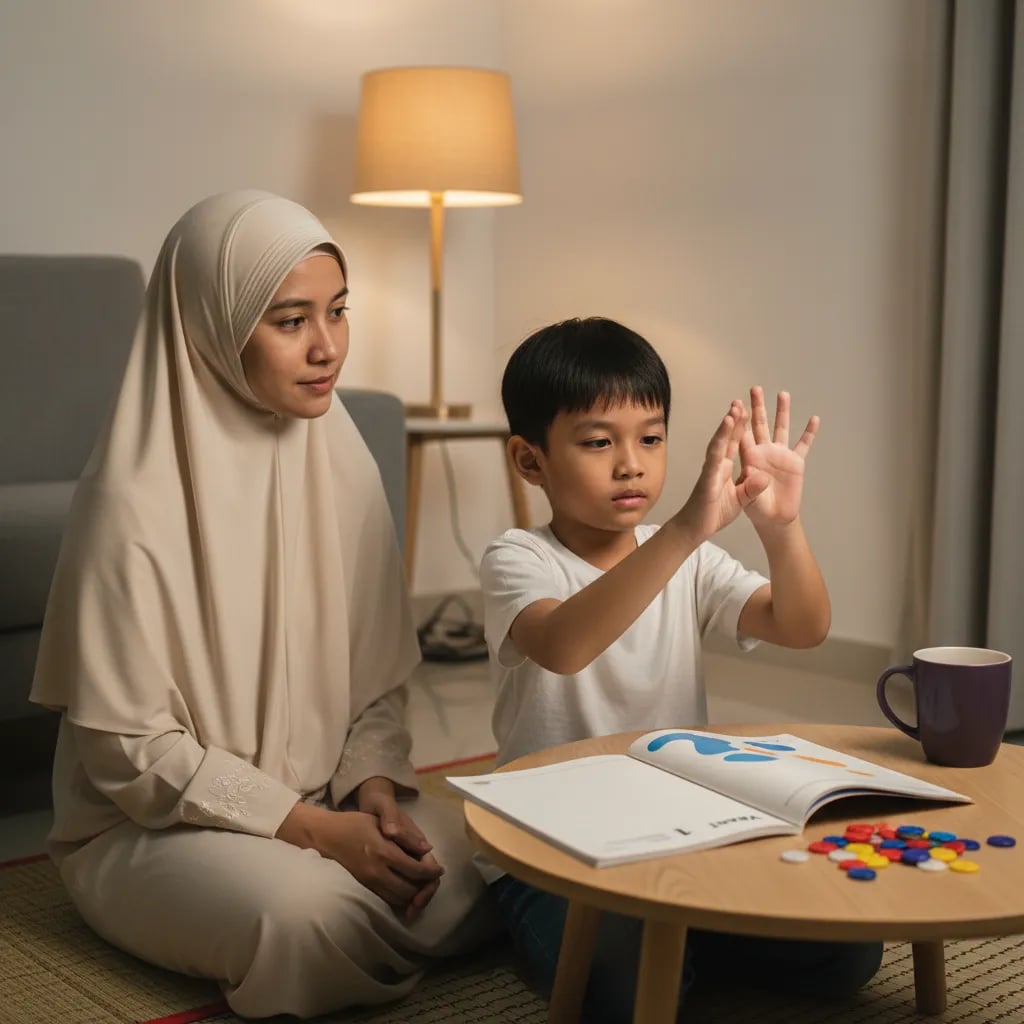
Banning fingers backfires, because for a 6 or 7 year old fingers are a tool. The EEF report (2020) calls fingers important manipulatives for young children, useful for counting and later for counting in groups.
Parents push for speed because they remember timed tests from school. In Tahun 2, children meet the 2, 5 and 10 times tables. Some parents respond by drilling the full sifir 1 to 12 at age 7. The child memorises "7 x 8 = 56" as a sound and has no idea that it means 7 groups of 8.
Picture Adam, 7, who adds 6 + 7 by counting up on his fingers from 6. That is a good sign: he no longer counts from 1. The next step is to show him that 6 + 6 = 12, so 6 + 7 is one more. Fingers fade on their own once he has strategies like this.
When your child is ready for times tables, use the order in our guide to sifir 1 to 12 for kids: understand groups first, then 2, 5 and 10, then the rest.
Fingers at 7 are normal. The child to worry about is the one who was told to stop and now quietly guesses.
Parents often pass their own maths worry to a child while trying to comfort them. "Don't worry, I was bad at maths too" sounds kind. It also tells a 6 year old that maths is something some people simply can't do.
A 2015 study by Erin Maloney, Sian Beilock and colleagues followed 438 children in Grade 1 and Grade 2 in the United States, the same ages as Tahun 1 and 2. Children of maths-anxious parents learned less maths over the school year. They were also more anxious about maths themselves, but only when those parents helped often with maths homework (University of Chicago, 2015).
Keep helping, but change what you say:
If your child already freezes or cries at maths, read our guide on math anxiety and how to help a child.
Jumping in with the answer, or your own shortcut, the moment your child gets stuck ends homework faster and teaches them to wait for you instead of thinking.
A common Tahun 2 example is 52 - 27. Many parents learned "borrowing" as a fixed rule and show it straight away. Their child's teacher may be using a number line or a "take away 20, then 7" approach. Now the child has two methods, understands neither, and starts crying at the table.
A better way to help your child with maths homework:
If homework turns into a battle most nights, the cause is often a missing basic such as place value rather than laziness.
One long sitting, such as 90 minutes every Saturday morning, rarely works at 6. Focus on a single task fades long before the hour is up, and the session ends in tears for both of you.
10 minutes a day across 5 days gives the same 50 minutes a week, and your child gets 5 chances to recall what they did yesterday instead of 1.
10 minutes of counting coins with a relaxed parent teaches more than an hour of worksheets with a parent who is checking the clock.
Games count as practice. The EEF report (2020) points to board games with numbered squares in a straight line as useful for number sense, and names Snakes and Ladders as an example. A game of ular dan tangga after dinner does the job. So does counting change at the kedai runcit.
A good routine for maths for 6 year olds is short and starts with something your child can already do, so the new part feels safe.
| Minutes | What you do | Tahun 1 example |
|---|---|---|
| 0 to 2 | Warm-up they can win | Count up in 2s to 20 |
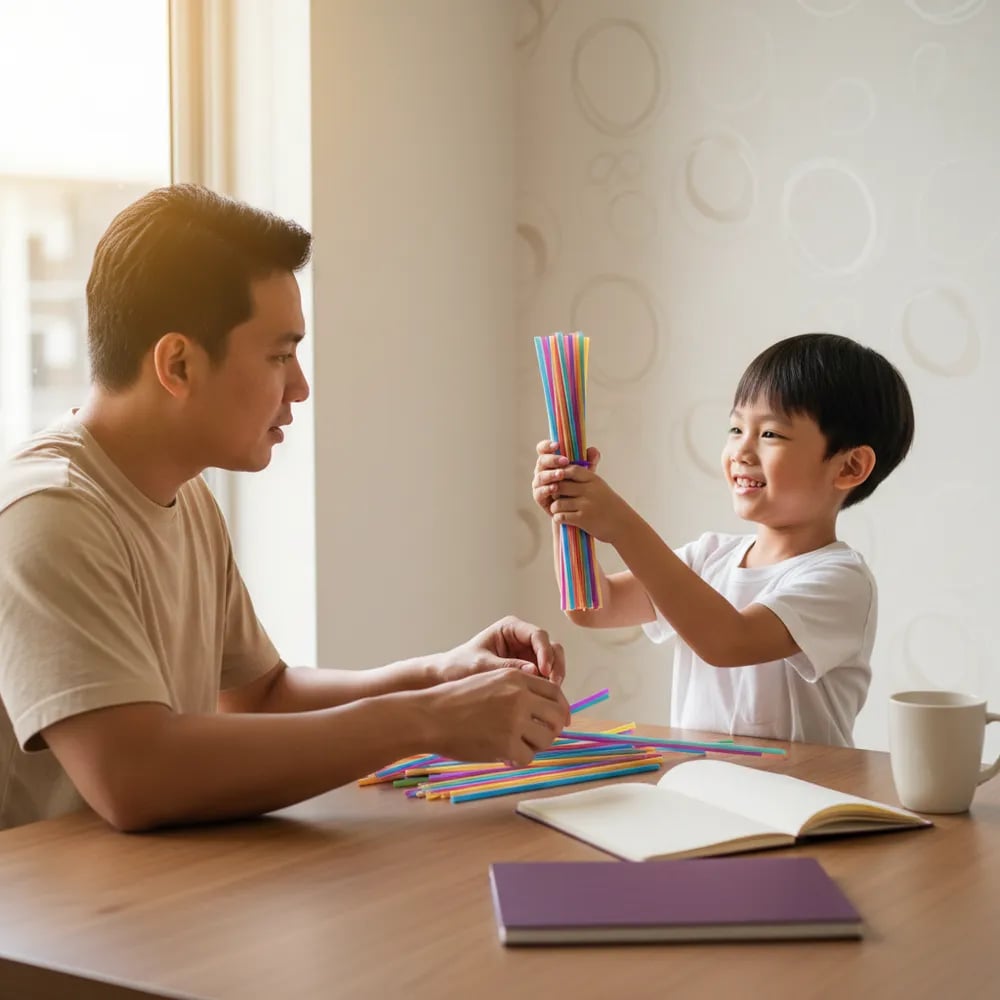
| 2 to 7 | One new idea with objects | Make 14 as 1 bundle of 10 straws and 4 loose straws |
| 7 to 9 | Draw or write the same idea | Draw 1 long stick and 4 dots, write 14 |
| 9 to 10 | Your child explains it back | "14 is 1 ten and 4 ones" |
Stop while your child still wants more. If a session goes badly, end it with an easy question so the last memory is a win.
Home practice is not enough when the same problem keeps coming back for 3 to 4 weeks, even with calm, short sessions. Common signs at 6 to 8 are counting from 1 every time, mixing up 31 and 13, or refusing maths homework altogether.
By then it's hard for a parent to see where the gap starts. Our article on why a child is weak in maths covers the usual causes.
Math Starters is Algonova's online maths course for children aged 6 to 8, matched to Tahun 1 and 2. Classes run live with a teacher in groups of up to 10. It starts with a free diagnostic of about 60 minutes that shows which basics are solid and which need work. Parents rate Algonova 4.9 out of 5, and you can read their reviews from Malaysian families.
A 6 year old in Malaysia is usually working on counting to 100, comparing numbers, and adding and subtracting small numbers with objects. Children who start Tahun 1 at 6 in 2027 will study the same Year 1 maths as 7 year olds. Under the current KSSR (the 2027 curriculum may adjust the details, so check the school's list), Year 1 covers whole numbers to 100, addition and subtraction within 100, money in ringgit and sen, time to the hour and half hour, basic 2D and 3D shapes, and simple picture graphs. A child who is ready can count 20 objects without losing track and can tell you which of 2 numbers is bigger. For example, they know 43 is bigger than 34 because 4 tens beat 3 tens. Reading numbers in words and writing them neatly comes later in the year. You do not need to teach all of it before school. Solid counting and a feel for "more" and "less" give your child a strong start in Tahun 1.
Yes, counting on fingers is normal for a 7 year old and shows they are working the sum out. The EEF guidance report (2020) describes fingers as important manipulatives for young children. What matters is how your child uses them. Counting out 8 + 5 from 1 every time is an early strategy. Starting at 8 and counting on 5 is a step forward. To help your child move on, teach facts that remove the need for fingers, such as doubles (6 + 6 = 12) and pairs that make 10 (7 + 3). Most children drop fingers for small sums by themselves once these facts stick. Forcing them to stop early often leads to guessing, which hides the gap instead of closing it. If your child still counts every sum from 1 by the end of Tahun 2, ask the teacher to check their number sense.
About 10 minutes a day, 5 days a week, is enough maths practice at home for most 6 year olds. Short, regular sessions keep attention high and build memory better than one long sitting. Ten minutes is short enough to stop before boredom sets in. That way your child finishes on a good note and wants to come back tomorrow. A useful shape for those minutes is a 2-minute warm-up they can win, 5 minutes on one new idea with objects, and a short chat where they explain what they did. Everyday maths also counts toward this time, such as setting the table for 6 people or counting change at the shop. If your child asks to keep going, that is fine. If they are tired or upset, stopping early with an easy question is better than pushing through.
Most children in Malaysia start the 2, 5 and 10 times tables in Tahun 2, usually around age 8. Full sifir 1 to 12 practice works best after your child understands multiplication as equal groups. Before memorising, your child should be able to show 3 x 4 as 3 plates with 4 grapes on each. Then they can see why 3 x 4 and 4 x 3 give the same total. Skip counting in 2s, 5s and 10s is the bridge between counting and times tables, and it fits Tahun 1 well. Drilling 7 x 8 at age 6 usually produces a memorised sound with no meaning behind it, which tends to fall apart once the harder tables arrive. A good order is groups first, then 2, 5 and 10, then 3 and 4, and only later 6 to 12. Our sifir guide explains each step.
Ask questions instead of giving answers, keep sessions short, and use the same method the teacher uses. Many homework fights start when the parent explains a different way from the school. Sit next to your child and ask them to read the question aloud first. Then ask "What did you try?" and wait about 10 seconds before saying anything. If they are stuck, use objects such as coins, straws or Lego to rebuild the problem. For a sum like 52 - 27, check the textbook or ask the teacher whether the class uses a number line, partitioning or the column method. If both of you are getting upset, stop and come back after a break. A wrong answer that goes back to school is useful, because it shows the teacher exactly where your child needs help.
Stop the task, calm things down, and come back later with an easier version. Tears at maths time usually signal that the work feels too hard or the pressure feels too high, not that your child cannot learn maths. Try to spot the trigger. Is it timed questions, a certain topic like subtraction with borrowing, or a fear of being wrong in front of you? Then lower the stakes. Use a game instead of a worksheet, or let your child be the "teacher" and correct your deliberate mistakes. Watch your own words too. A 2015 University of Chicago study of 438 first and second graders linked parents' maths anxiety to more anxiety and less learning in children who got frequent homework help from those parents. If crying happens most days for several weeks, talk to the class teacher or get a diagnostic check.
Use both, but start with games and objects and add worksheets later. For year 1 maths at home, hands-on play builds understanding, and worksheets work best as a check that the idea has stuck. Board games with numbered squares in a line, like ular dan tangga, help children count on and compare numbers. The EEF report (2020) names Snakes and Ladders as a game that may support number understanding. Card games where you add 2 cards or find a pair that makes 10 work well too. Worksheets become useful once your child can explain a sum with objects. At that stage, 5 to 8 questions are plenty, not a full page. A child who finishes 5 questions confidently learns more than one who struggles through 30 and ends the session upset. Mix in real life as well: shopping, cooking and reading the clock all practise Tahun 1 topics.
Your 7 year old may be behind if they still count every sum from 1, mix up numbers like 31 and 13, or cannot tell which of 2 numbers is bigger by the middle of Tahun 1. Other signs include avoiding maths homework, guessing answers quickly to finish, or saying "I'm stupid at maths." A single bad test is not a sign on its own. Look for patterns that last 3 to 4 weeks. A simple home check is to give your child 10 objects, cover some with your hand, and ask how many are hidden. Children with solid number sense work it out without counting everything again. If you see several of these signs, the gap often starts with counting or place value, which is easier to fix at 7 than at 10. A diagnostic with a maths teacher shows which basics are missing.
Yes, online maths classes can work for a 6 year old when they are live, short, and taught in small groups by a teacher who uses objects and games on screen. What helps at this age is a teacher who sees each child and asks them to show their thinking. A group of up to 10 children lets the teacher call on everyone in a lesson. Your child should also use real objects at home during class, such as counters or coins, so the lesson stays hands-on. Expect to sit nearby and help with the laptop for the first few weeks. Algonova's Math Starters course is built for ages 6 to 8 and follows Tahun 1 and 2 topics. It starts with a free diagnostic, so you see your child's level before choosing a plan.
A little maths before Tahun 1 helps, but it should be play, not formal lessons. Counting, sorting and comparing through daily life prepares a 5 or 6 year old better than written sums. Good starting points are counting stairs, sorting laundry by colour or size, setting the table, and asking "Who has more?" with snacks. These build number sense, which is the base of every school maths topic that follows. If your child will start Tahun 1 at 6 in 2027, focus on counting reliably to 20 and recognising numbers to 10. Spotting simple patterns, like red, blue, red, blue in a row of beads, matters too. Writing numbers neatly and doing sums on paper can wait until school starts. A child who arrives at school curious about numbers adjusts faster than one who has already learned to dread worksheets.
Blog
Start your child's tech journey
Book your free 60-minute trial class with an Algonova certified tutor. No payment, no obligation, just discover what your child can build.

Algonova worldwide
Contact us
Email: int_legal@alg.team
Visit us
Suite 8634, 1021 E Lincolnway, Cheyenne, WY, Laramie, US, 82001
Algonova online LLC International tech school for kids and teens

