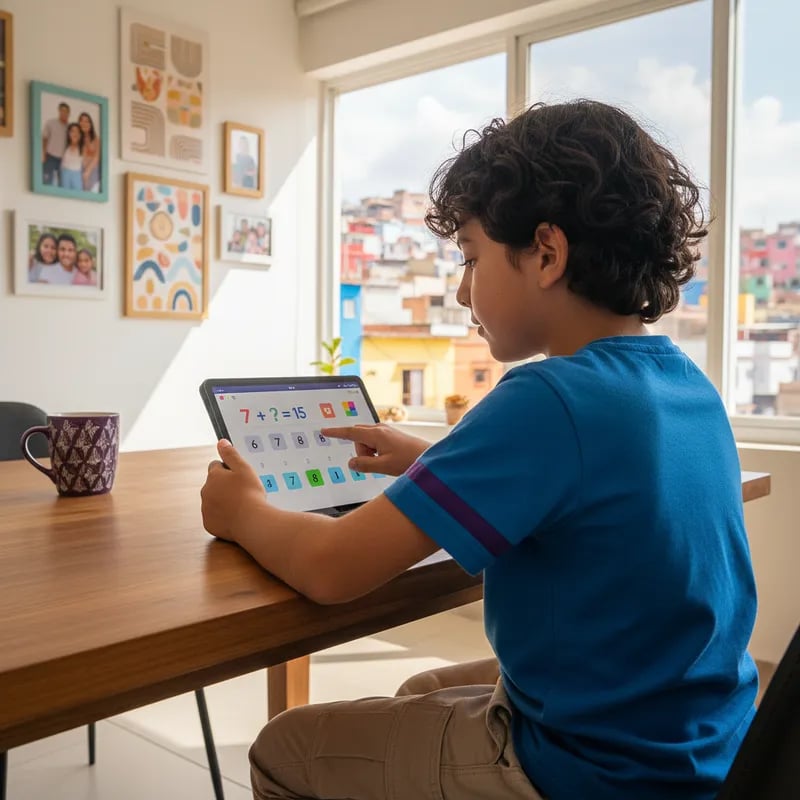

Knowing how to write prompts with kids is the part of AI that survives the next tool change. Chat windows will look different in three years; asking precisely for a method, a limit and a verification does not change. A child of 9 and up learns the 4-part structure below in a single sitting, and it takes about two weeks of short daily use before it comes out automatically.
The four part structure
Role, task, limit, verification. Every prompt worth writing has those four parts, and children memorise them faster than adults.
| Part | What it is for | How it sounds |
|---|---|---|
| Role | Defines who answers | "You are a patient maths teacher" |
| Task | Says what to produce | "Explain how to add fractions" |
| Limit | Narrows the answer | "For a 10 year old, under 100 words" |
| Verification | Forces a check | "Then ask me two questions to see if I understood" |
Verification is the part almost everyone skips, and it is exactly what turns the chatbot into a study partner. Without it the child reads an answer. With it, they have to produce something.
Lazy prompt versus directed prompt
A lazy prompt asks for the answer. A directed one asks for the process. Same tool, completely different result.
| Lazy | Directed |
|---|---|
| "What is 3/4 plus 2/5?" | "Show me the steps to add 3/4 and 2/5, without the final result" |
| "Write a text about recycling" | "Give me three angles for a text on recycling and critique my first line" |
| "Is this right?" | "Do not tell me if it is right. Show me how to verify it myself" |
| "Explain photosynthesis" | "Explain photosynthesis for a 9 year old and then test me" |
Show your child the left column once, then the right, and ask which taught them more. Most pick correctly without it being explained.