
Online Math Tutoring for SMP Students: How to Choose and What to Check in the Trial Class

Learn Math10 min read
Learn Math

Nadia Rahmawati
Math Curriculum Team, Algonova
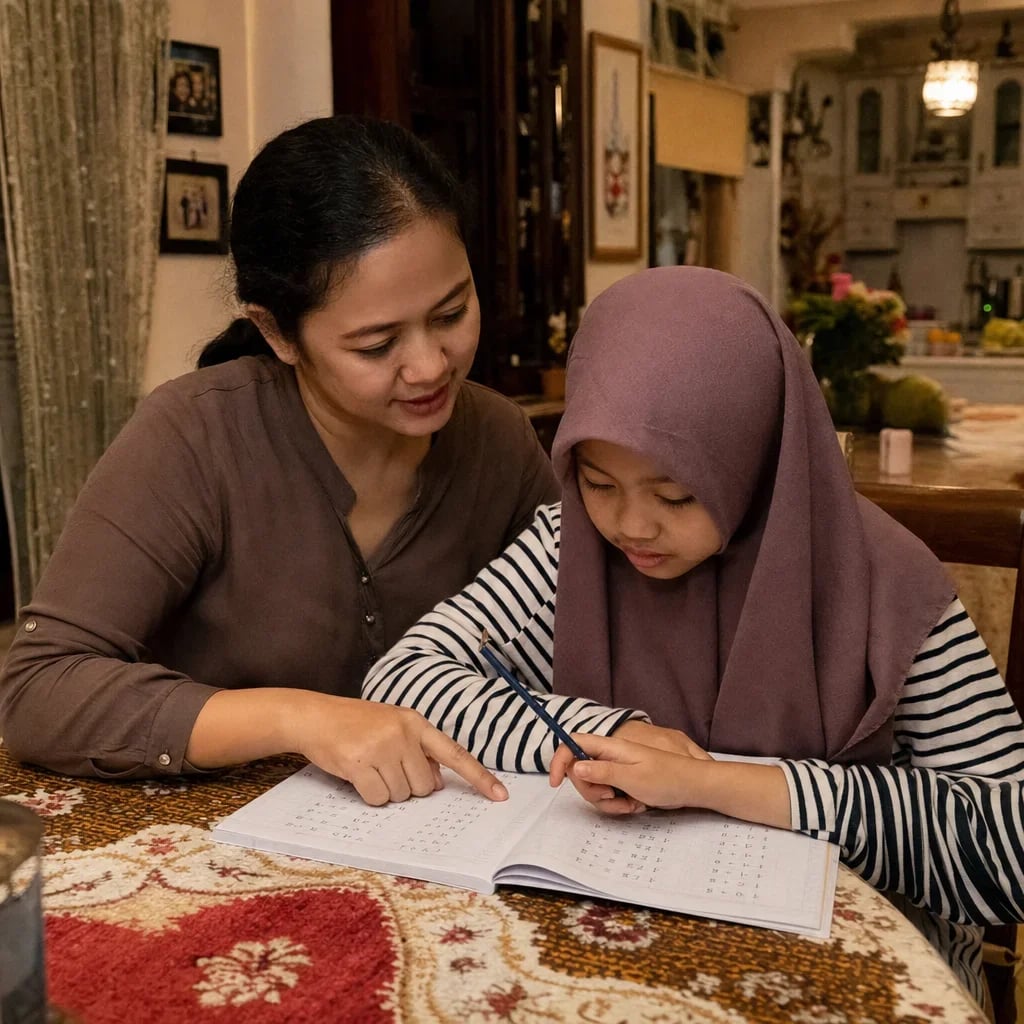
Year 6 primary maths covers five broad areas: integers including negative numbers, circles, solid shapes with their surface area and volume, statistics, and a revision of the whole primary syllabus for the final exam.
Year 6 carries two jobs at once, and that is what makes it heavy. On one side is genuinely difficult new material - negative numbers and circles. On the other, everything from Years 1 to 5 must be tidied up again for the final exam. Many children stall not because of the new material but because old gaps that were never closed all come due at once.
| Chapter | What is covered | Difficulty |
|---|---|---|
| Integers | Negative numbers, the number line, arithmetic with integers | High |
| Circles | Parts of a circle, the value of pi, circumference and area | High |
| Solid shapes | Volume and surface area of cylinders, cones, spheres, prisms, and pyramids | High |
| Statistics | Presenting data, mean, median, and mode | Moderate |
| Primary revision | Fractions, percentages, scale, speed, plane shapes | Moderate |
The first three chapters are new material, and all three demand the same thing: the ability to work with formulas that take more than one step. This is a real jump from Year 5, where most formulas are single-step.
This is the newest idea a child meets in the whole of primary school: numbers smaller than zero. Up to Year 5 every number represents something countable - three apples, half a loaf. A negative number represents no object at all, but a direction.
That is why the explanations that land fastest always use contexts with two natural directions:
The number line is the main tool, and it is best drawn horizontally, like a thermometer laid on its side. Adding means moving right, subtracting means moving left - the same for positive and negative numbers alike.
The hardest part is subtracting a negative. Children struggle to accept that 5 minus negative 3 gives 8, because subtracting ought to make things smaller. The explanation that makes most sense to a child: cancelling a debt is the same as gaining money. If a debt of 3 thousand is written off, you are 3 thousand better off.
The sign rules for multiplication are also often memorised without understanding. One sentence is enough: matching signs give a positive, differing signs give a negative.
This chapter matters far beyond primary school - the whole of secondary algebra stands on it. A child leaving Year 6 shaky on negative numbers will struggle in Year 7, and the connection is rarely noticed.
The circle is the first shape whose formula uses a number that is not whole: pi. Until now every formula used tidy numbers. Now 3.14 or 22 over 7 appears, and a child quite reasonably asks where that number came from.
The answer is worth giving, because it makes the whole chapter make sense: pi is a circle's circumference divided by its diameter, and the result is the same for every circle there is - from a cup lid to a car wheel. Measuring the circumference and diameter of a pan lid with string and dividing them is usually more convincing than any explanation.
Two formulas are taught: the circumference and the area of a circle.
The most frequent mistake is confusing radius with diameter. The circumference formula uses the diameter, the area formula uses the radius, and questions often supply the other one. The habit that saves you: before putting numbers into a formula, write down what the radius is and what the diameter is.
Choosing between 3.14 and 22 over 7 also confuses. The rule is simple: use 22 over 7 when the radius or diameter is a multiple of 7, because the arithmetic then comes out exactly. Otherwise use 3.14.
In Year 6 the list of solids grows considerably: the cylinder, cone, sphere, prism, and pyramid. Plus the surface area of each - cylinder, cone, sphere, cube, and cuboid.
That is a lot of formulas, and this is where children most often give up and switch to rote memorisation. Yet there is a pattern that halves the memory load: the volume of a prism and a cylinder are both base area times height, while the volume of a pyramid and a cone are both one third of that. Only the shape of the base differs - square, triangle, or circle.
A child who catches this pattern needs to remember one thing per family rather than one formula per shape.
The lightest chapter in Year 6, and often the one that rescues an exam grade. Children learn to present data in bar, line, and pie charts, then calculate three measures of centre: the mean, the median, and the mode.
A way to remember all three without rote learning: the mean is what everyone would get if the total were shared equally, the median is the value exactly in the middle once the data is ordered, and the mode is the value that appears most often.
The most frequent mistake is with the median: children forget to order the data first. The data 7, 3, 9 has a median of 7, not 3 - but that is only visible after ordering it as 3, 7, 9. The single habit of sorting before calculating removes almost every error in this chapter.
That fourth cause is the one most often misdiagnosed. The child appears to be struggling with Year 6 material when the real problem is fractions that were never finished two years earlier.
When it is hard to tell which chapter is actually missing, a maths assessment of about 60 minutes is designed for exactly that - the result shows where the gap sits, often one or two years further back. Regular classes for ages 8-12 are Math Explorers, and for the next stage Math Masters. An introductory session can be tried through a free maths diagnostic. To revise the previous year, see Year 5 primary maths topics.
Algonova Indonesia accepts students aged 5 to 17 for coding and math courses. Every age group has a dedicated program designed for their cognitive development stage and interests. For kindergarten kids aged 5-7, we offer ScratchJr (visual block-based coding requiring no reading) and fun basic math introduction. For primary school kids aged 8-12, the program covers Scratch, Roblox, Python Start, and complete math. For junior and senior high teens aged 13-17, focus is on Python, JavaScript, secondary school math, AI courses, full Web Development, UTBK SNBT preparation, and university portfolio. No prior experience is required. An Algonova certified teacher will recommend the right learning path during the free trial class.
Yes, all Algonova Indonesia courses are fully available online with live sessions taught by certified teachers — not recorded videos. Kids learn in real time in small groups, with two-way interaction and tasks worked on alongside the teacher. To join online class, a child only needs a computer or laptop with a camera, a stable internet connection, and a headset. The Algonova platform runs directly in the browser so no special software installation is required. Many families choose a mixed schedule: weekday classes for flexibility around school, and weekend sessions for a calmer pace outside school hours. Our team helps choose the format best suited to family needs.
Algonova Indonesia classes come in three formats: 1-on-1 private, a mini-group of 2–4 kids, and a group of up to 10 students. This small group format is deliberately chosen because it provides the optimal balance between social interaction and personal teacher attention. In a mini-group, every child averages about 10 minutes of direct teacher interaction in a single session. Compare with traditional offline bimbel of 20-40 students per class — direct interaction there is only 1-2 minutes per child, or none at all. For families wanting full attention, one-on-one private class is also available (1 student per teacher). This format is more intensive and suits kids with special needs, competition preparation, or specific topic depth.
Choosing the right course for your child depends on three main factors: age, interest, and previous learning stage. The best way to decide is by taking a free trial class at Algonova Indonesia. During the trial class, a certified teacher will talk with the child, understand their interests (games, art, mathematics, science experiments), and assess their ability level. Based on this diagnostic, the teacher recommends the most suitable learning path — perhaps visual coding for creative kids, Python for logic-loving kids, or math tutoring for kids wanting to improve school grades. After the trial, the Algonova team provides a transparent explanation of the recommended program, along with schedule and pricing. No pressure to enrol — we believe the best decisions come from full understanding. Contact our WhatsApp to book a trial.
The Algonova Indonesia trial class is 100% free, no credit card, no auto-subscription. You and your child can attend the entire 60-minute session with no obligation afterwards. Many families take a few days to decide, and that's completely fine. For regular programs, pricing starts from Rp 102,000 per lesson. The price includes a live session with a certified teacher, digital learning materials, platform access, and an official certificate upon completing each level. Final pricing depends on program (coding or math), child's age, and class format (private, mini-group, or group). Full pricing details are shared transparently after the trial class. No surprise fees, every cost component is explained before formal enrolment.
Algonova Indonesia uses Project-Based Learning methodology combined with modern cognitive science principles. Three main pillars: kids learn by creating (not memorising), small groups for personal attention, and a gradual curriculum matched to age. Every program level ends with a real project: kindergarten kids build animations, primary school kids build games or interactive stories, teens build Python applications or websites. Projects become concrete evidence of understanding, far more effective than theoretical exams. We also apply "scaffolded learning" principles — teachers provide full support at the start, then gradually reduce until the child is independent. This approach is inspired by Lev Vygotsky's work on the Zone of Proximal Development. The result: children master not just the material but also build confidence as independent learners willing to try new things.
Yes, Algonova Indonesia students receive an official certificate after completing each level of a coding or math program. The certificate lists the child's name, the program completed (for example Scratch Basics, Python Basics, or Primary School Math), the completion date, and is signed by the Algonova team. The certificate documents the child's learning journey, attaches to a school portfolio or coding competition application, and motivates kids to see the results of their hard work. Some primary and secondary schools in Indonesia accept Algonova certificates as evidence of digital extracurricular activity. Beyond the formal certificate, kids also take home a portfolio of real projects they built themselves: games, animations, websites, or running Python programs. This portfolio is concrete evidence of the child's ability that can be shown to family, teachers, friends, or even in university applications.
Year 6 primary maths covers integers including negative numbers, circles with circumference and area, solid shapes with their volume and surface area, statistics covering mean median and mode, and a revision of the whole primary syllabus for the final exam.
The three hardest chapters are negative integers, circles, and solid shapes. All three demand the same thing: working with formulas that take more than one step - a real jump from Year 5, where most formulas are single-step.
Because a negative number represents no countable object but a direction. The easiest explanations use contexts with two directions: temperature below zero, building floors below ground, or debt. For subtracting a negative, the explanation that makes most sense to a child is that cancelling a debt is the same as gaining money.
Pi is a circle's circumference divided by its diameter, and the result is identical for every circle. Use 22 over 7 when the radius or diameter is a multiple of 7, because the arithmetic comes out exactly, and use 3.14 otherwise.
There is a pattern that halves the memory load. The volume of a prism and a cylinder are both base area times height, while the volume of a pyramid and a cone are both one third of that. Only the base shape differs. A child who catches this needs one rule per family rather than one formula per shape.
Do not re-teach five years of material from scratch; it is unrealistic and exhausting for no gain. Identify the three or four chapters genuinely missing and close only those. Also practise mixed questions without chapter labels, because in an exam the child must work out for themselves what is being tested.
Blog


Algonova worldwide
Contact
Whatsapp: +62 21 50996971
Email: info@algonova.id
Address
Coworking Area, Gedung IT 6 Lantai Dasar, Nongsa Digital Park, Jalan Hang Lekiu, Kelurahan Sambau, Kecamatan Nongsa, Batam, Indonesia Directorate General of Consumer Protection and Trade Compliance – Ministry of Trade of the Republic of Indonesia. WhatsApp Ditjen PKTN: 0853-1111-1010.
