

Online Math Tutoring for Primary & Middle Schoolers: Options & Pricing 2026
Math Education8 min
Math Education
Putri Anggraini
Head of Math Program, Algonova
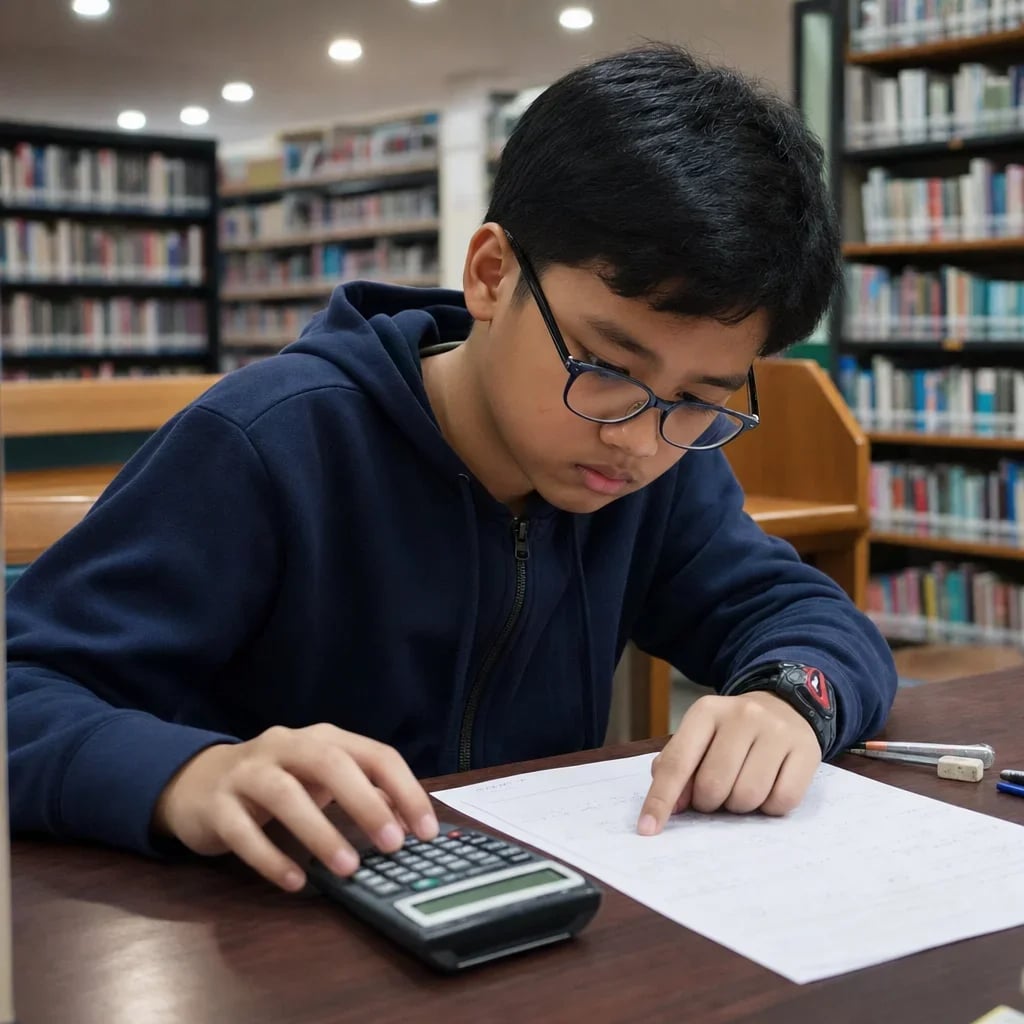
Year 10 upper secondary maths covers eight broad areas: exponents and logarithms, sequences and series, vectors, trigonometry, linear systems and inequalities, quadratic functions, statistics, and probability.
Year 10 begins Phase E. The biggest difference from lower secondary is not the difficulty of the material but the pace. A chapter that took two months in Year 9 is finished in two weeks. Teachers assume the lower-secondary foundation is solid and build straight on top of it.
The consequence is clear: a student arriving with gaps in algebra or functions has no time to close them while moving. This is why many students find Year 10 far heavier than Year 9, even when the material is not always more complex.
| Chapter | What is covered | Difficulty |
|---|---|---|
| Exponents and logarithms | Advanced index laws, surds, the definition and laws of logarithms | High |
| Sequences and series | Arithmetic and geometric sequences, series, infinite geometric series | Moderate |
| Vectors | Notation, vector operations, magnitude, vectors in the plane | High |
| Trigonometry | Trigonometric ratios, special angles, basic identities | High |
| Linear systems | Three variables, systems of inequalities, linear programming | Moderate |
| Quadratic functions | Graphs, the vertex, maximum and minimum applications | Moderate |
| Statistics | Presenting data, measures of centre and spread | Moderate |
| Probability | Counting rules, permutations, combinations, probability of events | Moderate |
The three chapters marked high share one feature: each introduces new notation never met in lower secondary. The difficulty is often not the concept but reading the symbols.
The most iconic chapter of upper secondary, and the one that makes students give up earliest - usually because of one wrong approach: memorising the table before understanding what it means.
Sine, cosine, and tangent are really just three ratios of sides in a right-angled triangle. Sine is opposite over hypotenuse, cosine is adjacent over hypotenuse, tangent is opposite over adjacent. At the start there is nothing more to it.
What makes it feel complicated is the notation. A student who draws the triangle and labels opposite, adjacent, and hypotenuse before touching any formula gets lost far less often than one who hunts for a formula that fits.
Special angles - 0, 30, 45, 60, and 90 degrees - do need to be known by heart, because they appear in almost every question. But memorising the table is far easier once a student understands where the numbers come from: the values for 45 degrees come from an isosceles right triangle, and those for 30 and 60 from an equilateral triangle cut in half. Both can be redrawn any time they are forgotten.
The full list of formulas and identities is in trigonometric formulas.
The link to Pythagoras' theorem is worth showing early too - the fundamental trigonometric identity is really Pythagoras rewritten in different symbols.
The logarithm is the idea most often feared without cause, because its definition sounds circular.
The clearest framing: a logarithm is the reverse question of a power. Where a power asks what two cubed equals, a logarithm asks to what power two must be raised to give eight. Both involve 2, 3, and 8 - only the position of the question shifts.
Every logarithm law follows directly from the index laws already learned in Year 9. Multiplication inside a logarithm becomes addition outside, because multiplying powers means adding exponents. A student who sees this relationship stops memorising six separate laws.
The real difficulty in this chapter almost always traces back to Year 9: if the index laws are not solid, logarithms will not land.
A vector is a number with a direction, and it is the direction that is new to students. Up to Year 9 every number had only magnitude. A vector adds one more piece of information.
The example that lands fastest: walking 5 kilometres is an ordinary quantity, while walking 5 kilometres north is a vector. Two people walk the same distance but end up in different places.
That is why adding vectors is not adding numbers. Walking 3 kilometres east then 4 kilometres north does not put you 7 kilometres from the start but 5 - and that number comes from Pythagoras. Drawing arrows on paper resolves more confusion than any formula.
Sequences and series usually feel like relief among the heavier Year 10 chapters, because the patterns are clear and the formulas few. Only two things need distinguishing: an arithmetic sequence grows by a fixed difference, a geometric one by a fixed ratio.
One idea often makes students pause: an infinite geometric series can have a finite sum. Adding a half, then a quarter, then an eighth, forever, approaches 1 and never exceeds it. This is a student's first meeting with the idea of a limit, long before the formal limits chapter in Year 11.
Quadratic functions largely revisit Year 9 with one addition: finding maxima and minima. This is where mathematics starts to feel useful - determining the price giving the greatest profit, or the pen dimensions giving the largest area from a fixed length of fencing. The solving basics are in solving quadratic equations.
A 45-minute maths assessment shows which chapter is genuinely missing, and for Year 10 students the result often points back to Year 8 or 9. Regular classes are Math Masters, with an introductory session through a free class. Previous year: Year 9. Next year: Year 11.
Algonova Indonesia accepts students aged 5 to 17 for coding and math courses. Every age group has a dedicated program designed for their cognitive development stage and interests. For kindergarten kids aged 5-7, we offer ScratchJr (visual block-based coding requiring no reading) and fun basic math introduction. For primary school kids aged 8-12, the program covers Scratch, Roblox, Python Start, and complete math. For junior and senior high teens aged 13-17, focus is on Python, JavaScript, secondary school math, AI courses, full Web Development, UTBK SNBT preparation, and university portfolio. No prior experience is required. An Algonova certified teacher will recommend the right learning path during the free trial class.
Yes, all Algonova Indonesia courses are fully available online with live sessions taught by certified teachers — not recorded videos. Kids learn in real time in small groups, with two-way interaction and tasks worked on alongside the teacher. To join online class, a child only needs a computer or laptop with a camera, a stable internet connection, and a headset. The Algonova platform runs directly in the browser so no special software installation is required. Many families choose a mixed schedule: weekday classes for flexibility around school, and weekend sessions for a calmer pace outside school hours. Our team helps choose the format best suited to family needs.
Algonova Indonesia classes come in three formats: 1-on-1 private, a mini-group of 2–4 kids, and a group of up to 10 students. This small group format is deliberately chosen because it provides the optimal balance between social interaction and personal teacher attention. In a mini-group, every child averages about 10 minutes of direct teacher interaction in a single session. Compare with traditional offline bimbel of 20-40 students per class — direct interaction there is only 1-2 minutes per child, or none at all. For families wanting full attention, one-on-one private class is also available (1 student per teacher). This format is more intensive and suits kids with special needs, competition preparation, or specific topic depth.
Choosing the right course for your child depends on three main factors: age, interest, and previous learning stage. The best way to decide is by taking a free trial class at Algonova Indonesia. During the trial class, a certified teacher will talk with the child, understand their interests (games, art, mathematics, science experiments), and assess their ability level. Based on this diagnostic, the teacher recommends the most suitable learning path — perhaps visual coding for creative kids, Python for logic-loving kids, or math tutoring for kids wanting to improve school grades. After the trial, the Algonova team provides a transparent explanation of the recommended program, along with schedule and pricing. No pressure to enrol — we believe the best decisions come from full understanding. Contact our WhatsApp to book a trial.
The Algonova Indonesia trial class is 100% free, no credit card, no auto-subscription. You and your child can attend the entire 60-minute session with no obligation afterwards. Many families take a few days to decide, and that's completely fine. For regular programs, pricing starts from Rp 102,000 per lesson. The price includes a live session with a certified teacher, digital learning materials, platform access, and an official certificate upon completing each level. Final pricing depends on program (coding or math), child's age, and class format (private, mini-group, or group). Full pricing details are shared transparently after the trial class. No surprise fees, every cost component is explained before formal enrolment.
Algonova Indonesia uses Project-Based Learning methodology combined with modern cognitive science principles. Three main pillars: kids learn by creating (not memorising), small groups for personal attention, and a gradual curriculum matched to age. Every program level ends with a real project: kindergarten kids build animations, primary school kids build games or interactive stories, teens build Python applications or websites. Projects become concrete evidence of understanding, far more effective than theoretical exams. We also apply "scaffolded learning" principles — teachers provide full support at the start, then gradually reduce until the child is independent. This approach is inspired by Lev Vygotsky's work on the Zone of Proximal Development. The result: children master not just the material but also build confidence as independent learners willing to try new things.
Yes, Algonova Indonesia students receive an official certificate after completing each level of a coding or math program. The certificate lists the child's name, the program completed (for example Scratch Basics, Python Basics, or Primary School Math), the completion date, and is signed by the Algonova team. The certificate documents the child's learning journey, attaches to a school portfolio or coding competition application, and motivates kids to see the results of their hard work. Some primary and secondary schools in Indonesia accept Algonova certificates as evidence of digital extracurricular activity. Beyond the formal certificate, kids also take home a portfolio of real projects they built themselves: games, animations, websites, or running Python programs. This portfolio is concrete evidence of the child's ability that can be shown to family, teachers, friends, or even in university applications.
Year 10 upper secondary maths covers exponents and logarithms, sequences and series, vectors, trigonometry, linear systems and inequalities including linear programming, quadratic functions, statistics, and probability with permutations and combinations.
The three hardest are exponents and logarithms, vectors, and trigonometry. All three share one feature: each introduces notation never met in lower secondary. The difficulty is often not the concept but reading the symbols.
Not because the material is more complex but because of the pace. A chapter that took two months in Year 9 finishes in two weeks, and teachers build straight on the lower-secondary foundation. A student arriving with algebra gaps has no time to close them while moving.
Do not memorise the table first. Sine is opposite over hypotenuse, cosine adjacent over hypotenuse, tangent opposite over adjacent. Draw the triangle and label all three sides before touching a formula. Even the special angles can be derived from two drawings: an isosceles right triangle for 45 degrees, and half an equilateral triangle for 30 and 60.
A logarithm is the reverse question of a power. Where a power asks what two cubed equals, a logarithm asks to what power two must be raised to give eight. Every logarithm law follows directly from the index laws, so they need not be memorised separately.
Almost always because the Year 9 index laws are not solid. Logarithms are built directly on them, so more logarithm practice will not help. What needs closing first is the powers and roots chapter from Year 9.

Algonova worldwide
Contact
Whatsapp: +62 21 50996971
Email: info@algonova.id
Address
Coworking Area, Gedung IT 6 Lantai Dasar, Nongsa Digital Park, Jalan Hang Lekiu, Kelurahan Sambau, Kecamatan Nongsa, Batam, Indonesia Directorate General of Consumer Protection and Trade Compliance – Ministry of Trade of the Republic of Indonesia. WhatsApp Ditjen PKTN: 0853-1111-1010.
PT Algonova Indonesia Cerdas All rights reserved 2026
