Future careers in the AI era: what to prepare now

AI Education8 min
Math Education

Dewi Lestari
Mathematics Specialist
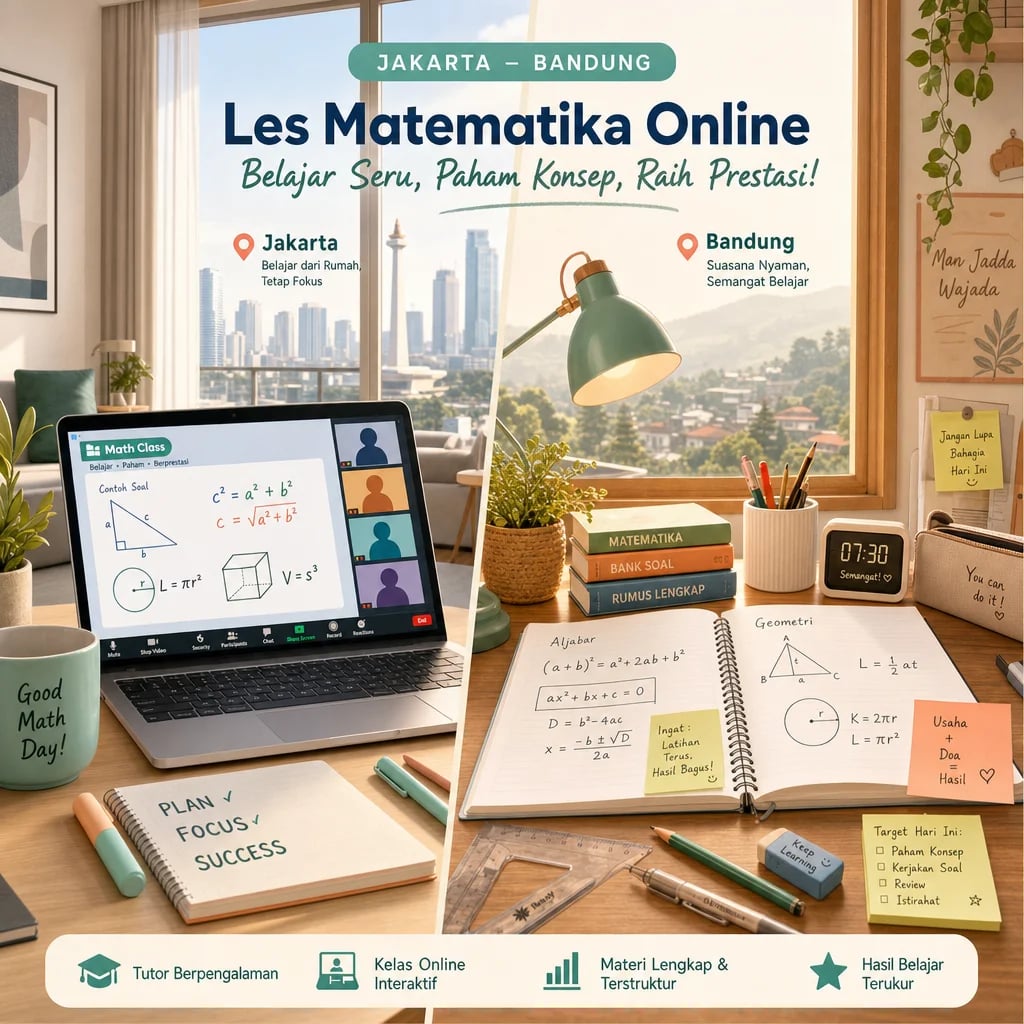
Jakarta, Bandung, Surabaya, and Medan each have dozens of math tutoring options, from large franchises like Kumon and Ganesha Operation to independent private tutors — the right way to choose is comparing 5 criteria: curriculum fit, teacher certification, teacher-to-student ratio, price transparency, and schedule flexibility. Algonova offers an online-first alternative that serves all four cities from the same class, with certified teachers in Private (1 student), Mini (2-4 students), and Group (up to 10 students) formats. This guide compares 10 math tutoring options honestly — strengths and limitations included — so you can choose based on your child's needs, not just brand recognition.
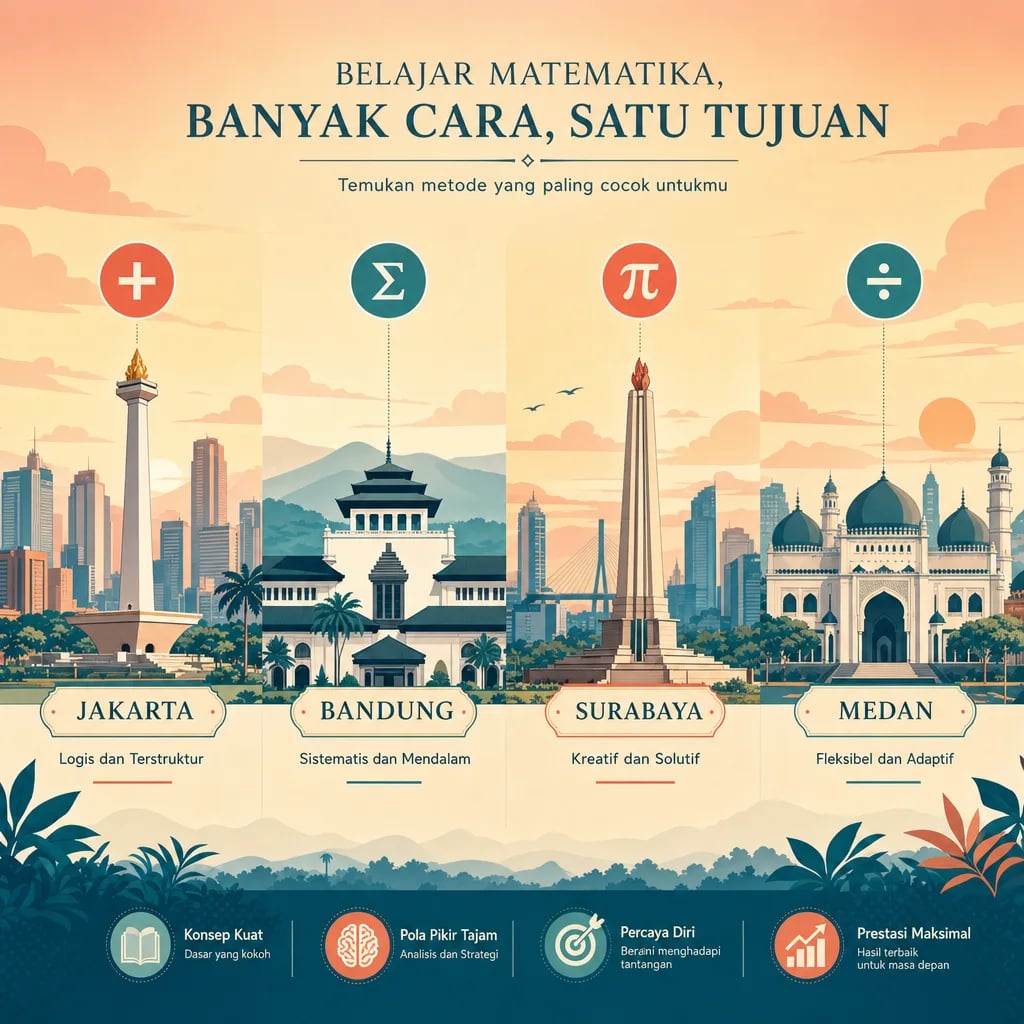
The five criteria below help narrow down dozens of options in your city to a handful of genuinely relevant candidates.
Here are the 10 math tutoring options most searched by parents in Jakarta, Bandung, Surabaya, and Medan — from large franchises to online alternatives. Price ranges below are based on publicly available information and can change; confirm directly with each provider for current rates.
One-on-one worksheet-based learning at franchise centers, completed mostly independently. Serves nearly all ages, from preschool through high school. Registration fee around Rp450,000 plus a monthly fee of Rp350,000-Rp450,000 per subject. Pros: an extensive branch network across all four cities. Cons: repetitive worksheets can feel monotonous for children who need concepts explained verbally.
Small-group classes at offline branches, using a Japan-origin method that emphasizes mental arithmetic logic without calculators. Primarily for primary-school age. Monthly fees range around Rp300,000-Rp500,000. Pros: a structured method proven across multiple countries. Cons: branch coverage is still limited and may not be available in all four cities.
A hybrid format combining on-demand video lessons with live online coaching sessions. Serves primary through high-school age. Self-paced plans start around Rp100,000-Rp300,000 per month; live coaching costs more. Pros: affordable pricing and a mature app experience. Cons: personal interaction with an instructor is more limited than direct private tutoring.
Not a school but a marketplace where parents find independent private tutors — either online or in-home. Suitable for all ages. Rates vary widely by tutor, typically Rp50,000-Rp200,000 per hour. Pros: flexible choice of tutor and schedule. Cons: tutor quality isn't standardized; parents need to vet credentials and track record themselves.
An in-home private tutoring service, generally for primary through high-school age. Rates around Rp75,000-Rp150,000 per hour. Pros: children learn in the familiar comfort of home. Cons: teacher quality can vary between branches or city areas.
An offline group tutoring franchise with classes organized by grade level, operating for decades. Serves primary through high school. Monthly fees around Rp300,000-Rp500,000. Pros: a well-known name with a long track record in the tutoring industry. Cons: class sizes tend to be larger, limiting individual attention.
An offline group tutoring franchise focused on school exam prep and entrance tests (junior/senior high, including UTBK). Monthly package fees around Rp400,000-Rp700,000. Pros: a strong reputation for exam strategy and practice. Cons: less ideal for primary-school kids still building basic math foundations, since the curriculum leans exam-oriented.
An offline group tutoring franchise with an Islamic learning environment, serving primary through high school. Monthly fees around Rp300,000-Rp500,000. Pros: an Islamic learning environment is a plus for some families. Cons: fixed group class schedules are less flexible for busy families.
An offline group tutoring franchise based in Java, with branches spread across several major Javanese cities. Serves primary through high school. Monthly fees around Rp300,000-Rp450,000. Pros: a long-running, research-based teaching method. Cons: branch coverage is concentrated in Java and may not reach Medan.
Live online classes with certified teachers — not pre-recorded videos — in Private (1 student), Mini (2-4 students), and Group (up to 10 students) formats, for ages 5-17. Trusted by over 1,000,000 alumni across 97 countries since 2016, with a 4.9-star rating. Pros: children in Jakarta, Bandung, Surabaya, or Medan join the exact same class without leaving home or sitting in traffic. Cons: requires a reliable internet connection and device at home.
For families in Jakarta, Bandung, Surabaya, and Medan, online math tutoring offers four concrete advantages over visiting a physical location.
Want to try an online math class without leaving home? Try a free 60-minute Master Class with a certified Algonova teacher — suitable for children in Jakarta, Bandung, Surabaya, Medan, or anywhere else.
The four questions below help narrow the 10 options above down to the one that best fits your child.
As a supplement, kids can also practice independently at home with math games for kids between regular tutoring sessions.
No single math tutoring place is automatically "the best" for every child — the right choice depends on your family's curriculum, schedule, and budget. Kumon and Sakamoto excel at structured methods, Ganesha Operation and Primagama are strong for exam prep, while Algonova is the pick for families in Jakarta, Bandung, Surabaya, or Medan who want live online classes with certified teachers, unrestricted by location.
Ready to try an online math class with a certified teacher? Sign up for a free 60-minute Master Class and see firsthand how your child learns in a small group from home.
Kids' classes by city: Jakarta · Bandung · Surabaya · Medan
Want your child to learn math live with a certified teacher? Try a free Master Class.
The best math tutoring place isn't the most famous one, but the one that fits your child's learning style, has quality teachers, and keeps classes small. A big city reputation or a big brand name doesn't guarantee the right fit for your child.
Is in-person or online tutoring better? Online is now equal in quality and removes commute time entirely, as long as the teacher is good and the class stays small.
How can you be sure? Try one session before subscribing. Beyond math, training logic through coding also strengthens a child's reasoning. See Algonova coding classes for ages 5–17, or try a free coding class.
There's no single answer since "best" depends on your child's needs — Kumon and Sakamoto Method excel at structured methods, Ganesha Operation and Primagama are strong for exam prep, while Algonova stands out for live online classes with certified teachers. Compare options using 5 criteria: curriculum fit, teacher certification, a small teacher-to-student ratio, price transparency (around Rp250,000-Rp600,000/month), and availability of a free trial. Parents in Jakarta should try at least 2-3 options before committing to a full month.
Math tutoring currently ranges from about Rp250,000 to Rp700,000 per month, depending on format and provider. Group programs like Primagama or Neutron typically run Rp300,000-Rp500,000/month, while private tutoring through platforms like Superprof is billed hourly at around Rp50,000-Rp200,000. Kumon adds a registration fee of about Rp450,000 on top of a monthly fee per subject. Prices vary by branch and city, so always confirm current rates directly with the provider before signing up.
Both are strong but for different learning styles — Kumon uses leveled worksheets completed independently, suiting kids who like working step-by-step on their own, while Sakamoto Method uses small group classes built on a Japanese approach emphasizing mental arithmetic without calculators. Kumon has a wider branch network, while Sakamoto's availability is more limited. The best way to decide is trying a trial session at both before committing monthly.
It's effective when the online class is live with a certified teacher, not just one-way recorded video. Algonova, for example, runs live classes in Private (1 student), Mini (2-4 students), and Group (up to 10 students) formats, keeping interaction close to an in-person class. An added benefit of online tutoring is consistent pricing across cities and no commute time lost — in Jakarta alone, travel to a tutoring center can take 30-60 minutes during rush hour.
Many parents start considering extra tutoring around grade 1-2 (ages 6-8), when basic arithmetic foundations are first built at school. That said, the right timing depends more on the child's readiness and interest than a fixed age. Before enrolling, it helps to understand when to start math tutoring through a simple assessment to see whether your child is behind, on track, or ahead of their grade-level standard.
Yes, Algonova is an online platform, so children in Bandung, Surabaya, Medan, or any other Indonesian city join the exact same live class as children in Jakarta — with the same certified teachers and the same price, with no location-based surcharge. Classes run live in Private (1 student), Mini (2-4 students), and Group (up to 10 students) formats, not one-way recorded video. Algonova has been trusted by over 1,000,000 alumni across 97 countries since 2016.
The most accurate way is a short math assessment that checks a child's grasp of grade-appropriate basics, rather than guessing from report card grades alone. Assessments like this are usually 10-20 quick questions that pinpoint whether a child struggles with a specific concept, like fractions or multiplication. The results help parents pick the right class level, so the child isn't bored from material that's too easy or frustrated by material that's too hard.
Group programs like Primagama or Ganesha Operation typically have 10-20 students per class following the same schedule and material, which keeps costs lower but limits individual attention. Private tutoring — whether an in-home teacher or a platform like Superprof — focuses entirely on one child so material can match their pace, though hourly rates run higher, around Rp50,000-Rp200,000. A middle option like Mini (2-4 students) or Group (up to 10 students) formats tries to balance both sides.

Algonova worldwide
Contact
Whatsapp: +62 21 50996971
Email: info@algonova.id
Address
Coworking Area, Gedung IT 6 Lantai Dasar, Nongsa Digital Park, Jalan Hang Lekiu, Kelurahan Sambau, Kecamatan Nongsa, Batam, Indonesia Directorate General of Consumer Protection and Trade Compliance – Ministry of Trade of the Republic of Indonesia. WhatsApp Ditjen PKTN: 0853-1111-1010.
PT Algonova Indonesia Cerdas All rights reserved 2026