Digital Drawing Apps for Kids: Free Picks for Phones, Tablets and Laptops

Course Guides8 min
Course Guides

Maya Putri
Early Childhood Education Specialist
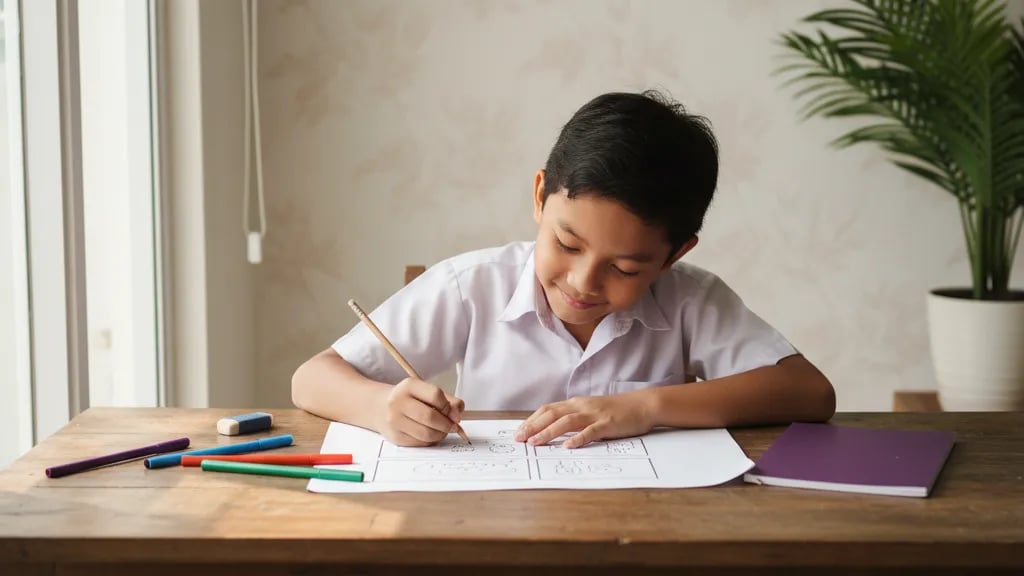
How to make a simple comic for primary school kids: pick one character and one event, divide the paper into 4 panels, fill the panels in order with the beginning, problem, climax and ending, then add speech bubbles and color. This 4-panel pattern is easiest for kids in grades 3 and 4 (ages 8 to 10). For a school assignment, set aside about an hour, from writing the idea to coloring.
Algonova is an online coding, math and design school for kids with more than 1,000,000 students in 97 countries. Classes run live with a teacher, in groups of up to 10 children, from Rp 102,000 per session, and parents rate us 4.9. In the design program, kids aged 8 to 15 learn drawing, illustration, character design and animation.
A good comic starts with a short story, not a complicated drawing.
Get some printer paper or a sketchbook, a pencil, an eraser, a ruler, a black marker and colored pencils. Then follow these seven steps:
If your child struggles to draw characters, the basic shape practice in our guide to kids' drawing courses can help.
A 4-panel comic follows the pattern beginning, problem, climax, ending; in Japan this format is called yonkoma.
Here's a sample script about friendship that's ready to draw:
| Panel | Picture | Text |
|---|---|---|
| 1. Beginning | Dodi opens his bag in class at break time | Dodi: "Hey, where's my lunch?" |
| 2. Problem | Dodi sits glumly holding his stomach | Stomach: "Grrrumble..." |
| 3. Climax | Rani holds out her lunch box | Rani: "Let's share!" |
| 4. Ending | They eat together, laughing | Dodi: "Tomorrow I'll bring the cake!" |
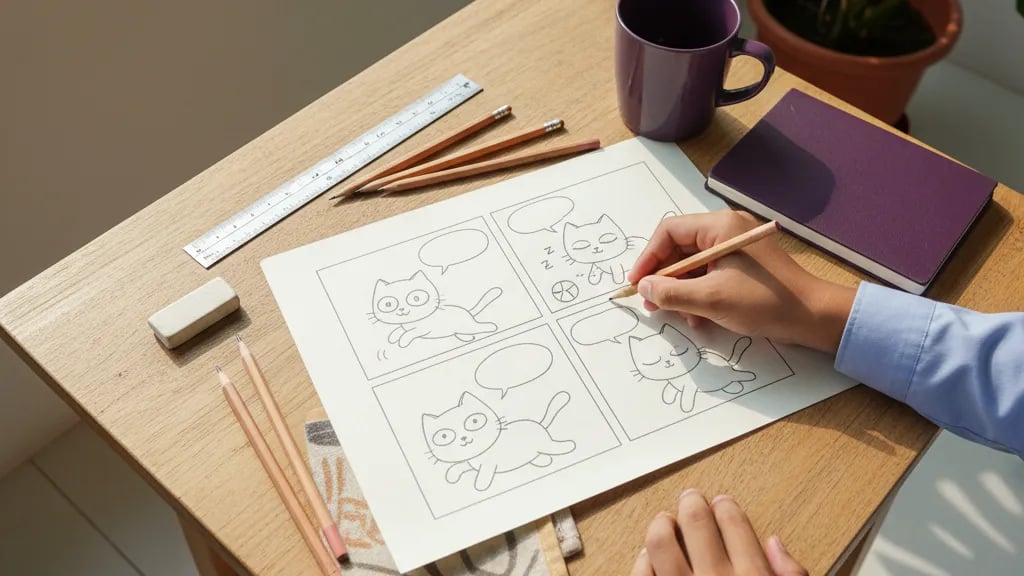
Other themes teachers often ask for: keeping the environment clean, saving water, waiting in line, or a holiday story. The pattern stays the same. Panel 1 introduces the character and place, panel 2 brings in a problem, panel 3 holds a surprise or a solution, and panel 4 closes the story with a message or a joke.
For a 6-panel comic, add two panels in the middle: one for a first attempt that fails and one for a second attempt. The story gets longer without losing its direction.
A child's first comic doesn't need to be beautiful. It needs a character, a problem and an ending that makes the family smile as they read.
Maya Putri, Child Education Specialist
Grade 3 kids only need 4 panels with short sentences, while grades 5 and 6 can already play with viewpoint and narration.
| Grade | Panels | Characters | What to add |
|---|---|---|---|
| Grade 3 (ages 8 to 9) | 4 | 1 to 2 | Short dialogue, up to 8 words per bubble |
| Grade 4 (ages 9 to 10) | 4 to 6 | 2 | Facial expressions, sound effects like "CRASH!" |
| Grades 5 to 6 (ages 10 to 12) | 6 or more | 2 to 3 | Narration boxes, close-ups and wide shots |
Facial expressions make a comic feel alive, and kids pick them up quickly. Happy just needs curved eyes and an open mouth. Sad uses lowered eyebrows and a mouth curving down. Surprised is big round eyes and a mouth shaped like the letter O.
Grade 4 kids can also start using different bubble types: round bubbles for speech, cloud bubbles for thoughts, and spiky bubbles for shouting. Small details like these tell readers the mood right away without extra words.
Kids who enjoy inventing their own characters often take to the illustration and character design lessons in the graphic design program for kids.
Digital comics can be made for free: Canva for building from templates, ibisPaint X on a phone or tablet, and Krita on a laptop.
Canva offers 4-panel and 6-panel comic strip templates, a collection of speech bubbles and plenty of free fonts. Your child picks a template, drags in characters or uploads their own drawing, then types the dialogue. Important note: under Canva's terms of use, children under 13 may only use Canva through Canva Education, which students join through a teacher's invitation.
ibisPaint X is free on Android and iOS, with layers and screentones, so it works well for drawing comics with a stylus. MediBang Paint has comic panel tools, speech bubbles and more than 60 fonts, but it's rated 12+ on Google Play, so it's a better fit for middle schoolers or with a parent's guidance.
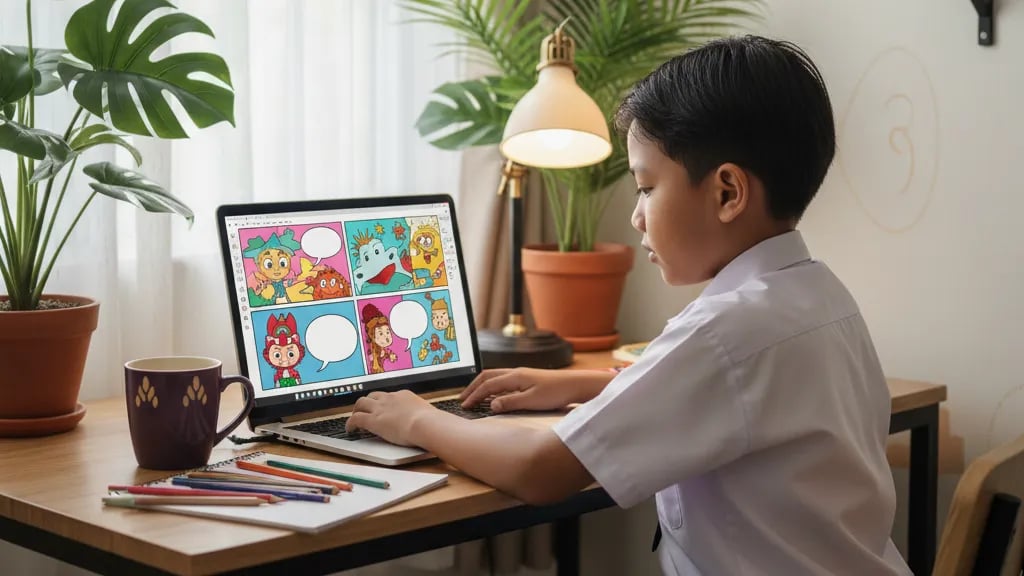
Krita is free for Windows, macOS and Linux, and its description says it supports comic book project management. Laptop specs that handle design apps are covered in our guide to laptops for primary school kids. Often the easiest route for beginners: sketch on paper, take a photo with a phone, then color it and add bubbles in an app. A full comparison of apps is in our list of digital drawing apps for kids.
When a child writes a script for each panel before drawing, they're learning how to build a story. The drawing will improve with practice.
Maya Putri, Child Education Specialist
The most common mistake is too much text in one panel, until the picture is hidden behind speech bubbles.
Once a comic is finished, ask your child to read it aloud to the family. A simple question like "Which part is the funniest?" helps them judge their own work. Kids who want their comic to move can try making an animation in Scratch, and more creative activity ideas are in school holiday activities for kids.
For kids aged 8 to 11 who want more structured learning, there's the digital drawing course for primary school kids. The path onward to a portfolio is explained on the digital designer path for kids.
Want your child to learn to draw characters and stories with a mentor? Try a free 60-minute design master class.
To make a simple comic for primary school kids, write a one-sentence idea, divide the paper into 4 panels, fill each panel with one event, then add speech bubbles and color. The order is always story first, then drawing. The child writes a short script for each panel, sketches in pencil, inks the lines with a marker, then colors. One panel holds one event and at most two lines of dialogue. For example, a grade 3 child makes a comic about a cat stealing a fish. Panel 1 the cat spots a fish on the table, panel 2 the cat jumps, panel 3 mum walks in, and panel 4 the cat pretends to be asleep. The story is short, clear and funny. For a school assignment, allow about an hour. Split it up: 10 minutes for the idea and script, 30 minutes for sketching, and 20 minutes for inking and coloring.
A 4-panel comic is a comic strip that tells a complete story in four panels, following the pattern beginning, problem, climax and ending. In Japan this format is known as yonkoma. The first panel introduces the character and place, the second brings in a problem, the third gives a surprise or solution, and the fourth closes the story with a message or a joke. For example, a comic about saving water: panel 1 Sinta washes her hands, panel 2 she forgets to turn off the tap, panel 3 her little brother points at the running water, and panel 4 Sinta turns it off and says, "Thanks for reminding me!" Because there are only four panels, kids learn to pick the most important part of the story. It's practice in concise writing that also helps with language lessons at school.
Grade 3 kids do best with a 4-panel comic, one or two characters and short dialogue, up to about 8 words per bubble. At ages 8 to 9, kids can already sequence a story, but they still find it hard to fit long sentences into a small space. Simple characters, like animals or a child with a round head, keep the focus on the story rather than drawing detail. For example, a grade 3 child makes a comic about waiting in line at the canteen. There are only two characters: the child and a friend who cuts in. In the last panel the friend apologizes and joins the back of the line. The dialogue is short, like "Wait your turn!" and "Sorry." Once your child is comfortable, add one small challenge, such as a different facial expression in every panel.
Grade 4 kids usually make 4 to 6 panels with expressions and sound effects, while grade 6 kids can make 6 panels or more with narration and different viewpoints. In grade 4, kids start adding sound effects like "CRASH!" or "Ring!" and using different bubbles for speech, thoughts and shouting. In grades 5 and 6, they can add narration boxes, close-ups to highlight emotion, and wide shots to show the setting. For example, a grade 6 child makes a comic about a running race. One panel shows the whole field from far away, then the next zooms in on the character's tense face before the starting signal. That change in distance makes the story feel like a film. Raise the challenge a little at a time, at a pace your child is comfortable drawing.
To make a digital comic on a phone, use a free app like ibisPaint X: create a canvas, draw the panel boxes, sketch the characters on a separate layer, then add speech bubbles and color. ibisPaint X is free on Android and iOS, with layers, screentones and lots of brushes. It shows ads, so it's best if a parent installs it and manages in-app purchases. MediBang Paint has comic panel tools and speech bubbles, but it's rated 12+ on Google Play. For example, a 10-year-old sketches a comic on paper, photographs it, then opens the photo in ibisPaint X as the bottom layer. They ink the lines on a new layer and color on a third. This is easier than drawing directly with a finger. Phone screens are small, so a cheap stylus really helps keep lines and lettering neat.
In Canva, choose a 4-panel or 6-panel comic strip template, swap in characters from the library or your child's own drawings, then add speech bubbles and dialogue. Canva provides comic templates, a speech bubble collection and plenty of free fonts, so kids can build a comic without drawing everything from scratch. Worth knowing: under Canva's terms of use, children under 13 may only use Canva through Canva Education, which students join through a teacher's invitation. For example, a grade 5 child gets a comic assignment about cleanliness from a teacher who already uses Canva Education. They pick a 4-panel template, upload a photo of their own character sketch, then add the speech bubbles. The result is tidy and still feels like their own work. Drawing their own characters is still recommended, so the comic doesn't look the same as their classmates'.
Free apps for making comics include ibisPaint X on phones and tablets, Krita on laptops, Canva through Canva Education, and MediBang Paint for kids aged 12 and up. Each app has its strengths. ibisPaint X is handy on a phone and has screentones. Krita is free, open source, and supports comic project management on Windows, macOS and Linux. Canva is fastest thanks to its templates. MediBang Paint has panel and bubble tools, but it's rated 12+ on Google Play. For example, a 9-year-old just starting out can use ibisPaint X on the family tablet. At 12, wanting to make a comic series, they can move to Krita or MediBang Paint with more complete panel tools. Choose the app by the device you have and your child's age, not by the number of features.
Facial expressions in a comic come down to three parts: the shape of the eyes, the position of the eyebrows and the shape of the mouth. Happy is drawn with eyes curving up and an open mouth. Sad uses eyebrows that drop at the outer ends and a mouth curving down. Angry uses eyebrows slanting toward the middle with teeth showing. Surprised is big round eyes and a mouth shaped like the letter O. Sweat drops or small lines on the cheeks add to the mood. For example, before drawing the comic, a child makes a practice sheet with one round head in four different expressions. They keep the sheet next to the comic paper as a cheat sheet, so the character's expressions stay consistent from the first panel to the last. Five minutes of practice like this often makes a child's comic feel much more alive.
The most common mistake is too much text in one panel, until the picture is hidden behind speech bubbles. Other frequent mistakes: a story too long for four panels, bubbles drawn before the text is written, characters changing shape from panel to panel, and too many colors. The reading order can also get confusing if the bubble's tail doesn't point to the character speaking. For example, a grade 4 child writes three long sentences in the first panel, so only half the character is visible. After cutting the dialogue down to one short sentence, the drawing shows clearly and the story is actually easier to follow. An easy way to prevent this: write the script for each panel on a separate sheet, read it aloud, then cross out unnecessary words before drawing. This step only takes five minutes.
Yes. Making comics trains kids to build a story, write concisely and draw, while building confidence when others read their work. In one short comic, a child has to think about the order of events, choose the most important words and show the character's feelings through drawing. These skills help with language lessons and with interests in illustration, design or animation. For example, a 10-year-old who used to be shy about storytelling in front of the class became bolder after reading their comic aloud to classmates. They felt they had something to show, rather than just being asked to talk. If your child wants to grow their skill at drawing characters and stories, Algonova's free 60-minute design master class can be a first step, with no card and no commitment.

Algonova worldwide
Contact
Whatsapp: +62 21 50996971
Email: info@algonova.id
Address
Coworking Area, Gedung IT 6 Lantai Dasar, Nongsa Digital Park, Jalan Hang Lekiu, Kelurahan Sambau, Kecamatan Nongsa, Batam, Indonesia Directorate General of Consumer Protection and Trade Compliance – Ministry of Trade of the Republic of Indonesia. WhatsApp Ditjen PKTN: 0853-1111-1010.
PT Algonova Indonesia Cerdas All rights reserved 2026