December School Holiday 2026 Coding Plan for Kids 7-12: 4 Weeks From Scratch to Roblox

Learn Coding13 min read
Learn Math

Nurul Izzati
Math Curriculum Team, Algonova Malaysia
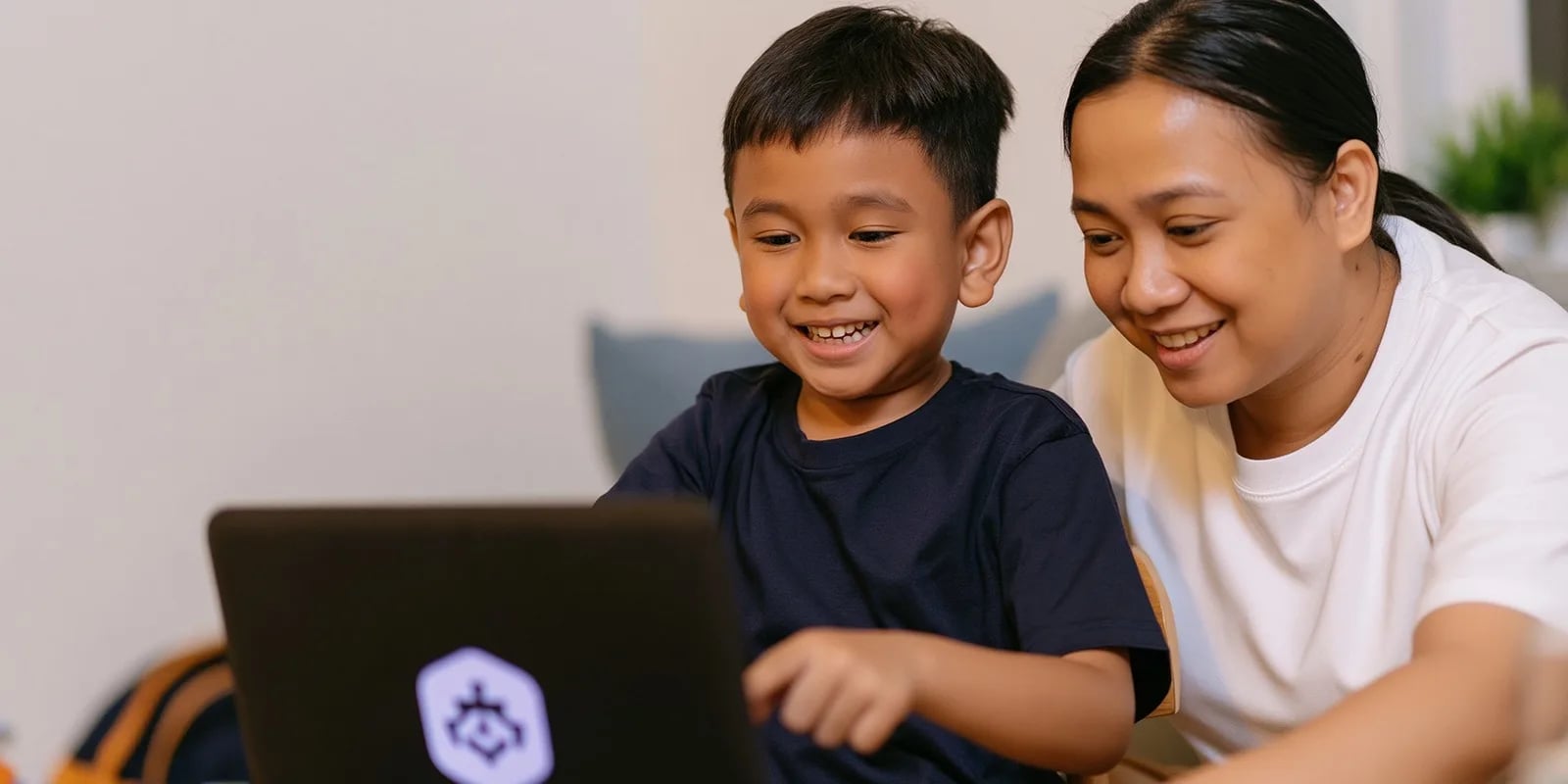
These 15 practical math activities use materials you already have at home: coins, cooking ingredients, board games and kitchen items. Each activity takes 10-20 minutes, suits kids aged 5-12, and teaches KSSR concepts without worksheets or screens. Your child will not realize they are "learning math" because the activities feel like play.
Algonova is an online platform of coding, math, AI and design courses for kids aged 5-17, with over 1,000,000 students in 97+ countries since 2016. Classes are live with certified teachers in groups of up to 10 students, not recorded videos.
Kids who use physical objects (coins, marbles, buttons) grasp number concepts faster than those who only write digits on paper.
The first five activities use things you already have at home and need no special preparation.
1. Mini grocery store (15 minutes) Arrange 10-15 household items (tissue boxes, cans, fruit) and stick on "prices" using sticky notes: RM 1, RM 2, RM 5. Give your child real RM 10 in coins and ask them to "buy" items while working out the change. For older kids (8+), add discounts: "Today's promotion, 50% off all fruit!"
KSSR concept: Addition and subtraction, ringgit and sen, percentages (Year 4+).
2. Number hunt in the kitchen (10 minutes) Ask your child to find and write down every number they can see in the kitchen: the expiry date on a can (23/09/2027), the net weight (400g), the oven temperature (180°C), the number of tea bags in a box (25). Then arrange the numbers from smallest to biggest.
KSSR concept: Place value, number order, measurement.
3. Math dice (10 minutes) Roll two dice. Younger kids (5-6) add the two numbers. Middle kids (7-8) multiply. Older kids (9+) make a fraction (first die/second die) and simplify it. Who reaches 50 (adding) or 100 (multiplying) first?
KSSR concept: Basic operations, basic fractions.
4. Weigh and compare (15 minutes) No scale needed: use a clothes hanger as a "balance." Hang a plastic bag on each side and fill them with different things. "Which is heavier: 5 apples or 10 eggs?" Let your child guess first (estimation), then check.
KSSR concept: Measuring mass, estimation, comparison.
5. Button patterns (10 minutes) Collect buttons, paper clips or colored marbles. Ask your child to make patterns: red-blue-red-blue, or 2 red-1 blue-2 red-1 blue. Then ask them to invent their own pattern and challenge you to guess the rule.
KSSR concept: Patterns and sequences, early algebraic thinking.
For structured practice on basic operations and fractions, see also our guide to the best online math tuition that complements these home activities.
Geometry at home works better than on paper because kids can touch, turn and measure real shapes instead of drawing 2D pictures.
6. Shape builder with spaghetti and playdough (20 minutes) Use raw spaghetti as the sides and balls of playdough as the corners. Build a triangle (3 sides, 3 corners), a square (4 sides, 4 corners), a pentagon (5 sides, 5 corners). For older kids: build a 3D pyramid and cube. Question: "How many more edges does a cube have than a rectangle?"
KSSR concept: 2D and 3D shapes, sides, vertices, symmetry.
7. Measure the house (15 minutes) Give your child a tape measure and a task list: measure the length of the dining table, the width of the door, the height of a chair. Write it in cm. Then work out: "How many books (20 cm) fit on an 80 cm shelf?" For Year 5-6: calculate the perimeter and area of a bedroom.
KSSR concept: Measuring length, perimeter, area.
8. Find geometric shapes at home (10 minutes) Walk around the house and find shapes: wall clock = circle, TV = rectangle, roof = triangle, can = cylinder, football = sphere. Photograph each one and make a collage. Follow-up question: "What do a can and a ball have in common? Both can roll. Why?"
KSSR concept: Identifying shapes, properties of shapes.
9. Symmetry folds (10 minutes) Fold a sheet of paper in half. Cut out half a shape (half a heart, half a star, half a butterfly) and open it up. The result is always symmetrical. Question: "Is the letter A symmetrical? What about B? S?" Make an alphabet of symmetrical vs non-symmetrical letters.
KSSR concept: Symmetry, lines of symmetry.
10. Volume with water (15 minutes) Set out containers of different sizes (cup, bowl, bottle). Guess first: "How many cups of water to fill this bowl?" Then check by filling it. For older kids: "This tank (a shoebox) measures 30 cm x 20 cm x 15 cm. How many ml of water can it hold?" (30 x 20 x 15 = 9,000 cm3 = 9,000 ml = 9 litres)
KSSR concept: Volume, capacity, unit conversion.
A child who measures the dining table with a tape measure understands 'centimetre' on a different level from a child who just writes '80 cm' on a worksheet. Physical touch makes abstract concepts real and keeps them in long-term memory. One 15-minute session measuring the house is worth about an hour of written practice.
Nurul Izzati, Math Education Specialist
Word problems are the hardest part of UASA, and the best practice is real situations where your child NEEDS to calculate to get the answer they want.
11. Holiday planner (20 minutes) Give your child a budget: "We have RM 500 for a weekend family trip." Ask them to plan: car fuel (RM 0.50/km, distance 200 km = ?), hotel (RM 150/night, 2 nights = ?), meals (4 people x 3 meals x RM 15 = ?). Does the total go over RM 500? "Where can we save?"
KSSR concept: Multi-step operations, money, problem solving.
12. Math chef (20 minutes) Cook together with your child using a real recipe. Double the recipe: "This recipe is for 4 people. We have 6 people, how much of each ingredient?" (x 1.5). Or halve it: "The recipe says 2 cups of flour, but we only want to make half." Fractions become real when you have to measure 3/4 cup of flour correctly.
KSSR concept: Fractions, multiplication, measurement, ratio.
13. Math gardener (15 minutes) "We want to plant trees in a rectangular garden 4 m x 3 m. Each tree needs 50 cm x 50 cm of space. How many trees fit?" Draw a grid on paper. For older kids: "Garden fencing costs RM 12 per metre. How much to fence the whole garden?"
KSSR concept: Area, perimeter, division, money.
14. Data detective (15 minutes) Ask your child to collect real data: daily temperature for a week (read from the phone), the number of white cars vs other cars in 10 minutes at the window, or each family member's favourite drink. Make a simple bar chart on paper. Calculate the average weekly temperature.
KSSR concept: Data collection, bar charts, average, mode.
15. The 24 game (10 minutes) Take 4 cards from a regular deck (numbers only). Challenge: use all 4 numbers and the operations (+, -, x, /) to get exactly 24. Example: cards 3, 4, 6, 2 -> 3 x (4 + 6 - 2) = 24. Brackets are allowed. Who finds the answer fastest?
KSSR concept: Multi-step operations, order of operations (BODMAS), flexible thinking.
For more structured UASA preparation using exam-format questions, see the collection of Year 5 UASA questions and the guide to Year 6 exam preparation.
If you are wondering whether worksheets or live classes suit your child better, read worksheets vs live classes for maths.
Also try Algonova's free 60-minute trial class, where the teacher spots your child's weak topics and recommends the right practice.
I asked my child 'what is 3/4 of 200?' and they said 'hard.' Then I asked 'the recipe says 200 grams of flour for 4 people, we have 3 people, how many grams of flour?' They answered 150 grams in 10 seconds. Context changes everything. Math on a worksheet is a burden. Math in cooking is a tool.
Nurul Izzati, Math Education Specialist
Three to four times a week for 15-20 minutes per session is the ideal frequency. Short, frequent sessions work better than one long session a week because a child's brain consolidates memory through regular repetition, not one intensive session. The Ahmad family set a simple schedule: Monday and Wednesday (a 15-minute counting activity after dinner), Saturday (a 20-minute geometry or cooking activity in the morning). The schedule is light enough to keep up for months without the child feeling burdened. After 3 months, their child showed clear improvement in school math tests. Do not be too strict with the schedule. If your child is tired after school, skip and swap to tomorrow. Consistency matters more than perfection.
These activities hide math inside games and real situations. A child who says "math is boring" usually means "worksheets are boring." They are not boring when counting money in a shop game, or measuring flour for a cake they want to eat. Aisyah's younger sibling (age 8) refused the math workbook every night. Their mother introduced "Mini Grocery Store" without ever saying the word "math." The child spent 25 minutes counting change, giving discounts and sorting coins. When their mother said "you just solved 30 addition and subtraction questions," they were surprised. Main rule: do not start with "let's study math." Start with "let's play shop" or "let's bake a cake." Hidden math is the most effective math.
Home activities complement but do not replace structured teaching. They build conceptual understanding (WHY math works that way) while tuition and workbooks build procedural skill (HOW to solve exam questions). Your child needs both. Puan Nadia's child was good at working out change at the "mini shop" but got stuck on exam-format questions because the way the questions are written was unfamiliar. A mix of home activities (3 times a week) and structured tuition (once a week) gives balance: conceptual understanding from the activities, and exam skills from tuition. Use home activities as a "warm-up" before written practice. A child who already understands the concept through hands-on experience finishes worksheets faster and gets less frustrated.
All 15 activities use materials that most homes already have: coins, dice (or a dice app on your phone), a tape measure, paper and pencil, cooking ingredients, buttons or paper clips, raw spaghetti and playdough, one regular deck of cards. No special materials need to be bought. The only useful investment is a set of dice (RM 5 at a RM 2 shop), a tape measure (RM 3) and a deck of cards (RM 5). The total is under RM 15 and can be used again and again for months. Compare that with a RM 10-15 workbook that gets used once. If you do not have dice, use a free app on your phone. If you do not have a tape measure, use string and a ruler. A parent's creativity is the most important material.
Start with smaller numbers and easier tasks, then raise the level gradually. Example: for "Mini Grocery Store" with a weaker child, start with prices of RM 1 and RM 2 only, and give RM 5. When the child is comfortable, add prices of RM 3 and RM 5, and give RM 20. Darren (age 9, weak in math) started with the "Math Dice" activity using ONE die only (add the die number to 3, always). After a week, when he was comfortable, his teacher added a second die (add two dice). After two weeks, switch to multiplication. Gradual steps prevent frustration. Rule: if the child answers correctly 80% of the time, the difficulty is right. Below 60%, it is too hard. At 100%, too easy. Aim for the "comfortable but challenging" zone.
Yes, but indirectly. These activities build the conceptual understanding that makes practising UASA questions easier. A child who has measured their bedroom understands "perimeter" intuitively, so an exam question about perimeter is not a foreign concept but a situation they have already experienced. Nurul used "Math Chef" for 2 months before UASA Year 5. The UASA questions on fractions and ratio felt familiar because she was used to doubling and dividing recipes. She answered 4 of 5 fraction questions correctly because she understood the concept through experience, not memorization. For direct UASA preparation, combine these activities with exam-format questions. The activities build understanding, practice questions build speed and accuracy in the exam format.
The first five activities (Mini Grocery Store, Number Hunt, Math Dice, Weigh and Compare, Button Patterns) suit preschoolers with adjustments: use numbers 1-10 only, swap multiplication for addition, and shorten sessions to 10 minutes. Sarah's younger sibling (age 4) played "Button Patterns" using just two colors (red-blue-red-blue). They could not yet explain "pattern" but could continue the sequence correctly. At age 5, they handled three colors and started creating their own patterns. For preschoolers, focus on sensory experience (touching, counting real things) and do not stress the "right answer." The goal is to build a positive relationship with numbers, not accuracy.
Yes. Video games contain lots of hidden math: scores and leaderboards (big numbers, comparison), in-game shops (budgets and money), health bars (percentages) and strategy (probability). Ask questions like: "You have 500 coins and the sword costs 350, how much is left?" or "What percentage of your health is left?" Imran (age 10) plays Minecraft every day. His mother challenged him: "Build a house with a perimeter of exactly 20 blocks. Any shape you like." Imran tried a 6x4 rectangle, then 7x3, then an L shape. He learned that many shapes can have the same perimeter but different areas, without realizing he was revising a KSSR topic. Do not fight video games. Use them as a vehicle for math.
Activities involving building, competition and practical problem solving often draw dads in: "Math Gardener" (measuring and calculating materials), "The 24 Game" (a speed contest) and "Holiday Planner" (a real family budget). Choose activities that match dad's interests. Mr Lee rarely got involved in "studying math" but joined every time the "24 Game" was played because it is competitive. He and his son play 15 minutes every night after dinner. Dad's presence in math activities sends a strong message: math is not "schoolwork" but a life skill that adults use too. Do not force it. Invite dad with activities that match his interests.
Match the activity to your child's school level: Year 1-2 (activities 1-5, 6, 8), Year 3-4 (activities 1-10), Year 5-6 (activities 6-15). If unsure, start with activity 1 (Mini Grocery Store) and watch: if your child finishes easily, try a harder one. If they get stuck, simplify. Puan Siti started her child (Year 3) with Activity 11 (Holiday Planner) and found it too challenging because it needs large multiplication. She stepped down to Activity 1 (Mini Grocery Store) with smaller numbers, and her child enjoyed it. After 3 weeks, she went back to Activity 11 with a smaller budget (RM 100 instead of RM 500) and it worked. Start easy and raise the level as your child gets comfortable. There is no harm in starting from the bottom.
Blog
Start your child's tech journey
Book your free 60-minute trial class with an Algonova certified tutor. No payment, no obligation, just discover what your child can build.

Algonova worldwide
Contact us
Email: legal@algonova.com